Margam Abbey: A Cistercian Monastery in Wales
Site at a Glance
- Popularity
- Medium
- Country
- United Kingdom
- Primary era
- Medieval
- Eras represented
- Medieval, Modern
- Civilizations
- British, Norman
- Site type
- Religious
- Remains
- Monastery
On this page19 sections
History
Margam Abbey is a former Cistercian monastery at Margam in Wales, United Kingdom. Founded on 23 November 1147 as a daughter house of Clairvaux, one of the order’s principal monasteries, it was dedicated to the Virgin Mary. Robert, Earl of Gloucester, arranged and endowed the foundation so the monks would pray for him, but died about three weeks before its formal establishment.
Earlier community and Cistercian foundation
There may have been a monastic community at Margam before the Cistercians arrived, perhaps as early as the eleventh century. Its monks have been associated with the Celtic Church, a term for early Christian communities in Britain and Ireland rather than a single centralized body. Their precise affiliation remains uncertain. William of Clairvaux became the new house’s first abbot, and construction took nearly forty years.
Robert’s grant encompassed 18,000 acres between the Kenfig and Afan rivers, from the mountain ridge to the coast. Margam’s authority also extended beyond its immediate estates: in 1227, Monasteranenagh, a Cistercian abbey in Ireland, was placed under its control.
Estates, production, and trade
Margam organized much of its land into granges, outlying agricultural estates managed by lay brothers who undertook manual work and estate duties. Llanmihangel, the main grange on the Kenfig estate, is mentioned from 1186. Rossoulin belonged to the Penhydd district, Stormy produced grain in the Vale of Glamorgan, and Resolven lay in the upper Neath valley. By 1291 the abbey directly cultivated about 7,000 acres and received £256 in annual income. It was then Wales’s wealthiest monastic house.
Sheep raising underpinned much of the estate’s income. Flocks grazed on Mynydd Margam and the hills to the west of Glamorgan, and wool went by way of Taibach to markets in continental Europe. Flemish and Italian merchants negotiated with Cistercian communities, at times paying in advance for wool from future harvests. Skins from the sheep also supplied parchment for Margam’s extensive record keeping.
Water-powered mills processed both grain and wool. At Llanmihangel, a channel diverted from the Kenfig drove a flour mill and a fulling mill, where machinery cleaned and thickened woollen cloth. Around 1250, Owen ab Alaythur granted Margam rights to mine what was then called stone coal on his Penhydd lands, extending as far as the Ffrwdwyllt. This is the earliest known reference to coal extraction in West Glamorgan and among the earliest in Wales. The coal supplied Rossoulin, the abbey, and its tenants. Margam also mined small amounts of iron ore on its mountain lands for the abbey forge.
Charity, writing, and community life
The abbey kept food in reserve for times of local scarcity and offered hospitality to travellers and people in need. In 1188, cleric and historian Giraldus Cambrensis commended its almsgiving and praised Abbot Conan as learned and discreet. Giraldus was travelling with Baldwin of Forde, Archbishop of Canterbury, to preach the Crusade.
Conan is credited with writing the headings that introduce sections of St Bernard’s sermons on the Song of Songs. Margam’s Latin Annales de Margan, a chronicle covering 1066–1232, is especially dependable for the history of Glamorgan during its final fifty years; its earlier narrative probably drew on William of Malmesbury. The chronicle tells of the purported discovery of King Arthur’s bones and the alleged killing of Prince Arthur by King John. The Book of Taliesin is also attributed to the abbey.
Several dozen thirteenth-century cartulary rolls, collections of charters and other records, survive in the National Library of Wales and the British Museum. Important manuscripts from the abbey library appear to have endured the dissolution, including a copy of the Annales de Margan.
Disputes and royal favour
Relations between the abbots and lay brothers sometimes broke down. In 1190, the Cistercian General Chapter, the order’s governing assembly, condemned the abbot for permitting beer at the granges despite a ban. Two brothers were sent to Clairvaux to do penance, and the abbot was ordered to fast for forty days.
A more serious revolt erupted in 1206. Rebels attacked Abbot Gilbert and the cellarer, the officer responsible for provisions, and chased them on horseback as far as the dormitory, where both took refuge. The rebels then imprisoned or exiled Gilbert about forty kilometres away and surrounded the monastery, leaving the monks short of food. Fountains Abbey intervened; the offenders were sent to Clairvaux and then dispersed among other monasteries. Giraldus understood the revolt as a response to the brothers’ treatment and restrictions on drinking.
King John stayed at Margam in 1210 on his way to suppress the Irish, and returned three months later. In gratitude for the hospitality, he exempted the abbey from a tax he had imposed on monasteries. Margam and Beaulieu, his own foundation, were the only English abbeys granted that exemption.
Decline, dissolution, and estate changes
The Black Death, a plague epidemic, struck in 1349, reducing the workforce of lay brothers and hindering recruitment. Margam consequently began leasing its granges to lay tenants. The Welsh uprising led by Owain Glyndŵr in 1401–02 brought further hardship, and the monks had to beg for their support.
In 1535, Margam’s net income was assessed at £181, below the £200 threshold in the first Suppression Act, the law targeting monasteries below that income level. Henry VIII dissolved the abbey in 1536. In June, Abbot Lewis and the eight remaining monks were dismissed with pensions.
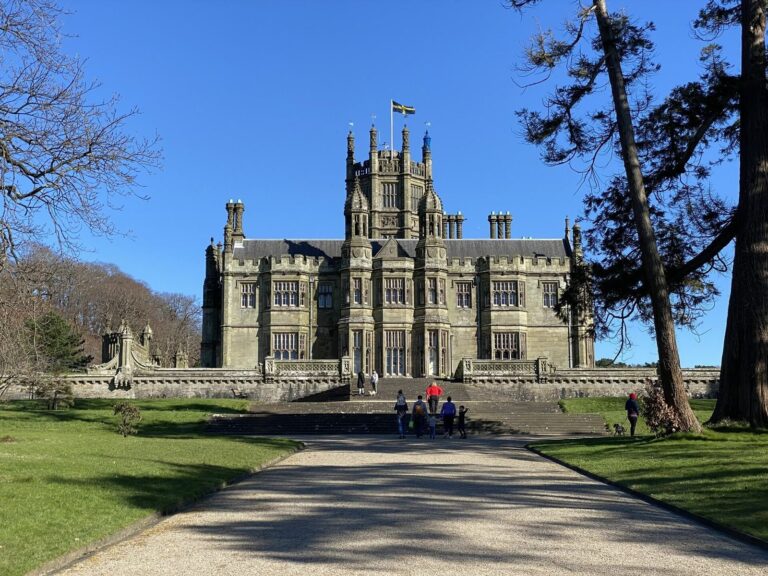
After the dissolution, the estate was divided and much of the monastery dismantled. Sir Rice Mansel leased the property in 1537 and purchased it in 1540. The east end of the church served as a carriage house before falling into ruin and being demolished, while the west end became a parish church in 1542. The estate later passed through Mansel female descendants to the Talbot family. Around 1630, the Mansels moved their principal home from Oxwich Castle to Margam; after Bussy Mansel, 4th Baron Mansel, died, his nephew Thomas Talbot inherited the estate.
In the eighteenth century, the chapter house, the room where the monastic community met to hear its rule and conduct business, was used to store coal, while its entrance vestibule served for brewing. Thomas Mansel Talbot removed its lead roof and had a plain wooden one put in its place. The building deteriorated, and a storm in 1799 brought down its central vault-supporting column. Talbot demolished the old manor house in 1787 and had an orangery built by 1793 to designs by Anthony Keck, for orange trees and antiquities.
Parish worship and later care
At parishioners’ request, major repairs to the ruined parish church began in 1805 and were completed in 1810. In the nineteenth century, Christopher Rice Mansel Talbot built Margam Castle overlooking the abbey remains. An organ was installed in 1866 for his daughter Bertha’s wedding. His son Theodore, a supporter of Anglo-Catholicism, the Anglican tradition emphasizing historic Catholic worship and practices, later commissioned an altar, west windows, and further church decoration.
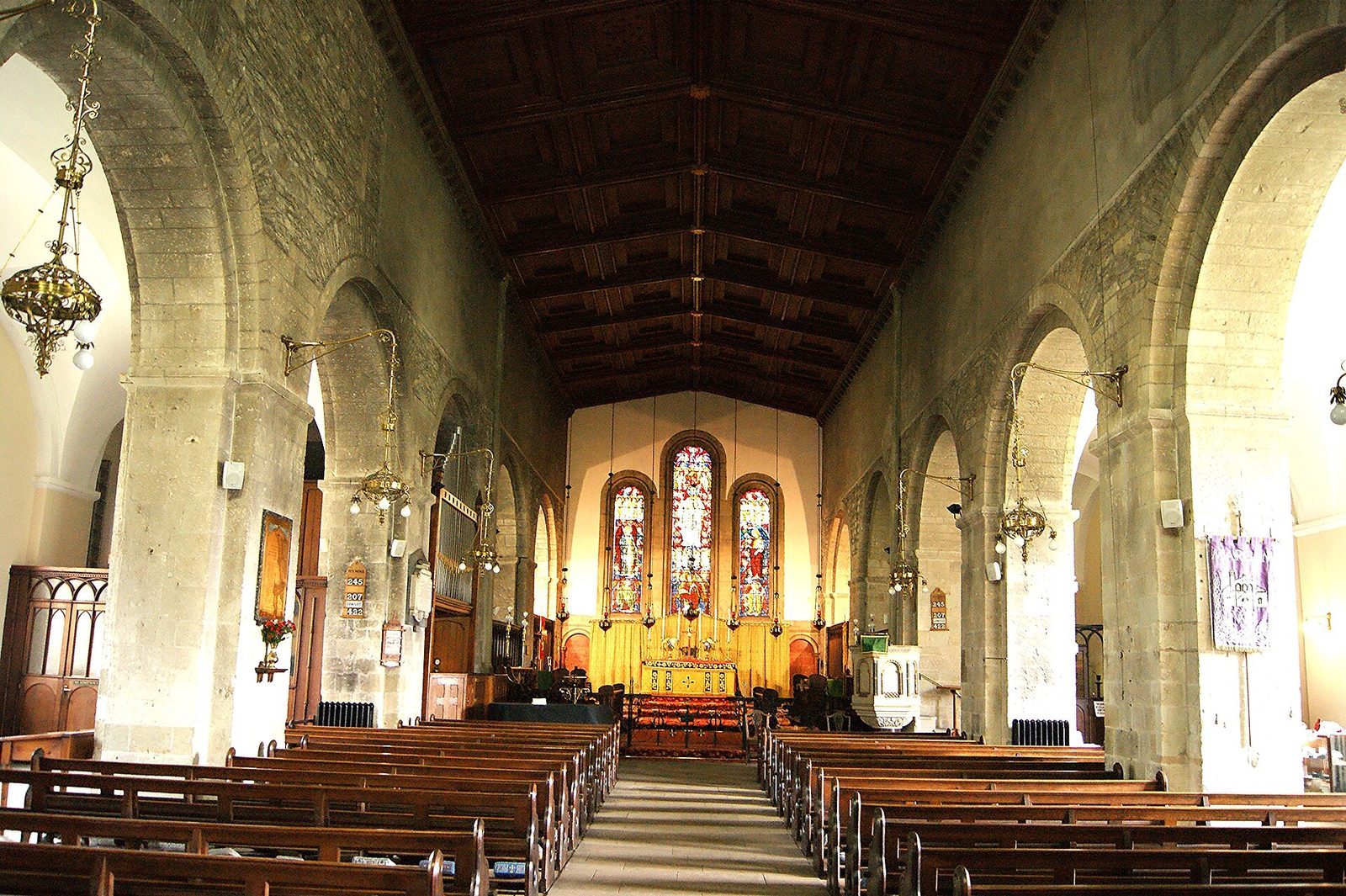
The nave has continued in parish worship since the dissolution. It is now St Mary’s Church in the Church in Wales, within the Diocese of Llandaff, and follows the Anglo-Catholic tradition. Its continued use is unusual: it is the only Welsh example of a Cistercian nave still used for worship and, apart from Holme Cultram, one of only two medieval Cistercian churches in Britain that remain in use. Margam’s church, chapter house, granary, and undercroft are Grade I listed, the highest category of listed-building protection in Wales.
Remains
The remains stand where a small valley meets the Afon Kenfig, near Margam Lake, between the Mynydd Margam hills and the coastal plain south of Port Talbot. They lie within Margam Country Park, near Margam Castle. The church and surviving monastic buildings form the principal group, while related mills, mining remains, and an outlying chapel occupy parts of the wider landscape.
The church and monastic buildings
Abbey church
Built of Sutton stone, a local stone from the Vale of Glamorgan, the church originally measured 272 feet (83 metres) in length. The surviving nave is 115 feet (35 metres) long, with six structural divisions called bays; the original church had eight. The nave and side aisles date from the twelfth century. During the parish repairs, the aisles and south wall were rebuilt on their earlier foundations.
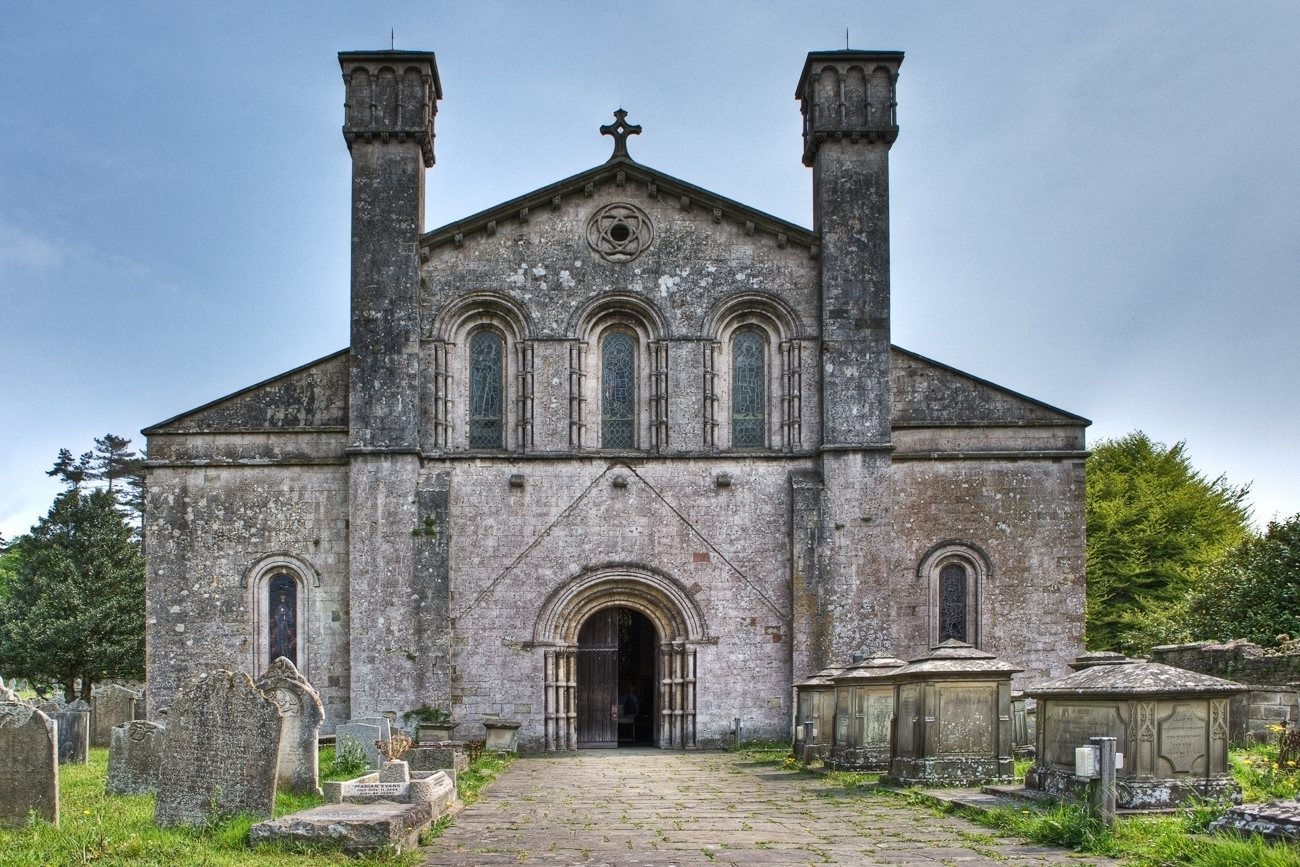
The west front has a deeply set Romanesque entrance, a style using features such as round arches and substantial forms. Dating to about 1175–80, it is framed by banded shafts with carved capitals, with three round-arched windows above. The façade has undergone repeated alterations, and the three windows contain glass designed by Edward Burne-Jones and made by William Morris. Burials in the south aisle include the Mansel baronets Rhys Mansel (died 1559), Edward Mansel (died 1585), and Thomas Mansel (1556–1631), together with their wives.
Chapter house
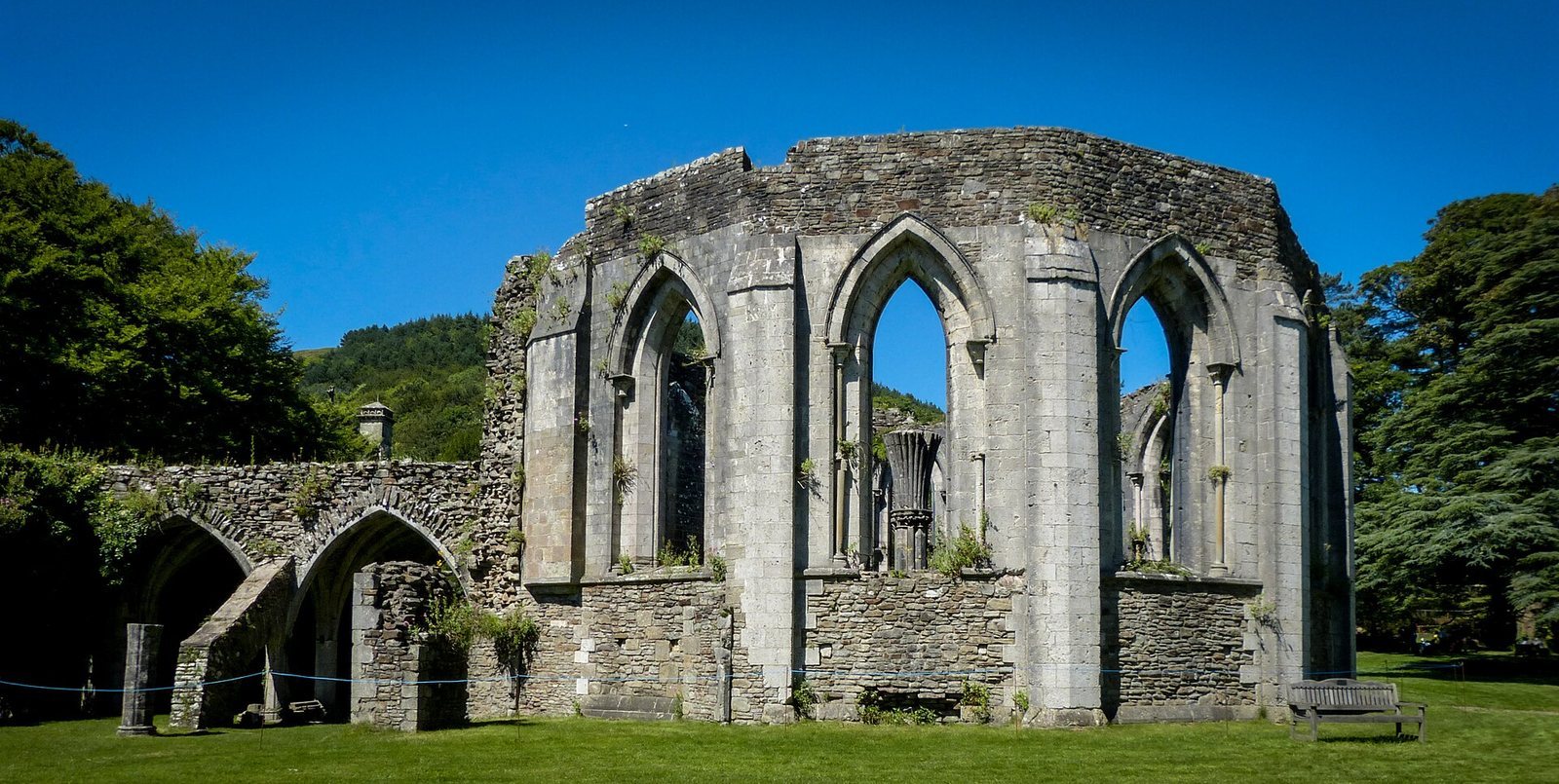
Southeast of the church stands the chapter house, dating to around 1200. Its twelve-sided Gothic plan is also found at Dore Abbey, where the building is less well preserved. The central column that supported its vault collapsed during a storm in 1799.
Cloister and undercroft
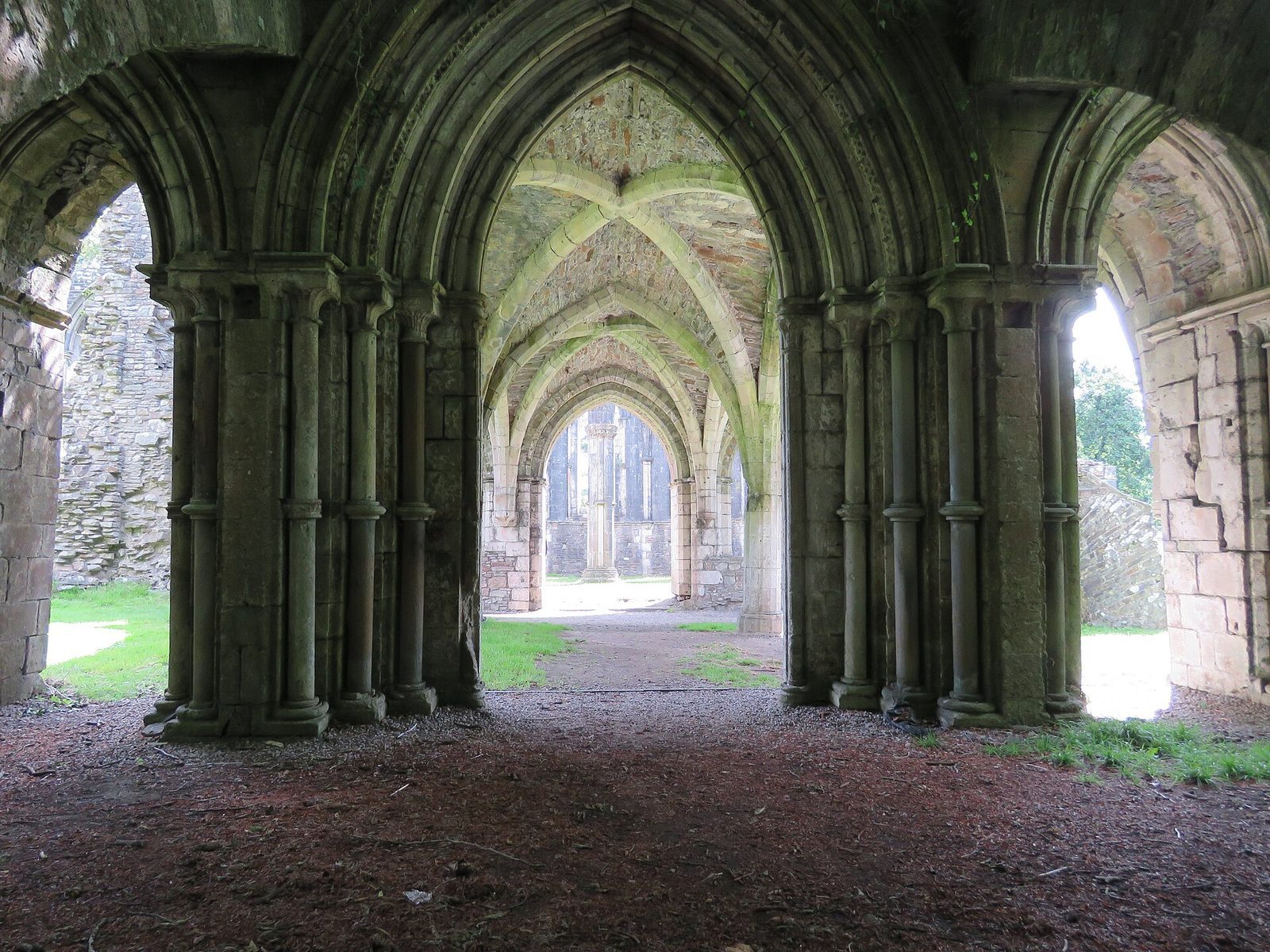
The abbey undercroft, a lower-level space beneath a building, survives among the ruins. The west wing of the cloister was set aside for the lay brothers.
Outlying estate buildings and workings
Llanmihangel mills
At Llanmihangel, the grist mill and fulling mill drew power from a channel diverted from the Kenfig. Their associated dam and watercourse survive. The fulling mill’s water-driven machinery cleaned and thickened woollen cloth.
Coal workings
Medieval coal extraction used bell pits and hillside adits. A bell pit began as a vertical shaft that widened underground into a bell-shaped cavity; an adit was a horizontal passage cut into a hillside. Rows of circular depressions in the landscape mark bell-pit workings.
Capel Mair ar y Bryn
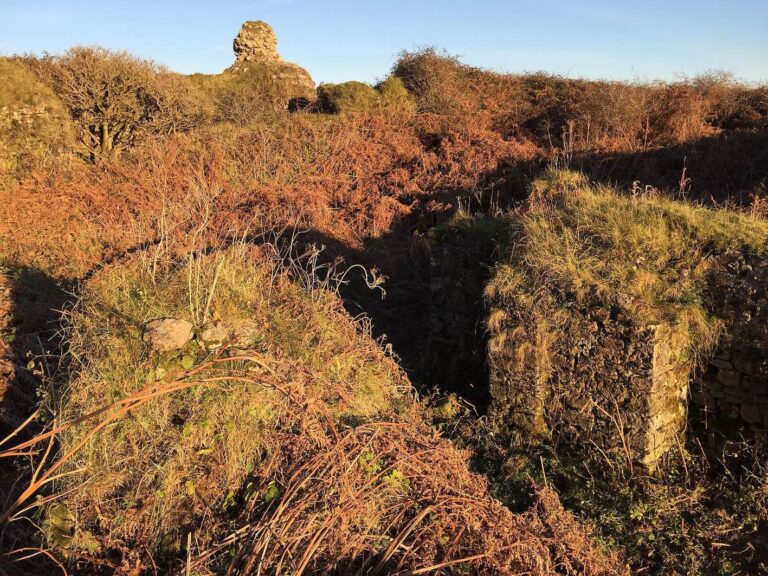
The ruins of Capel Mair ar y Bryn, or Chapel of St Mary on the Hill, stand on a hill overlooking the abbey. The chapel is thought to have provided monks tending flocks with a place for devotional observance without a return to the main church.
Stones and landscape features
Margam Stones Museum
The former monastic school beside the churchyard now houses the Margam Stones Museum. Its collection includes 28 inscribed or carved stones, 27 from the Roman period and one sixth-century grave marker bearing Latin and Ogham, an early alphabet used chiefly for inscriptions. The museum also holds several Celtic crosses from the tenth and eleventh centuries, including the finely carved Conbelin Cross, also known as the Cynfelyn Cross. Other pieces include medieval abbots’ gravestones, a fourteenth-century epitaph for a knight, and early Christian crosses found in the surrounding area.
Orangery and grounds
The orangery stands on the former manor-house site. A knot garden laid out to a medieval design lies west of the church, and a beech tree associated with the chapter house grows among the abbey ruins.