Minami Shingū-sha: A Subsidiary Shrine of Atsuta Shrine
Site at a Glance
- Popularity
- Medium
- Country
- Japan
- Primary era
- Early Modern
- Eras represented
- Early Modern
- Civilizations
- Tokugawa, Toyotomi regime
- Site type
- Religious
- Remains
- Sanctuary
On this page11 sections
History
Minami Shingū-sha is a subsidiary shrine within the grounds of Atsuta Shrine in Japan, traditionally dated to either 1000 or 1023, in the late tenth or early eleventh century. Its establishment is thought to have been connected with epidemics during Emperor Ichijō’s reign and efforts to appease spirits associated with disease. A ceremony against epidemics was held in Kyoto in 1001, but this is not a stated foundation date for the shrine.
Origins and early records
The shrine’s early history is fragmentary. A record notes repairs to its sanctuary in 1291, while a deed from 1431 refers to “Minami Shingū.” A different interpretation, proposed by a local historian, places its establishment around the middle of the Muromachi period, the era before the Edo period. In that account, another shrine stood at the site first, and the Oda family, a powerful samurai clan, founded Minami Shingū-sha after the Ōnin War, with particular devotion to Gozu Tennō.
Religious identity and local worship
Before the Meiji-era religious reforms, Minami Shingū-sha was closely associated with Gozu Tennō, a deity linked to pestilence and its prevention, and identified with Susanoo. Accounts of the deity’s arrival at the shrine connect it either to the Gion shrine, now Yasaka Shrine, or, more commonly, to an invitation from Tsushima Shrine. People also called Minami Shingū-sha the “Tenno Shrine.” Yakushi Nyorai, the Buddha of healing, was regarded as the underlying Buddha behind its deity, reflecting the premodern blending of Buddhist and Shinto beliefs.
Although institutionally attached to Atsuta Shrine, Minami Shingū-sha also served local forms of Gion and Tsushima worship and acted as a protective shrine for residents of Atsuta’s town districts. Its popular religious character differed from that of Atsuta Shrine and its subsidiary shrines dedicated to child deities.
During a major renovation of Atsuta Shrine in the 1680s, temple-and-shrine magistrate Sakai Tadaoki questioned the nature of Minami Shingū-sha. Senior officials at Atsuta struggled to account for it before another shrine official described its status as a “sacred mystery.” Traditions treated the sanctuary as an “empty seat”: some understood it as a place for honoring the rising sun, while another interpretation saw it as a separate shrine for deities invited from Atsuta Shrine and Hakken Shrine during the June 5 festival.
In the eighteenth century, scholars and shrine clergy continued to debate the shrine’s identity. One view distinguished popular devotion to Gozu Tennō from the clergy’s identification of the deity as Susanoo. Another explained Susanoo and Amaterasu together through a balance between opposing forces, thought to help prevent epidemics.
Rites and festival traditions
The South Shingū Shrine Festival was traditionally held on the fifth day of the sixth lunar month and is now celebrated on June 5. Its purpose is to avert epidemics. Reeds were renewed at the sanctuary on June 4, and priests conducted a ceremony the following afternoon before casting the previous year’s reeds and the displayed bundles into the shrine pond. A former custom involved priests and attendants in white robes collecting reeds prepared by parishioners at Aofusuma Shrine on the morning of June 4. That visit had ended by 2018.
A festival tradition written down in 1790 traces the Tenno Festival to an epidemic said to have struck between 1004 and 1011. Nearby residents supposedly offered banners and poles to appease the disease deity, after which the epidemic subsided. A person from Atsuta-go is traditionally credited with establishing festival rites in the late fifteenth century. By 1752, these rites included a reed festival, which continued as the South Shingū Shrine Festival, as well as a spirit-appeasement observance that developed into the Tenno Festival.
Eight Atsuta communities took turns supplying festival floats. Tanaka and Ōseko alternated in providing the large yama float, while Tenma, Nakaze, Ichiba, Gōdo, Higashiwaki, and Suga supplied danjiri floats in rotation. The processions went from the districts to Minami Shingū-sha, where musicians performed, then continued north to the lower bridge at Atsuta Shrine. There, the large float was dismantled, a practice traditionally associated with the 1582 festival when news of the Honnō-ji Incident, the attack on warlord Oda Nobunaga at Honnō-ji, arrived as the procession reached the bridge. Atsuta’s chief priest gave a sword to each float, and shrine officials supplied white ceremonial robes. This large-float festival continued for more than 400 years.
Overhead electrical wires made the old procession impracticable, and it ended after 1893. From 1906, a festival boat decorated with makiwara, lantern-covered festival structures, was floated at Atsuta Beach, following the example of Tsushima’s evening festival. This practice continued until 1973. Today’s presentation uses five makiwara displays bearing 365 lanterns, lit at the east, west, and south gates of Atsuta Shrine. Air raids during the Pacific War destroyed storage buildings for the Tanaka, Tenma, Ichiba, Gōdo, Higashiwaki, and Suga floats. The Ōseko float survived; after its storage building was dismantled after the war, the float and its stored contents were given to Atsuta Shrine.
The Atsuta Festival, now held annually on June 5 as Atsuta Shrine’s principal festival, developed from Minami Shingū-sha’s rites. Atsuta’s principal festival had previously taken place on June 21. In 1949 it was aligned with the South Shingū Shrine Festival, contributing to the festival’s present form.
Construction, reform, and changing grounds
A major construction project for Minami Shingū-sha is recorded on July 22, 1598, with Toyotomi Hideyoshi, a leading military ruler, as chief patron. Atsuta Shrine’s buildings underwent extensive construction and rebuilding under the Tokugawa shogunate in 1686 and Owari Domain in 1700.
After the Meiji government separated Shinto from Buddhism and rejected worship of Gozu Tennō, Atsuta Shrine chief priest Tsunoda Tadayuki presented a new official account. He described Minami Shingū-sha as founded through an invitation from Atsuta Shrine and identified its deity as Susanoo, the second deity enshrined there alongside the principal deity. This explanation replaced earlier accounts of a popular foundation and the theological interpretations developed by shrine clergy.
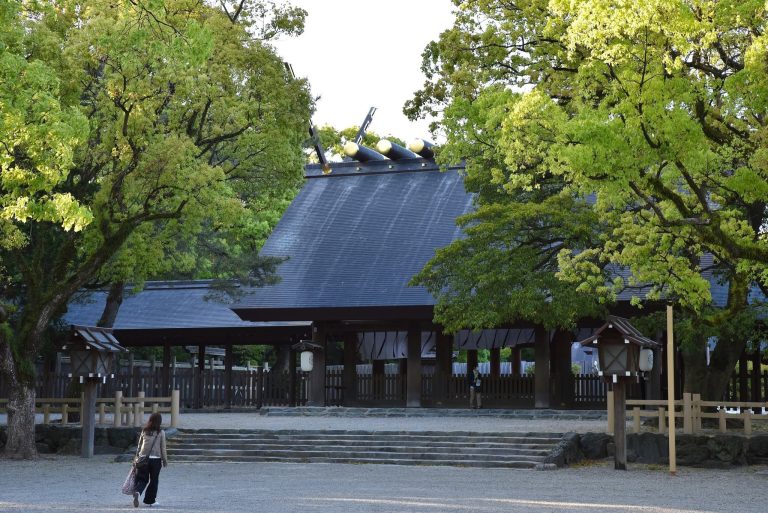
Minami Shingū-sha is thought to have remained at its present location since its foundation. For centuries it stood south of Atsuta Shrine’s walled sacred precinct, in the town area. It entered the shrine grounds when the main and Hakken Shrine precincts were consolidated in the early Meiji period; the grounds were further expanded and reorganized in the 1920s. In 1893, many Atsuta buildings, including the main shrine, were rebuilt in a straight-gabled shrine style, and the main sanctuary was moved about 100 metres northwest. Minami Shingū-sha remained in place.
Remains
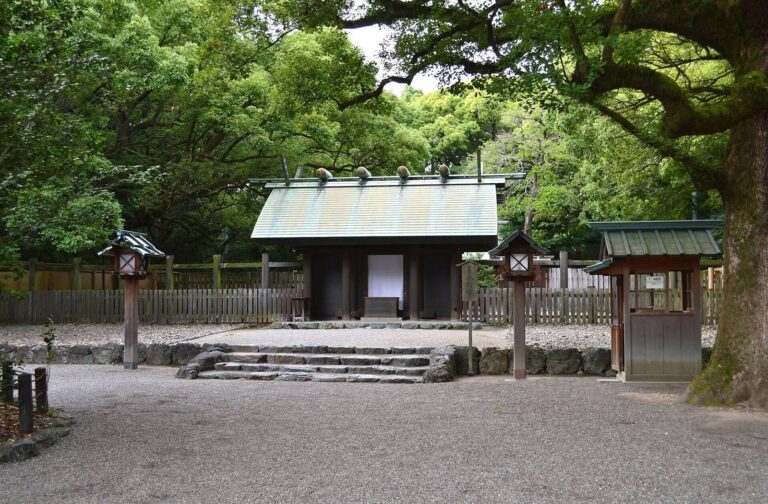
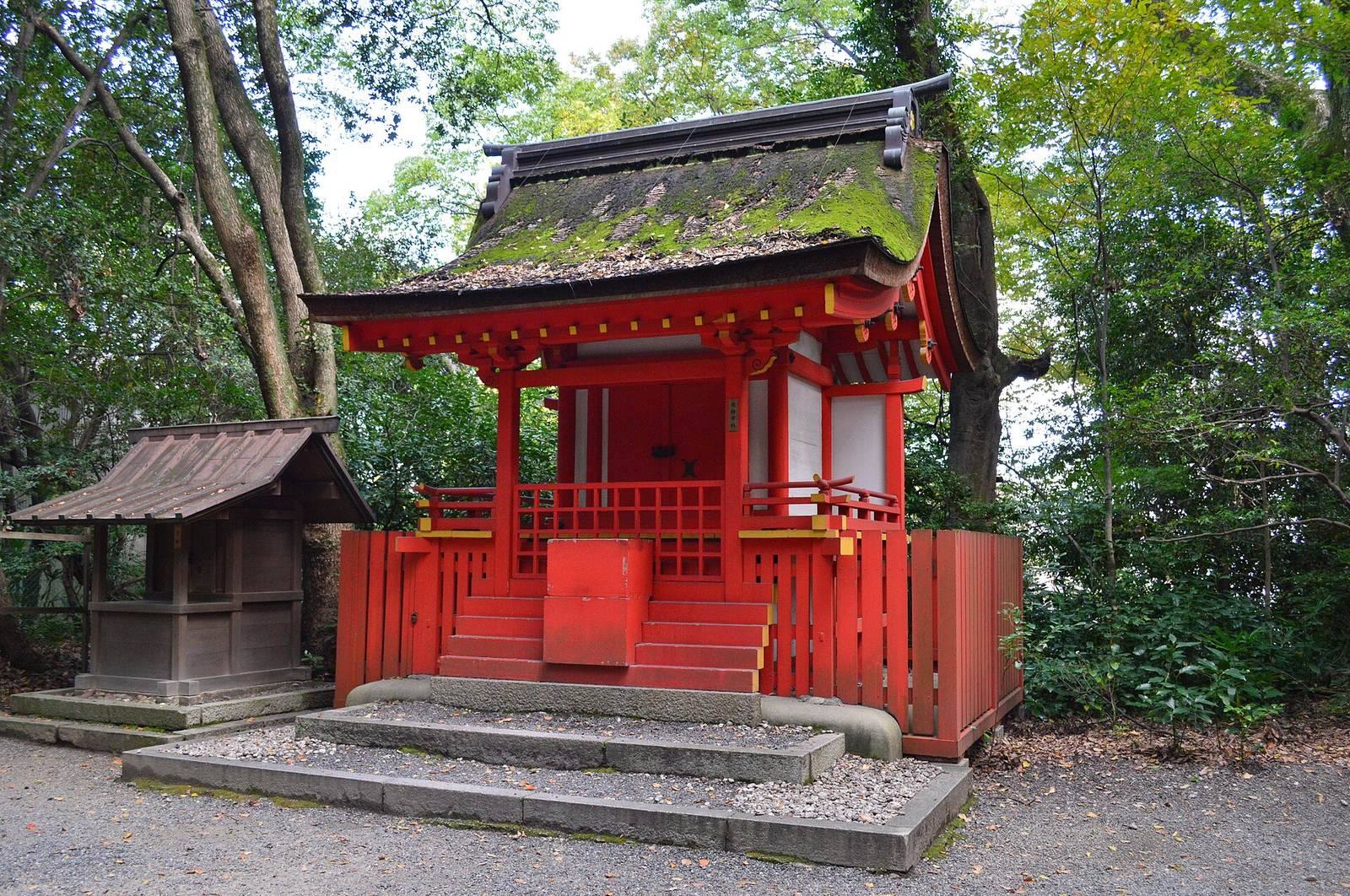
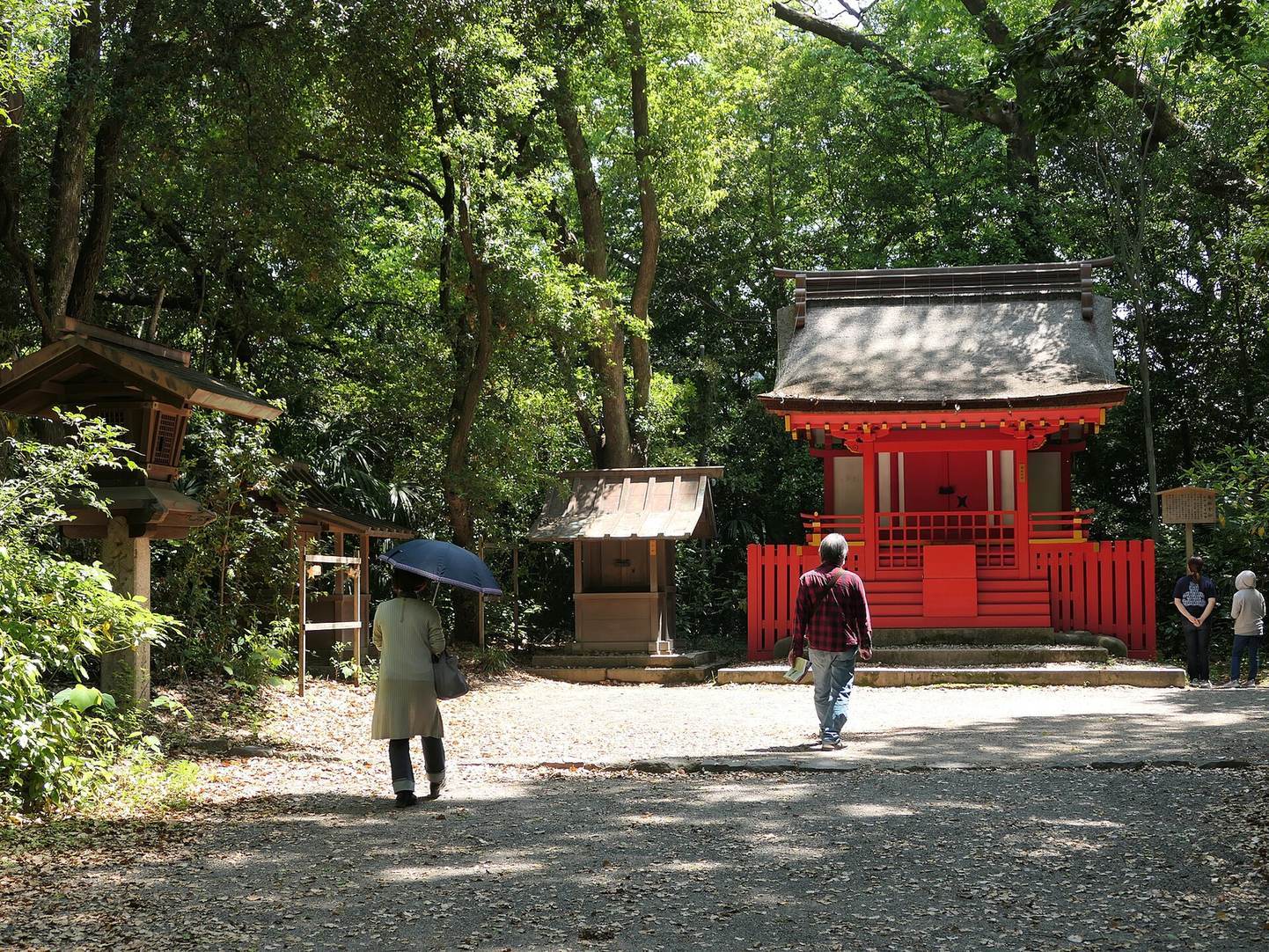
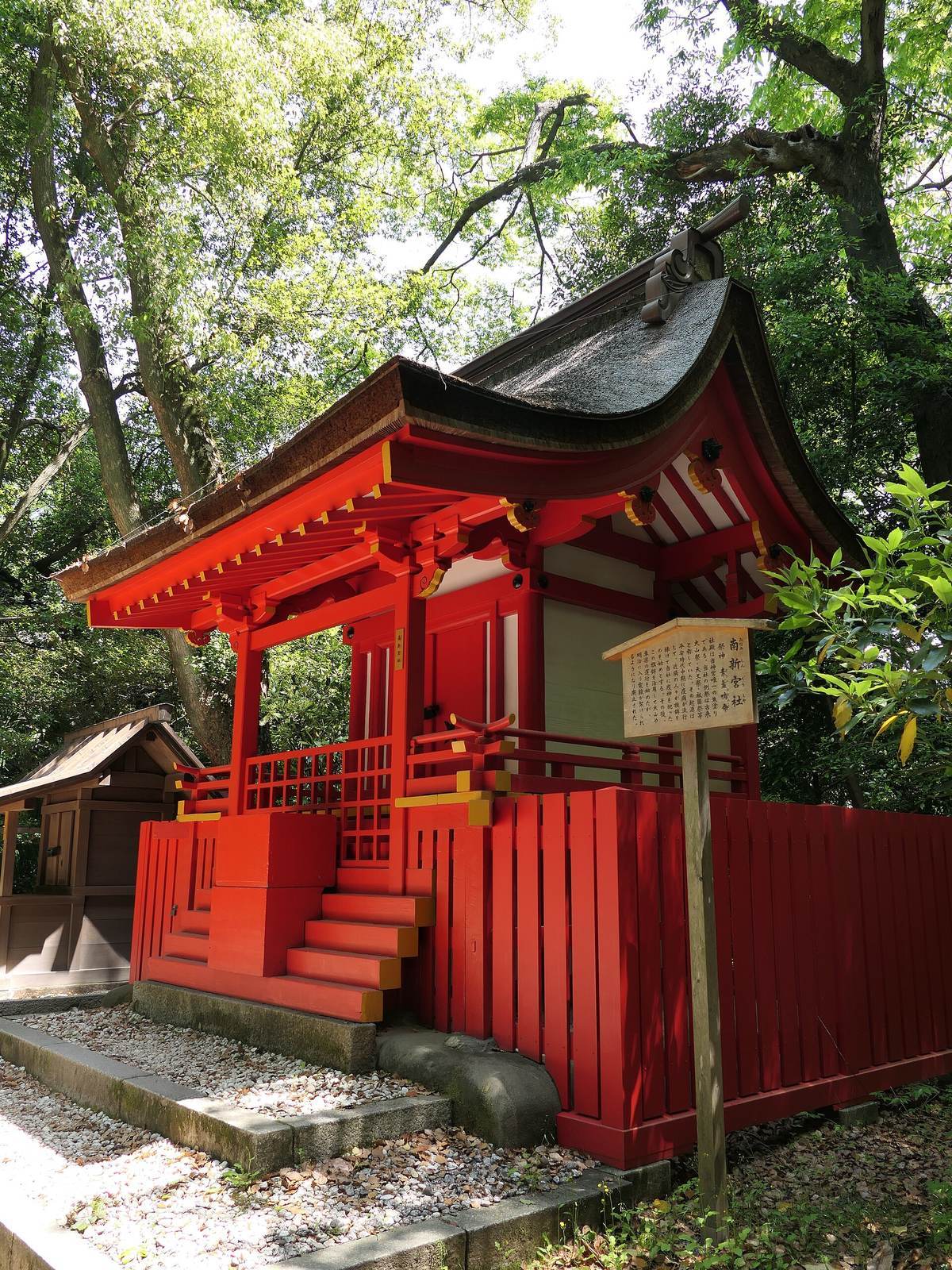
Minami Shingū-sha occupies the southeastern part of Atsuta Shrine’s grounds. Its precinct covers about 909 square metres, and the shrine faces west. An older approach runs north from the eastern side of the southern shrine gateway, with Minami Shingū-sha on its right. The surviving precinct includes its main sanctuary and smaller associated shrines.
Buildings and ritual features
Main sanctuary
The honden, or main sanctuary, is a one-bay building, with a single structural space between its supports. Its roof sweeps forward above the entrance, which is set on the building’s long side, and has a gabled end. Boat-shaped support brackets sit above the principal pillars, with three sets of brackets beneath the eaves. At the gable, a curved beam is topped by tapered supports. The building’s vermilion-painted surfaces and white walls form a color scheme distinctive among Atsuta Shrine’s buildings. Its roof covering and vermilion finish were renewed in 1992.
Yako Shrine
Yako Shrine is a small west-facing subsidiary shrine in front of Minami Shingū-sha, to its left. It enshrines five male and three female deities.
Soshimori Shrine
Soshimori Shrine is a small south-facing subsidiary shrine, also positioned in front of Minami Shingū-sha to its left. It enshrines Komori no Okami, another name for Susanoo. The meaning of “Soshimori” is uncertain. One proposed explanation links the name to a place in Silla, an ancient kingdom on the Korean Peninsula, associated in Japanese tradition with Susanoo’s arrival. The shrine is also connected by tradition with Imori Shrine, a subsidiary of Tsushima Shrine.
Festival reeds
The reeds used for the South Shingū Shrine Festival are placed in set quantities and positions. On June 4, two bundles of 20 reeds, each about 75.8 centimetres long and tied at five points, go inside the sanctuary. Two bundles of 18 reeds, each about 145.5 centimetres long and tied at three points, are set on either side of the sanctuary steps. Twelve bundles of 18 reeds, each about 121.2 centimetres long and tied at three points, are arranged on a platform beside the sanctuary.