Ōsu Kannon Temple: A Shingon Buddhist Head Temple in Nagoya


Site at a Glance
- Rating
- 4.2
- Popularity
- High
- Country
- Japan
- Primary era
- Modern
- External website
- Open
- Eras represented
- Modern
- Civilizations
- Japanese
- Site type
- Religious
- Remains
- Temple
On this page12 sections
History
Ōsu Kannon Temple is a Shingon Buddhist temple in Nagoya, Japan, formally known as Kitanosan Shinpukuji Hōshō-in. The institution began in 1333, when the monk Nōshin founded Shinpukuji and its associated temple, Hōshō-in, at Kitano Tenmangu in what is now Gifu Prefecture. Its principal image is Kannon, the Japanese Buddhist form of Avalokiteśvara, a bodhisattva associated with compassion. Today, the temple is popularly called Ōsu Kannon and belongs to the Chizan branch of Shingon Buddhism.
Medieval Origins and Growth
The institution’s tradition reaches back to Nakajima Kannon, established during the 1190s at Ōsu in Nagaoka village, in present-day Kuwabara, Hashima, Gifu Prefecture. In 1324, Emperor Go-Daigo established Kitano Tenmangu in Nakajima County. Nine years later, Nōshin founded Shinpukuji and Hōshō-in as the shrine’s associated temple, and an image of Kannon was brought from Shitennōji in Settsu Province to serve as the principal image.
The temple buildings were later established under Emperor Go-Murakami, and the institution became an imperial prayer temple, meaning one founded under imperial patronage for religious observances. During the tenure of its third chief priest, Prince Ninyo, its estate reached 10,000 koku, a historical measure based chiefly on assessed rice production. The temple also supervised Shingon temples in Ise, Mino, Owari, Mikawa, Tōtomi, and Shinano.
Relocation to Nagoya
During Japan’s Sengoku period, an era of prolonged warfare among regional military powers, Oda Nobunaga granted the temple an estate of 500 koku. In 1612, Tokugawa Ieyasu ordered Hōshō-in to move from Ōsu-gō to its present position in the Nagoya castle town. Naruse Masanari, lord of Inuyama Castle, carried out the relocation, which included the principal image and the Shinpukuji library. Repeated flooding at the former site was also cited as a reason for the move.
Fire, War, and Reconstruction
A five-story pagoda was built in 1815. On March 21, 1892, the Great Fire of Ōsu destroyed the main hall, the pagoda, and the Niōmon Gate. The fire began behind the temple’s Hōshōza theater. A contribution ledger made that April contained plans and drawings for rebuilding the three structures in five sections. The main hall and Niōmon Gate were rebuilt, but the pagoda was not.
The temple was destroyed again during the Nagoya Air Raid on March 19, 1945. Its principal image survived because it had been moved into the reinforced-concrete Ōsu Library. Temporary versions of the main hall and Niōmon Gate were erected in 1949, while financial difficulties greatly delayed construction of a permanent main hall. The present main hall was rebuilt in reinforced concrete in 1970. Plans also included cloisters and a five-story pagoda, but insufficient donations stopped those works, and the planned elements have not been rebuilt.
Religious and Pilgrimage Role
Ōsu Kannon is classified as a special head temple and is regarded as one of Japan’s three major Kannon pilgrimage sites. It is the first temple of the Owari Thirty-Three Kannon pilgrimage, the tenth of the Tokai Thirty-Six Fudō, the twenty-first of the Owari Eighty-Eight Pilgrimage, and the first of the Nagoya Twenty-One Daishi Pilgrimage. The temple also houses a statue of Hotei, one of the Seven Lucky Gods of Nagoya, and supervises the Dai-Nagoya Twelve Zodiac pilgrimage.
Remains
The temple precinct combines a modern reinforced-concrete main hall with the Shinpukuji Library and surviving collections connected with the institution’s medieval and early modern history. The principal Kannon image remains the central sacred object of the temple, while the library preserves manuscripts and other works of exceptional historical and scholarly value.
Temple Buildings
Main Hall
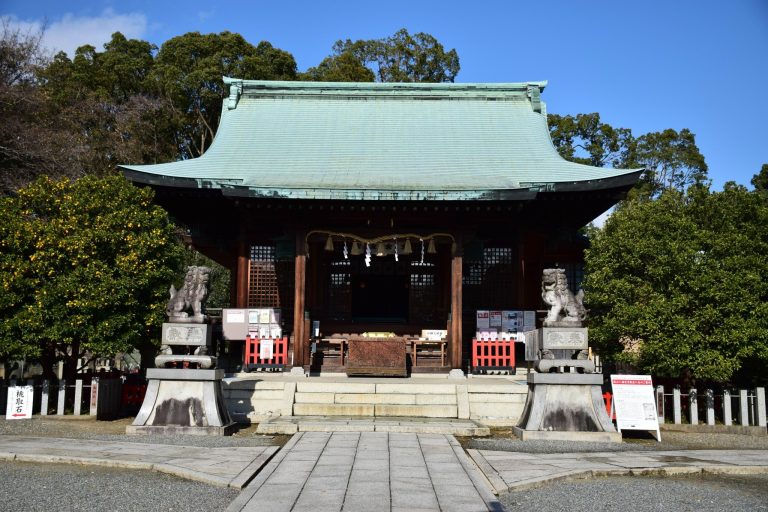
The present main hall is a reinforced-concrete building completed in 1970 after the temporary postwar structure had served the temple. A very large red paper lantern hangs from the ceiling. Worshippers attach small paper strips bearing wishes to the wires that support it.
Niōmon Gate and Pagoda
The Niōmon Gate was rebuilt after the 1892 fire, destroyed in the 1945 air raid, and replaced temporarily in 1949. The five-story pagoda erected in 1815 was also lost in the 1892 fire and has not been rebuilt. It had housed a statue of Aizen Myōō attributed to Kūkai, the ninth-century monk who established the Shingon tradition in Japan. The statue’s present location is not specified.
Shinpukuji Library and Collections
Library
The reinforced-concrete Shinpukuji Library, also called the Ōsu Library, stands within the temple precinct. It holds approximately 15,000 classical Japanese and Chinese works. The library is described as one of Japan’s three major sutra repositories, and alternatively as one of the country’s three major libraries.
Manuscripts and Votive Tablet
The library’s most prominent manuscript is the Shinpukuji manuscript of the Kojiki, Japan’s earliest surviving major chronicle, which combines creation narratives, mythology, genealogies, and early historical traditions. Transcribed by the monk Ken’yū in three volumes in 1371 and 1372 during the Nanboku-chō period, the era of rival Northern and Southern imperial courts, it is the oldest surviving manuscript of the Kojiki and is designated a National Treasure.
Other National Treasure manuscripts in the collection include Hanshu, “Treatise on Food and Money,” chapter four; volumes 12 and 14 of Chōgyokushū, copied in 747; and the Poems of Hanlin Scholars. The library also holds numerous works designated Important Cultural Properties. The temple collection includes a reconstructed mathematical votive tablet dated April 1815 and dedicated by Mitsuya Kinzaemon.