The Black Monastery in Wismar: A Dominican Convent
Site at a Glance
- Popularity
- Medium
- Country
- Germany
- Primary era
- Medieval
- Eras represented
- Medieval, Modern
- Civilizations
- German, Holy Roman Empire
- Site type
- Religious
- Remains
- Monastery
On this page15 sections
History
The Black Monastery in Wismar was a Dominican convent in Germany, founded in 1292–1293 by the Order of Preachers, a Catholic mendicant order whose friars preached and traditionally relied on alms. Its foundation coincided with the captivity of Mecklenburg Prince Henry the Pilgrim in the Arab world. A donation in 1292 marks the friars’ first recorded presence in the town, and the order’s General Chapter, its central governing assembly, approved the new house the following year. A Mecklenburg ruler endowed land for the convent, as an inscription in the church recalled.
Foundation and civic life
A town-council agreement dated 27 June 1294 brought the friars within Wismar’s legal framework. They had to help build nearby roads and bridges, could not brew beer, and were expected to represent the town in disputes over church affairs while following their religious rules. The arrangement may have helped Wismar defend its authority amid jurisdictional disputes with Mecklenburg’s rulers. Before the friars had their own church, they preached regularly at St Mary’s Church.
The convent first belonged to the Dominican province of Teutonia and, from 1303, to Saxonia, administrative provinces of the order. Its name, the Black Monastery, referred to the Dominicans’ black habits, in contrast to the Franciscans, known as the Grey Friars. The community took part in civic affairs as witnesses and authenticators of documents. Johannes Blomberg served as a town clerk before 1352, while Johann Blomenberg, a deputy within the Dominican province, was confessor to Duke Albrecht II in the fourteenth century.
The friars enlarged their property through purchases and gifts of land and other assets. Wismar residents also gave the convent money, wax, lamp oil, clothing, and food, often in return for masses for the dead. The convent and individual friars received money and regular payments despite the order’s vow of poverty. The council required donated buildings and land to be sold to townspeople within a year, and the friars used legal representatives to manage their affairs. The convent probably collected alms at Sternberg, about 30 kilometres away. It also held rights to present candidates for church posts and had connections to parishes at Warnemünde, St Mary’s in Rostock, Lübow, and Neubukow through the sixteenth century.
The convent hosted a town-council assembly in 1325 and a final hearing in a dispute between Schwerin Bishop Albrecht and the von Bülow family in 1357. The Dominican province of Saxonia held meetings there in 1365, 1404, 1439, and 1515. At the 1515 assembly, an extraordinary decision united the order’s Observant and Conventual branches.
Study, worship, and reform
A theological school operated at the convent from the fourteenth century. A theology lecturer is recorded in 1369, and a master oversaw friars studying there. During the convent’s Observant period, it trained members of the Congregation of Holland, a reform group within the order. Friars from the Low Countries and the Lower Rhine came to study theology and, from about 1480, philosophy and logic.
On 1 February 1400, Pope Boniface IX granted the friars permission to offer an indulgence on certain feast days using a relic of the Virgin Mary’s garment. A relic is an object kept for its religious association with a sacred person; an indulgence concerns the temporal consequences of sin in Catholic practice. The privilege drew worshippers and brought income to the convent. A Rosary confraternity, a religious association promoting devotion through the Rosary, was established in Wismar in 1483.
In 1462, Prior Johann Brakel led friars to carry church valuables to Lübeck to prevent their being pledged to the town council. The objects included reliquaries, monstrances, gilded chalices and plates, and cross-shaped reliquaries. On 12 July 1468, under pressure from Dominican leaders, the convent joined the Observant Congregation of Holland, which enforced stricter religious discipline, including poverty. The change had support among Wismar’s citizens, possibly in response to the convent’s wealth. Reformers from Dutch houses came to Wismar, and Prior Adriaan van Meer became a leading figure in the movement.
After receiving Duke Henry IV’s protection in March 1469, the friars promised the dukes and town council that they would maintain Observance. Individual friars apparently stopped accepting money, while the convent continued to hold property communally and receive income from regular payments. The house returned to the province of Saxonia in 1517, when its strict Observant rules were lifted.
The church and convent also served as burial places for donors, council members, merchants, and members of Mecklenburg’s ruling family. Master builder Martin Kremer was buried in 1405, and the murdered mayor Heinrich von Haren in 1429. Duchess Sophie of Pomerania, who had been duchess of Mecklenburg since 1478, was buried before the high altar in 1504. Her sister Margarethe was buried there in 1526.
Reformation and dissolution
The convent remained Catholic during the Reformation, first introduced in Wismar by the Franciscan Heinrich Never. The town council prohibited the Dominicans’ public worship but allowed them to remain together and worship privately, promising them lifelong residence in the monastery. In 1533 the council appointed a Protestant preacher to the church. It began inspecting Wismar’s monasteries in 1535 in preparation for taking their property, and in spring 1536 seized Dominican valuables worth 80 silver marks.
The friars sought protection from Mecklenburg Dukes Heinrich and Albrecht and applied for vacant church posts. Their ties to the ruling family helped them elect Johannes Hoppener as prior in 1546. Duke Henry V’s death in 1552 weakened their position. In 1553, the year an almshouse was established in part of the monastery, Dominican Joachim Tancke received an inheritance. As Wismar’s Protestant church order was enforced more firmly, the convent was dissolved in 1562. On 4 December, Hoppener and the last remaining friar, Heinrich, surrendered the monastery in return for the council’s promise of lifelong support. They declined an invitation from Superintendent Johann Wigand to discuss conversion. Hoppener remained prior until the dissolution and died in 1575; an evangelical pastor began preaching in the church in 1566.
Remains
The monastery grounds lay in southeastern Wismar, southeast of present-day Mecklenburger Straße and south of Bei der Klosterkirche. They reached the city’s southeastern fortifications near two gates, with the market and town hall nearby. Construction began in 1297 using brick, and the friars operated their own brickworks from 1305. The church stood beside a square cloister complex, while a separate building lay southeast of the convent, parallel to the city wall.
The church
Medieval church
An early temporary church preceded a larger, east-facing building constructed in the fourteenth century in the style of a mendicant-order church. Its main body, or nave, had three aisles and five bays, the structural divisions between supports. The nave may date to about 1320–1330. By the late nineteenth century, the west front had been remodelled in Renaissance style to resemble the gable of a prominent town house.
Surviving choir
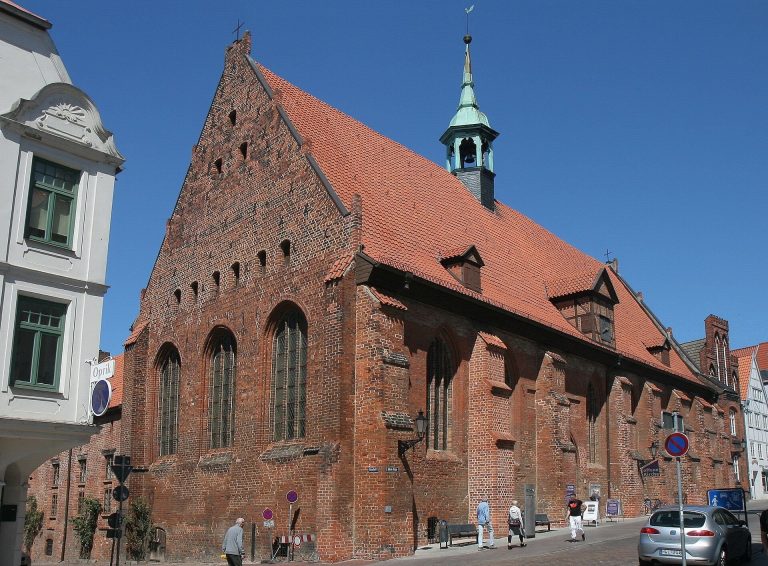
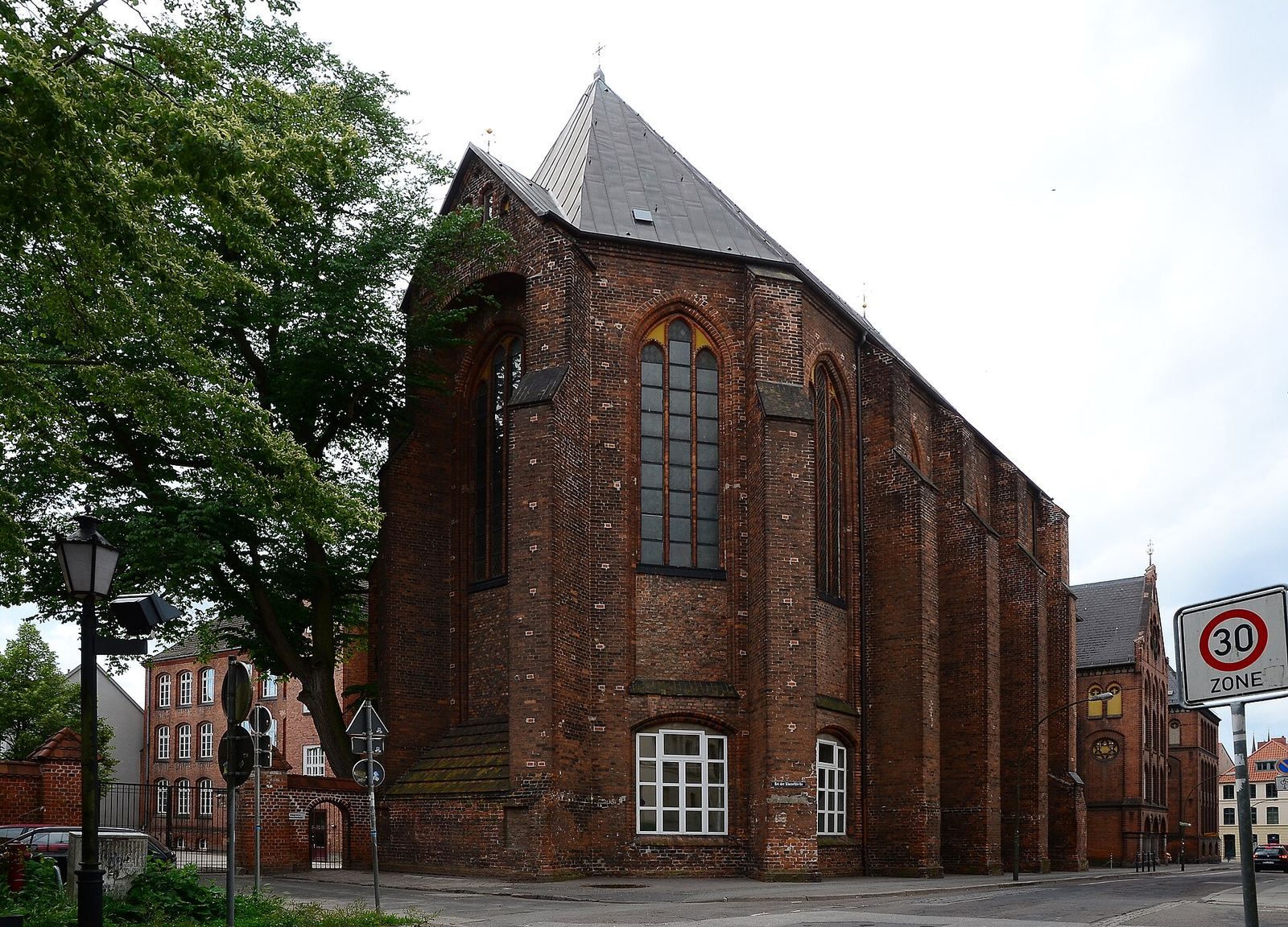
The church’s choir, the area used by clergy for worship, was its final medieval building phase. Built by Martin Kremer in a mature Gothic style, it has three bays and an asymmetrical plan shaped to fit the city wall. Its eastern end forms five sides of an eight-part polygon. The choir retains medieval cross vaults, ceilings formed by intersecting arches. A floor inserted for school use divided the space into an upper assembly hall and a lower gymnasium. The nave was demolished in 1879 to make way for a civic school.
Monastic grounds and other buildings
Cloister and dining wings
The square cloister stood south of the church, with its eastern wing adjoining the choir. The one-storey south wing, like the west wing 7.4 metres wide, is partly preserved. It contained a summer dining hall and a heated winter dining hall. Remnants of elaborate wall paintings remain. A brewery stood south of the west wing in the fifteenth century.
Infirmary and later school buildings
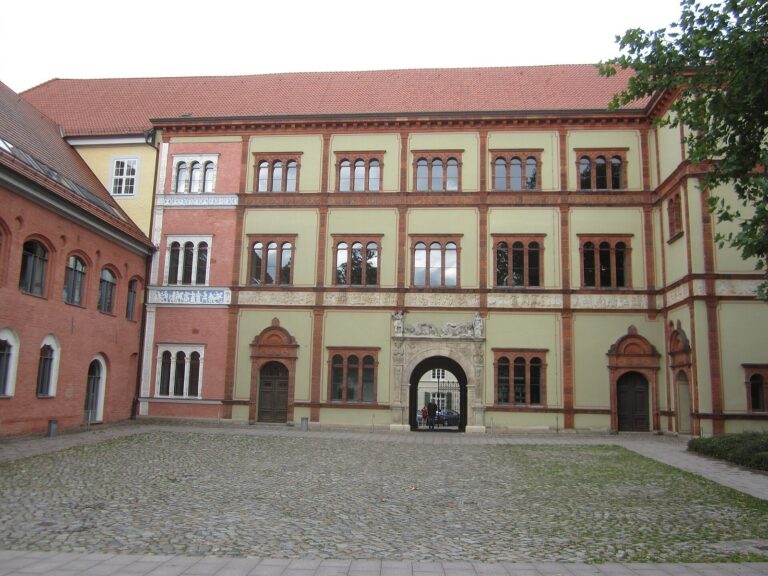
The separate building southeast of the convent measured 20 by 10 metres and had a full basement. Built in the first half of the fourteenth century, it initially served as an infirmary, a place where sick community members received care. The former monastery buildings now house the Johann Wolfgang von Goethe Integrated Comprehensive School, and the former church choir serves as its assembly hall and gymnasium. During the 2010s, one old annex was adapted as an art and music hall with studio windows and a stage; another was converted for dining, social work, support teaching, and workshops. A school complex at Mecklenburger Straße 36 c2–f also includes a south wing from the eighteenth or nineteenth century and a corner house dating to the thirteenth century. The former hospital building now accommodates a senior residence run by Diakonie Nord Nord Ost.
Chapel, memorials, and furnishings
Northeast chapel
In 1398, town clerk Heinrich von Balsee added a chapel to the church’s northeast side. Dedicated to the Virgin Mary and the Dominican theologian Thomas Aquinas, it was served by priests appointed to celebrate mass there daily.
Grave slabs and epitaph
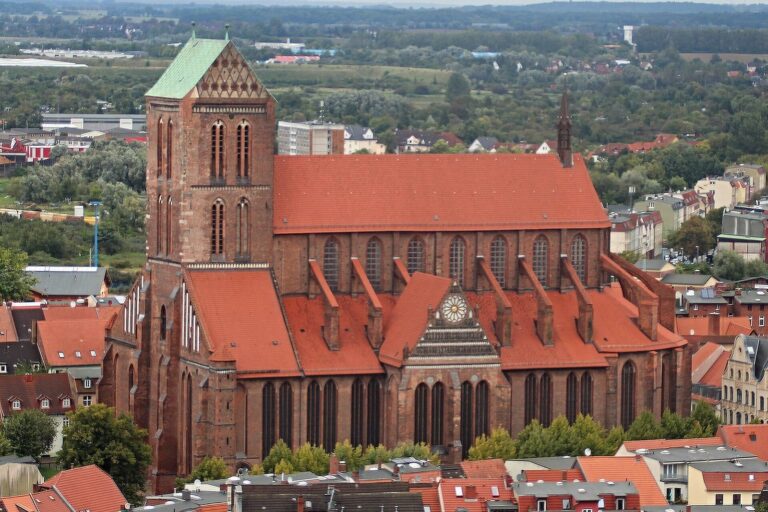
Sophie of Pomerania’s grave slab was moved to St Mary’s Church and, after that church was destroyed, to a northern side chapel in St Nicholas’ Church. An epitaph dated 1717 was found in the choir floor during conservation work in early 2021. It commemorates Wulf Christoph von Blanckensee as a colonel in the Royal Prussian Corps and Wismar’s city commandant.
Altars and other church furnishings
The church’s furnishings were dispersed among other Wismar churches and the city museum. St Nicholas’ Church holds the Dominican church’s triumphal cross group, Thomas altar, and carved Marian altarpiece, the latter two dating to about 1500. The Rosary confraternity donated the altarpiece. Other objects entered the city museum, while a late-seventeenth-century pulpit was transferred to the prayer room of the hospital associated with the Black Monastery.