Neubourg Abbey: A Cistercian Monastery in Alsace
Site at a Glance
- Popularity
- Medium
- Country
- France
- Primary era
- Early Modern
- Eras represented
- Early Modern
- Civilizations
- French
- Site type
- Religious
- Remains
- Monastery
On this page7 sections
History
Neubourg Abbey was a Cistercian monastery near Dauendorf in Alsace, France, founded in 1128 by Count Reinhold of Lützelburg with help from Frederick II, Duke of Swabia. The Cistercians were a monastic order shaped by Benedictine practice and known for disciplined communal life. Neubourg was a daughter house of Lucelle Abbey and belonged to the Morimond lineage, a network of communities that developed from one of the order’s principal abbeys.
Foundation and Cistercian expansion
The monastery’s community took shape in 1133, when Abbot Stephan of Lucelle sent twelve monks to Neubourg. Ulrich became its first abbot, and the new house was dedicated to Our Lady. Pope Eugene III confirmed the foundation in 1141. Reinhold gave the monks their building site and three farmsteads: one with a chapel at Harthouse, and others at Laubach and Soufflenheim. The monks built their monastery themselves.
Ulrich died in 1147 and was buried in the abbey church, where later generations of monks honored his memory. Reinhold died at Marmoutier on 1 January 1150 and was also buried in the church. Neubourg’s third abbot, Nendung, led the community from 1153 to 1178, and the church was dedicated in 1158. Monks from Neubourg helped establish Maulbronn and Herrenalb, both founded in 1147; Neubourg later became the mother house of those abbeys and Baumgarten.
Soon after the foundation, Frederick Barbarossa, a later Hohenstaufen ruler and Holy Roman Emperor, investigated the abbey and forced the monks to give up their claims to the valuable Hohenstaufen Forest. A tradition also says that St Bernard of Clairvaux stayed at Neubourg, perhaps because its library was reputed to be among Europe’s richest at the time.
Medieval and early modern changes
In 1237, Heinrich von Fleckenstein founded Marienbrunn, a convent of Augustinian nuns, on the eastern side of Liebfrauenberg near Görsdorf. On 8 December 1356, Holy Roman Emperor Charles IV placed Neubourg and its possessions under his protection and granted it further rights. The lords of Lichtenberg exercised the abbey’s vogtship, a form of secular protective jurisdiction.
The abbey suffered repeated destruction and rebuilding between the fourteenth and seventeenth centuries. During the German Peasants’ War, a series of uprisings in German-speaking lands, insurgents plundered Neubourg on 18 April 1525. The attackers came from the counties of Zweibrücken-Bitsch and Hanau-Lichtenberg, and from imperial villages around Haguenau. Their commander was Jacob Küfer of Oberbronn. The raid followed the outbreak of an uprising near Molsheim by two days. Many members of the band later died at the Battle of Lupstein on 16 May and in the massacre at Saverne the following day.
The Augustinian nuns left Marienbrunn in 1575. In 1697, the last lord of Fleckenstein transferred the convent and its lands to Neubourg, which established a community of Cistercian monks there. By the eighteenth century, Neubourg held the villages of Dauendorf, Dunnenheim, Uhlweiler, and Nieder-Altdorf.
Dissolution and later history
The French Revolution suppressed Neubourg Abbey in 1790 and dispersed its monks. The church and monastery were demolished in 1818, while a small chapel remained until 1846. In 1990, the surviving enclosure, portal, residential-building remains, and archaeological ground were inscribed as historic monuments.
Remains
The precinct and buildings
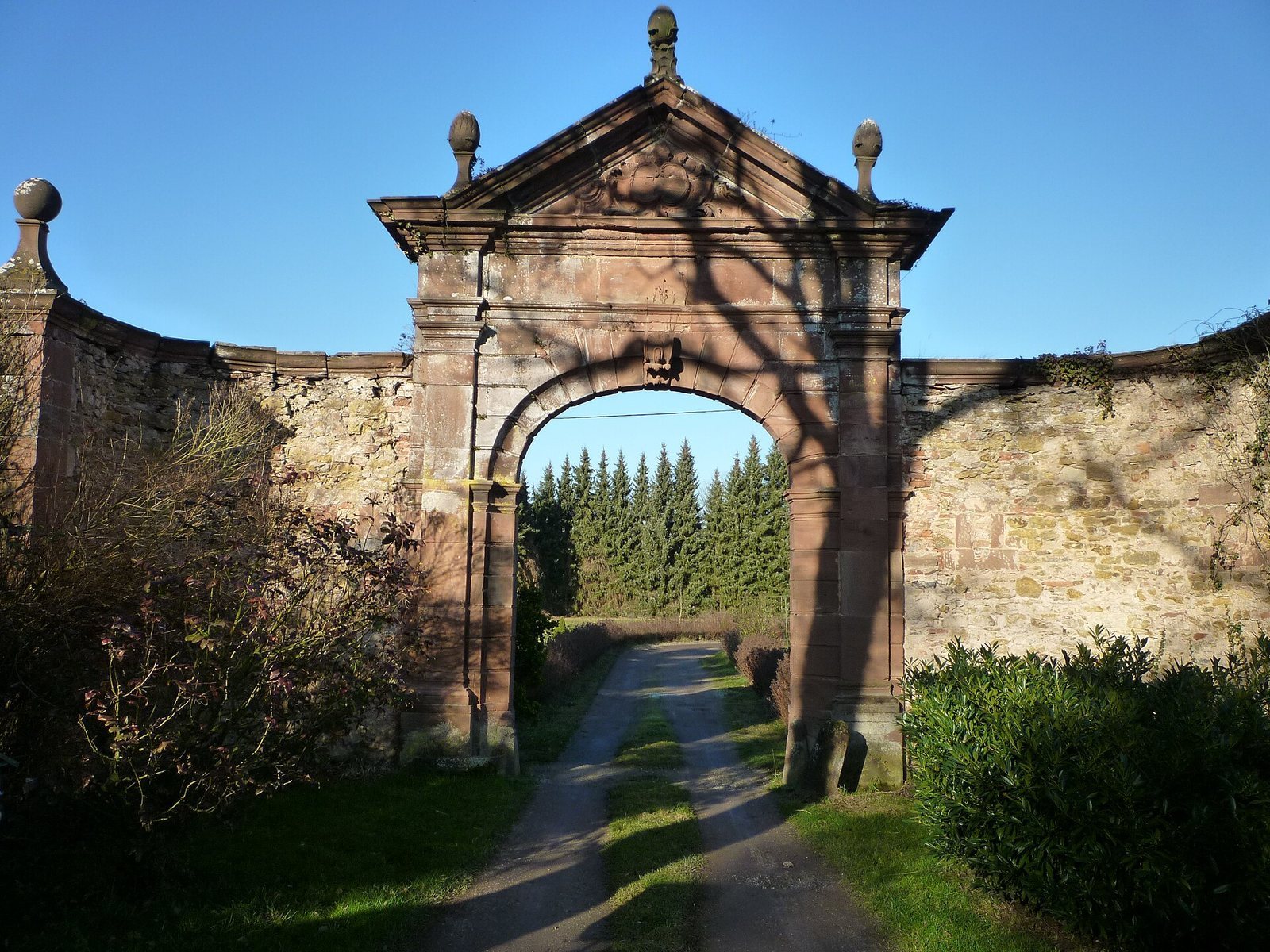
The abbey stood in the Moder valley on the territory of Dauendorf, between Haguenau and Pfaffenhoffen and about nine kilometres west of Haguenau. Its surviving remains include the precinct, parts of its enclosing wall, a mill, fragments of residential buildings, and archaeological deposits beneath the grounds. A Baroque gatehouse dating to 1744 survives as a prominent architectural feature of the precinct. Within the former garden precinct stood a small chapel in pointed Gothic style, with an altar.
Relocated objects and reused materials
A distinctive eighteenth-century sundial with 24 faces was moved to Mont Sainte-Odile Abbey in 1935. The Bees Fountain, once part of Neubourg, is near St George’s Church in Haguenau, while an altar from the abbey is in the church at Rottelsheim. Wooden church furnishings in Rococo, an ornate decorative style, are now at St Nicholas’s Church in Haguenau. They include choir stalls, an organ case, a pulpit, choir panelling, statues of the Church Fathers, and other sculptures. Doors from Neubourg are held by Haguenau’s Historical Museum, and stones from the abbey walls were reused in the construction of the Saint-François clinic.