Helfta Monastery: A Medieval Convent and Center of Women’s Theology
Site at a Glance
- Popularity
- High
- Country
- Germany
- Primary era
- Modern
- Eras represented
- Medieval, Modern
- Civilizations
- German, Holy Roman Empire
- Site type
- Religious
- Remains
- Monastery
On this page14 sections
History
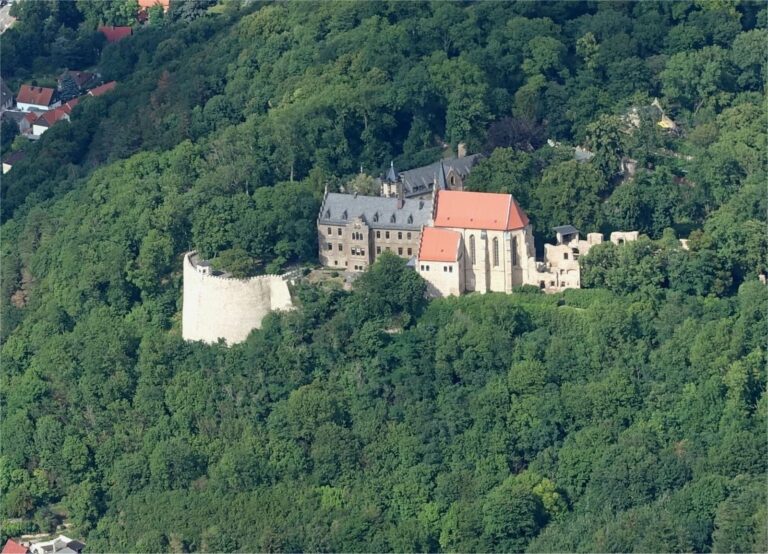
Helfta Monastery was a medieval convent near Eisleben, Germany, founded in 1229 near Mansfeld Castle by Count Burchard of Mansfeld and his wife, Countess Elisabeth von Schwarzburg. Its church, built in the second half of the thirteenth century, was an early Gothic structure. Helfta later became a leading center of women’s theology and mysticism.
Foundation and the convent’s intellectual life
The first community consisted of seven nuns from St. James Monastery near Halberstadt. In 1234, after Burchard’s death, his widow moved the convent to Rossdorf, northwest of Eisleben, and entered the community herself. She died there in 1240. Severe water shortages led to another move in 1258, this time to Helfta.
Gertrude of Hackeborn led the convent from 1251 to 1291 and worked to strengthen its independence. The nuns followed the Rule of Saint Benedict, a guide to communal monastic life, while adopting reforms associated with the Cistercians, a Catholic monastic order. They did not formally join that order, but both Benedictines and Cistercians regarded Helfta as part of their tradition. The Mansfeld counts protected the convent and endowed it with land, while the Hakeborn, Querfurt, and Schraplau families also gave gifts. Its school educated girls from noble families. Fifteen of its eighteen abbesses were noble, and the community may at times have numbered about one hundred nuns.
Helfta’s intellectual life drew on a well-stocked library, a place where manuscripts were copied, and an important musical tradition. The writings of Mechthild of Magdeburg, Gertrude the Great, and Mechthild of Hackeborn were supported by the wider community of nuns. An unnamed nun known as Sister N helped edit written accounts of revelations associated with Gertrude and Mechthild. Helfta also had close ties with the Dominicans of Halle and embraced ideas connected with the poverty movement. The convent welcomed Mechthild of Magdeburg, a Beguine, meaning a woman who pursued a religious life without taking the formal vows of an order, both to shelter her and to let her teach the other nuns. The Eucharist, the Christian rite recalling the Last Supper, and the Sacred Heart, a Catholic devotion centered on Christ’s love, were among the themes of Helfta’s mystical writing.
The convent’s writings circulated from Magdeburg through Nuremberg to Swabia, the Upper Rhine, and Switzerland, and became influential in German mysticism. A possible influence on the Dominican theologian Meister Eckhart remains uncertain, while Helfta’s impact on southern German women’s convents is considered likely and is reflected in the work of Christine and Margareta Ebner. With Duchess Zedena’s encouragement, Helfta’s works were printed in Saxony shortly after 1500; they may have reached the former nun Katharina von Bora and her husband, Martin Luther. From the later sixteenth century, Gertrude’s writings spread widely in the Catholic world. Their emphasis on a personal, loving relationship between God and humanity continues to draw interest across confessional boundaries.
Attacks, relocation, and decline
Helfta suffered repeated attacks. Gebhart of Querfurt assaulted the convent in 1284, and King Adolf of Nassau besieged it in 1294. During the Halberstadt bishopric conflict of 1342–1344, Albrecht II of Brunswick caused extensive damage. The convent’s protector, Count Burchard IX of Mansfeld, moved it between 1343 and 1346 to a site beside Eisleben’s eastern town wall. This new location became known as Neu-Helfta.
During the Peasants’ War, the nuns fled through Halle and abandoned the convent. Many of its records, plans, and books were burned to heat brewing kettles, while the Mansfeld counts took the community’s valuables into their keeping. In 1529, some nuns returned to Alt-Helfta under Abbess Katharina von Watzdorff, after Count Hoyer arranged for the monastery to be restored. Some early printed books from Neu-Helfta survive in the tower library of St. Andrew’s Church in Eisleben.
Secularization and changing ownership
After the death of the last abbess, Walburg Reuben, Count Hans Georg von Mansfeld-Eisleben secularized the monastery in 1542. In 1566, a heavily indebted Mansfeld count sold its estate, with a right of repurchase, to Franz von Kerssenbrock. The property passed through marriage to Georg Adam von Pfuel in 1641 and to his son-in-law, Field Marshal Heino Heinrich von Flemming, in 1699. In 1712, King Frederick William I of Prussia incorporated Helfta and neighboring estates into a royal domain.
A Catholic parish acquired the former Neu-Helfta in 1868. Benedictine nuns from Osnabrück tried to revive the convent there from 1869 to 1875, but the order was prohibited in Prussia during the Kulturkampf, a period of conflict between the Prussian state and the Catholic Church in the 1870s. The nuns found refuge in Oldenzaal in the Netherlands.
Renewal and the modern community
In 1949, the East German state took over the estate and turned it into a state-owned agricultural enterprise employing about 2,000 people. Poor maintenance led to increasing deterioration. After parts of the complex collapsed, demolition, including of the church remains, was planned in 1988. Art teacher Joachim Herrmann intervened and helped prevent it.
A Mass was celebrated in the ruined monastery church on 1 May 1991, the first there in more than sixty years. Friends’ groups formed an association in 1992 to support the site’s revival, and the Diocese of Magdeburg acquired the property from the Treuhandanstalt, the agency responsible for privatizing former East German state property, in August 1994. Archaeological building investigations began in the former church and cloister areas in 1996. A foundation stone marked the rebuilding in June 1997, and construction began on 1 September 1998 under Bishop Leo Nowak’s patronage.
Seven Cistercian nuns from Seligenthal Abbey re-established a community at Helfta on 13 August 1999. Its founding prioress, Maria Assumpta Schenkl, led the convent and its spiritual life. A papal letter confirmed the refoundation on 17 November, and Bishop Nowak consecrated the church and convent buildings on 21 November. The buildings and grounds passed to the Foundation of St. Mary’s Monastery at Helfta, established in 2002. The monastery serves as a religious community and as an educational and retreat center.
After Schenkl’s death in 2009, Agnes Fabianek became administrator and was elected prioress in 2010. She served until her death in 2015, when Christiane Hansen succeeded her. Helfta was directly under the Cistercian order’s abbot general, the head of the order, until 2022, when it joined the Congregation of Saint Gertrude the Great, an association of monasteries within the order. Bruno Robeck became its first president. Katharina Hauschild was appointed prior-administrator for a year in July 2023. On 12 June 2026, Helfta became affiliated with Seligenthal Abbey, whose abbess, Christiane Hansen, became its higher superior.
Remains
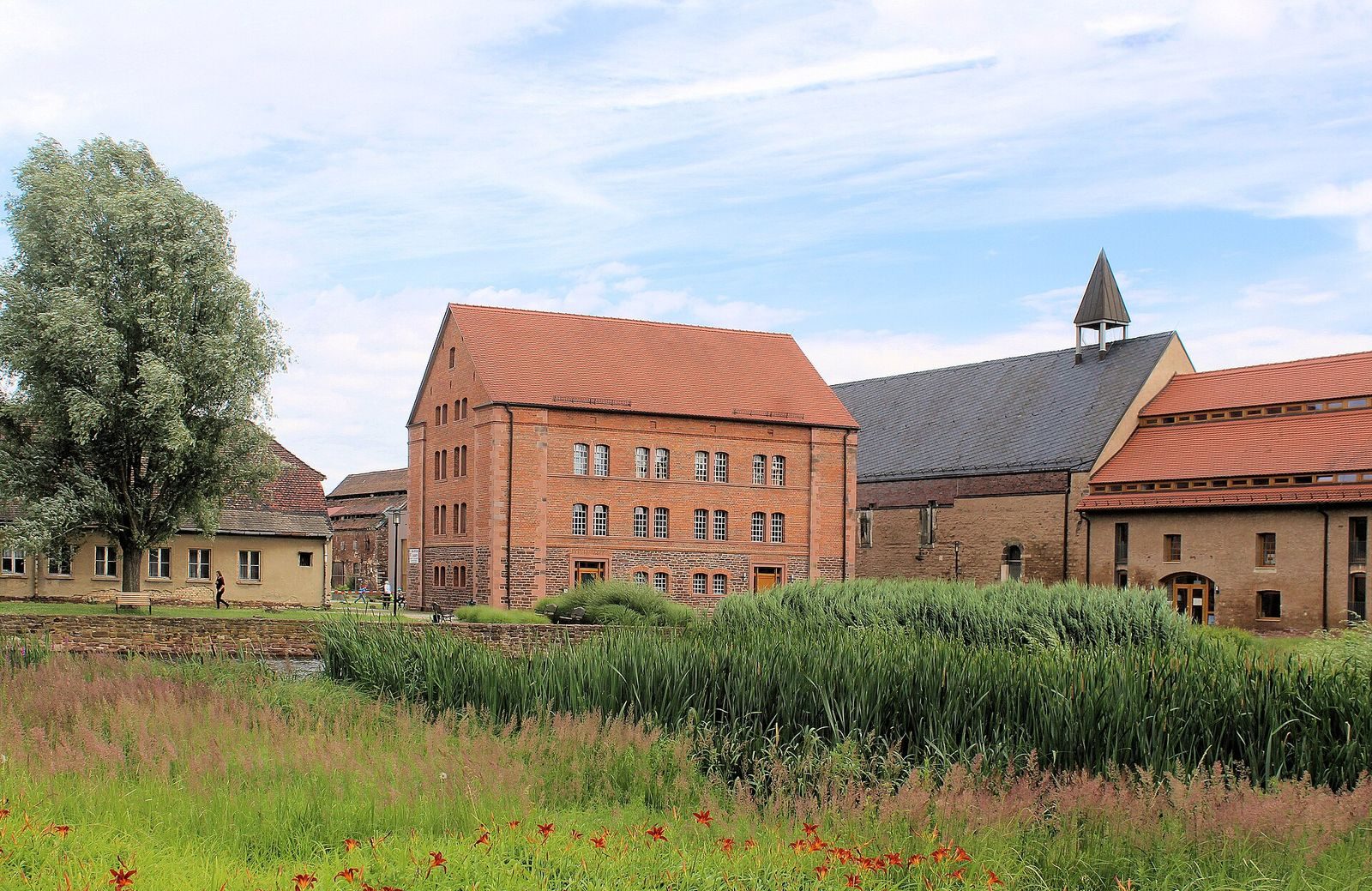
The present complex combines surviving medieval fabric with modern construction. The reconstructed Church of St. Mary, convent house, and cloister form its central group, with educational, residential, and religious buildings also included in the wider complex.
Medieval church
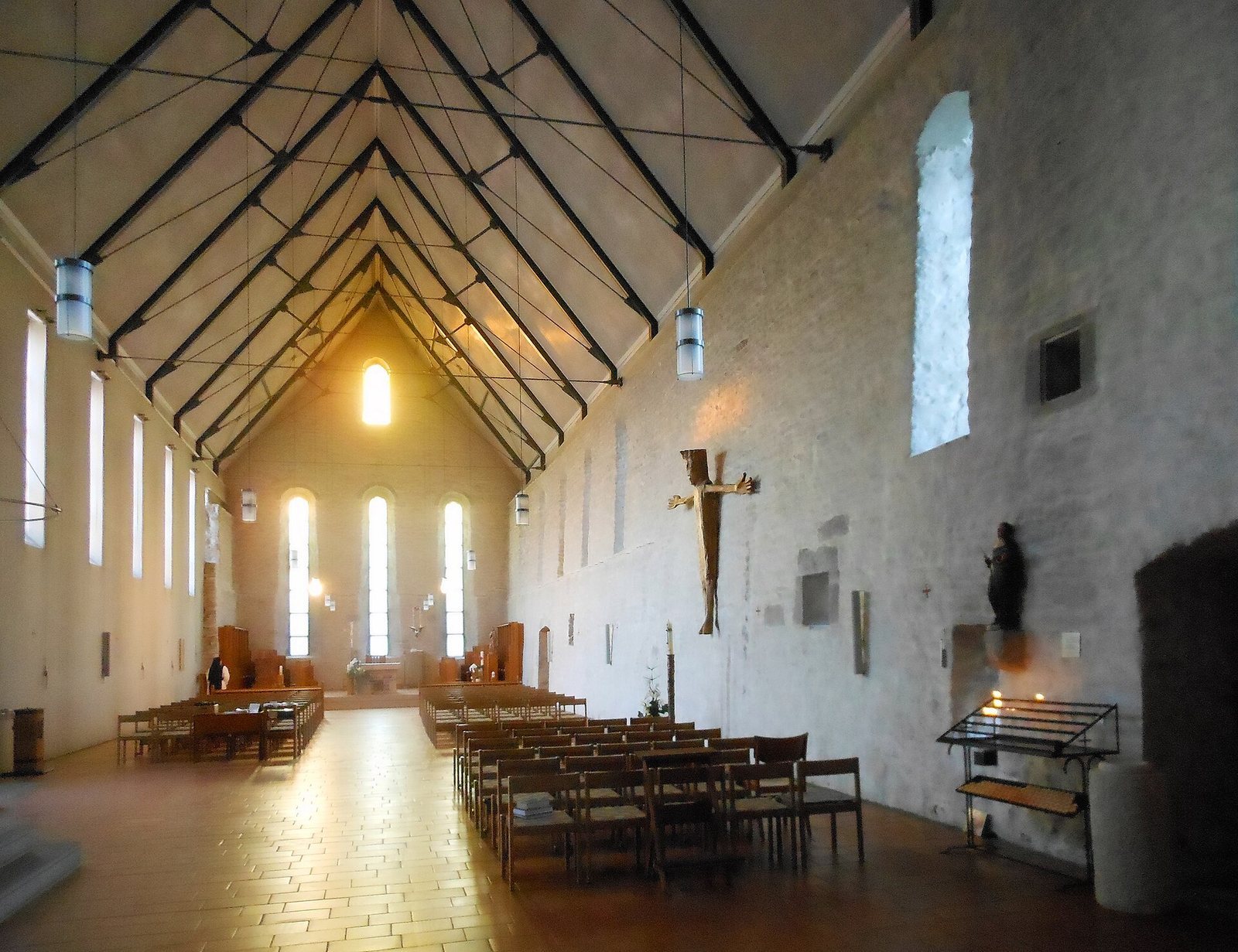
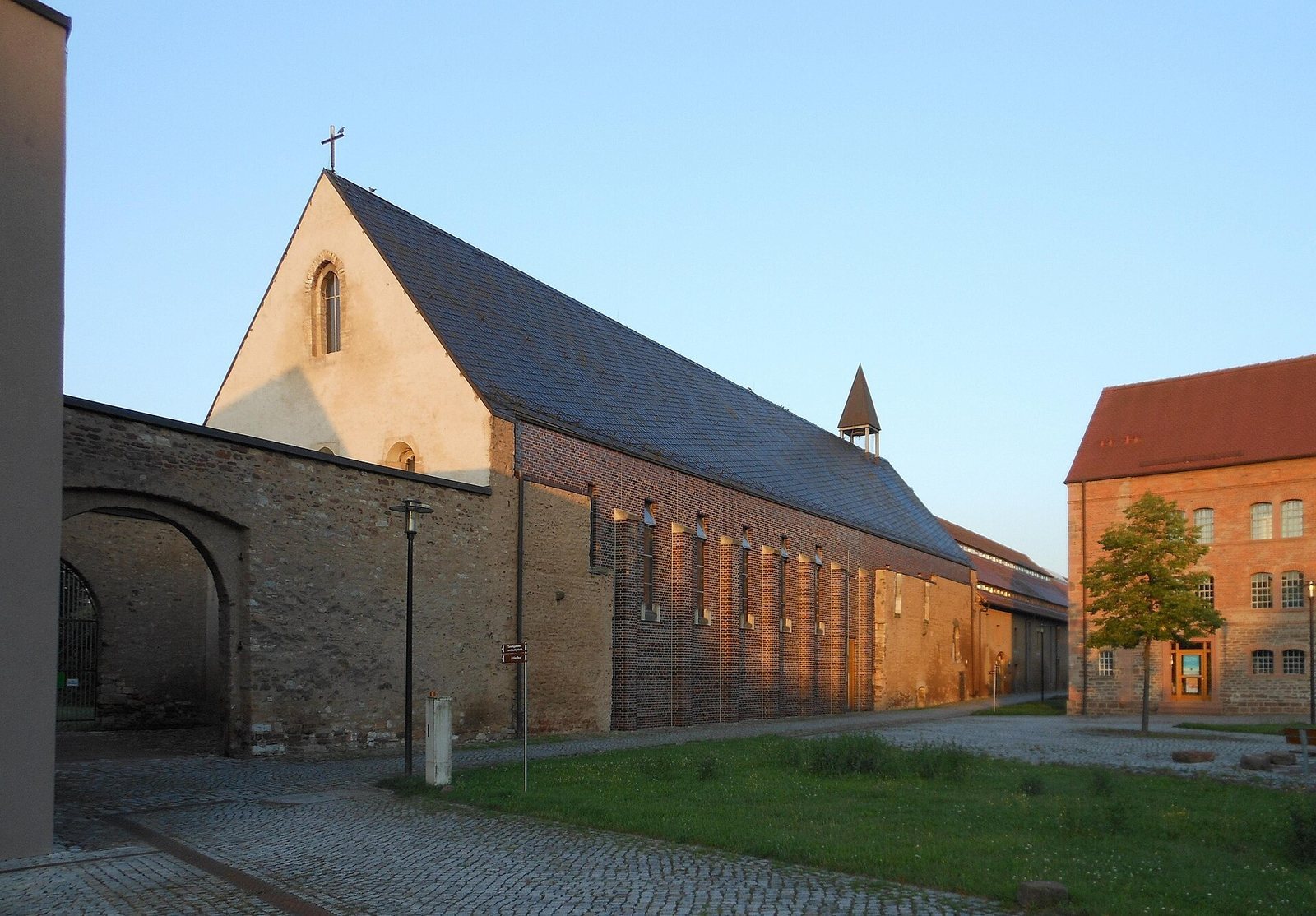
The original church was rectangular and had a single nave. Its surviving fabric includes the east wall, where three round-arched windows form an elongated group, portions of the north and south walls, and the western gallery used by the nuns. These remains belong to the early Gothic church built in the second half of the thirteenth century.
Reconstructed buildings
Church and cloister
The reconstructed Church of St. Mary, convent house, and cloister bring together historic fabric and modern architecture. Their arrangement preserves the church and cloister areas as central parts of the renewed monastery.
Associated buildings
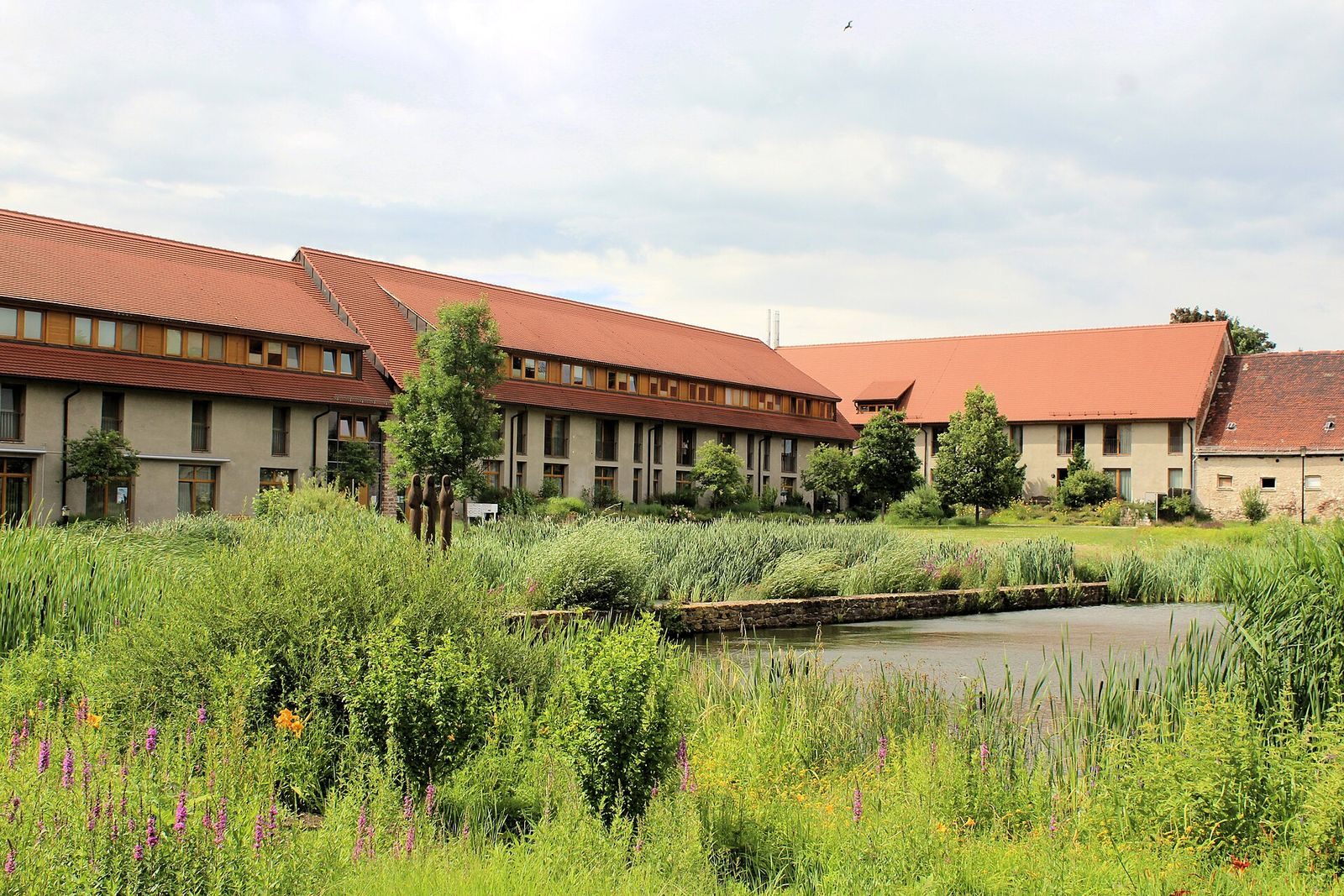
The complex also includes an educational and retreat house, St. Gertrude House, a manor house, and Liborius House, which occupies an old granary. St. Mechthild care home is run by Caritas, and the grounds include the Gertrude Chapel.
Features of the grounds
The Living Labyrinth, laid out by the Catholic Women’s Association of Germany and opened in 2007, occupies open ground behind the monastery. At its center is a sheltering willow figure, representing divine mercy and the womb of God as a place of life. A tree monument to German reunification was planted at the monastery in 2014. The intended pine, meant to represent eastern Germany, was replaced by a linden.
Memorial and seals
Founders’ grave slab
The founders’ grave slab was moved among the monastery’s different locations and is now preserved in St. Andrew’s Church in Eisleben.
Monastic seals
An oval convent seal depicts the Annunciation, with the angel Gabriel and Mary beneath a double-arched canopy. Its inscription reads S. SCE. MARIE VIRGINIS IN HELPEDE. A seal of Abbess Sophie, dated 1311, shows a praying woman beneath the Resurrection of Christ. A damaged seal belonging to Abbess Lukardis and a seal of Provost Johannes are attached to a document dated 9 September 1346. The surviving inscriptions read ABBATISSE … RD HELPED and (S)IGILLUM PREPOSITI IN HELPE.