Capponi Chapel: A Renaissance Family Chapel in Florence
Site at a Glance
- Popularity
- Medium
- Country
- Italy
- Primary era
- Medieval
- Eras represented
- Medieval, Early Modern
- Civilizations
- Grand Duchy of Tuscany, Republic of Florence
- Site type
- Religious
- Remains
- Chapel
On this page15 sections
History
The Capponi Chapel is a Roman Catholic family chapel within Santa Felicita in Florence, Italy. Filippo Brunelleschi designed it around 1420 for Bartolomeo Barbadori, during the early Renaissance. After Brunelleschi’s Ridolfi Chapel at San Jacopo sopr’Arno was destroyed, the Capponi Chapel became his oldest surviving chapel of this type.
From Barbadori to the Capponi family
Originally called the Barbadori Chapel, it was dedicated to the Virgin and was probably intended to honor an Annunciation fresco on the church’s interior wall opposite the main entrance. The chapel changed hands in 1487, when it was sold to Antonio Paganelli. On 22 May 1525, Bernardo Paganelli transferred it to the Capponi family, especially Lodovico di Gino Capponi, who planned to use it as the burial place for himself and his relatives. A document dated 1 July that year records his arrangements for sacred furnishings and five Masses each week.
Pontormo’s decoration
Lodovico rededicated the chapel to the Pietà, an image of Mary mourning Christ after his death, and commissioned Jacopo Pontormo to restore and decorate it. The young Agnolo Bronzino assisted, and the work was complete by 1528. Pontormo asked that a covering shield the paintings from view until they were ready; their eventual unveiling astonished people in Florence.
The reason for choosing Pontormo is uncertain. Lodovico may have been responding to his artistic ability, his sympathy with ideas for reforming the Church, or both. Rather than concentrating on the life of the family patron, the decoration places Christ at its center, an unusual emphasis for a side chapel. Its funerary purpose also shaped an interpretation of the paintings as a reflection on the soul’s resurrection: Christ’s death is linked to the hope of rising again, witnessed by the Evangelists.
Alterations and restoration
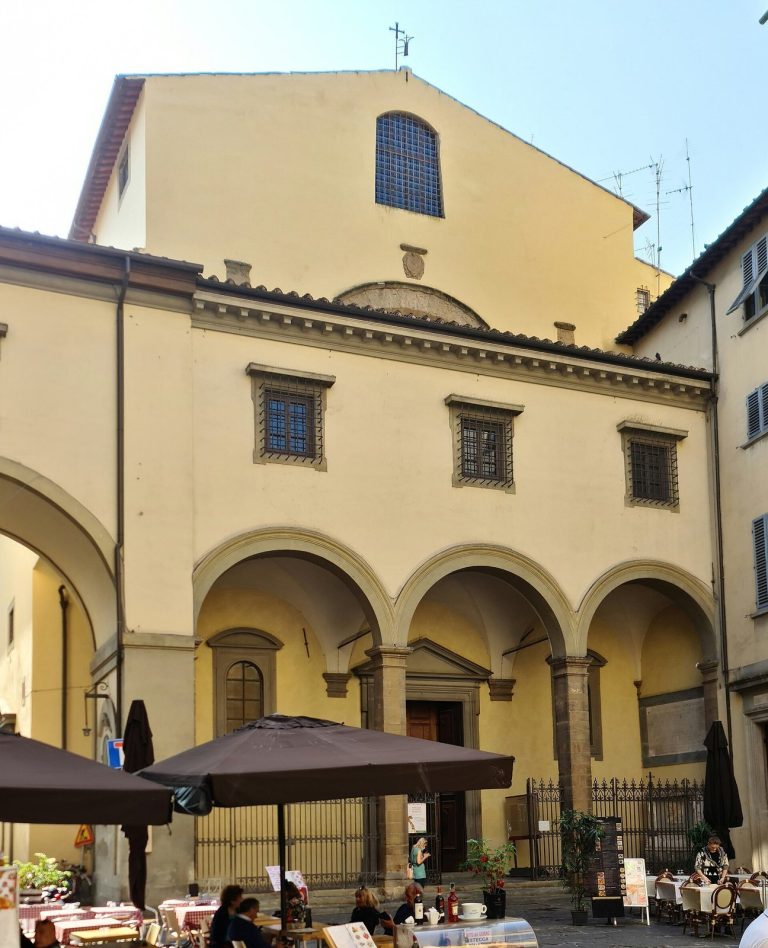
In the early seventeenth century, Orazio Capponi, bishop of Carpentras, added a reliquary monument to Saint Charles Borromeo between the figures in the Annunciation. Ferrante Capponi commissioned further work in 1722, including a new altar and an iron enclosure. From 1735, rebuilding of Santa Felicita under architect Ferdinando Ruggieri also brought changes to the chapel’s exterior.
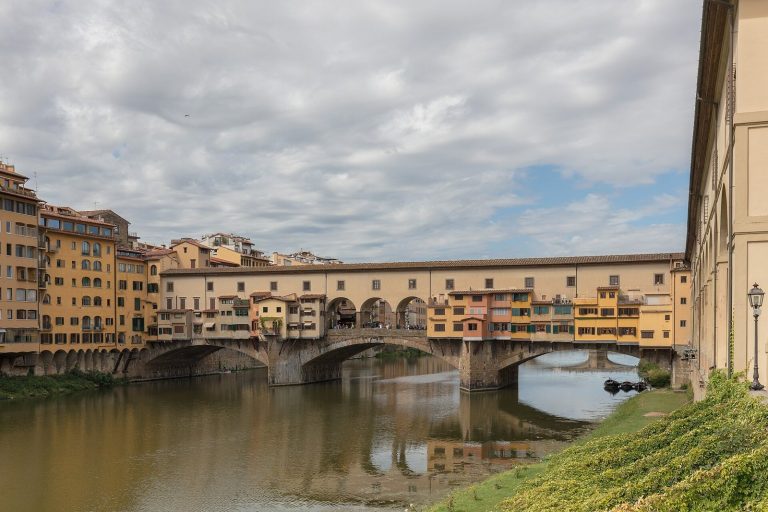
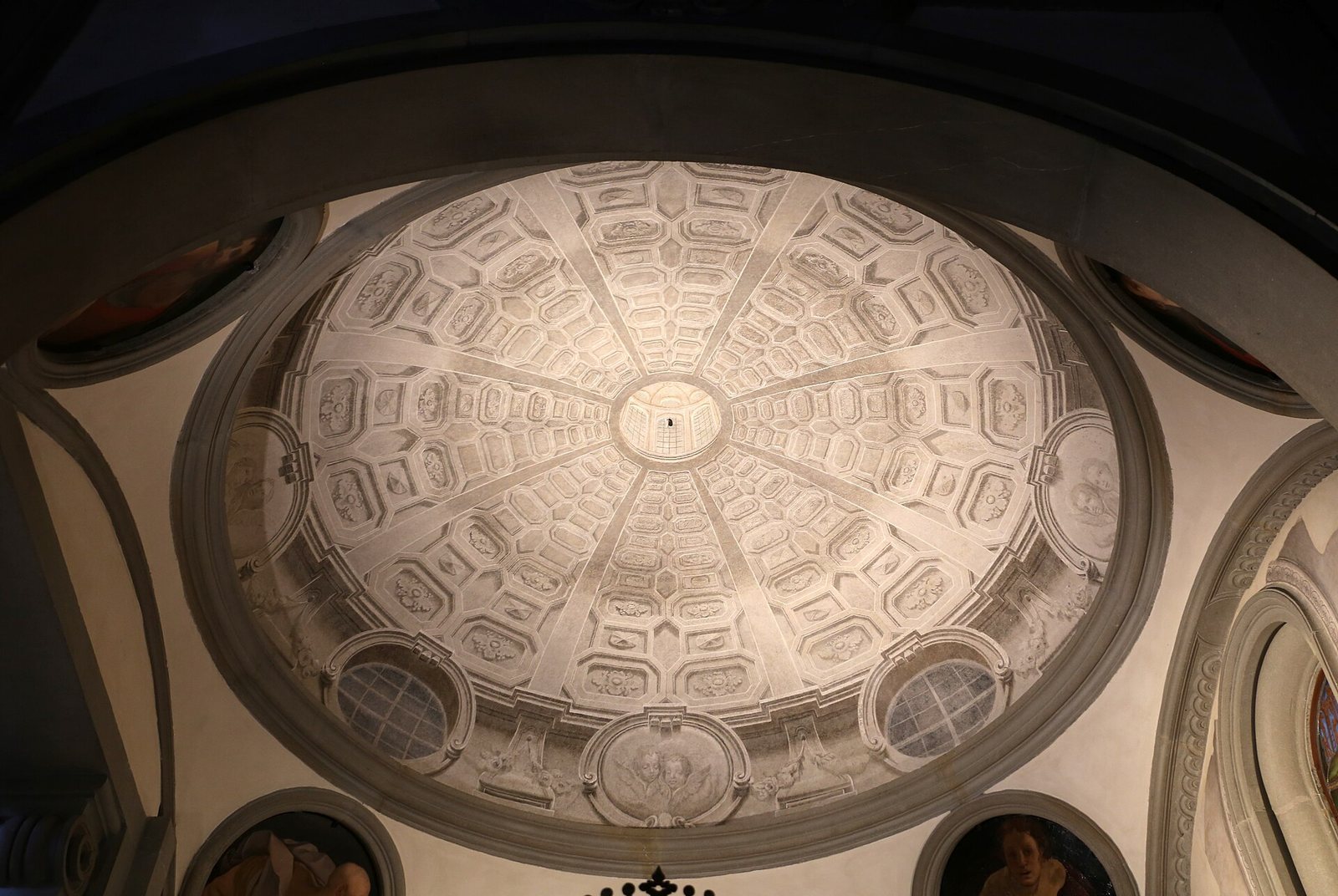
In 1765–67, the chapel’s vault was demolished and rebuilt to make a viewing gallery for a prince above the nave, along the Vasari Corridor, an elevated passage between two Florentine palaces. The work removed Brunelleschi’s original dome and Pontormo’s ceiling fresco. The fresco may have been intentionally destroyed because its image of God the Father was considered unacceptable under later Counter-Reformation standards, the Catholic Church’s response to Protestant reform. Construction damaged other frescoes, which Domenico Stagi later restored. Work completed in 2018 revealed the chapel’s interior dome decoration, attributed to Stagi and dated to about 1770.
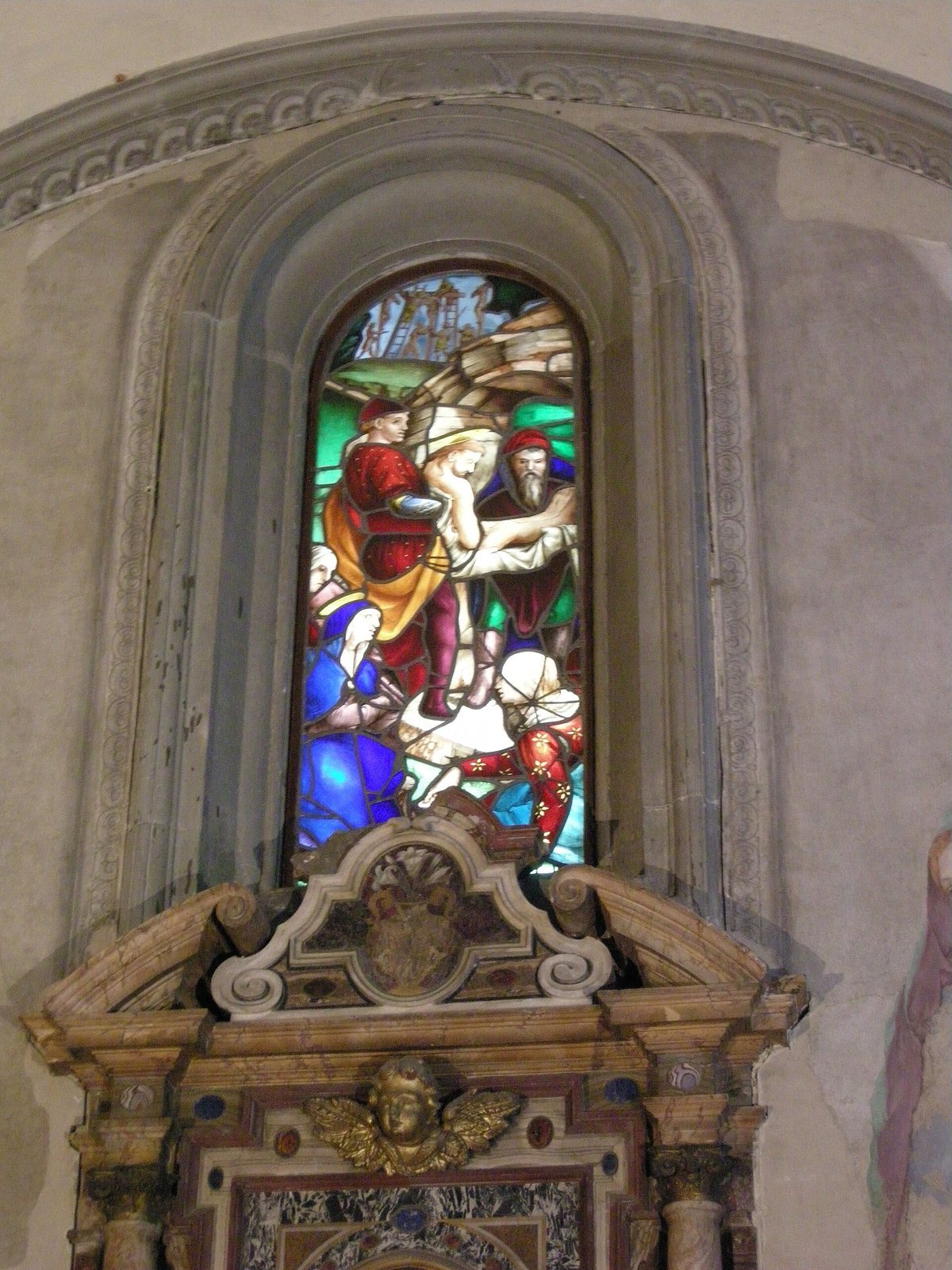
During the Second World War, the original stained-glass window was taken down to protect it from possible damage and kept at Palazzo Capponi alle Rovinate. A replacement made by the Polloni glassworks in 1997 was put in its place.
Remains
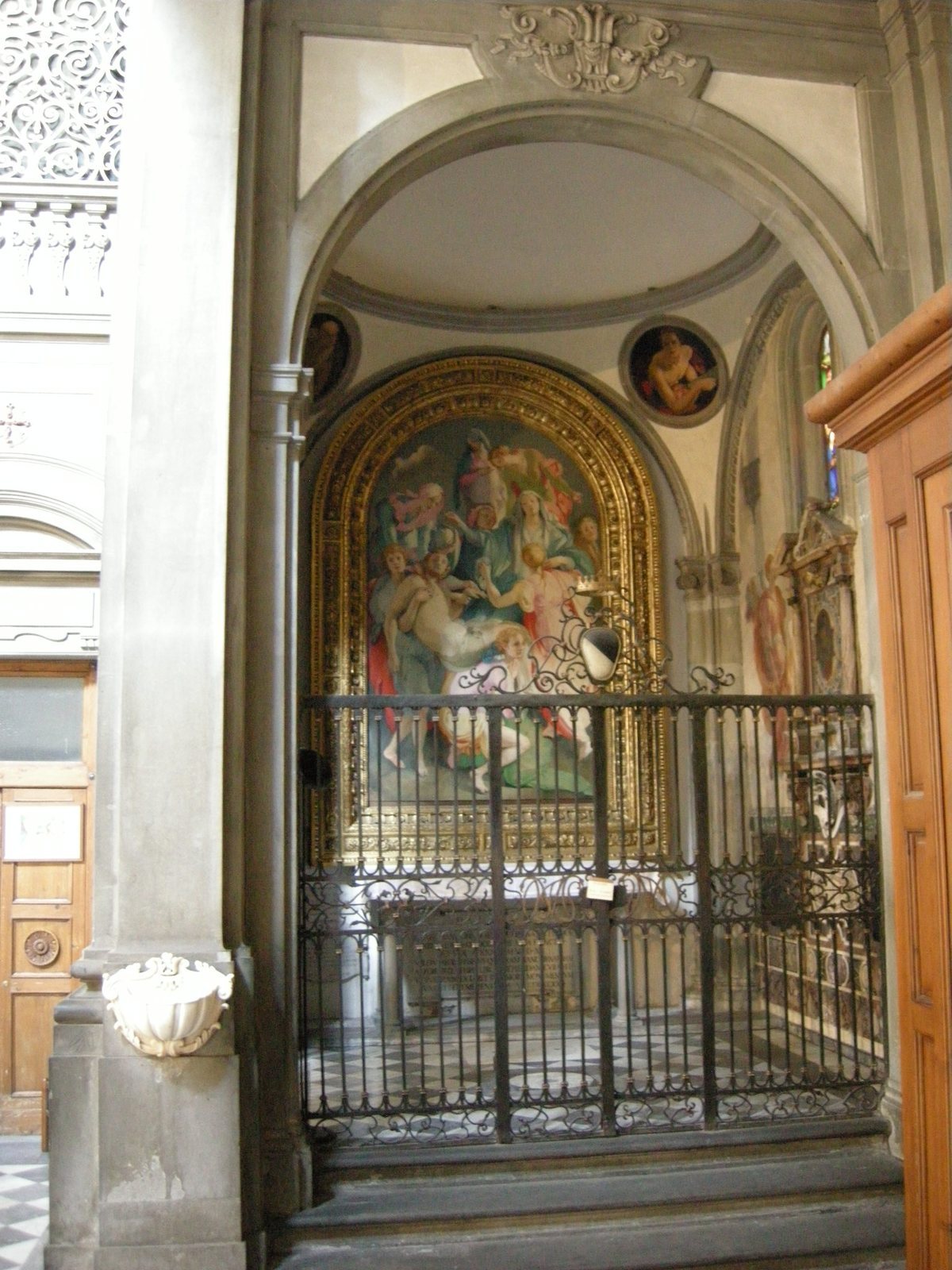
The chapel occupies the southwest corner of Santa Felicita’s nave, immediately to the right of the main entrance. Its Renaissance interior is built of limestone and combines a rectangular plan with a cubic sense of space. The paintings, altar furnishings, and dome decoration belong to different phases of its history.
Architecture
Plan and dome
The chamber’s original hemispherical dome rested on four pendentives, curved triangular surfaces that carry a dome above a rectangular room. Round arches span the walls beneath them, and each pendentive contains a circular recess now occupied by a painting of an Evangelist. The current dome may be lower than the original. Its surface carries nearly monochrome painted architecture designed to create an illusion of three-dimensional form.
Corner supports
Paired Ionic half-columns, a classical column form, occupy the corners where Gothic flat wall supports were customary. On their outer sides, they rest on Corinthian corner supports, another classical form. This arrangement isolates a structural bay also used in the portico of Florence’s Spedale degli Innocenti, or Foundling Hospital. Brunelleschi later adapted the scheme, with small changes, in the Old Sacristy and the Pazzi Chapel. The chapel’s original appearance has also been compared with the illusionistic architecture in Masaccio’s fresco Trinity.
Pontormo’s paintings
Deposition
Pontormo’s oil painting on panel, known as the Deposition or the Transport of Christ to the Tomb, measures about 313 by 192 centimetres. Its rounded top fits the arch above the high altar, and it remains in its original sixteenth-century frame. In the foreground, two angels carry Christ. Mary and six grieving women appear behind them, while a figure at the rear right has been identified as a self-portrait of Pontormo.
The scene brings together Christ’s removal from the Cross, the women’s grief, and his burial. There is no explicit setting; an open space among the figures suggests the tomb. Their intertwined poses seem suspended, while elongated bodies and striking pink and blue hues heighten the emotional force. Mary’s partly open eyes and mouth convey distress, and her extended arms recall the Cross. The colors have been interpreted as suggesting passage from earthly life to the next and Christ’s transition from man to Son of God. The sharp outlines defining figures, clothing, hair, and muscles also recall features of Michelangelo’s earlier work.
Annunciation
The west wall bears Pontormo’s fresco of the Annunciation, measuring 168 by 368 centimetres. A window separates the angel from Mary. The angel’s billowing garments and Mary’s turning movement animate the scene, while her face expresses surprise.
Evangelists
Four fresco roundels, each about 70 centimetres across, portray the Evangelists in the pendentives. Their precise division between Pontormo and Bronzino remains uncertain: John is attributed to Pontormo, Mark probably to Pontormo or Bronzino, Luke to Bronzino, and Matthew probably to Bronzino. Books, writing tools, and other identifying attributes accompany the figures, who vary in age, gesture, and direction of gaze. Matthew appears as a beardless youth with an angel, looking outward; Mark is bearded and turns his head; Luke is a mature, beardless man with a bull behind him and his gaze raised; John is old, long-bearded, and bends forward in profile. Their gazes may originally have been directed toward four patriarchs painted on the dome. The roundels are no longer in their original positions.
Window and altar furnishings
Stained glass
Above the tabernacle, toward the church façade, is a copy of a stained-glass window made by Guillaume de Marcillat in 1526. Christ is carried to the tomb between the Virgin and Mary Magdalene, with a monochrome scene of the Deposition from the Cross behind them. The window has been interpreted as showing events immediately before and after those in the altarpiece. The Annunciation figures on the same wall also turn toward it. The angel has been read as a radiant revelation of God, while Mary’s gesture suggests both her son’s coming fate and her confidence in his resurrection.
Tabernacle and other furnishings
A small tabernacle of colored marble beneath the window contains a portrait of Saint Charles Borromeo whose maker is unknown. Jacopo Barozzi da Vignola designed the tabernacle, and two inscriptions in black marble beside it commemorate the chapel’s foundation. The iron enclosure installed in 1722 bears the Capponi family arms. A circular painting, or tondo, of Pontormo’s Madonna and Child, once set at the center of the altar frontal, is now in the private chapel at Palazzo Capponi alle Rovinate; it may have been moved during the alterations of 1722.