Saint-Vivant de Vergy Monastery: A Burgundian Abbey and Vineyard Estate
Site at a Glance
- Rating
- 5
- Popularity
- Very Low
- Country
- France
- Primary era
- Early Modern
- Eras represented
- Early Modern
- Civilizations
- French
- Site type
- Religious
- Remains
- Monastery
On this page10 sections
History
Saint-Vivant de Vergy Monastery was an abbey in Burgundy, France, founded by the Vergy family shortly before 920. Manassès I the Elder and Wallon, bishop of Autun, are both named among its founders. Dedicated to Saint Vivant, a saint from the Vendée, it became an important Burgundian house and later joined the network of Cluny, a major Benedictine monastery with dependent communities.
Foundation and monastic affiliations
One proposed explanation for the foundation connects it with the tomb of Guérin of Vergy, believed to lie beneath the abbey church. Guérin, the first known lord of Vergy, was said to have been stoned to death on the mountain in 674 at the instigation of Ebroin, a powerful official in Neustria. His brother, Saint Leger, was also killed in the same political conflict. The suggestion that a religious community already occupied the site before the abbey was established has also been raised, but does not explain why this steep, confined location was chosen.
Around 1000, Saint-Vivant became attached to Saint-Bénigne Abbey in Dijon, a Benedictine house, during the period of reform associated with William of Volpiano. In 1087 it became an indirect dependency of Cluny. A charter of 1036 records Gauthier, bishop of Chalon, ceding Saint-Vivant to Cluny under a special right associated with the abbey. Its ecclesiastical connections extended across the dioceses of Autun, Chalon, and Mâcon.
Saint-Vivant was a double monastery, meaning it comprised communities of monks and nuns. Its superiors were known as priors or deans, and it operated as a deanery, an administrative unit overseeing dependent priories, within the Diocese of Autun. The community numbered about thirty monks between 1136 and 1262. It was regarded as one of Burgundy’s oldest and wealthiest monastic houses and was an important member of the Cluniac order. A paréage, an agreement for sharing rights or authority, also linked the abbey with King Louis VI of France.
Land, vineyards, and dependent houses
The abbey’s estates grew through grants and exchanges. In 1131, Duke Hugh II of Burgundy gave it uncultivated land, woodland, and fields at Flagey and Vosne. In 1232, Alix of Vergy, Duchess of Burgundy, donated her best vineyard, then called the Cloux des cinq journaux. A journal was a historical land-area measure of about 3.4 ares. The abbey also acquired property at Vosne in exchange for land on the southern part of Mount Vergy.
Saint-Vivant controlled much of the vineyard land at Vosne-Romanée, including holdings associated with the later Romanée-Conti and Romanée-Saint-Vivant vineyards. The monks exploited these wine lands for nearly 650 years. By the late fifteenth century, they distinguished wines from vines they cultivated directly and kept for themselves from wine received as rent or as tithes. They blended their own produce together, grouped rent wines by parish, and did not necessarily receive tithe wines from a single parish. The estate also included property at Arcenant and in the nearby village of Saint-Vivant.
Several priories depended on the abbey, including the large house at Amaous, whose estate extended to the Saône and included woodland, farmland, vineyards, mills, jurisdictional rights, payments, and required labor. In the seventeenth century, Jesuits, members of the Society of Jesus, sought Amaous for their college at Dole. The dispute led to the sequestration of its revenues. Saint-Vivant had to repair the buildings and send two monks to live there before the sequestration was lifted.
In an exchange approved through several stages between 1611 and 1617, Saint-Vivant surrendered the priories of Amaous and Voisey and received the temporal holdings of Losne. Royal letters and the abbot of Cluny approved the arrangement in 1611; it was presented to the Roman court in 1614, with papal and parliamentary procedures completed in 1616–17. Saint-Vivant also held smaller priories at Charrey, Trouhans, and Saules. Losne had been ceded to Cluny in 1136 under a special right associated with Saint-Vivant. Between 1299 and 1324, its dean lost rights there after visitors found that the house had failed in hospitality and almsgiving, and its conventual buildings were demolished.
The Détain estate passed to Cîteaux in 1164 and returned to Saint-Vivant in 1452 after Cîteaux could not pay for it. During the Hundred Years’ War, a series of conflicts between England and France from 1337 to 1453, a lay brother and two tenant families occupied the estate. Settlers from Lorraine arrived with the monks’ permission in 1610. Saint-Vivant also established the women’s abbey of Lieu-Dieu-des-Champs in the twelfth century; it later affiliated with Cîteaux, the Burgundian monastery that gave its name to the Cistercian order, between the late twelfth and second quarter of the thirteenth century. Alix of Vergy was closely attached to Lieu-Dieu and often retired there. Saint-Vivant also held the parish of Saint-Symphorien-sur-Saône.
Rebuilding and dissolution
The community had dwindled to four monks by 1678, but later rose to seven and then nine. That number persuaded the Clergy Assembly of 1761 to leave the establishment open. In 1762, proposals were made to repair or replace the monastery. One scheme would have moved the buildings, another would have adjusted the levels of the monastic building and church, and a separate proposal envisioned a château in the Louis XVI style. A more modest design was chosen, and plans were prepared in 1765.
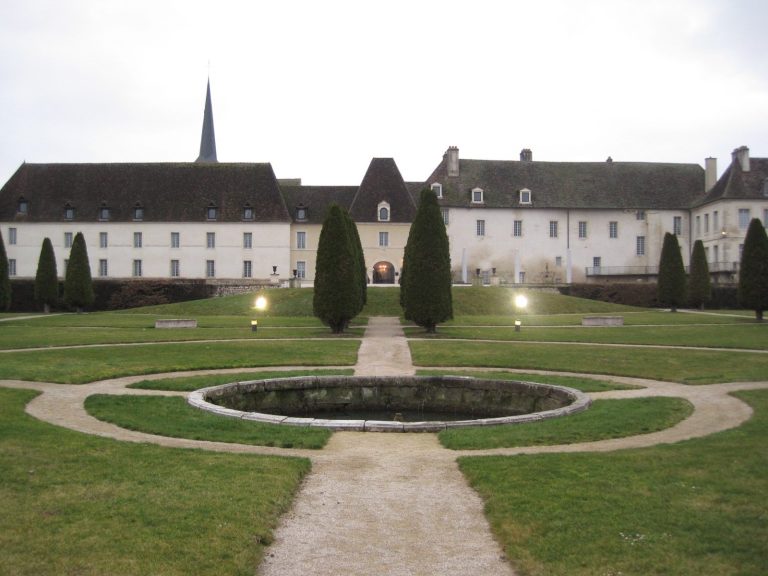
Demolition and rebuilding began in 1766, encompassing the abbey church and cellars. The works were complete by the community’s dissolution in 1788, although the surrounding grounds remained unfinished. Cluniac houses were secularized in 1789, ending their monastic administration. By then, the claustral prior Dom Jean-Baptiste Trémolet and monks Denis Marillet and François Admirai appear to have been the only religious remaining. They were expelled from their apartments in July 1790.
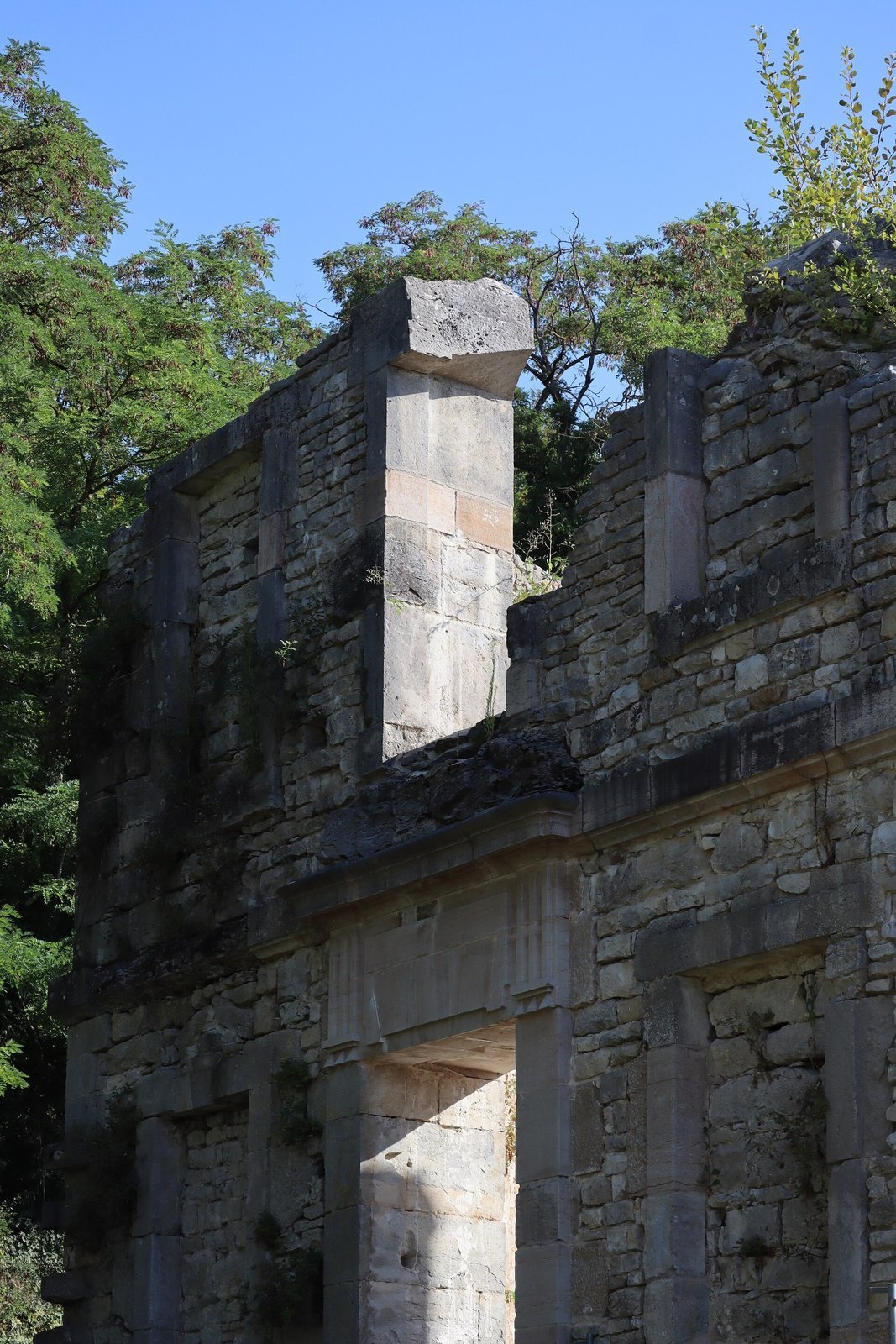
During the French Revolution, the monastery became national property. Ironmaster Antoine Mollerat purchased it in 1796 and demolished almost all the buildings, sparing the priory church. The roof frame was reused on one of his buildings at Pellerey, and the entrance grille was taken to the château of Villars-Fontaine.
Decline and conservation
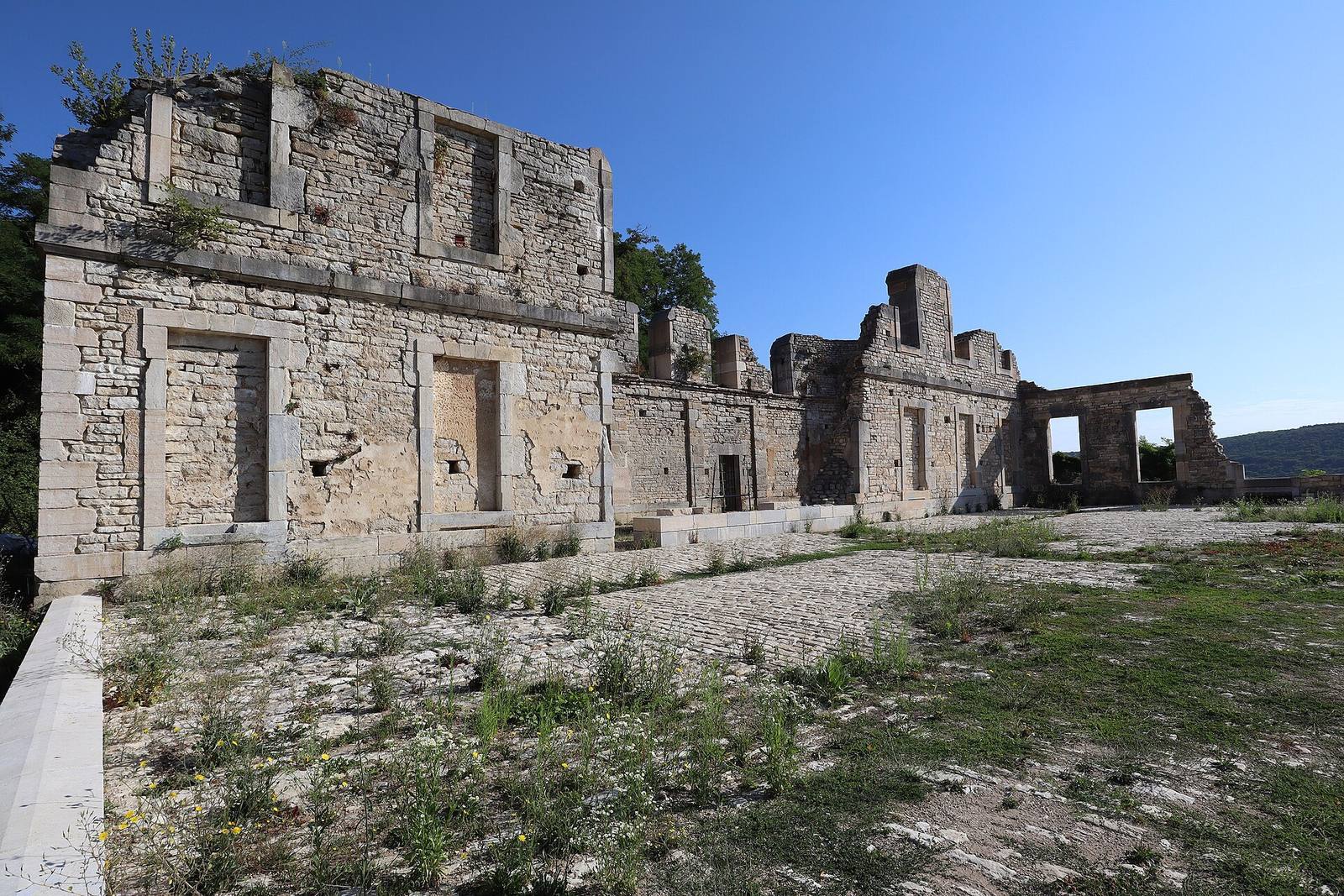
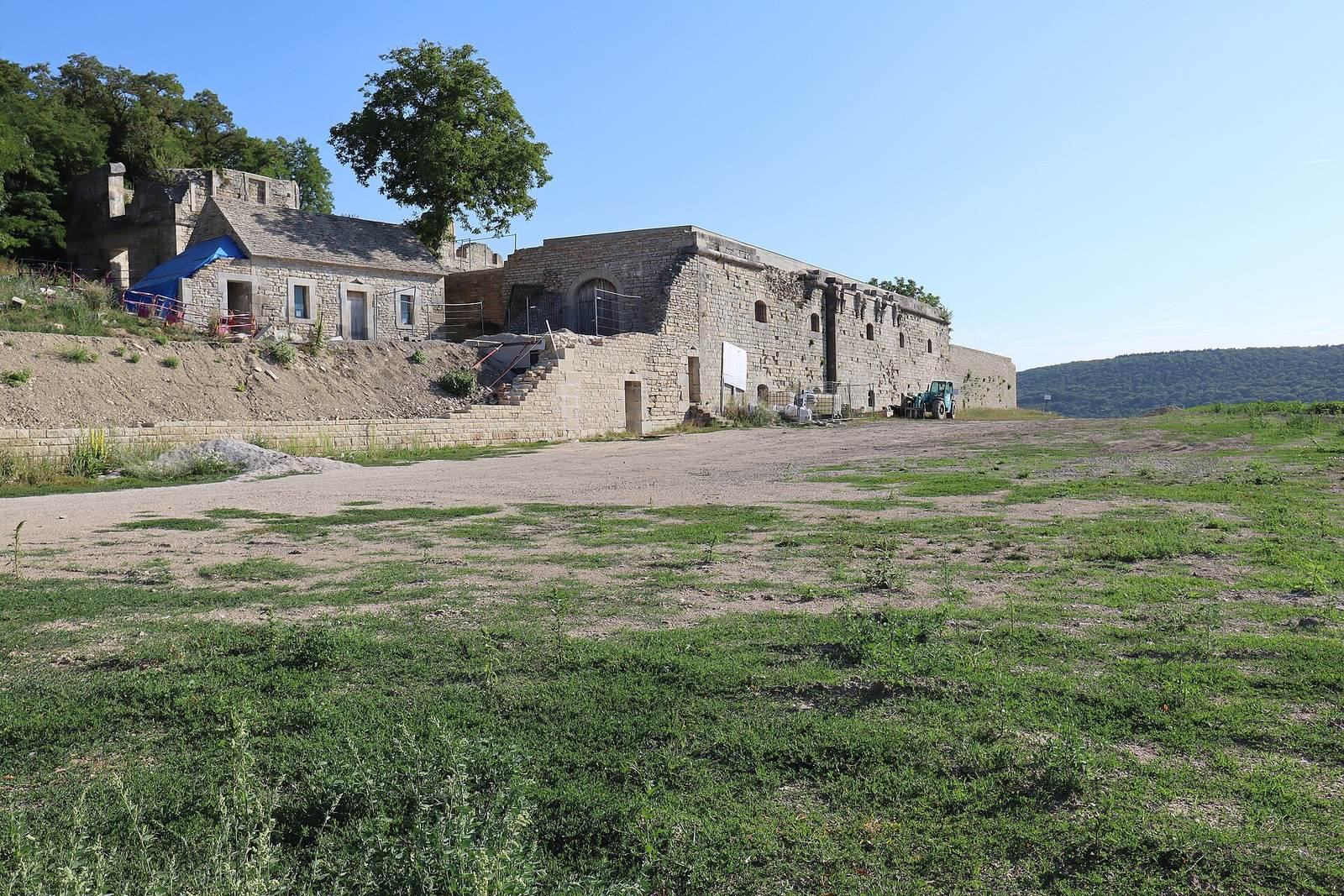
During the nineteenth century, the abandoned buildings deteriorated, became overgrown, and were quarried for stone. Félix Maret bought the remains in 1828 and sold them to an architect in 1854. The abbey buildings were listed as historic monuments in 1992. A French agricultural land-holding body acquired the ruins in 1996, and an association formed in 1999 to preserve and consolidate them. Restoration began in 2001, using plans prepared in 1775.
The abbey’s former vineyard plots at Romanée now form part of The Climats, terroirs of Burgundy, inscribed on the UNESCO World Heritage List in 2015. In Burgundian wine terminology, a climat is a named, bounded vineyard parcel associated with a particular terroir. In 1958, a few days after John XXIII was elected pope, a lead seal from a papal bull belonging to John XXII, pope from 1316 to 1334, was found on Mount Vergy.
Remains
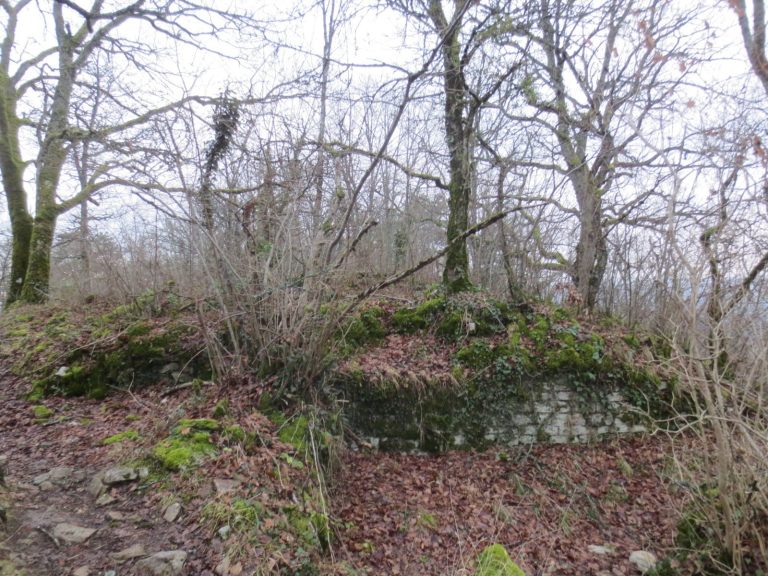
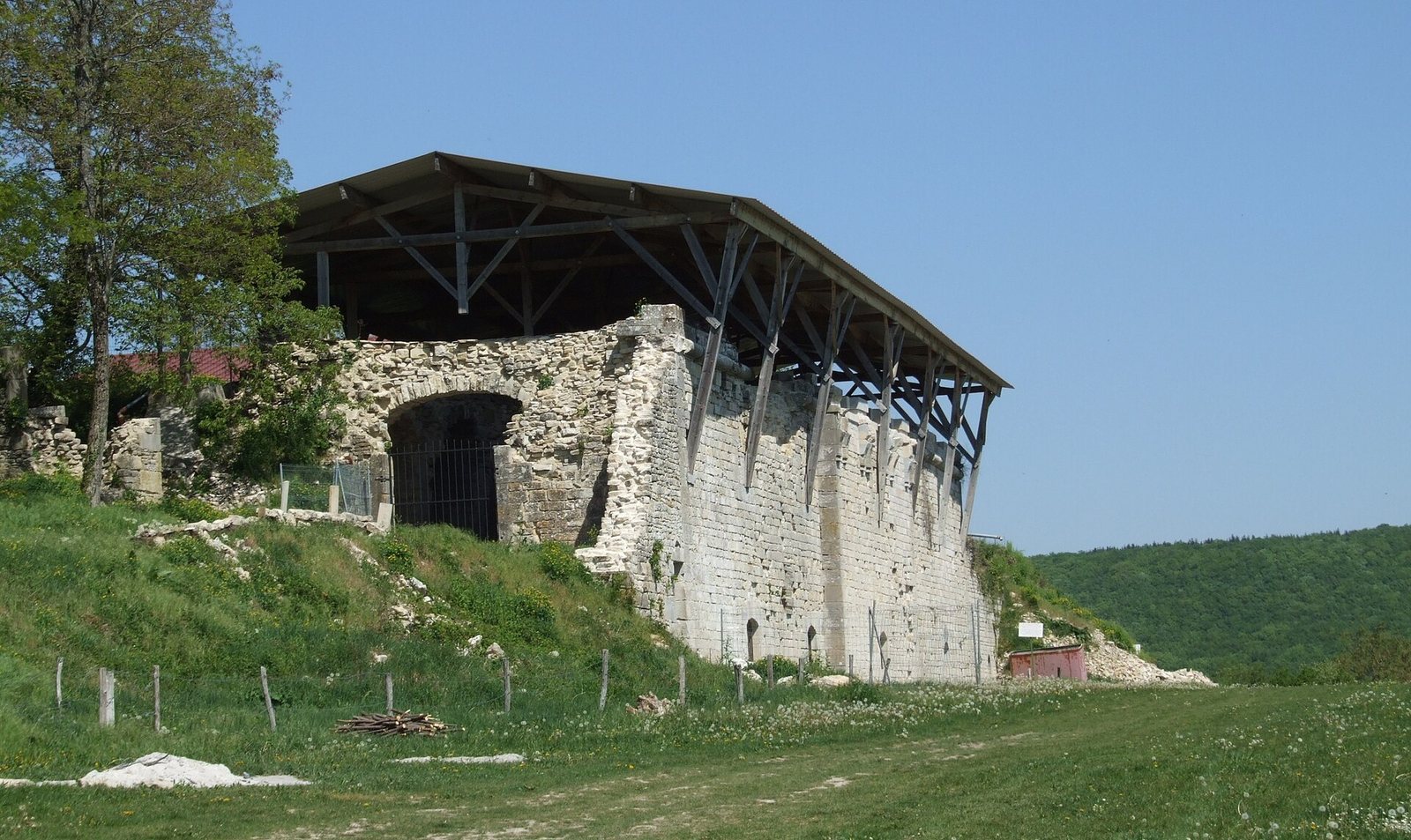
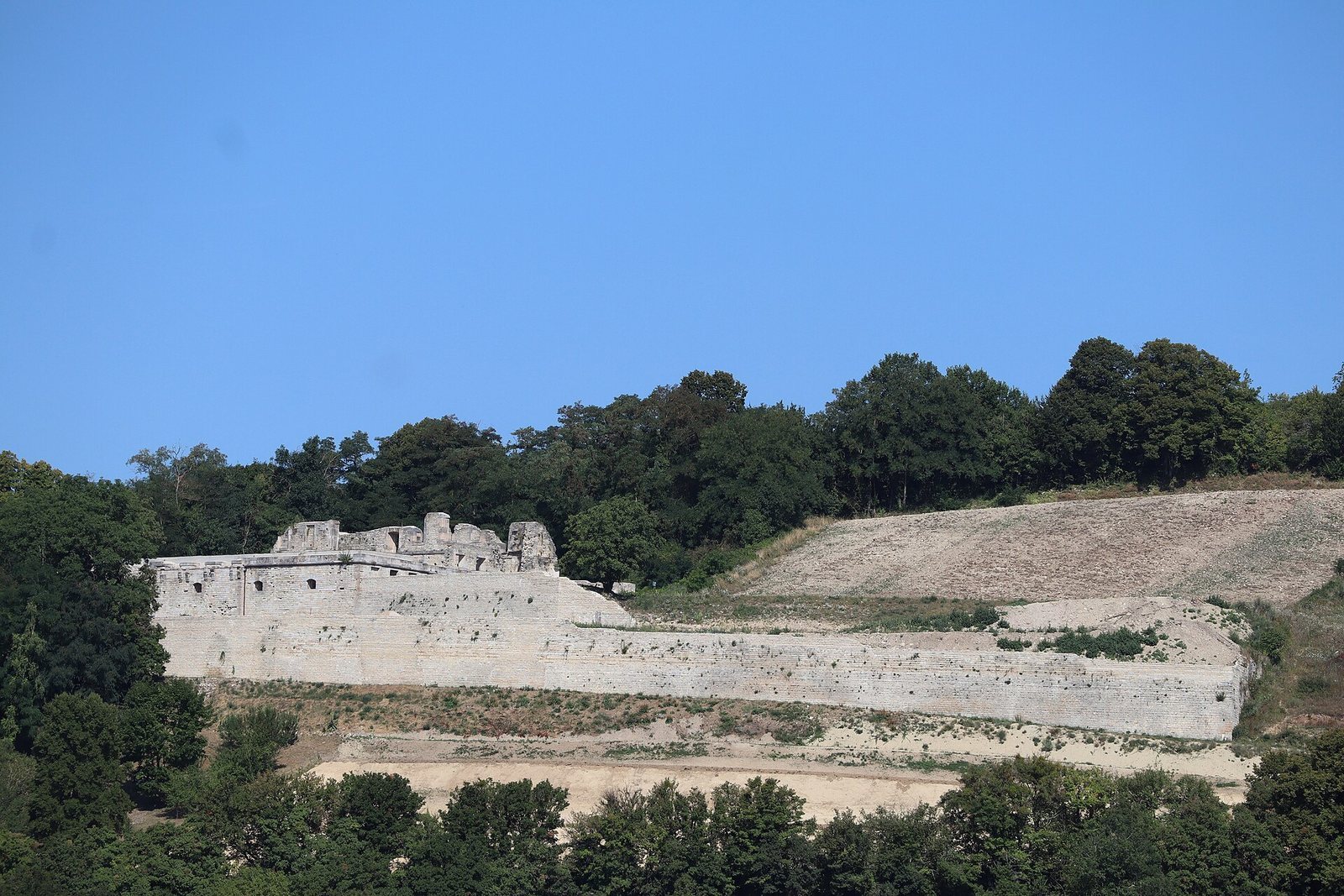
The monastery stood on a steep, cramped terrace of loose slope debris below the southern side of the rocky spur occupied by Vergy Castle. A few hundred metres to the west, flatter ground near the Reclus spring later became the village of Saint-Vivant. The abbey grounds included an enclosed pleasure garden on the southern part of Mount Vergy, while its wider vineyard estate had harvest buildings at Vosne-Romanée.
Monastic buildings
Priory church
The priory church was the monastic building spared during the demolition of 1796. It formed part of the reconstruction begun in 1766.
Cellars and south wing
The eighteenth-century cellars lay on two levels beneath the new south wing. Their ceilings were made with intersecting barrel-shaped vaults. They were the principal structures from the reconstruction to survive into the modern period. During restoration, a full wine bottle was found concealed beneath a cellar slab. Radiocarbon dating placed it either at about 1772 or sometime between 1810 and 1860; it was tasted in 2011.
Garden and vineyard buildings
The enclosed pleasure garden occupied the southern part of Mount Vergy. Among the estate’s harvest buildings at Vosne-Romanée was a harvest lodge associated with the Romanée-Conti estate.