Vöslau Castle: From Moated Fortress to Municipal Town Hall
Site at a Glance
- Popularity
- Medium
- Country
- Austria
- Primary era
- Early Modern
- Eras represented
- Medieval, Early Modern
- Civilizations
- Habsburg, Habsburg Austria, Holy Roman Empire
- Site type
- Domestic
- Remains
- Castle
On this page11 sections
History
Vöslau Castle is a former moated fortress and later palace in Austria. It was built in the early twelfth century and first appears in a known document in 1136. Its earliest named owners were the noblemen of Veselove.
Medieval fortress and religious change
The Pollen family, prominent citizens active in municipal government, lost the property after joining a revolt against Frederick the Fair, a Habsburg ruler who also claimed the German throne. The Hailpechen family then owned the castle. Later owners included Georg Theschütz, Hans Zinzendorf, Hans Paul Bayr, and Carl Ludwig, Count von Hofkirchen.
In 1483, troops of Matthias Corvinus, king of Hungary and Croatia, devastated the castle. It became freehold property in 1502 and belonged to the Sinzendorf family in the second half of the sixteenth century. During the Reformation, the movement that divided Western Christianity and established Protestant churches, the castle chapel served as a spiritual center for the surrounding area. Vöslau returned to Catholicism in the seventeenth century, but the castle remained connected with the Protestant parish of Gainfarn until 1870.
Transformation into a palace
By the Ottoman siege of 1683, part of the Ottoman-Habsburg conflicts in the region, the castle was too dilapidated to provide refuge. It was later converted into a palace, incorporating older parts of the building. Under its new owner, August von Wöber, it was enlarged and remodeled in the Baroque style between 1740 and 1753. The architect may have been Franz Anton Pilgram.
Imperial Count Johann von Fries acquired the property in 1761. Architect Johann Ferdinand Hetzendorf von Hohenberg carried out further work for the family. The Fries family held the castle, with interruptions, from 1773 to 1887.
Nineteenth-century ownership and spa development
After the Fries family went bankrupt in 1826, Baron Georg Simon von Sina bought the castle from the estate. Sina later sold it to Johann Heinrich von Geymüller, who founded the Vöslau worsted mill in 1833. Geymüller also went bankrupt, a failure attributed to his lavish lifestyle. The castle returned to the Fries family in 1837 and passed to Count Moritz II von Fries. As Bad Vöslau developed as a spa town from the first half of the nineteenth century, the castle became part of that development.
War, restitution, and municipal use
The estate and castle passed to Moritz von Gutmann in 1901. During the Nazi regime, the property was forcibly transferred to non-Jewish ownership, and the municipality became its owner. The property was returned in 1947. During the Second World War, the building was used in part as a hospital; Soviet occupation forces later left it severely damaged. The municipality acquired the castle definitively in 1951. Following restoration and reconstruction, it became the town hall in 1974.
Remains
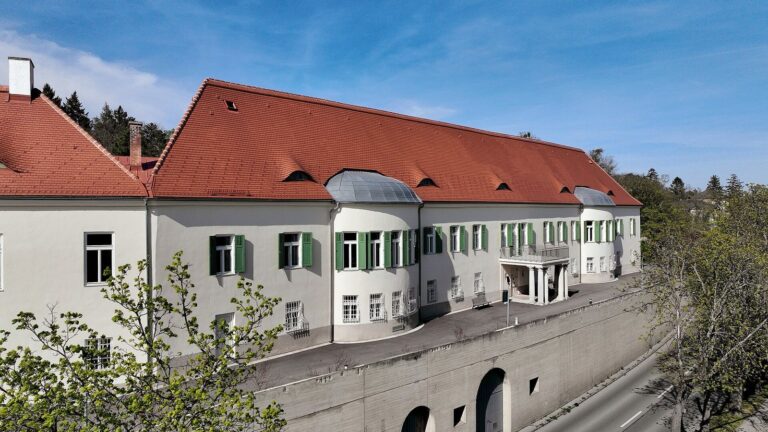
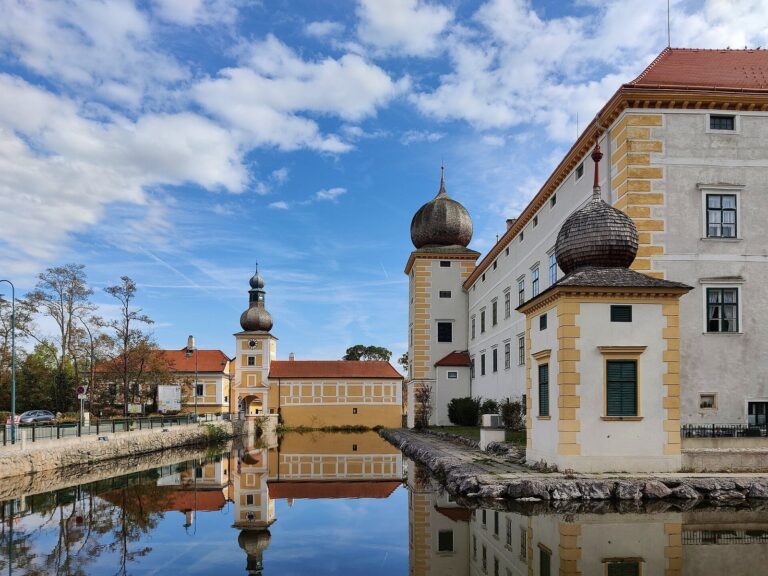
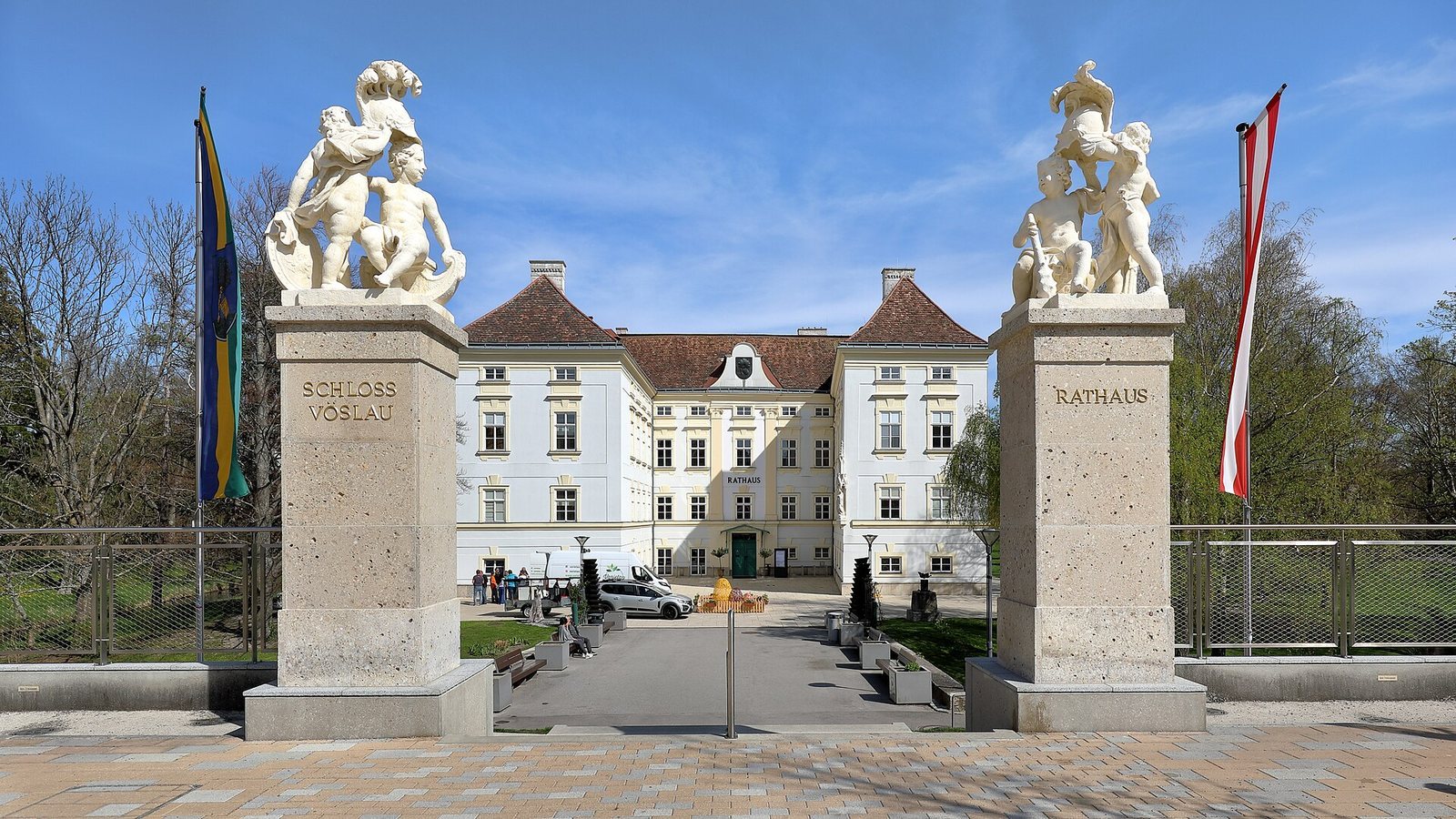
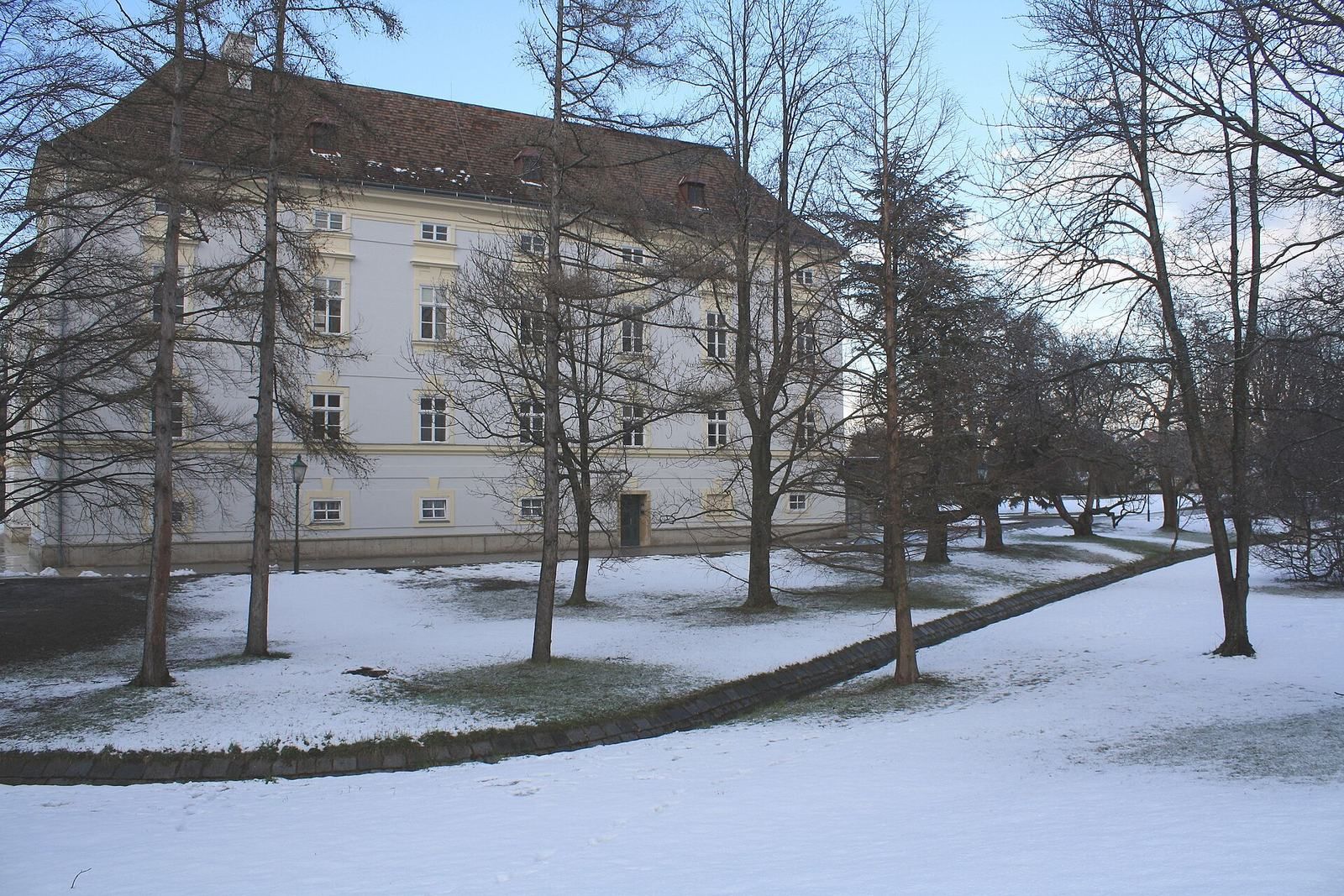
The castle stands in a green area within the town. Its main façade faces a water-filled moat, and two projecting wings enclose a small entrance courtyard. The grounds retain channels left from the former moat system.
Castle and interiors
Rear extension and halls
A two-storey extension with a polygonal plan stands at the rear, over the former chapel’s location, and contains a meeting room. Inside the castle, a large hall extends across two floors, while a smaller hall retains notable early Neoclassical wall panelling. Some eighteenth-century wall decorations were recovered during restoration.
Park and sculpture
Landscape features
Architect Johann Ferdinand Hetzendorf von Hohenberg created artificial hills and grottoes in the park. The small channels in the grounds also preserve traces of the earlier moat system.
Gate figures and stone vases
Groups of putti, childlike decorative figures, stand at the garden gate alongside four stone vases. These ornaments came from Vienna’s Palais Pallavicini. Sculptor Franz Anton von Zauner made the vases in 1783–1784; they represent Asia, Africa, America, and Europe.