Leerort: A Late-Medieval River Fortress in East Frisia
Site at a Glance
- Popularity
- Medium
- Country
- Germany
- Primary era
- Early Modern
- Eras represented
- Early Modern
- Civilizations
- Holy Roman Empire
- Site type
- Military
- Remains
- Castle
On this page10 sections
History
Leerort was a late-medieval river fortress at the confluence of the Leda and Ems rivers, about 3 km southwest of Leer in Germany. Hamburg merchants of the Hanseatic League, an association of northern European trading towns and merchants, established it to protect shipping. It became an important stronghold in East Frisian political and military history, serving first Hamburg’s interests and later the region’s rulers.
Origins and Hamburg occupation
The fortress arose in a period when local chieftains divided power in East Frisia. The Hanseatic League was also concerned about the Vitalienbrüder, seaborne raiders and privateers expelled from Gotland in 1398 by the Teutonic Order, a medieval Catholic military order. Some East Frisian rulers gave them refuge. In response, the Hanseatic towns organized punitive expeditions, and Hamburg forces occupied parts of East Frisia, including Emden.
An older reconstruction dates Leerort’s beginning to about 1435, describing an earthwork with a stone round tower reportedly built in two months using material from Focko Ukena’s destroyed Fockenburg in Leer. A two-stage development is considered more likely: a field fortification during Hamburg’s first occupation, from 1433 to 1439, followed by a permanent castle around 1450 during a second occupation, from 1447 to 1453. A later tradition about a “Hamburg Tower” is probably legendary.
When Hamburg’s garrison withdrew in 1453, the castle was placed in the care of Ulrich Cirksena, then an East Frisian chieftain who later became a count. Hamburg formally retained ownership, and the Cirksena rulers were initially expected to return the fortress if asked. It became the residence of the count’s Drost, a regional governing official, and the administrative centre of the Leerort district. The district covered Leer, Moormerland, western Overledingerland and Oberrheiderland as far as the present Dutch border. In 1493, Count Edzard I secured Hamburg’s rights and claims through payments and privileges. From 1501, he greatly enlarged the fortress.
The Saxon Feud and the 1514 siege
Edzard I sought to extend his authority into Groningen, which lay within the sphere of influence of George, Duke of Saxony and imperial governor in the Netherlands. This dispute formed part of the Saxon Feud, an early-sixteenth-century conflict between East Frisian and Saxon political interests. In 1514, George’s ally Henry I entered East Frisia with an army of 20,000 and besieged Leerort, defended by only a small group of farmers and soldiers. Several days of bombardment badly damaged the fortress.
On 22 June, the besiegers demanded Leerort’s surrender. Its commander, Johann von Soest, refused. The following day, just before an assault, a shot fired from within the fortress killed Henry I. Without their leader, the besieging force abandoned the attack and withdrew from East Frisia. Members of the force later raised the Hartog Hinnerk Steen at Bagband in memory of Henry’s death.
Expansion and division under the Cirksena
Between 1528 and 1531, Count Enno II enlarged the castle into a fortress about twice its former size. The expanded defences included three bastions, projecting parts of a fortress’s outer defences, a ravelin, an outwork placed before the main defences, a moat and a drawbridge. After Enno’s death, his widow Anna governed as regent until their sons came of age. She added a Drost’s house and two watchtowers. A storm surge on 11 January 1558 severely damaged the fortress. During rebuilding, the Great Zwinger, a fortified space between defensive walls, was raised, and a new gatehouse was built at the drawbridge.
Anna abolished primogeniture, the system of passing succession to the eldest child, and intended her sons Edzard, Christoph and Johann to rule jointly. After Christoph died, Edzard and Johann did not govern together, and East Frisia was effectively divided until Johann’s death. Edzard ruled eastern East Frisia from Aurich, while Johann governed from Leerort the districts of Emden, Leerort, Greetsiel and Stickhausen. Johann strengthened the fortress on its waterside. In 1594, after his death, the castle complex was enlarged again with a new house or wing.
Dutch garrison and the Thirty Years’ War
Conflict between the East Frisian estates and the counts led the Netherlands to station a garrison at Leerort in 1611 to protect the estates. The Osterhusen Accord, a political settlement between the ruler and the estates, legitimized the occupation on 21 May and initially allowed for a Dutch presence of five years. The castle remained the counts’ residence, while the fortress was divided into count’s and military sections. Dutch soldiers could not enter the count’s section. The first Dutch captain was instructed to repair the already dilapidated complex, but the garrison remained despite repeated requests to leave.
During the Thirty Years’ War, a series of conflicts in Central Europe from 1618 to 1648, East Frisia suffered hardship as troops led by the Protestant commander Ernst von Mansfeld moved through the region. Count Enno III took refuge at Leerort and died there in 1625. The fortress’s strategic importance declined over the eighteenth century, even as Dutch soldiers remained until 1744.
Demolition and the end of the garrison
Civilian residents began settling at Leerort as its military importance waned. In 1712, the dilapidated castle, formerly the residence of the East Frisian counts, was demolished, and its stones were used to build an orphanage at Esens. In 1720, parts of the ramparts were levelled and earth from the ditches was used to fill them and make gardens. The fortress was enlarged for the last time in 1744 during the Appell War, an eighteenth-century conflict in East Frisia.
On 25 May 1744, Carl Edzard, the last East Frisian prince of the Cirksena house, died. Frederick II, king of Prussia, then asserted his succession rights under the Convention of Emden, which set out the claims Prussia relied on. After guaranteeing repayment of debts owed by the East Frisian estates, Prussia secured the Dutch garrison’s withdrawal under Otto Georg Veldtmann. Items from the former garrison church went to Bourtange fortress and Esklum church. A Prussian company initially occupied Leerort, but the last company left in 1749. The complex was then sold for demolition. The village grew over part of the site, while the rest became farmland.
Remains
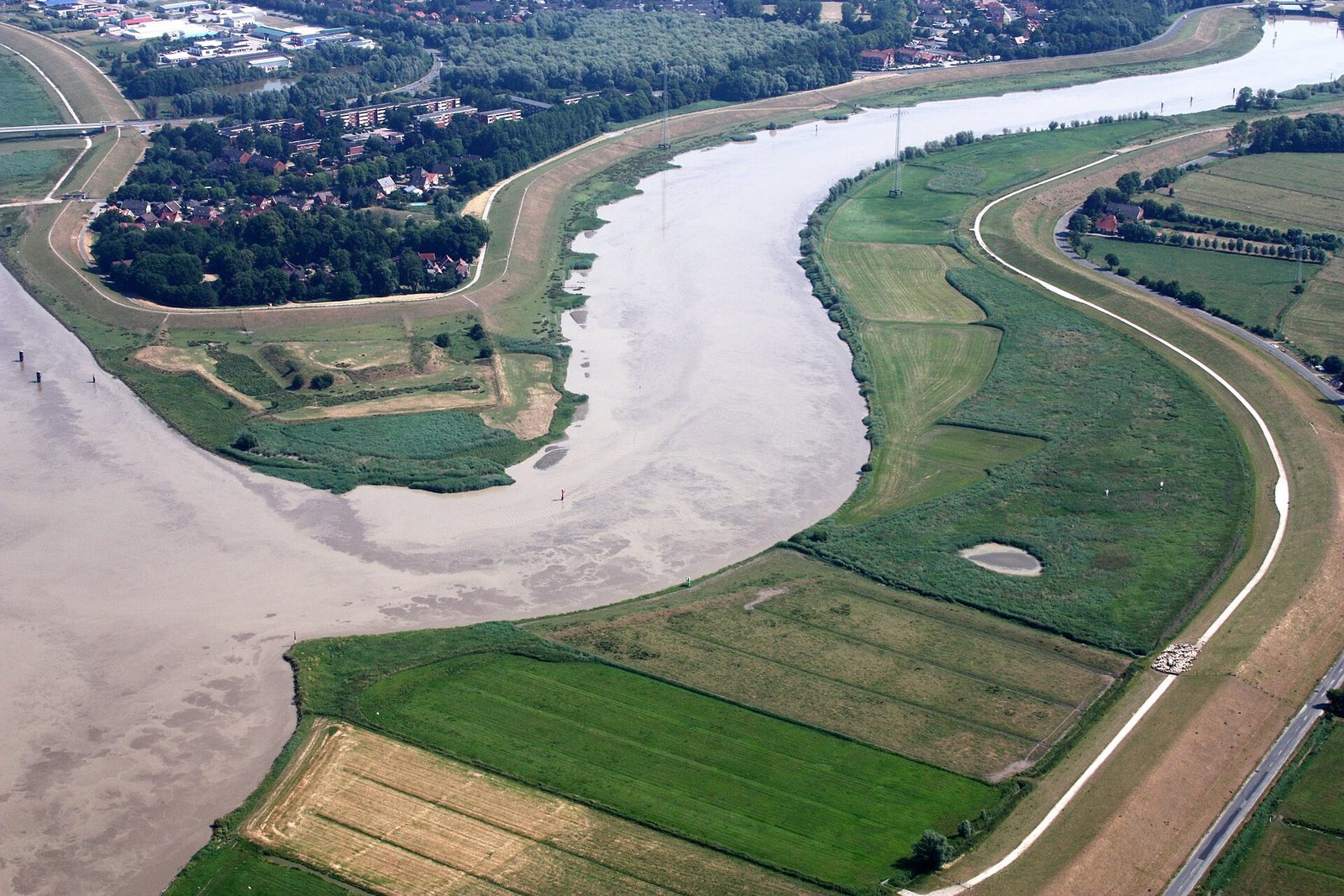
The fortress occupied a low peninsula at the junction of the Leda and Ems, built on coastal marsh soil at an elevation of about 2 m. Brick was used in its construction. The layout followed the ground: the upper fortification stood on firm terrain, while the lower section occupied less stable ground marked by a moat system that has since silted up. Its position at the river confluence exposed it to storm surges.
Earthworks and surviving layout
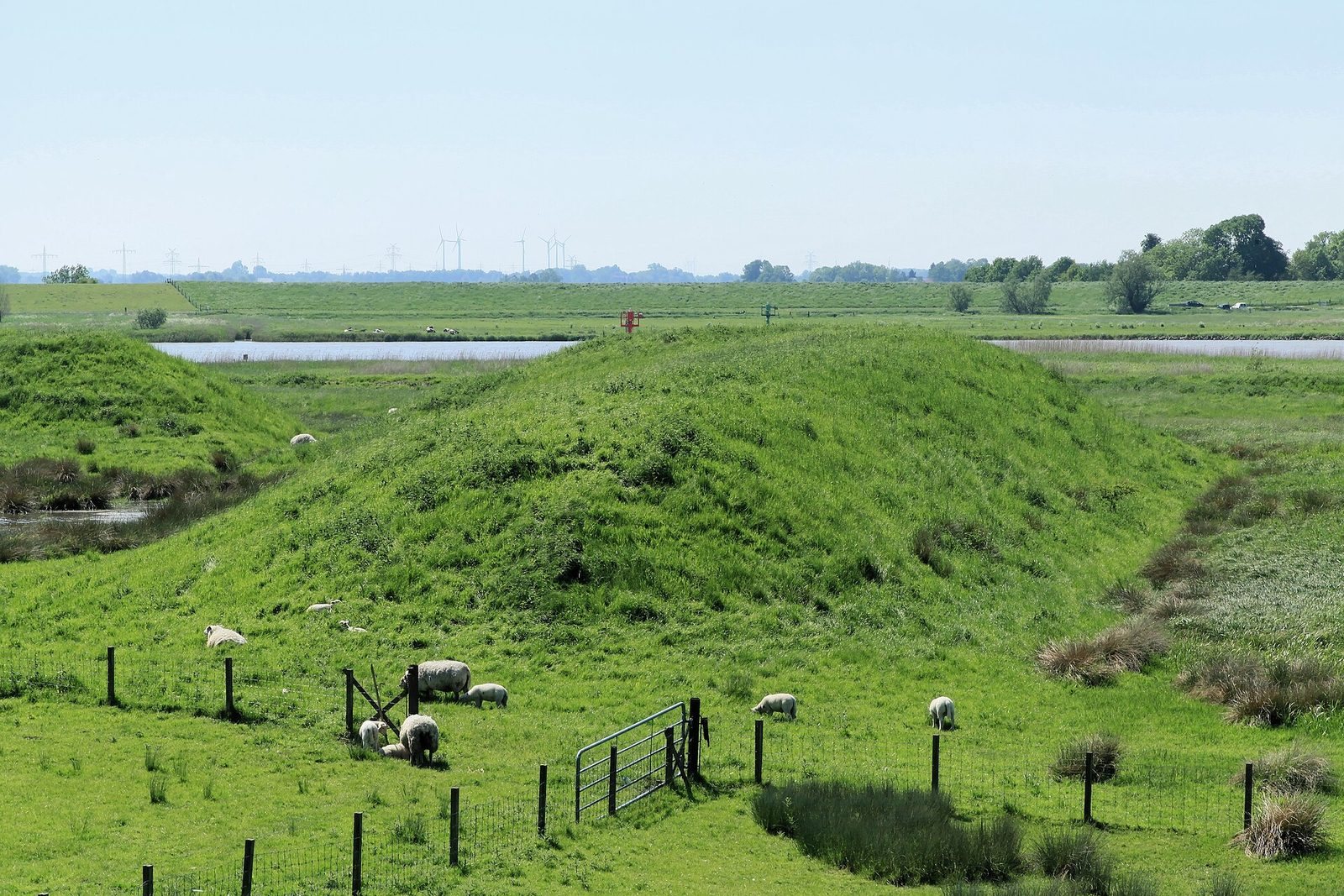
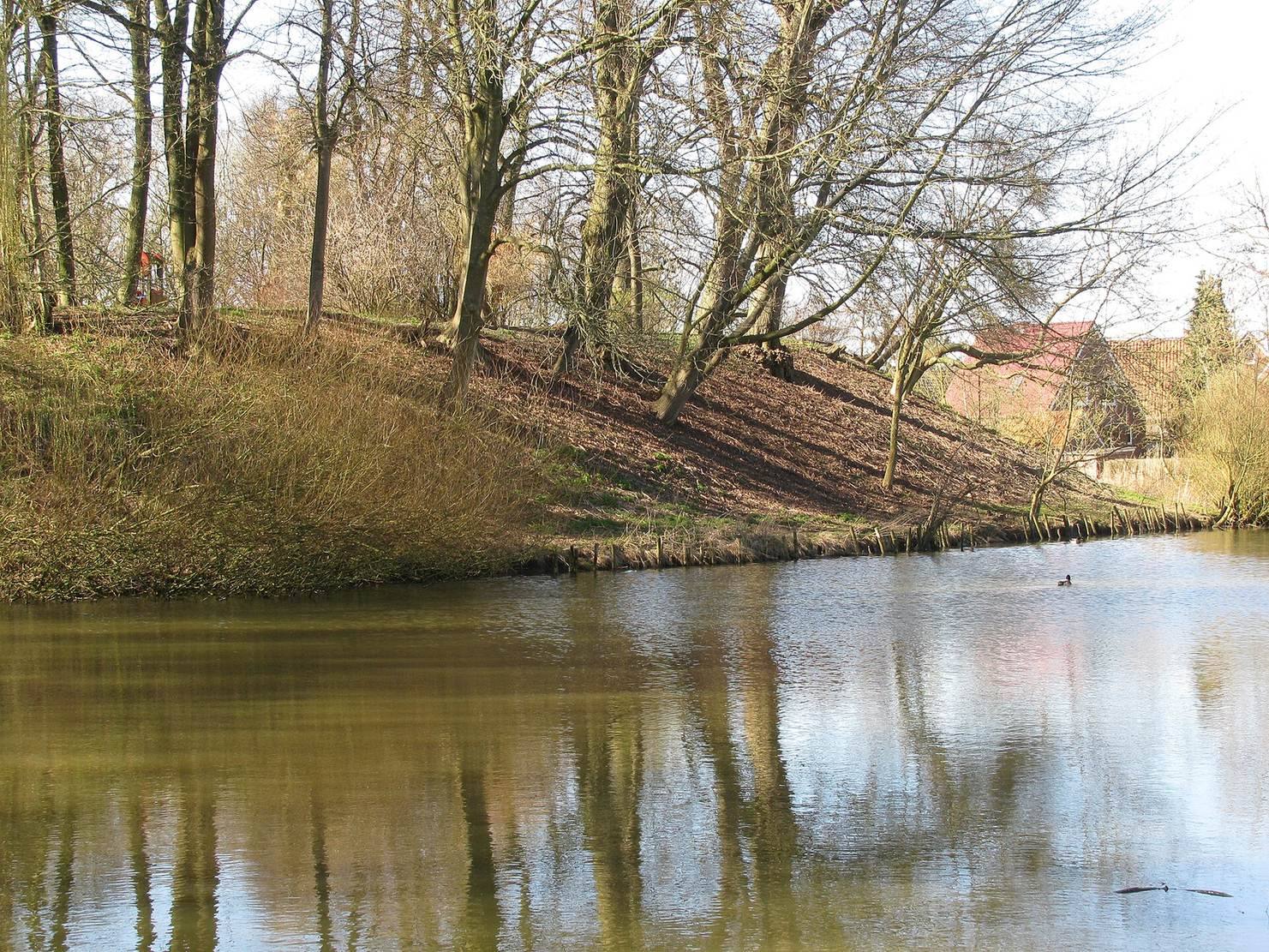
Surviving earthworks include the inner rampart of the old castle, built under Enno II, and the New Contrescarp, the outer slope of a defensive ditch, whose shape can be discerned toward the Ems. The ramparts of the White Zwinger, a fortified space between defensive walls, lie beside the Great Ditch.
White Zwinger and excavated finds
The White Zwinger included a bastion about five metres high, built under Enno II in the early sixteenth century. An excavation there in 2011 uncovered a patrol path one metre wide, paved with yellow bricks, a building material widely used in the Netherlands in the seventeenth century. Pottery from the late sixteenth and seventeenth centuries was also recovered. Finds now held at the Leer Local History Museum include earthenware from the Werra region dating from the late sixteenth to early seventeenth century, as well as seventeenth-century stoneware and earthenware.
School on the former castle rampart
A school built on the former castle rampart in 1851 now houses an exhibition about the fortress.