Winterreitschule: The Imperial Riding School of the Vienna Hofburg
Site at a Glance
- Popularity
- Medium
- Country
- Austria
- Primary era
- Early Modern
- Eras represented
- Early Modern, Modern
- Civilizations
- Habsburg, Habsburg Austria, Holy Roman Empire
- Site type
- Civic
- Remains
- School
On this page10 sections
History
The Winterreitschule is an imperial riding school in Vienna’s Hofburg palace complex, Austria, built between 1729 and 1735 in the Baroque style. Commissioned by Habsburg ruler and Holy Roman Emperor Charles VI, it was created to teach noble youth and train horses for riding and warfare.
Construction and imperial use
Joseph Emanuel Fischer von Erlach designed the school using ideas developed by his father, architect Johann Bernhard Fischer von Erlach. Gundaker Count Althann, who oversaw imperial building works and the court stables, supervised construction. On 14 September 1735, Charles VI, Empress Elisabeth Christine, Archduchess Maria Theresa and her fiancé Francis Stephen of Lorraine visited the completed building. Chief riding master Weyrother and the other riding masters presented the horses.
Under the Habsburg monarchy, the imperial box was reserved for members of the imperial family and their personal guests. Continuous use as a riding school helped preserve an almost authentic impression of the Hofburg in the eighteenth century. Until later alterations, the Winterreitschule and the Prunksaal, the former Imperial Court Library’s ceremonial state hall, were among the few representative Baroque rooms in the Hofburg to retain most of their original state.
Court ceremonies and public events
The school hosted equestrian carousels, formal choreographed displays of riding. On 2 January 1743, Maria Theresa participated in a women’s carousel connected with Prague’s recovery. It followed the 26 December 1742 capitulation of Bavaria’s elector Charles Albert, a prince entitled to vote for the Holy Roman Emperor, and the French southern army to the Habsburg commanders Charles of Lorraine and Prince Lobkowitz.
From 1812 to 1847, the Society of Friends of Music in Vienna held its major concerts in the building. In 1848, the Austrian parliament met there.
Continuing use
The Winterreitschule remains in use for training and performances by the Spanish Riding School, Vienna’s traditional institution for classical riding. Its Lipizzaner stallions belong to a breed developed for the Habsburg court.
Remains
Setting and exterior
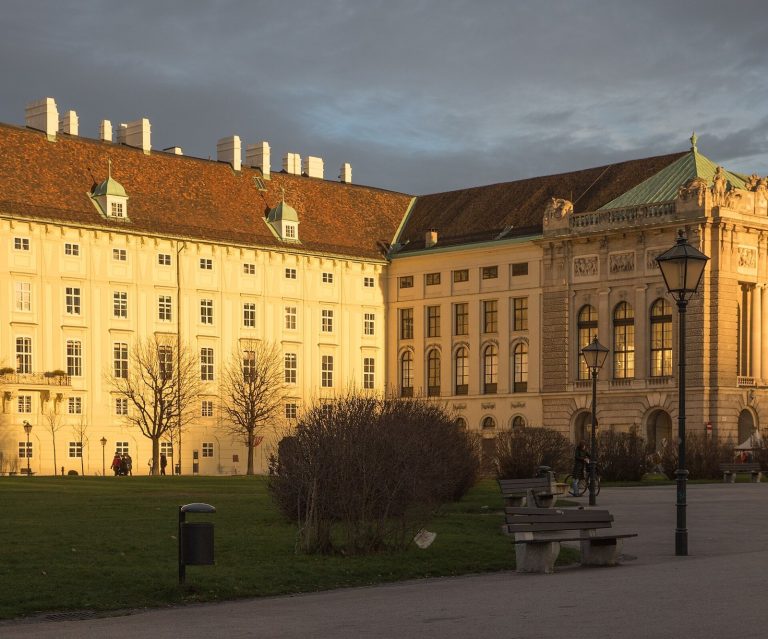
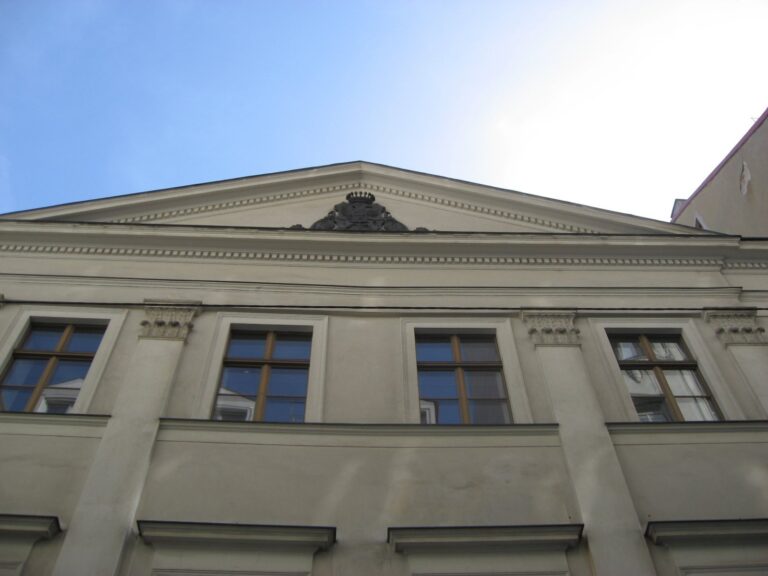
The Winterreitschule occupies a tract of the Hofburg between Josefsplatz and the Michaelertrakt, one of the palace wings. It adjoins the Redoutensäle, ceremonial halls used for court functions and balls, at a right angle, and stands opposite the Stallburg, a Renaissance palace within the complex. An archway connects the two buildings. The school’s exterior is one storey high, with paired projecting supports and columns framing the facade. Its large dome was redesigned in 1735, the year the building was completed.
The riding hall
Dimensions and gallery
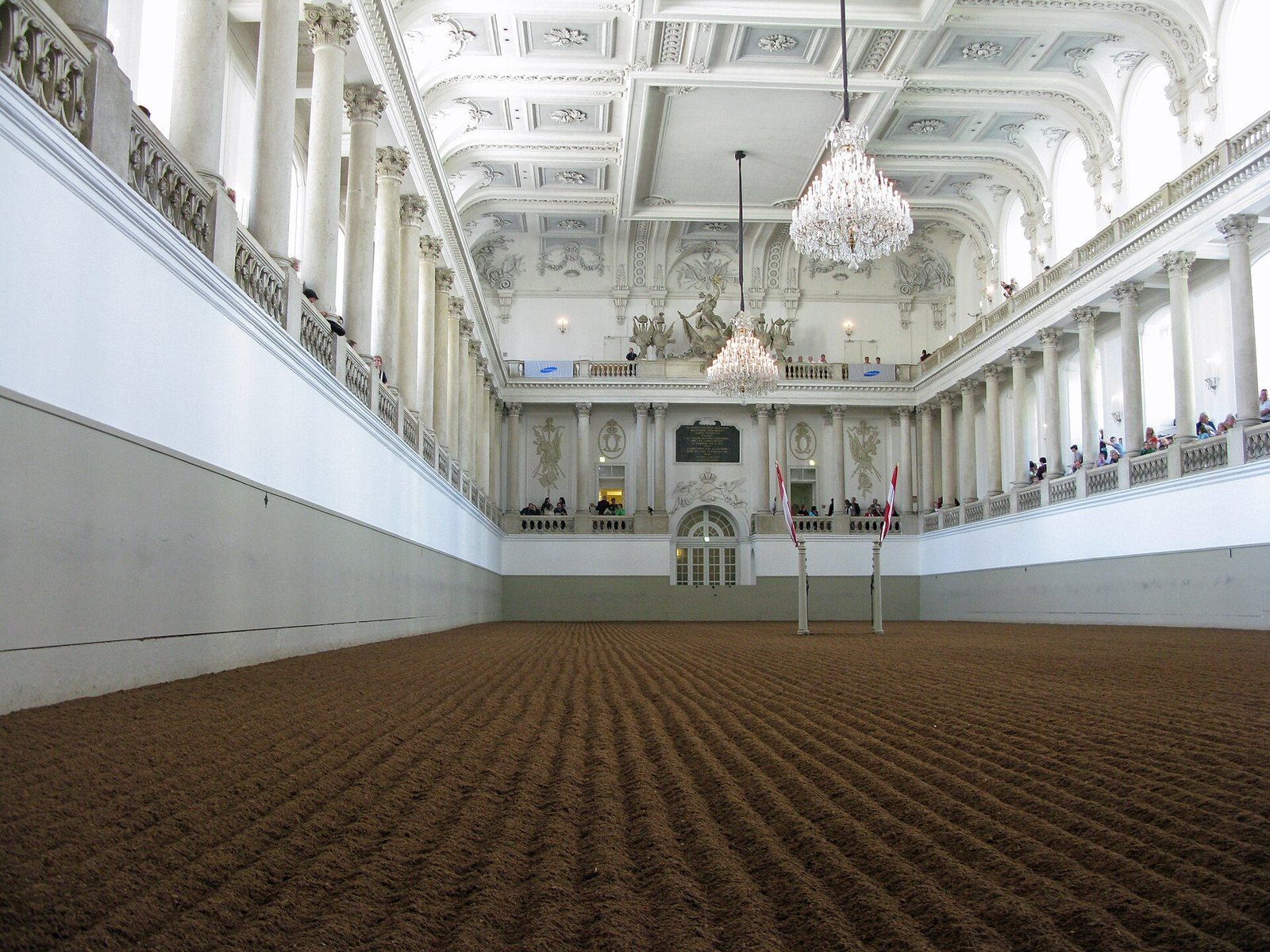
Finished in an off-white tone, the hall measures 58 metres long, 18 metres wide and 17 metres high. A gallery runs around it, supported by 46 Corinthian columns, a classical form with ornate capitals, made from Eggenburg stone.
Staircases and ceiling
Winding staircases leading into the hall are built entirely from hard Kaisersteinbruch stone. Above, the ceiling is formed from recessed panels and suspended from a complex supporting structure. It is regarded as an outstanding work of craftsmanship.
Imperial box and arena floor
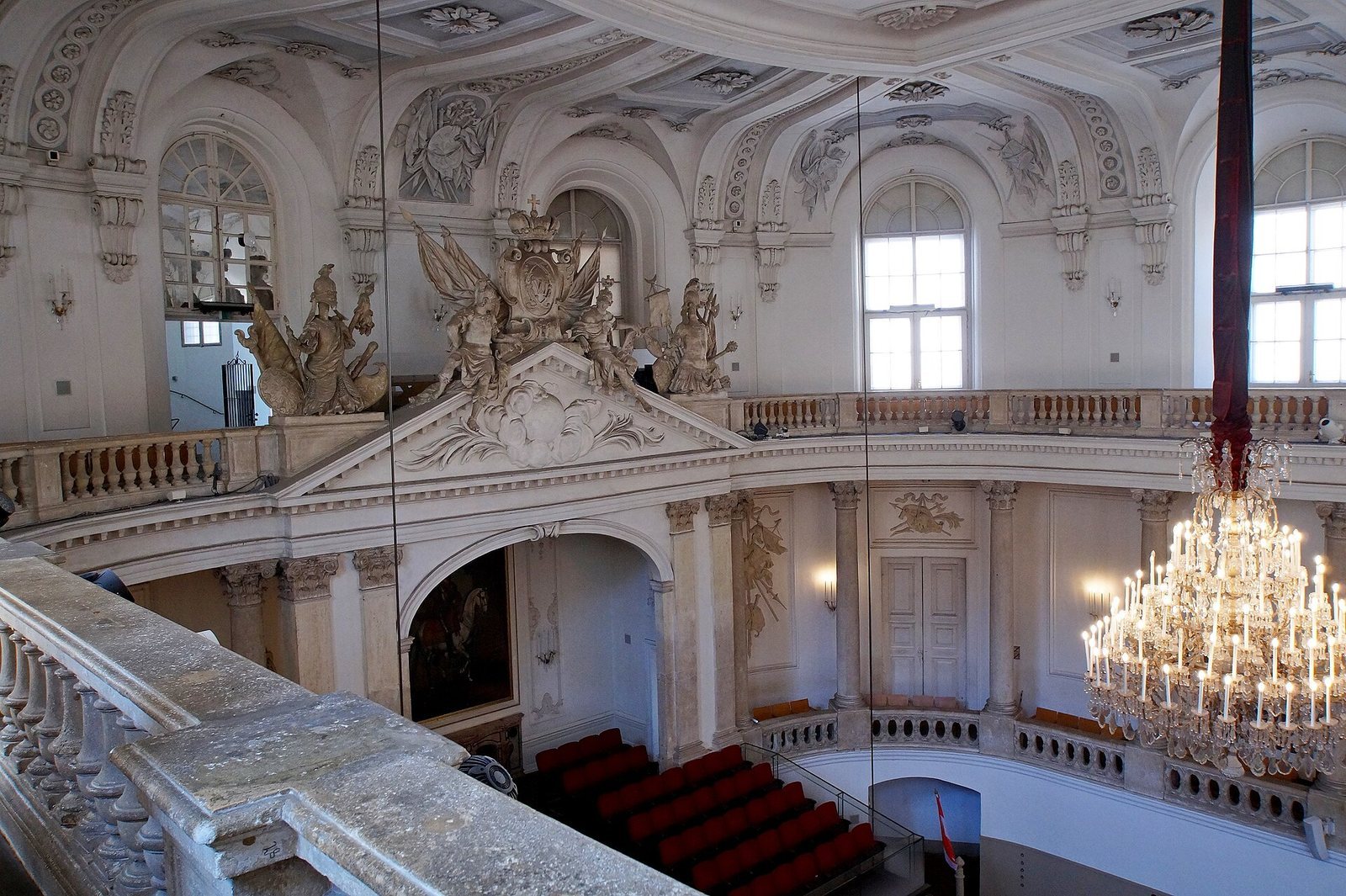
The imperial box contains an equestrian portrait of Charles VI. Horses and riders enter the arena through the double doors opposite the portrait, which riders still salute as a gesture of gratitude. An inscription in Latin above the doors names Charles VI as the founder and Althann as the construction supervisor, and gives 1735 as the year the school was erected.
Until August 2010, the arena floor consisted of sand mixed with sawdust. It was then replaced by rubber mats covered with waxed sand. In 2019, the imperial box was enlarged and a balcony added. The alterations were presented through an aesthetic “drawer” concept but were driven by economic criteria, costing the Hofburg another of its few surviving historic states.