Diehsa Church: A Historic Parish Church in Waldhufen, Germany
Site at a Glance
- Popularity
- Very Low
- Country
- Germany
- Primary era
- Medieval
- Eras represented
- Medieval, Early Modern, Modern
- Civilizations
- Electorate of Saxony, Holy Roman Empire, Kingdom of Bohemia
- Site type
- Religious
- Remains
- Church
On this page10 sections
History
Parish origins and the Reformation
Diehsa Church is a church in Waldhufen, Germany, built in rubble stone in the late fifteenth and early sixteenth centuries. Diehsa appears in a church directory of the historic Catholic Diocese of Meissen. In the early sixteenth century, its parish belonged to the Sedes Reichenbach, an ecclesiastical administrative district. The Reformation, a sixteenth-century movement that established Protestant churches in Europe, was introduced in the parish in 1539.
The parish then included Kaana and Quitzdorf. Both settlements were later cleared to make way for the Quitzdorf Reservoir: Quitzdorf in 1969 and Kaana in 1981.
War damage and rebuilding
During the First World War, Diehsa’s bells were taken and melted down for weapons production. A replacement set was acquired after the war. On 19 April 1945, as the Second World War neared its end, fighting left the church burned out and its bells fallen. In spring 1946, weather conditions caused the nave roof to collapse, destroying its Gothic rib vault, a ceiling formed by intersecting supporting ribs.
Building materials for a faithful reconstruction were unavailable, so the nave was rebuilt provisionally at a height 1.20 metres lower than before. The church was consecrated again in 1949.
Church affiliations and later use
Until 1945, Diehsa belonged to the Evangelical Church of the older provinces of Prussia. After the war, its congregation joined the Evangelical Church in Silesia, later renamed the Evangelical Church of Silesian Upper Lusatia, and was part of the Niesky church district. In January 2004, that church body joined the Evangelical Church in Berlin-Brandenburg to form the Evangelical Church Berlin-Brandenburg-Silesian Upper Lusatia. On 1 January 2007, the Niesky district merged with the Görlitz and Weißwasser districts to form the church district of Lower Silesian Upper Lusatia. On 1 January 2014, that district combined with Hoyerswerda to form the church district of Silesian Upper Lusatia. Diehsa belongs to this district and, with the congregations of Arnsdorf, Buchholz-Tetta, Jänkendorf-Ullersdorf, Melaune, and Nieder Seifersdorf, forms the Waldhufen-Vierkirchen parish union.
During Pentecost weekend in 2004, the church became a cycling church, a place for cyclists to stop along a cycling route, the Frog Cycle Route. It is protected as a monument for its architectural and local historical importance.
Remains
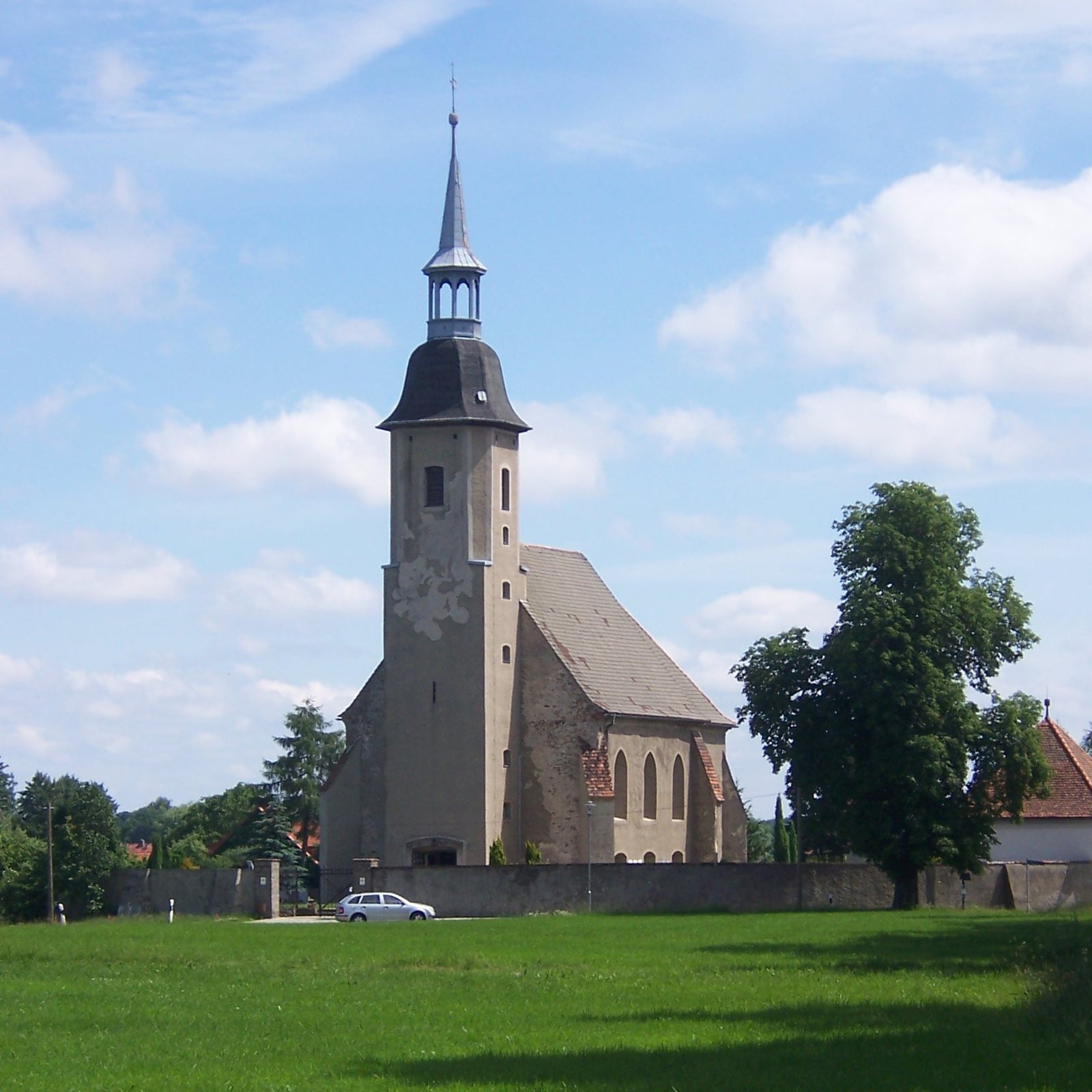
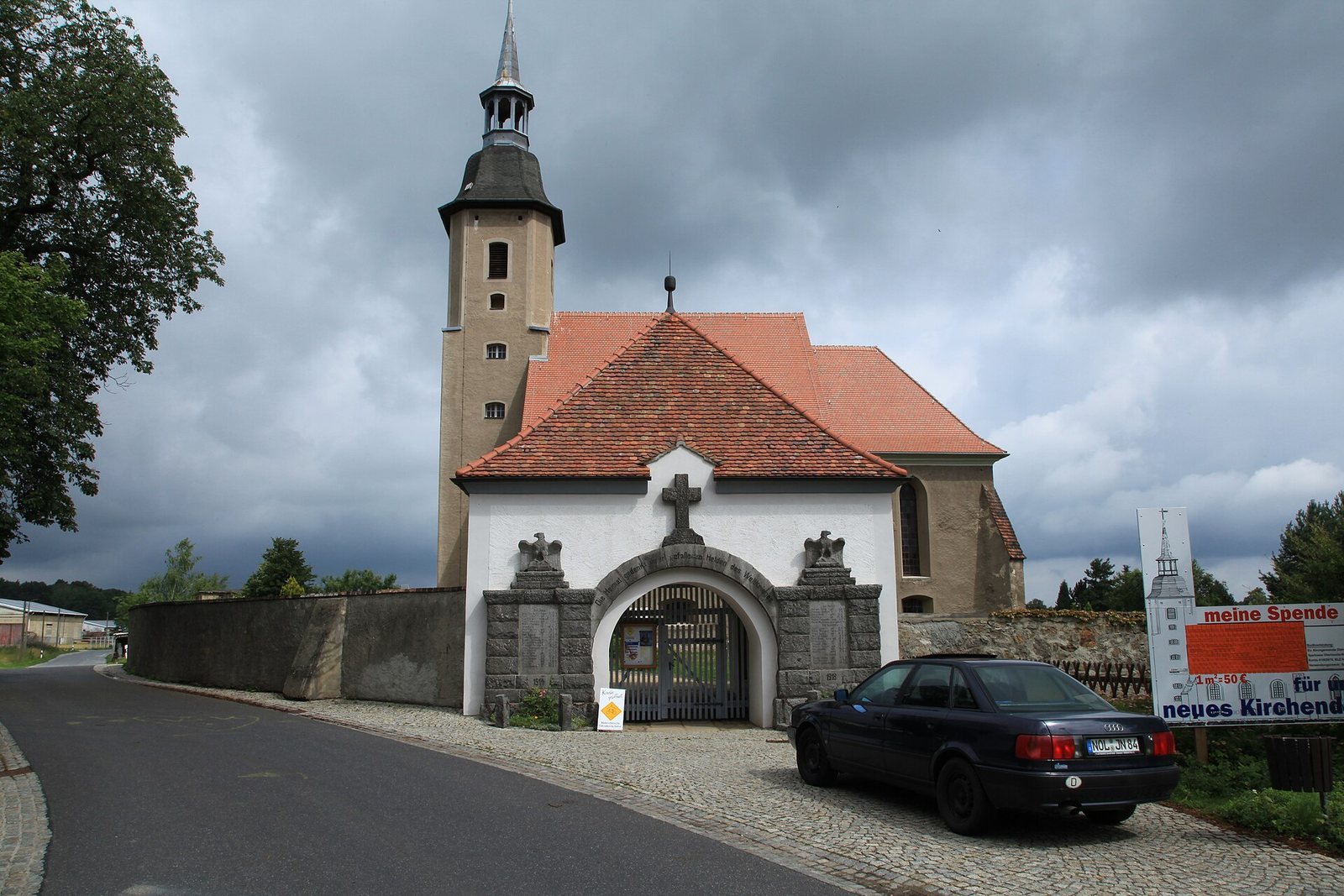
The church is built of plastered rubble stone, with a rectangular chancel, the area around the altar, and a rectangular tower at its west end. The nave has a gabled roof, while the roof over the altar area is hipped. A wall encloses the churchyard.
Exterior
West tower
The tower has an octagonal bell stage above its rectangular lower section. Its roof is crowned by an onion dome and lantern, followed by an eight-sided pointed spire clad in sheet metal, a tower ball, and a weather vane.
Nave and chancel
The nave’s slightly pointed-arch windows and south-side bat dormer, a curved window set into a roof, are among its exterior features. A two-storey patron’s box, reserved seating associated with a church patron, is attached to the north side. The nave stands 1.20 metres lower than before the postwar rebuilding.
Interior
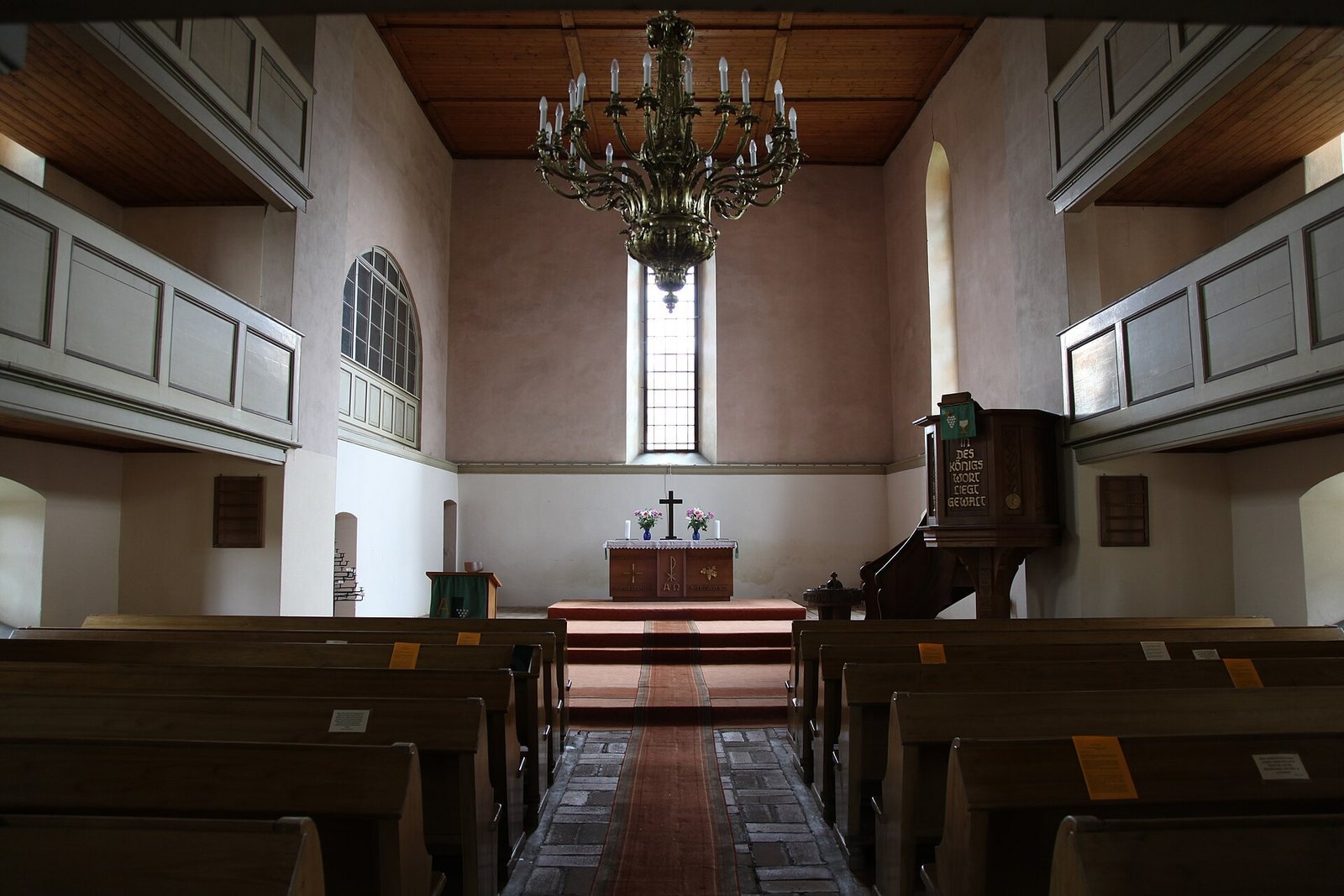
The rebuilt nave has a flat ceiling in place of the rib vault lost in the 1946 roof collapse, and a gallery runs along three sides. A fifteenth-century wall painting survives on the north side of the nave. The church’s wooden altar, pulpit, and baptismal font date to 1949. The National Front of the GDR, an East German political umbrella organization that included the ruling Socialist Unity Party and other political organizations, donated the pulpit.
Churchyard entrance
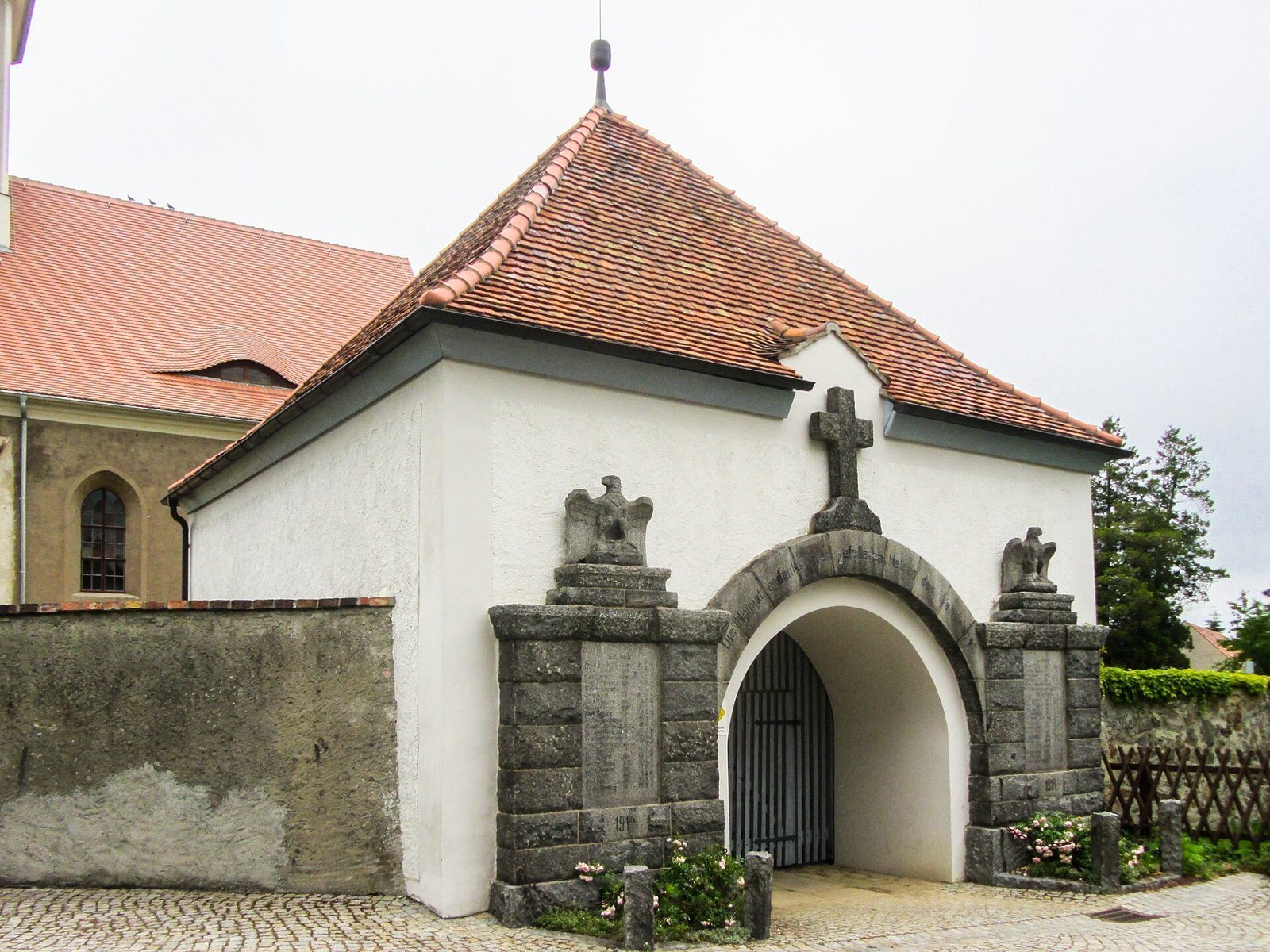
South of the church, a gatehouse built in 1687 has a tent roof and is flanked by two war memorials.