Forshem Church: A Medieval Church Dedicated to the Holy Sepulchre
Site at a Glance
- Popularity
- Medium
- Country
- Sweden
- Primary era
- Medieval
- Eras represented
- Medieval, Early Modern, Modern
- Civilizations
- Swedish
- Site type
- Religious
- Remains
- Church
On this page18 sections
History
Foundation and medieval changes
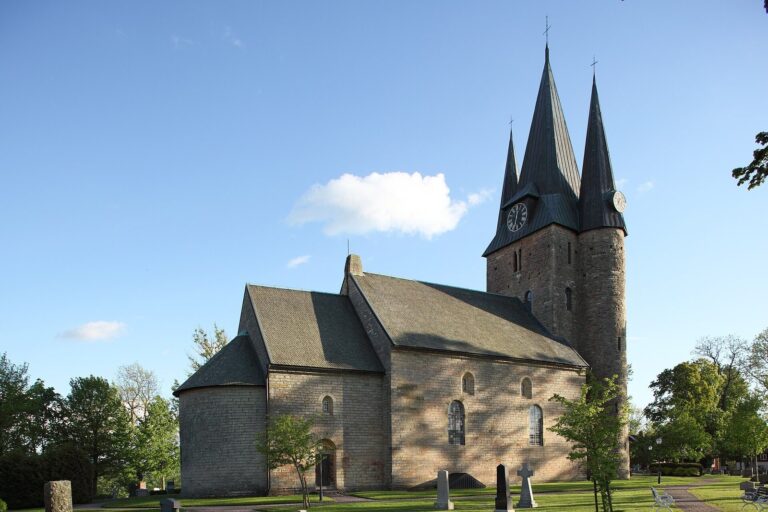
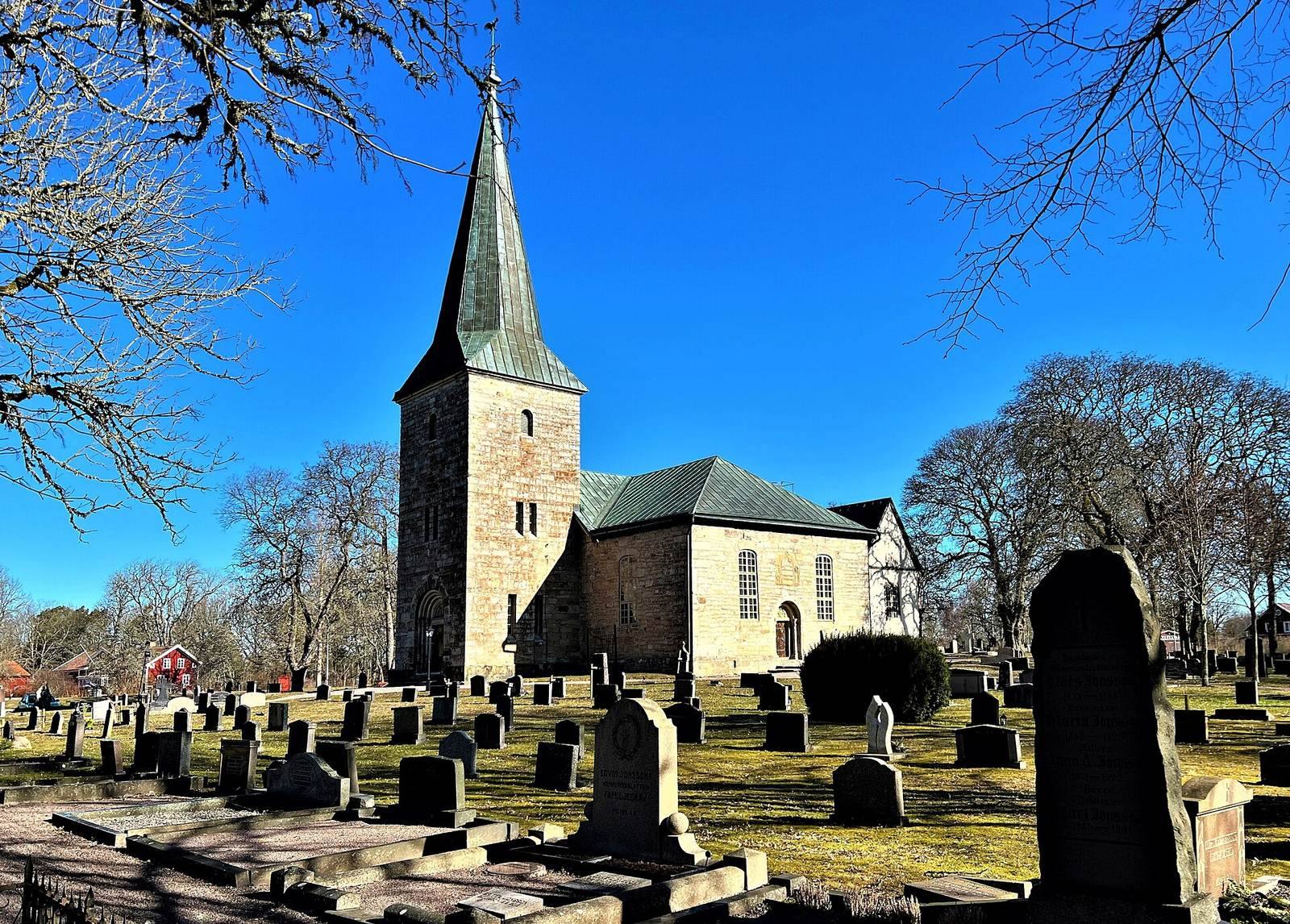
Forshem Church in Sweden is a Romanesque stone church whose original building dates to the 1130s; it was consecrated in the 12th century. Romanesque is a medieval architectural style associated with rounded arches and solid forms. A timber built into the northern roof framing provides the date for the original structure. The church is dedicated to the Holy Sepulchre in Jerusalem, the Christian holy site associated with Jesus’s burial and resurrection. So far as is known, it is the only church in Scandinavia with this dedication.
The western tower may be older than the rest of the stone church and may have belonged to an earlier wooden building. The original church also included a choir, the area around the altar, which was replaced in the 13th century by a larger Gothic choir. Gothic architecture is associated with pointed arches and greater verticality. The rectangular plan has prompted questions about claims that crusaders, participants in medieval Christian military expeditions to the Holy Land, or the Hospitallers were involved in the early decoration. The Hospitallers were a medieval religious and military order later known as the Knights of Malta; a round church would have more closely echoed the Jerusalem shrine.
Early modern additions
In 1663, a burial chapel was built against the south side of the choir using sandstone from the demolished Bolum Church. By the 18th century, the chapel served as a sacristy, a room for sacred objects and preparation for services. In 1761–1762, broad cross-arms were added on the north and south sides of the central worship space, doubling the floor area and creating a cross-shaped plan.
A painter, probably Johan Laurell, was paid for work at the church in 1773. The painted subject is unknown, and the work has not survived, although it included an inscription on the arch between the choir and the main body of the church. The same painter was paid to paint the church doors in 1774.
Restoration and parish history
The original tower was demolished in 1891 because it was in danger of collapse, and a copy was constructed in its place. Restorations in 1912 and 1929 raised the choir floor, installed a new stone altar slab, rehung the crucifix, replaced the pews, and repaired the ceiling and wall paintings. During the 1929 work, paintings from the 17th century were found beneath limewash.
Forshem Church belonged to Forshem Parish until 2002, when it became part of Kinnekulle Parish in the Diocese of Skara, a regional church district. It belongs to the Church of Sweden, a Lutheran church.
Remains
Plan and construction
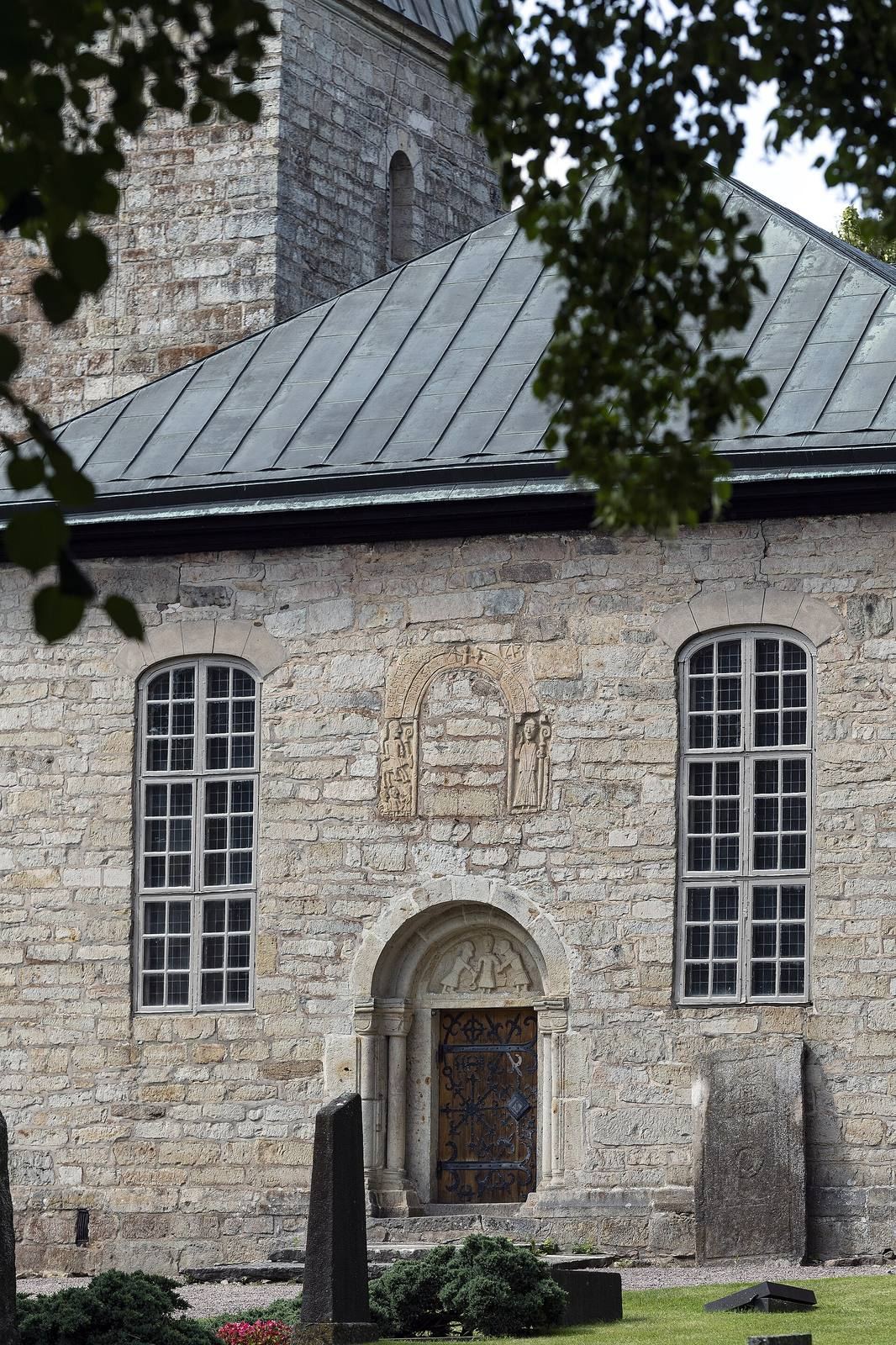
The church is built of sandstone ashlar, carefully dressed stone blocks. Its present plan has a nave, the main body of the church, with north and south transepts, the cross-arms extending from it. At the east end, the choir has a straight wall; the sacristy stands to its south. A tower at the west end also serves as a porch. The original Romanesque arrangement comprised a tower, nave, choir, and probably an apse, a recess at the end of a church. Part of the Romanesque roof framing remains above the nave.
Medieval stone reliefs
Seven stone reliefs survive: two decorated panels above doorways, known as tympana, and five square carvings now set in secondary positions. Six of the reliefs date to the 12th century. They are carved from Kinnekulle sandstone and attributed to one stone-carver, who also decorated Skara Cathedral.
West portal relief
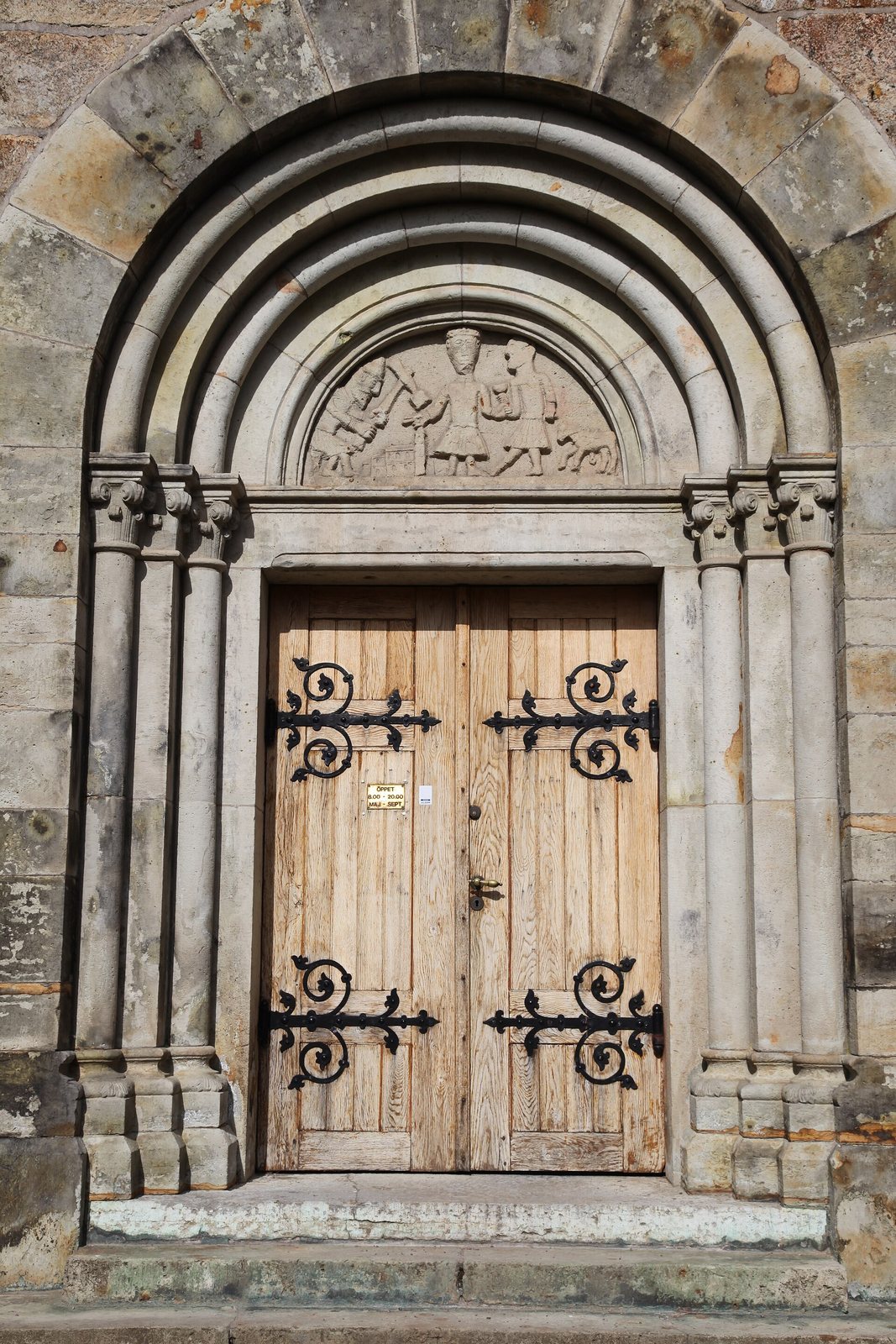
The tympanum above the entrance at the foot of the tower belongs to the church’s original construction. It shows Christ between a donor, portrayed as a nobleman and possibly a crusader, and a stone-carver. Neither person is identified by name.
South portal relief
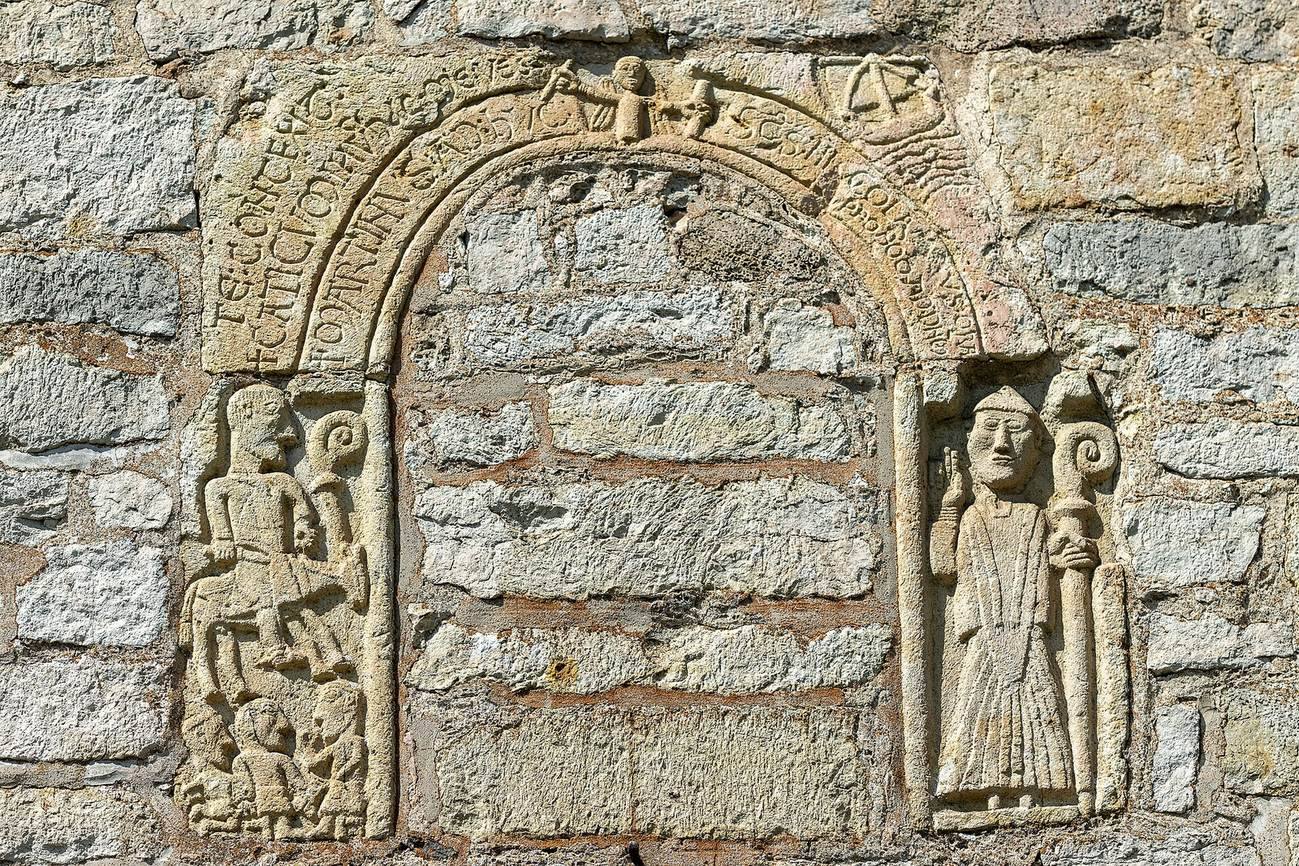
A second tympanum, associated with the south portal, depicts Christ between the apostles Peter and Paul, with the Latin alphabet represented below. Its inscription names Jesus Christ and the Holy Sepulchre, recording the church’s dedication. Maltese crosses are set at the south portal and above the western doorpost.
Transept and other reliefs
Carvings in the south transept include the conversion of Martin of Tours, presented as an example of charity, and Nicholas of Myra with a small ship. An adjacent inscription asks Saint Nicholas to intercede with the Lord. A cross of a type associated with the Maltese or Hospitaller order is also described to the left of the south-transept entrance, though the motif alone does not establish who commissioned or placed it.
Other reliefs show scenes from the Passion, the events of Jesus’s suffering and death. One represents the Crucifixion and Deposition, with Joseph of Arimathea embracing Christ’s body; another shows Christ in the tomb preaching salvation to souls in the underworld. A further scene depicts women arriving at the tomb on Easter morning. An angel stands there, soldiers lie as if dead, and Christ rises at the right. Two carvings show saints flanking an opening.
Paintings and furnishings
Painted decoration
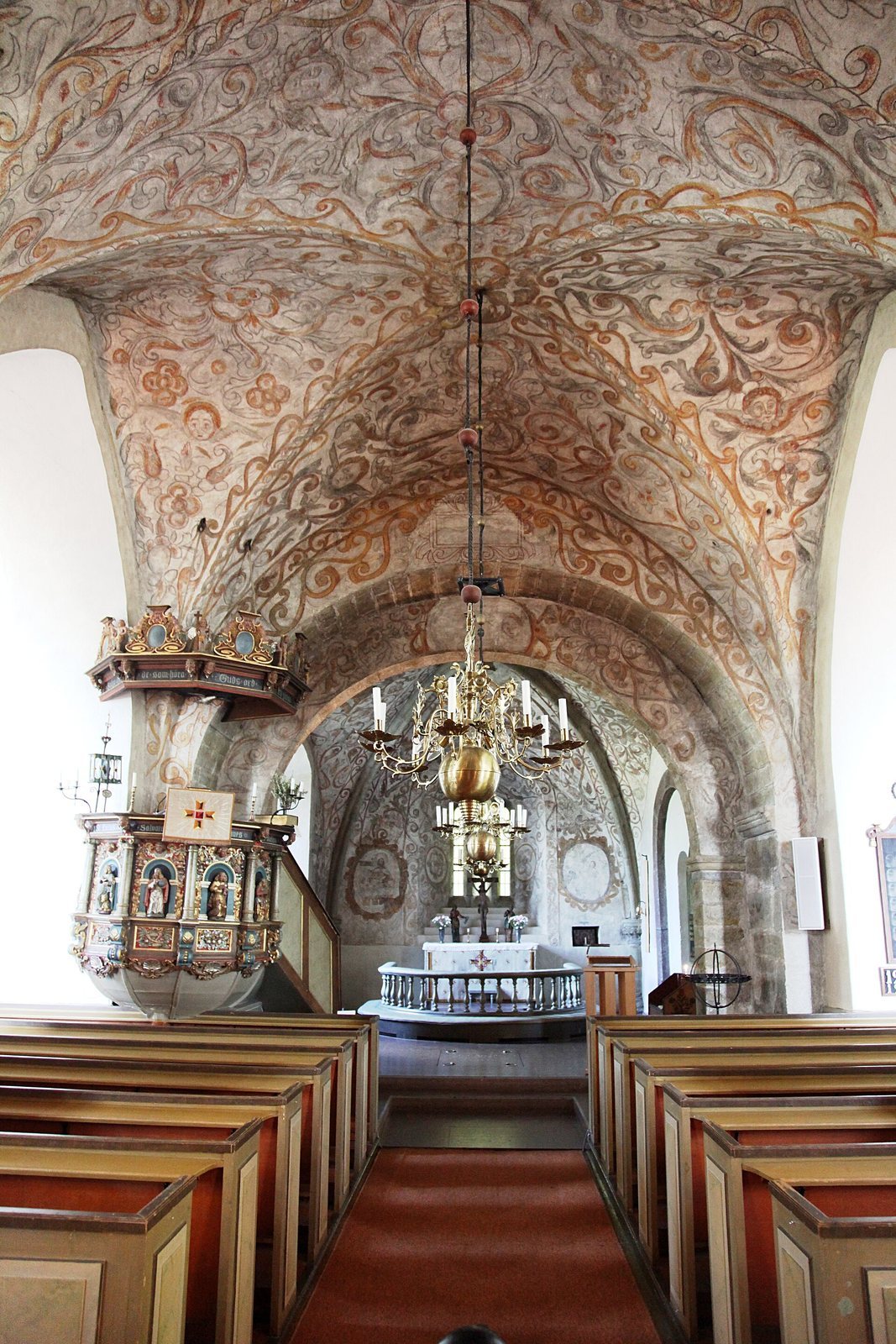
Interior paintings dated to 1638 belong to the regional Läckö school of church painting. In the choir, the four Gospel writers appear with their identifying attributes. The eastern section of its vaulted ceiling shows Calvary, while the other sections contain apostles. The nave’s vaulted ceilings instead carry dense ornament, chiefly vine patterns in red, black, blue-gray, and ochre. Both the nave and choir also feature winged putti heads, decorative childlike figures.
Altar, pulpit, and benches
The choir contains bridal benches from the 18th century. Nils Bratt of Kinne-Vedum made the richly ornamented, many-sided pulpit in 1673–1676. The altar’s Baroque retable, an ornamental structure behind or above the altar, dates to 1718. Baroque is a European artistic style known for elaborate decoration.
Font and crucifix
The baptismal font is a copy of a 12th-century Romanesque original. Its bowl is shaped like a chalice and decorated with plant forms; the original font is held by the Swedish History Museum in Stockholm. A Gothic triumphal crucifix, a crucifix associated with the arch between the choir and nave, dates to the mid-14th century. It was hidden beneath the sacristy floor for much of the 19th century, then found during renovation and returned to its present position.
Organ
Erik Adolf Setterquist of Örebro built an organ for the church in 1864, with eight stops, which control sets of pipes, and one hand-played keyboard. The present instrument was made in 1952 by Th. Frobenius og Sønner Orgelbyggeri of Kongens Lyngby, Denmark. It has nineteen stops, two hand-played keyboards, and a foot-operated keyboard; its façade was made for the instrument.
Other medieval features and grave stones
Roof timbers and bell
Two original wall plates, horizontal timbers that support roof framing along the tops of walls, survive with Romanesque animal ornament. The church also retains a medieval small bell with a simple, archaic form.
Grave stones
A lily stone, a decorated medieval grave slab with stylized plant ornament, is set as a threshold in the south transept. It formerly served as the lid of a grave. A small museum in the former mortuary across the road displays several lily stones, grave slabs, and other tombstones.