Skara Cathedral: Sweden’s Medieval Episcopal Church


Site at a Glance
- Rating
- 4.6
- Popularity
- Low
- Country
- Sweden
- Primary era
- Medieval
- External website
- Open
- Eras represented
- Medieval, Early Modern, Modern
- Civilizations
- Swedish
- Site type
- Religious
- Remains
- Cathedral
On this page17 sections
History
Skara Cathedral is a medieval Gothic church in Skara, Sweden, and the episcopal church of the Diocese of Skara as well as a parish church of the Church of Sweden. Dedicated to Mary, it was formerly Roman Catholic and is now Lutheran and Protestant. The Diocese of Skara is Sweden’s oldest diocese, traditionally founded in 1014 under King Olof Skötkonung, an early Swedish ruler traditionally regarded as the first Swedish king to be baptized as a Christian. The cathedral’s history reaches more broadly into the tenth or eleventh century.
Early cathedral and medieval development
The earliest church at Skara was probably built of wood. A Romanesque stone cathedral followed in the twelfth century. Romanesque architecture was a medieval style known for rounded arches and massive masonry. Parts of this earlier building remain within the present cathedral, including the crypt, fragments of the western tower, and four carved stone reliefs.
The present cathedral emerged through several medieval building phases. The choir was constructed in the early thirteenth century, followed by the nave and transept during the first half of the fourteenth century. The choir is the area around the main altar, while the transept is the crosswise arm that intersects the nave, the church’s principal lengthwise space. The building process appears to have been interrupted, as variations in the nave’s ornament and construction methods suggest. This interruption was probably connected with the Black Death epidemic, which spread across Europe during the fourteenth century.
The cathedral suffered repeated damage during conflicts with Denmark and in several urban fires. Danish devastation in 1566 led to the nave being covered by three star vaults. These remained until the major restoration of the late nineteenth century.
Baroque and Neoclassical changes
A substantial interior rebuilding began in 1759 under the architect Carl Johan Cronstedt. The work followed Roman Baroque principles, a style associated with dramatic forms and elaborate interior treatment. Lack of funds prevented the project from being completed. A Baroque gable built for the southern transept in the middle of the eighteenth century was later demolished.
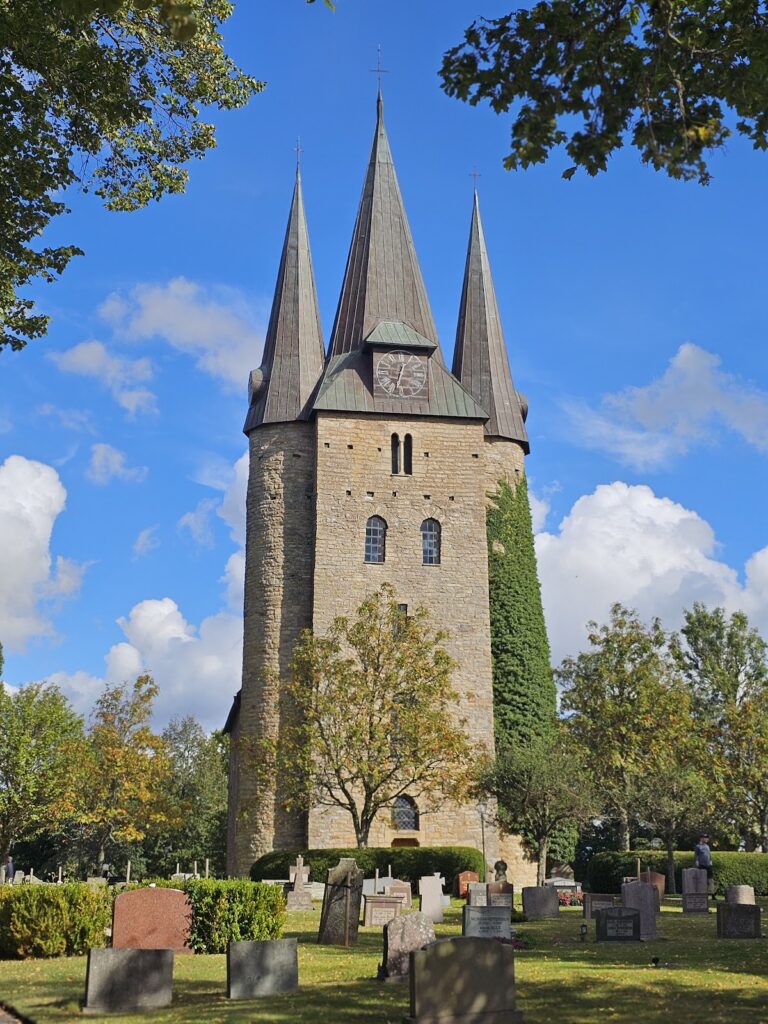
In 1809, architect Louis Jean Desprez redesigned the western facade in a Neoclassical manner. The two west towers were given flat tops, and their altered appearance led to the nickname “Skara’s trousers.” The choir was remodelled as a three-aisled space in 1839, and some grave slabs were removed during the work.
Gothic Revival reconstruction
Architect Helgo Zettervall directed a comprehensive restoration and rebuilding from 1886 to 1894. Zettervall was known for Gothic Revival reconstructions of historic churches. Gothic Revival was a nineteenth-century movement that restored or imitated medieval Gothic forms, often combining original fabric with newly reconstructed elements. At Skara, the work gave the cathedral a more unified Gothic Revival appearance while retaining much of the medieval nave.
To achieve stylistic consistency, the restoration removed later additions including medieval chapels and Cronstedt’s Baroque gable. The west towers received pointed Gothic spires in place of their flat-topped form, and their copper-sheet coverings date from this restoration. The intervention shaped much of the cathedral’s present external character, even though the building still incorporates substantial medieval fabric.
Fire, modern restoration, and religious continuity
An arson fire in 1947 destroyed the roof and its supporting framework. Architect Ivar Tengbom directed restoration between 1947 and 1949. The roof was rebuilt, and parts of Zettervall’s Neo-Gothic interior were removed in favour of earlier furnishings, including the Baroque high altar.
Between 1945 and 1976, artist Bo Beskow and glazier Gustav Ringström replaced the cathedral’s medieval stained-glass windows with 37 new windows. Their imagery is mainly biblical, with additional representations of Bridget of Sweden, the fourteenth-century religious visionary and founder of the Bridgettine Order, and Helena of Skövde, a locally associated twelfth-century saint.
Technical work from 1979 to 1985 relieved pressure on the vaults by installing tie beams beneath them. These beams transferred the loads of the roof and ceiling. A further restoration supervised by architect Jan Lisinski in 1999 exposed more of the interior’s Gothic character. The sacristy behind the altar was demolished, the crypt was enlarged and modernized as a worship hall, and additional stairs were built from the south.
Skara Cathedral is protected as an ecclesiastical monument under Chapter 4 of Sweden’s Cultural Heritage Act because it was erected before the end of 1939. Its continuing use as the cathedral of the Diocese of Skara connects the present Church of Sweden with a religious institution whose history extends back to the early eleventh century.
Remains
Layout and medieval fabric
Skara Cathedral is built principally from local sandstone, including stone from Broddetorp. Its plan is a three-aisled basilica, meaning that a central nave is flanked by lower side aisles, with a pair of western towers. The building is approximately 65 metres long, and the towers rise roughly 63 to 65 metres. The present appearance combines preserved medieval construction with later Gothic Revival rebuilding.
The choir
The medieval choir was originally straight-ended and single-aisled. Side chapels made the exterior appear to have a three-aisled basilical plan, while the choir and main nave were the same width. Cross vaults covered the choir and rested on corbels, which are projecting supports for masonry or vaults. Pointed-arch windows were positioned immediately below the vaults and above the side aisles when viewed from outside.
The choir’s elongated, straight-ended form and surviving details resemble Early English Gothic architecture. The two small medieval turrets flanking the choir remain part of the building. The northern turret preserves stairs that once led to a higher level of the north aisle.
The nave and transept
The nave and transept display forms closer to French Gothic architecture, including clustered piers, tracery, and pointed-arch portals. Tracery is the ornamental stone framework within a window. Galleries were built in both arms of the transept, and the walls of the nave and choir retain triforia, galleries or arcaded passages placed above the main arcades and below the upper windows.
The triforia are unique in Sweden. Their remains were uncovered during restoration and were probably never completed. They may have been walled up late in the Middle Ages when the walls threatened to collapse. The transept facades are crowned with pinnacles, small pointed architectural ornaments, while the west towers carry the pointed spires added during the 1886 to 1894 restoration.
Crypt and Romanesque sculpture
The medieval crypt
The medieval crypt is associated with the earliest phase of the cathedral and served as a burial place for early Swedish bishops. A crypt is a chamber, often beneath a church, used for burial or religious purposes. Buried under stones since the thirteenth century, it was rediscovered during the restoration after the 1947 fire.
Its archaeological remains include walls, central and corner columns, vault bases, and sections of two stairways that once led upward into the cathedral. A bishop’s grave containing a skeleton, a chalice, and a paten was found and dated to approximately 1100. A paten is a shallow liturgical plate used with a chalice. A rectangular concrete crypt was constructed around the remains, with additional stairs added from the north-eastern corner of the north aisle and, in 1999, from the south.
Twelfth-century reliefs
Four Romanesque stone reliefs are associated with the twelfth-century cathedral. Three depict the expulsion of Adam and Eve from Paradise, Herod’s feast, and Pope Gregory receiving words of wisdom from the Holy Spirit in the form of a white dove. The fourth relief is too damaged for its subject to be identified.
Windows, monuments, and furnishings
Stained glass
The cathedral contains 37 stained-glass windows created by Bo Beskow with Gustav Ringström between 1945 and 1976. Their subjects are predominantly biblical. Bridget of Sweden and Helena of Skövde also appear among the imagery, linking the modern glazing to important figures in Swedish religious tradition.
The Soop monument and donations
The monumental tomb of Colonel Erik Soop was made in Amsterdam in 1637 by Pieter de Keyser. It combines black marble with white alabaster. Originally placed in the southern part of the choir near the entrance to the family tomb, it was moved several times and has stood in the southern transept since 1999.
Statues of Mars and Minerva decorate the monument’s upper section facing north. Mars and Minerva were Roman deities associated with war and wisdom, conventional classical themes for a funerary monument. Soop’s tin coffin lies beneath the monument and is engraved with battle scenes.
Soop also donated an enamelled gold chalice made in Amsterdam. It weighs 772 grams and is decorated with enamel and 60 diamonds. The cathedral also preserves the Adalvard Chalice, associated with Bishop Adalvard, who died in 1064, and a chasuble probably made in Paris and associated with Bishop Brynolf Algotsson, dating from 1278 to 1317. Other historic liturgical vessels and textiles remain in the cathedral, along with a missal described as Sweden’s oldest written book. A chasuble is the principal outer vestment worn by a Christian priest or bishop during the Eucharist.
Hästehufvud memorials
Anders Eriksson Hästehufvud’s tomb was demolished in 1890, but two memorial grave slabs bearing images and inscriptions remain in the cathedral. His principal donation was an altar made by Hans Swant of Gothenburg, held by the cathedral since 1663. Hästehufvud also gave liturgical vessels, including baptismal vessels and cruets, small containers for wine or water used in worship.
Bells and organ
Four bells hang in the two western towers. The northern tower contains the largest, Storklockan, cast in Stockholm in 1725 and enlarged in Skara in 1785 by Nils Billsten. The other three bells hang in the southern tower.
The cathedral has a main organ and a choir organ. The main organ was built in 1964 by Copenhagen organ builder Poul-Gerhard Andersen. It has 46 stops distributed across three manuals and a pedal, with mechanical key action and electrical stop action.
Nearby sites