Georgenburg Castle: A Teutonic Fortress and State Stud Farm in Russia


Site at a Glance
- Rating
- 4.3
- Popularity
- Low
- Country
- Russia
- Primary era
- Medieval
- Eras represented
- Medieval
- Civilizations
- Teutonic Order
- Site type
- Military
- Remains
- Castle
On this page8 sections
History
Georgenburg Castle is a medieval Teutonic fortification in Russia, located in Chernyakhovsk, whose first stronghold was established in 1264 on the site of the old Prussian hillfort of Kapzowin. Built within the territories administered by the Teutonic Order, it was named for Saint George. The citadel was later rebuilt in the Teutonic Gothic style, and the castle became a strategic stronghold, an administrative center, and eventually a major horse-breeding estate.
Teutonic and episcopal rule
The first fortification was laid by the Teutonic knight Hartman von Grumbach. Timber-and-earth defenses were constructed in 1337, followed by rebuilding in stone in 1351. Georgenburg appears in written records in 1354. After the division of territory between the Teutonic Order and the Samland bishop in 1352, the castle passed to the bishop and remained under episcopal ownership until the secularization of the Order in 1525.
Its strategic position brought repeated military attacks. Lithuanian forces burned and destroyed Georgenburg in 1364 and 1376. Extensive stone rebuilding followed between 1385 and 1390, when a large foreburg was added on the western side. In 1403, the forces of Vytautas, Grand Duke of Lithuania, captured the castle.
Administrative estate and wartime occupation
After 1525, Georgenburg became the administrative center of a Kammeramt, an office responsible for managing state domains and their revenues. A Tatar raid damaged the castle in 1657, and Swedish troops commanded by General Gustav Horn occupied it in 1679. From 1709, the castle and its estate formed a state domain leased to private tenants. Under the von Keudel tenants, horse breeding expanded on the property.
Russian troops under Field Marshal Stepan Apraxin occupied Georgenburg in 1757 during the Seven Years’ War, the eighteenth-century conflict that involved Prussia, Russia, Austria, France, and other European powers. During the Napoleonic Wars, the castle housed the headquarters of Marshal Louis-Nicolas Davout, a senior French commander under Napoleon Bonaparte.
Horse breeding and the modern estate
After the Treaty of Tilsit, Prussia sold the Georgenburg domain to help meet its indemnity to France. The Scottish horse breeder William Simpson later became one of its best-known private owners. He established a celebrated stud farm and contributed substantially to the development of the Trakehner, a warmblood breed associated with East Prussia. The Schlechter family subsequently owned the estate.
The Prussian state repurchased Georgenburg in 1899 and made it the principal state stud farm of Prussia. The stud at Insterburg was placed under its administration, and the stud at Gudwallen was incorporated in 1929. By the beginning of the twentieth century, the estate had developed into a prosperous complex.
War aftermath, decline, and restoration
From 1945 to 1949, after the Second World War, the castle and stud-farm grounds housed a Soviet camp for German prisoners of war. Approximately 250,000 people passed through the camp, and about 16,000 may have died there. The castle later served as a prison and then housed an infectious-disease hospital. The Georgenburg cemetery and church stood beside the castle until 1960.
The castle deteriorated during the 1990s. In 1994 and 1995, the Russian Insurance Bank leased it for 99 years with plans for a cultural and entertainment center. Archaeological excavations began, but the project was abandoned after the economic crisis of the late 1990s, and the deterioration continued. Georgenburg became an object of regional cultural heritage of Russia on 23 March 2007. In 2010, it was transferred to the Russian Orthodox Church, after which volunteers and the Chernyakhovsk diocese cleared and improved the grounds and introduced guided visits and cultural activities. Full-scale reconstruction began in 2024, including restoration of the walls and strengthening of the foundations. The castle is regarded as one of the three best-preserved castles in the Kaliningrad region, together with Tapiau and Waldau.
Remains
Georgenburg stands in the Mayovka district of Chernyakhovsk on the right bank of the Instruch River. The river separates the district from the city’s main built-up area, and a stud farm with the same name lies near the castle. The surviving complex is organized around a nearly square citadel and a much larger foreburg adjoining it on the west.
The citadel
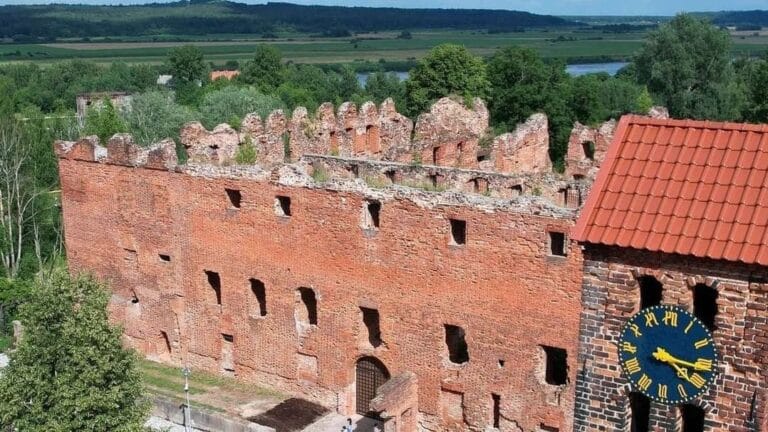
The citadel measures approximately 40 by 44 meters and encloses an inner courtyard. Its walls were built from fieldstone and brick using a construction technique characteristic of Teutonic Gothic architecture. The external walls survive, although with substantial losses, and the citadel forms the principal standing remnant of the medieval castle. The wider complex remains ruinous and is undergoing restoration.
The western foreburg and estate
The western foreburg served as the economic and service section of Georgenburg. It occupied considerably more ground than the citadel and contained stables, storehouses, barracks, and other service buildings. Much of this outer enclosure is now lost or ruinous, but its scale reflects the castle’s role as an administrative and agricultural estate as well as a fortified residence.
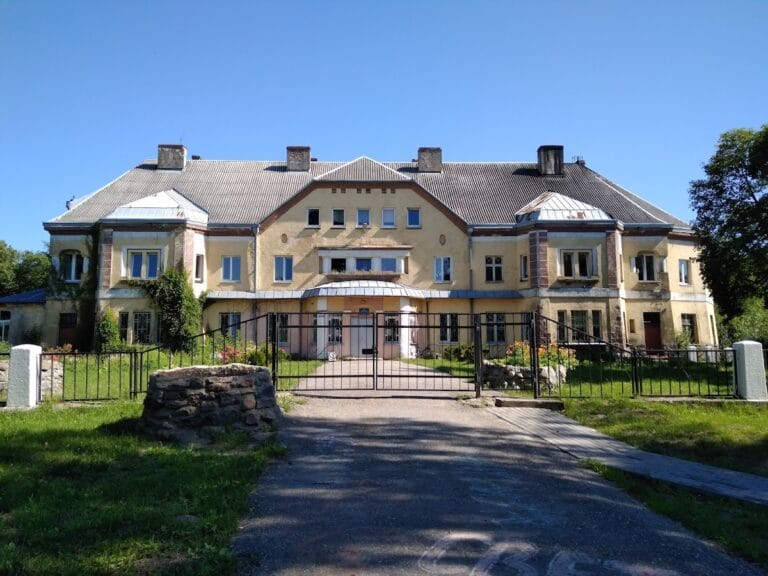
By the beginning of the twentieth century, the associated estate included a maintained park, stables, workers’ residential buildings, the Chapel of Saint George, its own water-supply system, and fountains. These features formed part of the later stud-farm complex surrounding the medieval stronghold.