Saint James Church in Znamensk: A Medieval Brick Gothic Parish Church


Site at a Glance
- Rating
- 4.6
- Popularity
- Low
- Country
- Russia
- Primary era
- Medieval
- External website
- Open
- Eras represented
- Medieval, Modern
- Civilizations
- Teutonic Order
- Site type
- Religious
- Remains
- Church
On this page12 sections
History
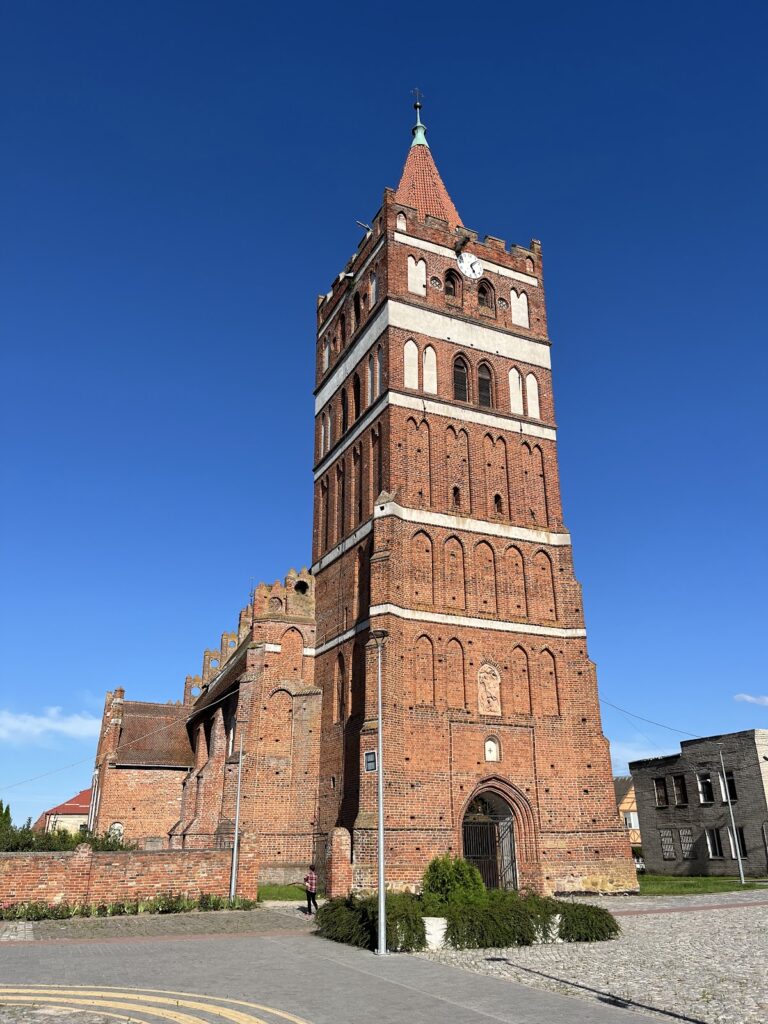
Saint James Church in Znamensk, Russia, is a medieval brick Gothic church built under the Teutonic Order between 1260 and 1280. Formerly in Wehlau, the church served as the town’s evangelical parish church until 1945 and was regarded as the most important church building in its district.
Foundation and Medieval Development
The church’s foundations and first construction belong to the period from 1260 to 1280. Lithuanian forces damaged the building in 1347, after which rebuilding began following 1351. The choir and sacristy were constructed between 1360 and 1380, while the nave and tower followed approximately between 1370 and 1400. A richly articulated eastern gable was added at the end of the fifteenth century.
A parish was established around 1380, before the Reformation. The church became the region’s only three-aisled church and developed into the central religious building of its district.
Reformation and Parish Life
Lutheranism, the Protestant tradition associated with the sixteenth-century reform movement of Martin Luther, was introduced at Wehlau at Pentecost in 1524. Until 1945, the parish belonged to the Wehlau church district and to the East Prussian Church Province of the Evangelical Church of the Old Prussian Union. This Protestant church body united Lutheran and Reformed congregations while preserving local traditions.
In 1925 the parish had three pastoral positions and 7,076 members. Parish records that survived are held at the Evangelical Central Archive in Berlin-Kreuzberg. They include alphabetical name indexes, including indexes for earlier years, and a special register of births of alleged followers of Edward Irving, a nineteenth-century Scottish Protestant minister whose followers formed a distinct Christian movement, from 1868 to 1872.
Destruction and Later Conservation
The East Prussian Operation of 1945 severely damaged the church, destroyed its furnishings, and ended its previous religious life. The flight and expulsion of the German population, together with the Soviet Union’s restrictive religious policy, made organized church life in Znamensk impossible after 1945.
Later conservation and partial restoration involved the Wehlau district association. Rubble was cleared from the nave, and in 1995 a steel structure with a spire was placed by helicopter on the surviving tower stump. In 1997, a church service was held in the ruin, partly in the open air, for the first time since 21 January 1945. New Evangelical Lutheran congregations emerged in the 1990s. The congregation nearest Znamensk is in Bolshaya Polyana, a branch of the Resurrection Church in Kaliningrad within the Kaliningrad provostry of the Evangelical Lutheran Church of European Russia.
The ruin is recognized as a regional cultural-heritage site of the Russian Federation. Its tower remains a widely visible landmark and a symbol of Wehlau. A stone plaque in the church wall identifies the building as the Teutonic Order Church of Saint James, gives the construction dates as 1260 to 1280, describes it as a ruin since 1945, and calls for its preservation.
Remains
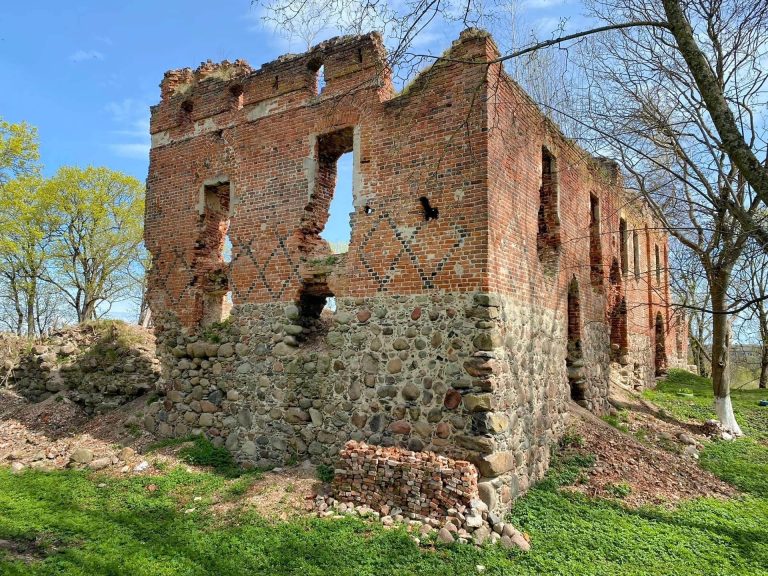
The surviving church is a brick Gothic, three-aisled hall church, meaning that the nave and aisles are approximately equal in height and form a unified interior space. It has a rectangular choir and a western tower partly incorporated into the nave. The building stands east of the Alle River, south of the Pregel, and north of the railway line and the road leading north from Znamensk.
Church Structure and Tower
Nave, Choir, and Vault
The choir and sacristy date from 1360 to 1380, while the nave and tower were built approximately between 1370 and 1400. The richly articulated eastern gable belongs to the end of the fifteenth century. The interior originally had a flat ceiling, which was replaced in the fifteenth century by a star vault, a stone vault whose ribs form a star-shaped pattern, supported by octagonal piers.
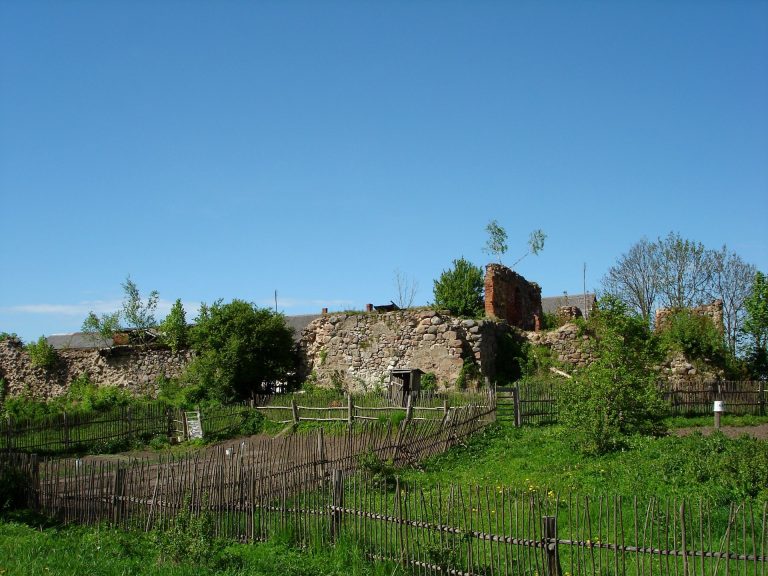
The 1945 damage left the vaults standing temporarily, but they were blown up in the 1960s. The surviving fabric now includes the external walls, supporting piers, the arcades between the nave and tower, and small sections of the defensive walls to the southwest.
Western Tower
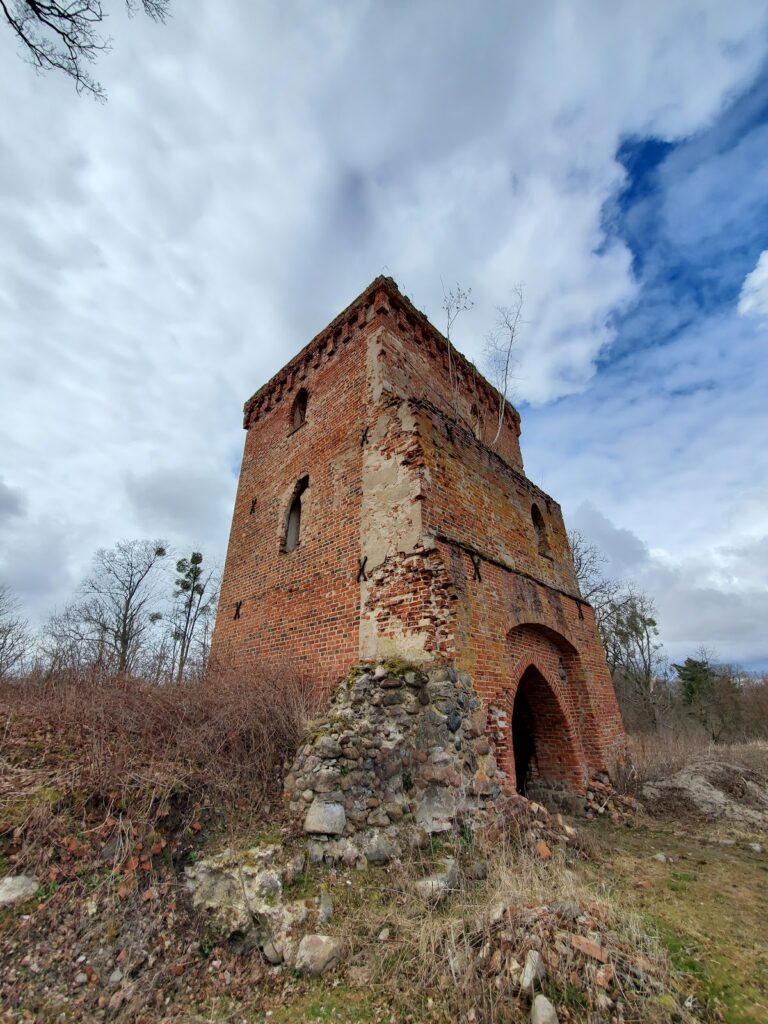
Lightning struck the tower in 1537, and it was rebuilt at a lower height. In 1820 it received a Baroque-style domed cap and a lantern, a raised structure above a dome or roof that admits light. The later damage left a tower stump, on which a steel structure with a spire was installed in 1995. Conservation also restored access to a viewing platform 58 metres above the ground. A combined heat and power plant stands beside the church.
Paintings and Furnishings
Medieval Wall Paintings
Fragments of medieval wall paintings survive on the arch opening from the tower’s first level into the nave. Their scenes show Judas’s betrayal of Jesus, the carrying of the cross, and the Coronation of Mary.
Altar and Interior Objects
The former altar retable, an architectural or sculptural structure behind an altar, was made in 1633. It combined late Renaissance and Baroque features and represented an allegory of a vine apparently growing from the base of the central painting. Its tiers contained paintings of Good Friday, Easter, and Pentecost.
The carved altar screen dates from 1688, and the pulpit from 1715. Parts of old pews, chandeliers, epitaphs, which are memorial plaques or monuments for deceased people, and church vessels from the seventeenth and eighteenth centuries also belonged to the interior.
Organ and Bells
An organ was installed in 1685, although 1699 is also associated with its installation. It was rebuilt in 1810 and replaced in 1896 by a new instrument made by the Geelhaar workshop of Königsberg. The church had three bells.