Sanctuary of the Blessed Virgin of Ariadello: A Marian Shrine near Soresina, Italy
Site at a Glance
- Popularity
- Low
- Country
- Italy
- Primary era
- Early Modern
- Eras represented
- Early Modern
- Civilizations
- Duchy of Milan, Spanish
- Site type
- Religious
- Remains
- Sanctuary
On this page9 sections
History
The Sanctuary of the Blessed Virgin of Ariadello is a Catholic shrine dedicated to the Virgin Mary, about 3 km from Soresina in Italy. By around 1640, worshippers were gathering at a portico sheltering a votive image of the Virgin and Christ Child, which many believed to work miracles. During a May visit by Soresina’s feudal lord, Marquis Giovanni Battista Barbò, his wife Eleonora, and their children, one daughter, who was deaf and unable to speak, reportedly gained hearing and speech as she approached the image and said the Virgin’s name. She may have been Teresa Gertrude Barbò, their fourth-born child, born in 1632.
From devotion to church foundation
Ecclesiastical authorities, particularly Cremona’s Bishop Francesco Visconti, feared that devotion to the image might encourage fanaticism. They ordered it covered and the portico enclosed, and did not allow a church to be built there for several years.
Construction and endowments
An act dated 26 September 1663 records Captain Pietro Maria Barbò, the marquis’s brother, planning an endowment to support a church. That year, Pietro Maria’s widow, Elisabetta Cattaneo, donated property for a side altar dedicated to the Visitation, the Christian account of Mary visiting Elizabeth. After he became a widower, Giovanni Battista Barbò entered the priesthood.
The first stone was laid on 21 January 1664. The building works continued for two years, and the church was blessed on 30 May 1666 by Orazio Malossi, Soresina’s parish priest. Its consecration is also dated to 1666. Completion of the sanctuary is dated to 1670, when a side portico was added. A church fabric board, responsible for the building and its assets, raised money for new altars. In 1674, the Community of Soresina gave adjoining land for a sacristy and a custodian’s residence. A governing body was later set up to administer the sanctuary’s endowments.
Later use and restoration
In 1817, the sanctuary served as a hospital for patients with epidemic typhus, a bacterial infection spread by body lice. Many ex-votos, offerings made in fulfillment of a vow or in gratitude for perceived divine favor, may have been lost during this period. The oldest surviving example dates to 1611.
Decorators Zanni, a father and son, partly revised the interior decoration around 1880. The Allodi firm of Cremona also worked on the church in 1912, and painter Giovanni Battista Galizzi repainted the vault medallion in the first half of the twentieth century. Water infiltration during the 1950s and 1960s damaged the building and made a major restoration necessary.
Remains
Setting and exterior
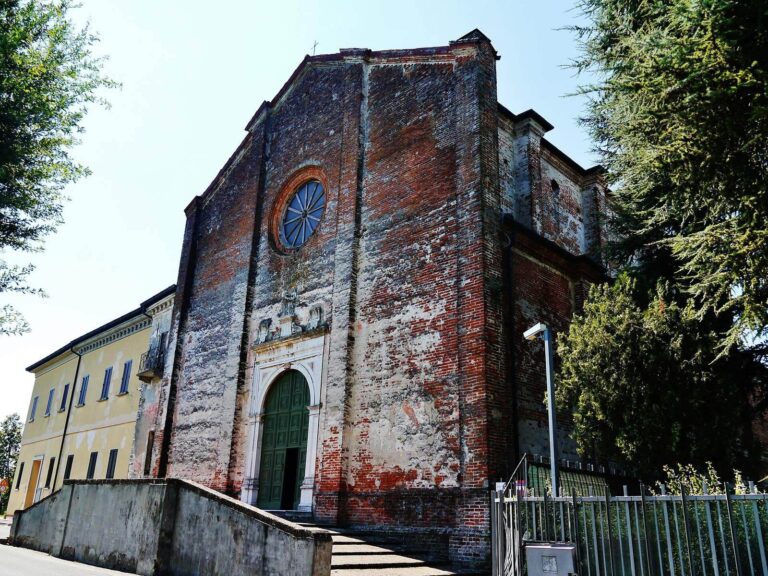
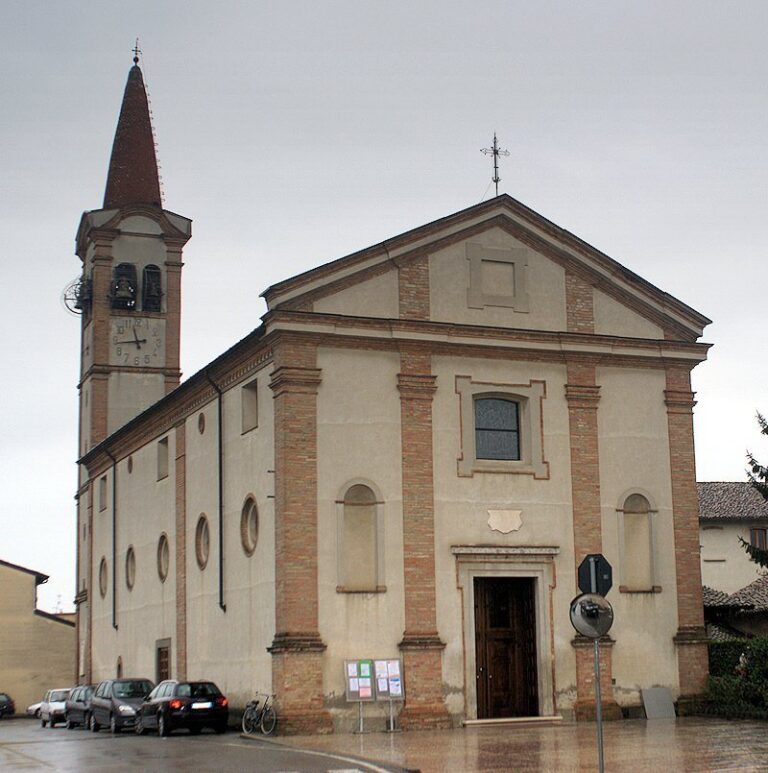
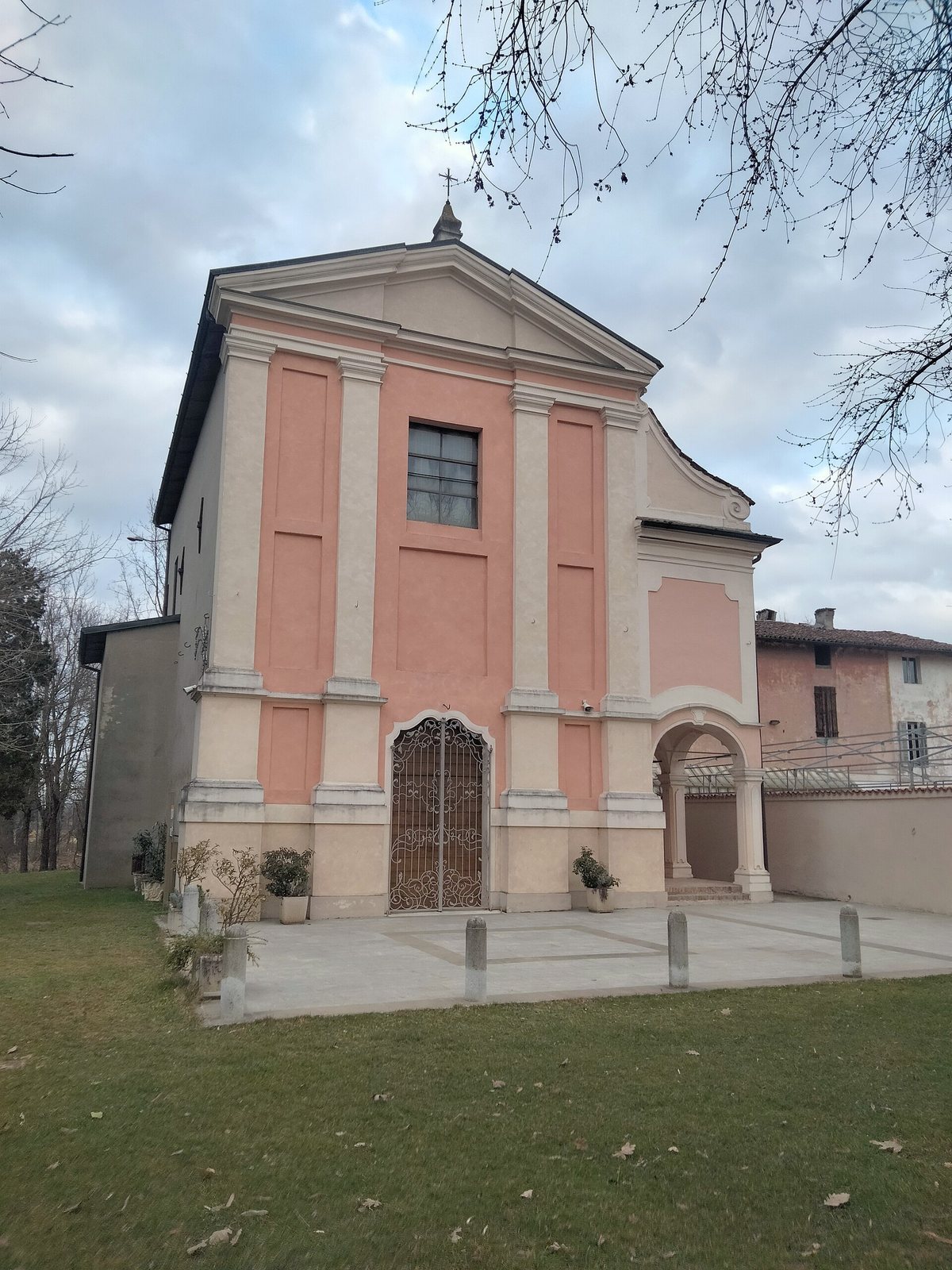
The church stands in open countryside near the boundary with Genivolta, within Ariadello and Valle dei Navigli Park. Its south-facing façade has four tall Ionic pilasters, shallow wall columns with spiral capitals, raised on piers and supporting a triangular pediment. Most of the rectangular panels are solid; one window admits light to the interior. A doorway with a frame of straight and curved lines is preceded by a wrought-iron gate. A curved scroll form joins the façade to the portico on the church’s right side. Two inscribed plaques are legible beneath the portico, and a painting of the Madonna on glass hangs at its far end. In 2016, the façade and side loggia were repainted in colors identified as original through examination of earlier paint layers.
Interior
Nave and chapels
The interior has a single nave, the main space for worshippers, and two side chapels. One is dedicated to Saint Fermo, an early Christian martyr; the other honors the Visitation of Mary to Elizabeth.
Altarpiece and paintings
A Baroque altarpiece encloses a fresco, probably dating to the sixteenth century, of the Madonna of Ariadello with the Christ Child. The altarpiece is made of scagliola, a decorative plaster finish that imitates marble or other stone. In the vault, Giovanni Battista Galizzi’s medallion depicts the Madonna of Ariadello with Soresina at her feet. Four paintings on the walls, probably from the Cremonese school of the second half of the seventeenth century, show members of the Barbò family worshipping before the Madonna.