Santa Maria delle Grazie: A Renaissance Church in Soncino
Site at a Glance
- Popularity
- Medium
- Country
- Italy
- Primary era
- Early Modern
- Eras represented
- Early Modern
- Civilizations
- Duchy of Milan, Holy Roman Empire
- Site type
- Religious
- Remains
- Church
On this page8 sections
History
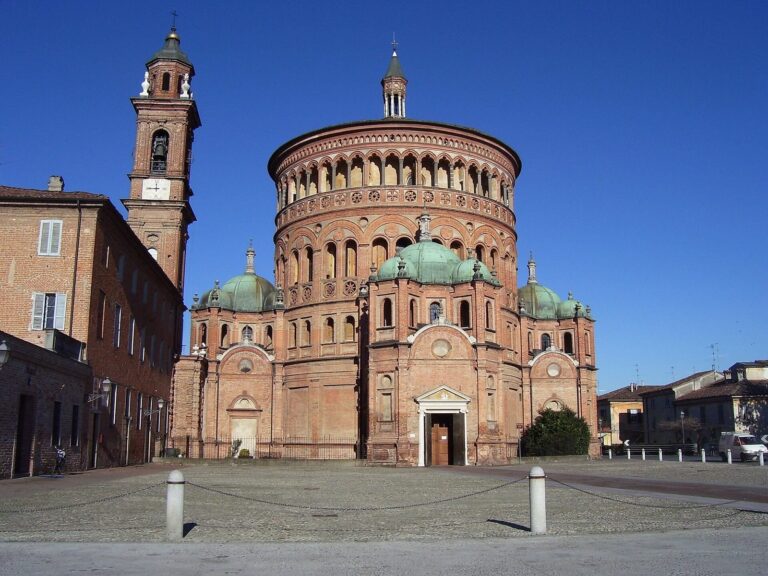
Santa Maria delle Grazie is a Catholic church in Soncino, Italy, dedicated to Our Lady of Grace and part of the Diocese of Cremona, the Catholic Church’s territorial jurisdiction under a bishop. Built during the Renaissance, a European cultural and artistic period, the church had its first stone laid in February 1501 and was completed in 1515.
Carmelite foundation and construction
In 1468, the Carmelites, a Catholic religious order, were entrusted with services at a small church outside San Giuseppe Gate in Soncino. A new church, strongly desired by Father Pietro da Mortara, was begun when Cardinal Raimondo Perauti, bishop of Gurk in Carinthia, laid its first stone. Father Antonio Maestri, who had come from the Carmelite convent in Mantua, supervised the work. The bell tower was built from 1515 to 1526.
Consecration and family patronage
Monsignor Luca da Seriate consecrated the church on 8 September 1528, at a ceremony attended by Francesco II Sforza, Duke of Milan, who had paid for the extensive fresco cycle. The church became a pantheon, or commemorative center, for the locally powerful Stampa family. In 1536, Charles V, a Habsburg ruler and Holy Roman Emperor, invested Massimiliano Stampa with the title of Marquis of Soncino inside the church.
Suppression and restoration
In 1772, an edict by Maria Theresa of Austria, an eighteenth-century Habsburg monarch, suppressed convents. The Carmelites consequently had to leave Soncino and the church, which then fell into decline. In 1864, Paola Elisabetta Cerioli, an Italian Catholic religious founder, bought the church and convent and restored them.
Remains
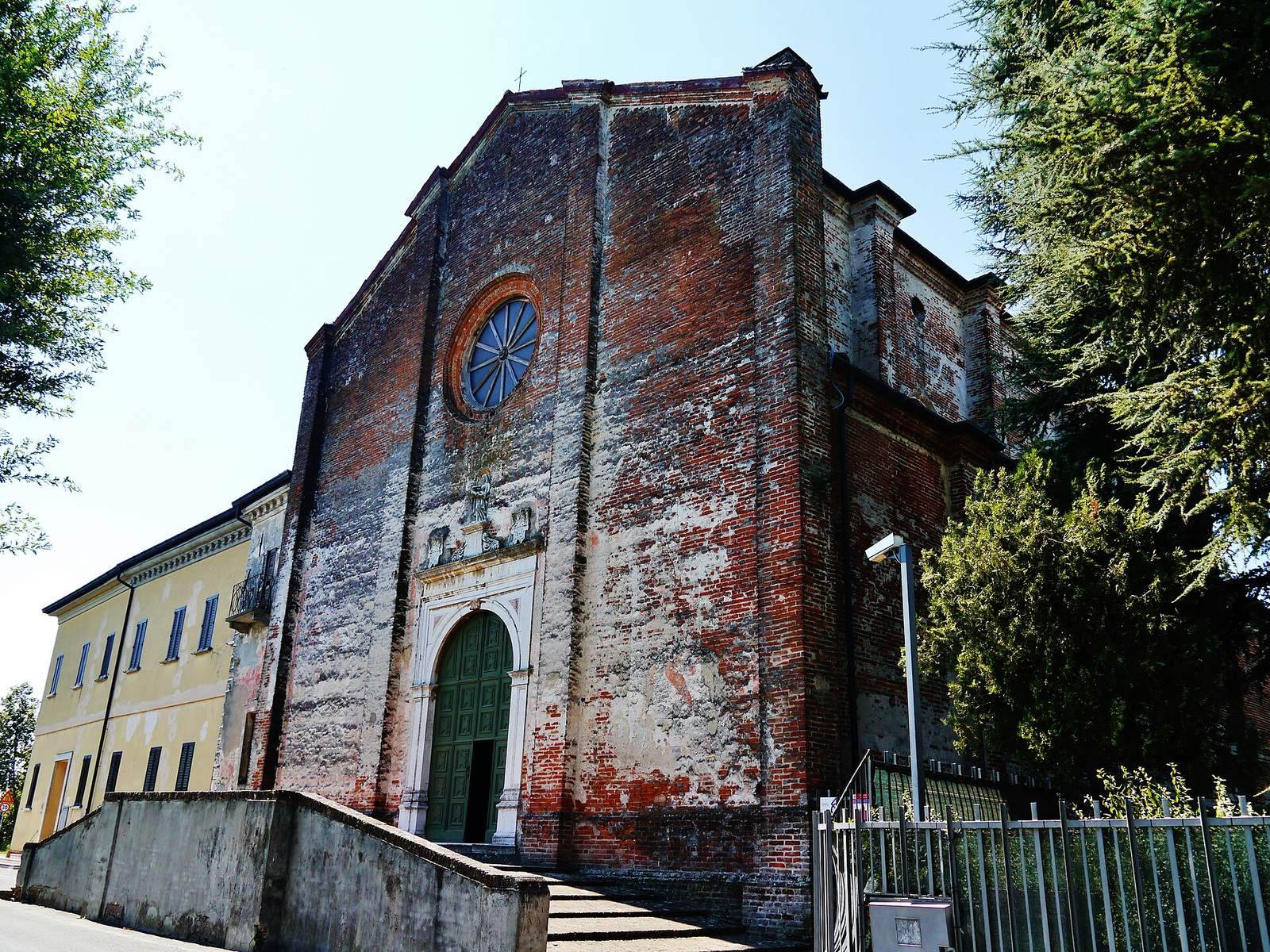
The church stands beside a disused stretch of the Calciana, an ancient commercial road of Roman origin connecting Bergamo and Cremona. Its rectangular plan centers on a single nave, with five shallow chapels opening on each side. A terracotta facade and vaulted interior define its principal architectural forms.
Facade and entrance
A two-flight staircase leads to the terracotta facade, which pilasters divide into three sections. Fragments of frescoes survive on its surface. The entrance portal, in the style of Renaissance architect Donato Bramante, is made of white marble from Rezzato, also known as Botticino marble. A rose window and a three-dimensional carved statue of the Virgin and Child stand above it.
Interior plan and vaults
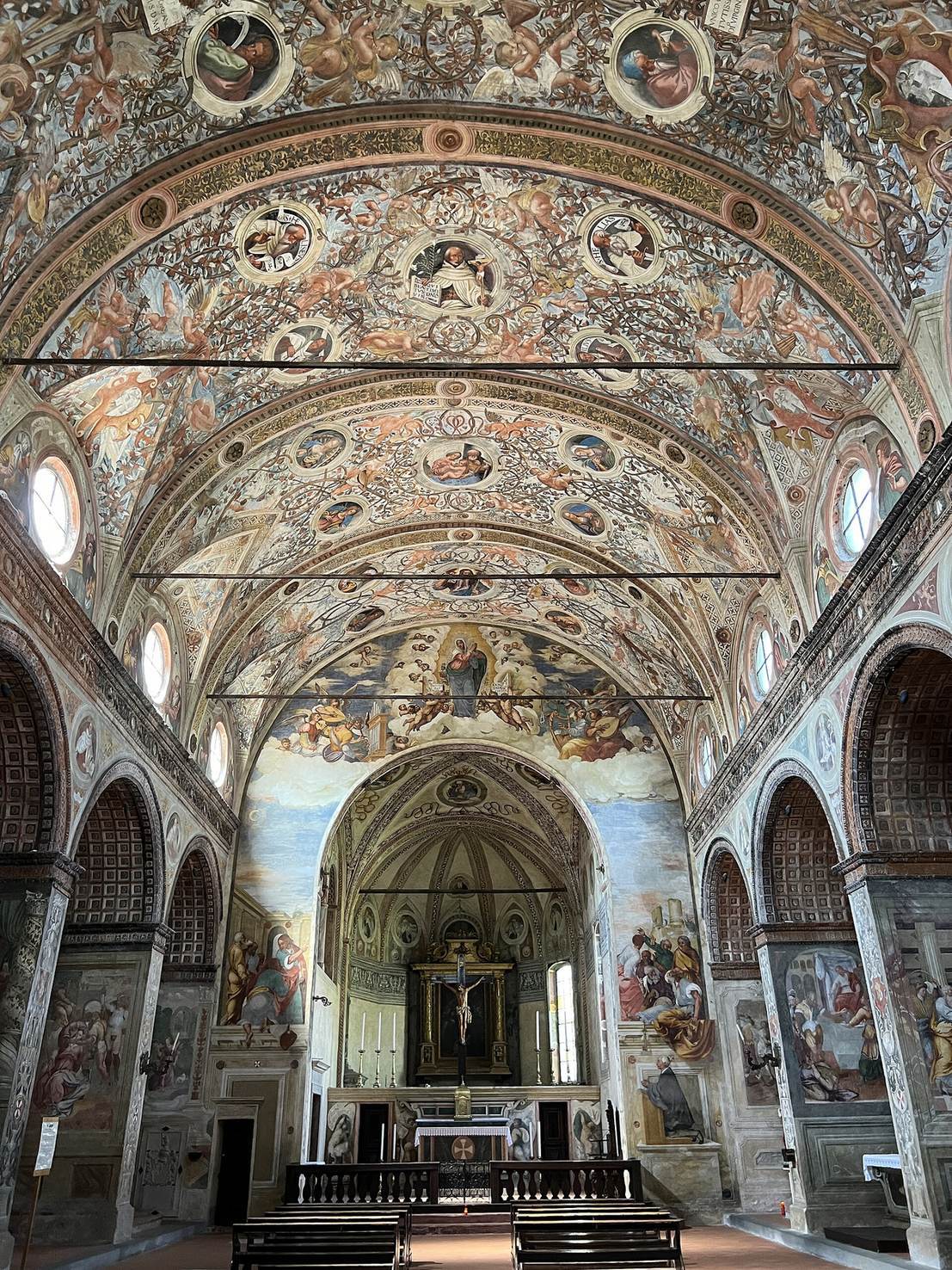
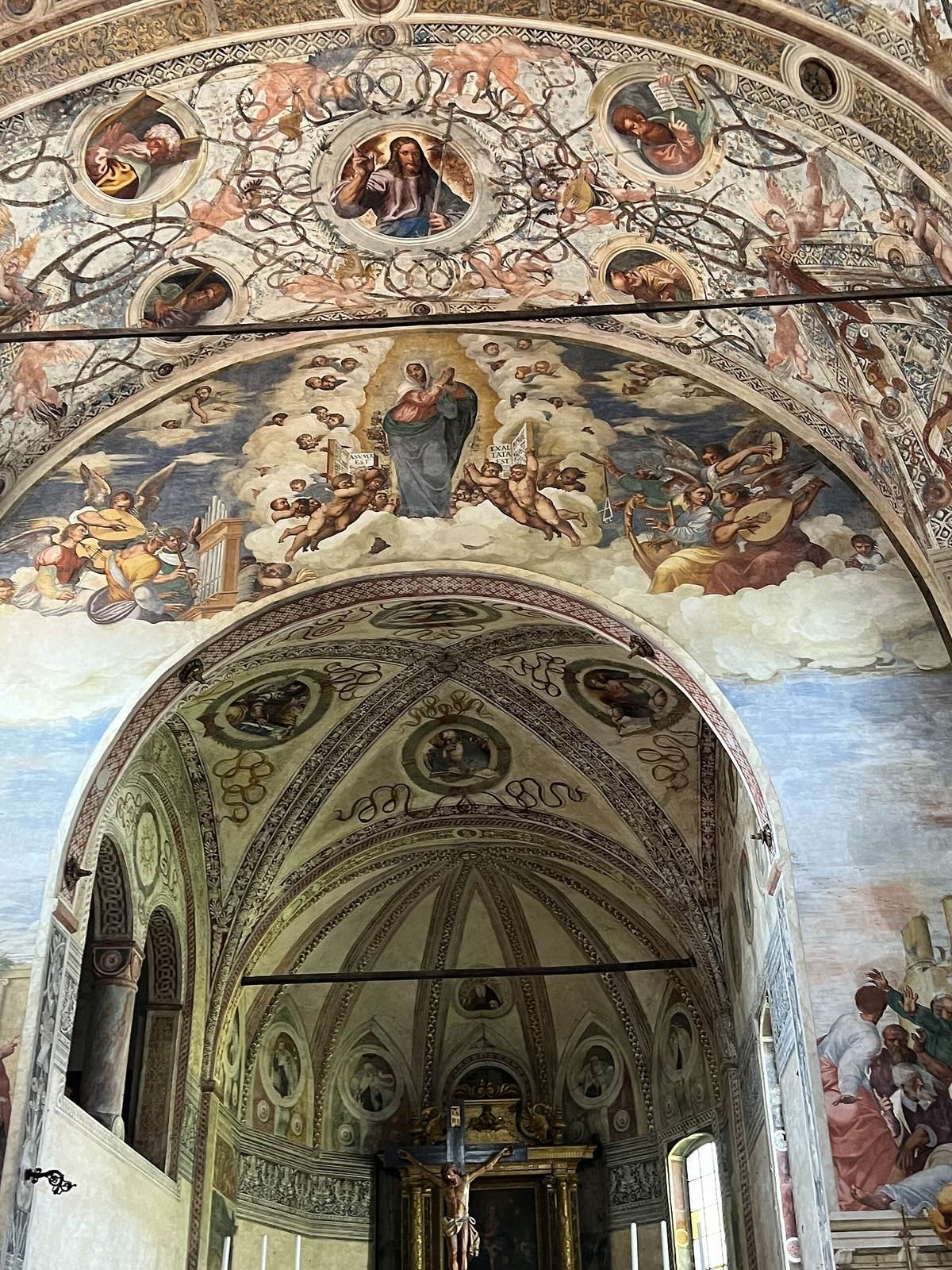
The nave, the church’s main body, is covered by a barrel vault, a continuous curved ceiling, divided into five bays, or repeated structural sections. Five shallow chapels open from each side. The presbytery, the clergy’s area around the altar, has a ribbed cross vault supported by intersecting ribs. Its four curved panels between the ribs show the Evangelists, figures traditionally associated with the authors of the four Gospels. A choir screen separates the presbytery from the apse, the sanctuary’s terminal section. The screen once divided the part of the church reserved for clergy from the area intended for the faithful.
Fresco cycle
Francesco Scanzi painted the first, fourth, and fifth chapels on the left and all five on the right. Their subjects include the Madonna and Child, the Flight into Egypt, the Annunciation, Christ appearing to Mary Magdalene, and saints. The presbytery’s vault paintings are attributed to Giulio Campi, as is an image of the Assumption of Mary, the Christian belief that she was taken into heaven, on the arch above. Francesco and Bernardino Carminati painted the Last Judgment on the interior wall opposite the entrance. Campi’s vivid colors, elaborate drapery, carefully developed compositions, and expressive figures have been associated with his growing engagement with Mannerism, a later style marked by expressive figures and deliberate artifice. In 1952, art historian Bernard Berenson described the interior as one of the Renaissance’s most elaborate decorative schemes.