Hryhorivske Fortified Settlement: A Multi-Period Archaeological Site in Ukraine
Site at a Glance
- Popularity
- Very Low
- Country
- Ukraine
- Primary era
- Iron Age
- Eras represented
- Iron Age
- Civilizations
- Unclassified
- Site type
- Military
- Remains
- Fortified Town
On this page16 sections
History
Hryhorivske fortified settlement is a multi-period archaeological site at Nova Hryhorivka, Ukraine. Its archaeological horizons span several cultural periods, including the late Chernoles culture, the early Scythian period, the Cherniakhiv culture, and the early medieval period.
Cultural phases
The site has Early Iron Age and early Slavic remains and is also associated with the Luka-Raikovets culture. Chernoles, Cherniakhiv, and Luka-Raikovets are archaeological classifications based on recurring material traits, rather than names for unified peoples. The Early Iron Age is a broad period associated with the adoption of ironworking. The early medieval period refers to the beginning of the Middle Ages, while the Early Scythian designation relates to the early Scythians, mobile Iranian-speaking peoples of the Eurasian steppe.
Recording and excavation
The site has been known since 1899, when Ukrainian historian and archaeographer Yu. Sitsinsky became the first to describe it. A local tradition associated with his description held that a “Turkish queen” had stayed there. Stories of buried treasure also led people to search the site.
The South Podolian Archaeological Expedition, led by Mikhail Illarionovich Artamonov, investigated the site in 1947 and 1948. Its first finds were identified as early Slavic antiquities. Systematic excavations began in 1952 and continued in 1953 after the initial work produced substantial results. Expedition teams also included researchers from Leningrad University, then named after A. Zhdanov, the Institute of Archaeology of the USSR Academy of Sciences, and the State Hermitage. Lev Gumilev, then a postgraduate student at the Institute of Oriental Studies, took part in the work.
Archaeological interpretation and protection
Archaeologists G. I. Smirnova and M. T. Kashuba identified a local group of the late Chernoles culture in the Middle Dniester region. They used the Brainerd-Robinson method, which compares the proportions of shared artifact categories, especially pottery, to assess similarities between sites. Their group included Hryhorivske as well as sites at Bronnytsia, Yaruha-Potlaivska Odaia, Yaruha near the Cross, Matviivka I, Bokotynka Ravine, Ozaryntsi above the Meadow, and Matviivka II.
Hryhorivske fortified settlement is designated an archaeological monument of national significance, listed as No. 020014-N.
Remains
Setting and earthwork defenses
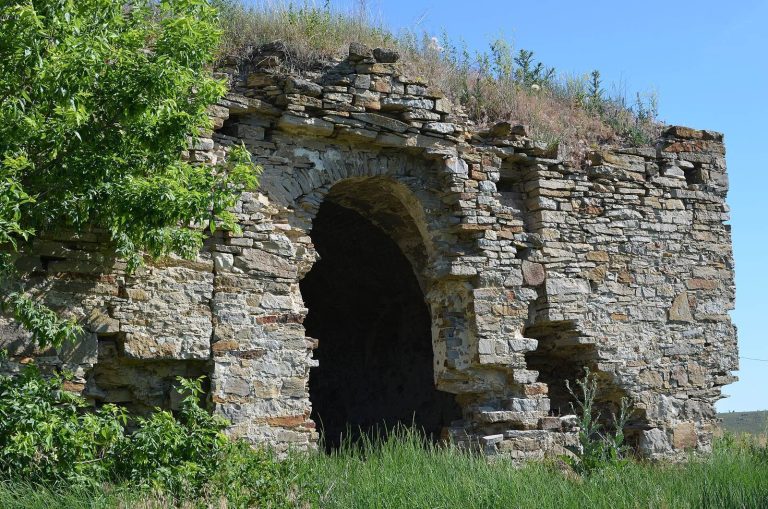
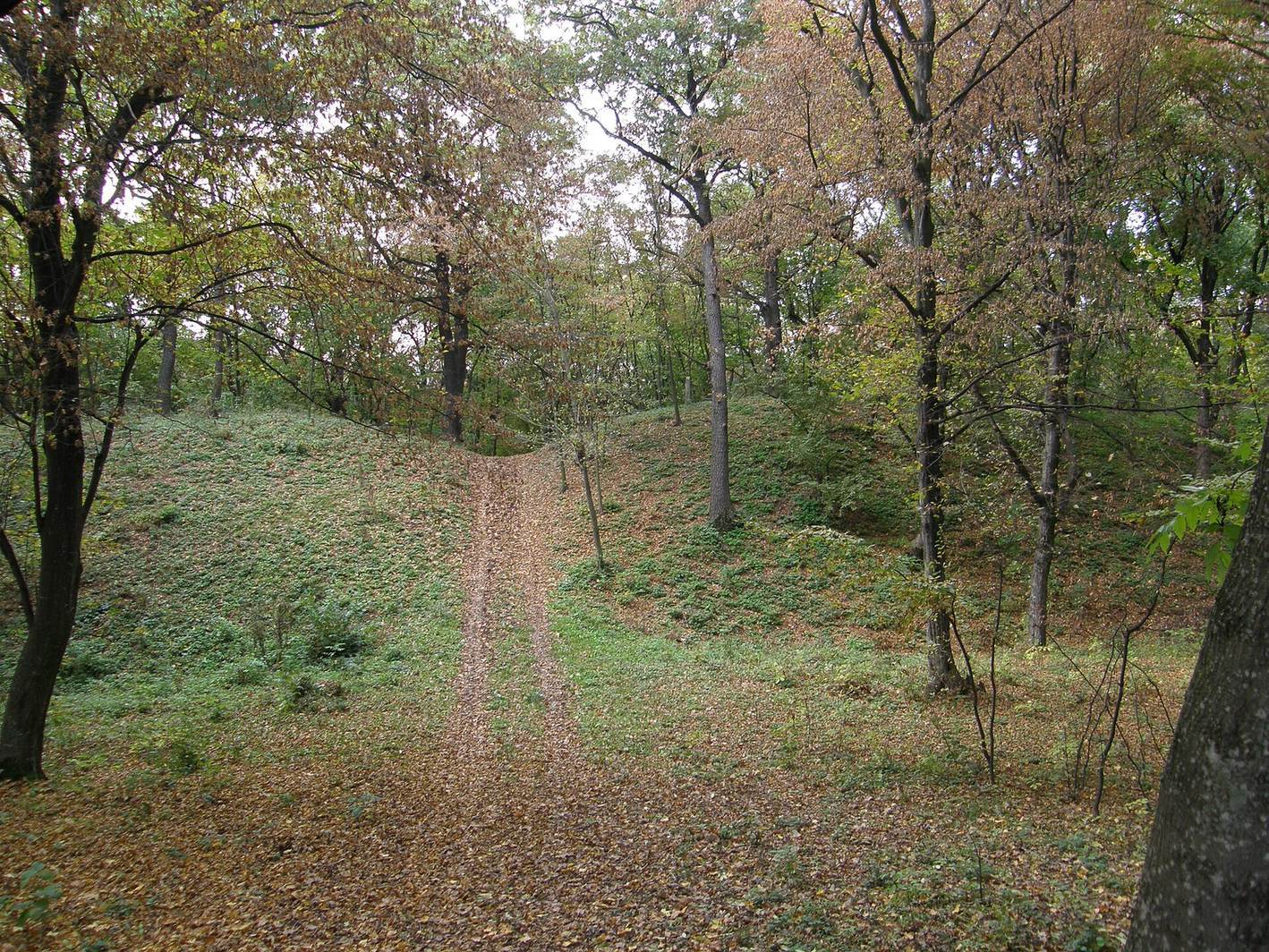
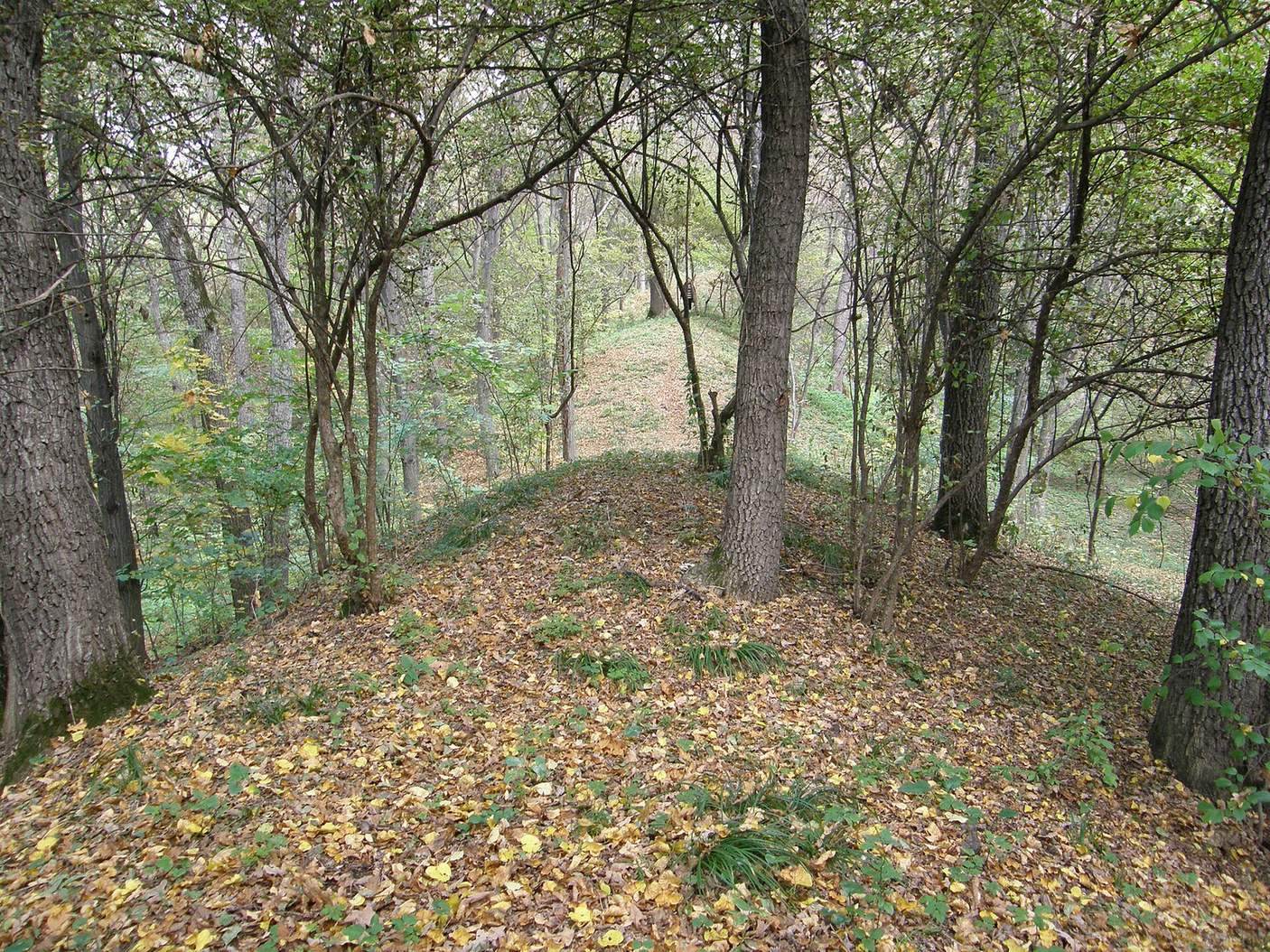
The site occupies a high, steep section of the left bank of the Kotlubaivka, a tributary of the Dniester, about 4 km from its mouth. Its fortified area extends across the slope and an adjoining plateau between two deep ravines. A rampart, or raised defensive earthwork, and a deep, dry ditch, an excavated trench, enclose the central area. Further earthworks protect the approaches and parts of the plateau.
Central enclosure
The central enclosure is irregularly circular and covers about 4 hectares. Its substantial rampart reaches up to 8 m in height, with the ditch forming an additional obstacle around the area.
Outer defenses
Below the central enclosure, a curved rampart follows the steep bank and protects the approaches. A ditch runs along its outer side, and both ends connect with the central rampart. The inner faces of these defenses are relatively low, while their outer slopes fall directly into the deep ditch. The rampart facing the riverside plateau is especially strong where the plateau meets the slope. Elsewhere, a smaller rampart and ditch enclose part of the plateau between the ravine heads on its landward side, and another rampart runs along the northeastern ravine edge. The ravine slopes are wooded, while the plateau is cultivated.
Excavated deposits and structures
Excavations in 1952 and 1953 involved numerous test pits and six excavation areas. Two areas in the central part of the site covered 280 square metres together. The accumulated archaeological layer reaches 0.7 m in places.
Pits
Numerous pits belong to the Early Iron Age. Artamonov considered that most probably served to store supplies, including grain. One pit, 2.1 m across and 2 m deep, was interpreted as a dwelling. It had traces of a hearth, a posthole at the bottom that apparently held a roof-supporting post, and a step in one side that marked the entrance. Its fill consisted chiefly of surrounding sterile soil that accumulated gradually, supporting the interpretation that it was neither a storage nor a refuse pit. Later, the pit was reused as a dwelling: above a 15 cm layer of sterile clay lay further hearth remains and a thick deposit of ash.
Hearths
Excavators also found numerous open hearths. These were thought likely to have served light structures built above ground.
Pottery and other finds
Cooking vessels
Pottery fragments were the most numerous finds. Coarse grey kitchen vessels were made with clay tempered by quartz sand, sometimes mixed with small pebbles. The forms included tulip-shaped and jar-shaped pots. Tulip-shaped vessels often had a smooth or segmented ridge around the body and holes along the rim. Straight-sided examples had rim perforations and a segmented ridge just below the rim.
Tableware and storage vessels
Tableware included ladles with cup-shaped bowls and rounded bases, sometimes with a central boss, or raised knob. Goblets had either tall cylindrical necks or short ones, while bowls had rims that curved inward. Jar-shaped vessels could have a ridge around the body and a handle like those on ladles. Large storage jars had low necks and projecting grips, or a ridge at the shoulder. Some vessels were grey or brown, made from relatively fine clay and lightly smoothed. Others were black and burnished, meaning polished by rubbing. Bowls in this dark, polished group often had varied projections along their rims.
Decorated pottery
Ladles, goblets, and small storage jars often carried incised patterns, cut into the surface, or stamped designs that were sometimes filled with white paste. The motifs included toothed impressions, ring stamps, and S-shaped stamps. One notable brown, polished vessel had a pointed base and four rows of hatched diamonds, with small pits at the corners. A small double cup had one handle and a hole through its wall. Ladle handles were often tall and ended in a blunt cylindrical projection; some had two or three projections, including flat knobs, and some were decorated with incised lines.
Other finds
Other finds included distinctive clay objects shaped like animal paws with claws, small leaf-shaped flint arrowheads with or without short tangs, and a clay stamp used to apply S-shaped designs to pottery. The metal objects included a bronze needle, a bronze pin, and several arrowheads. A tang is the narrow projection by which an arrowhead attaches to its shaft.