Belinho Castle: A Neolithic Settlement and Islamic Fortified Manor in Portugal
Site at a Glance
- Popularity
- Low
- Country
- Portugal
- Primary era
- Stone Age
- Eras represented
- Stone Age
- Civilizations
- Unclassified
- Site type
- Domestic
- Remains
- Manor House
On this page10 sections
History
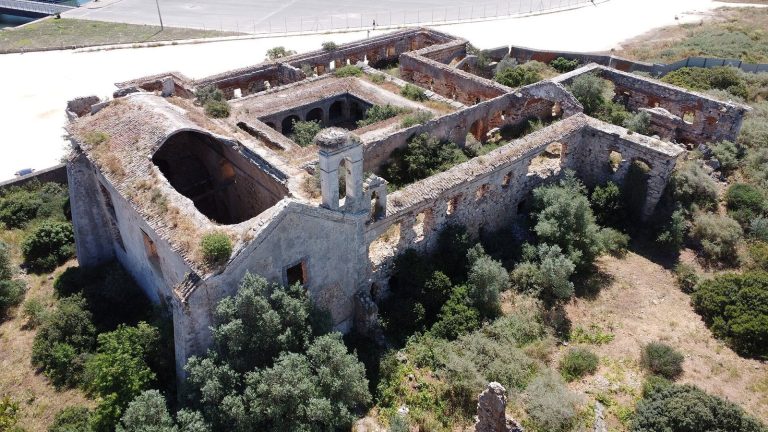
Belinho Castle is an archaeological site at Morgado do Reguengo, about five kilometres north of Portimão, Portugal. Its earliest occupation belongs to an evolved phase of the Early Neolithic, the later part of the Stone Age associated in many regions with settled communities and farming, around the middle of the fifth millennium BCE. An Islamic fortification occupied the site in the medieval period, creating a sequence of prehistoric and medieval use.
Early Neolithic occupation
The first community may have used the place as a sanctuary with an associated burial ground. This early use predates the medieval fortification by millennia.
Islamic fortification and later use
A fortified Islamic complex was built over the earlier remains, damaging them in places. Its construction probably followed the Almohad reconquest of Silves in 1191. The Almohads were a Muslim dynasty that ruled parts of North Africa and the Iberian Peninsula. Christian forces destroyed the complex during the reconquest of the Algarve in the 1240s, although occupation at the site continued into a final phase in the seventeenth century.
The earliest recorded place-name was Castelo do Ninho, or Castle of the Nest, possibly a reference to birds nesting there. The name Castelo Belinho is thought to recall the Islamic fortification.
Archaeological investigations
In the 1980s, Rosa Varela Gomes interpreted the medieval remains as an outlying fortress of Silves. Archaeological work in 1994 sought ways to limit damage from forestry, and the Portuguese Institute of Archaeology studied the site in 2000.
Excavations in 2004 and 2005 brought the Neolithic remains to light and led to a new interpretation of the Islamic complex as a fortified manor within a wealthy Muslim’s agricultural estate. In 2005, Mário Varela Gomes described the Neolithic site as potentially the most important of its period in Portugal, an assessment supported by historian Carlos Damas.
Remains
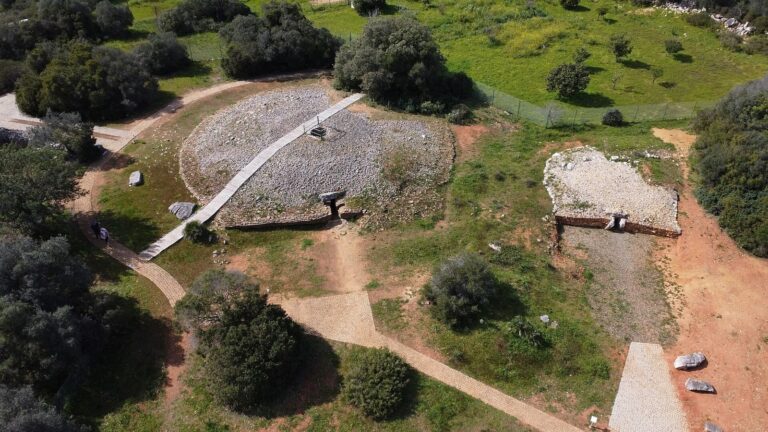
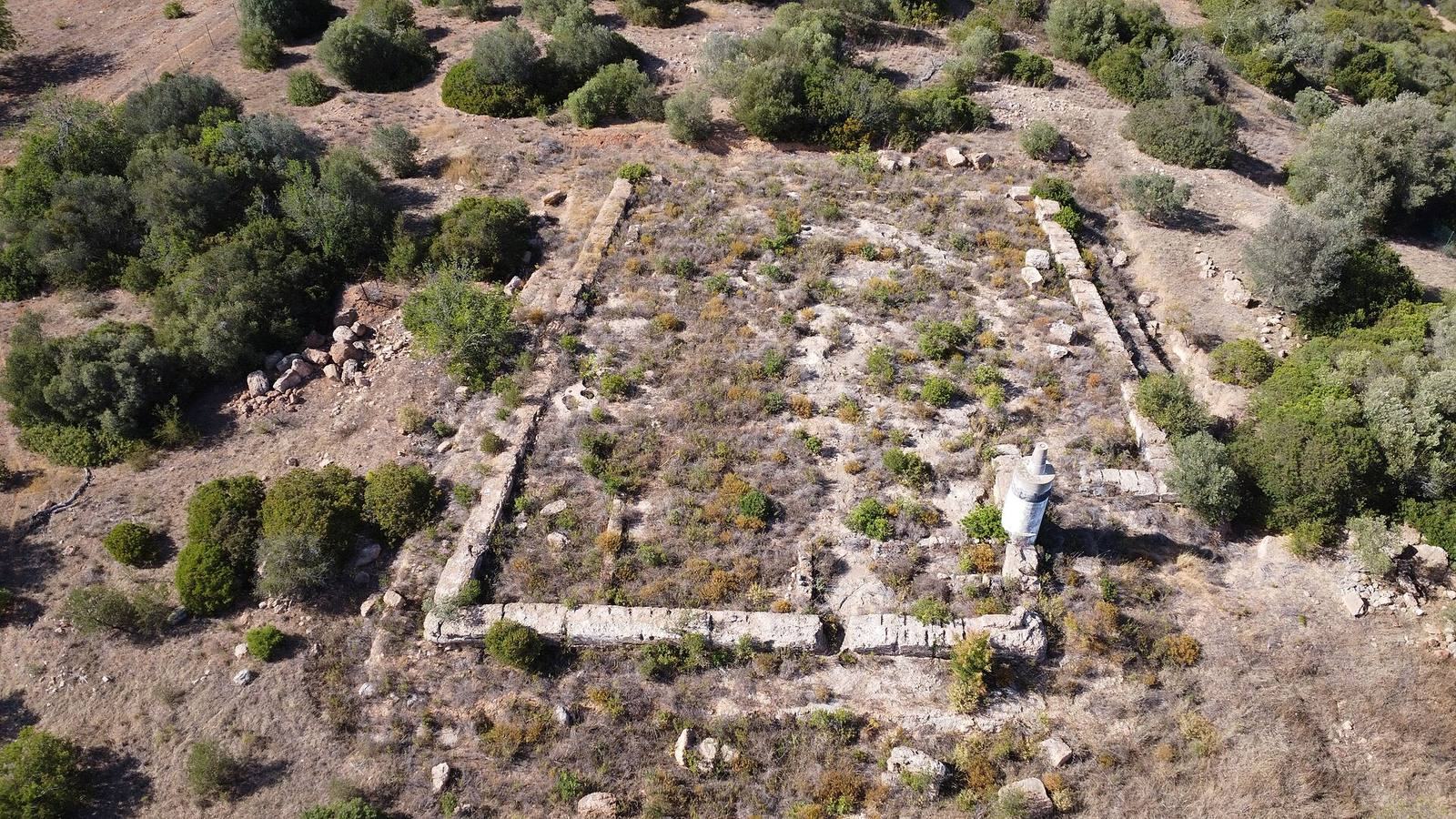
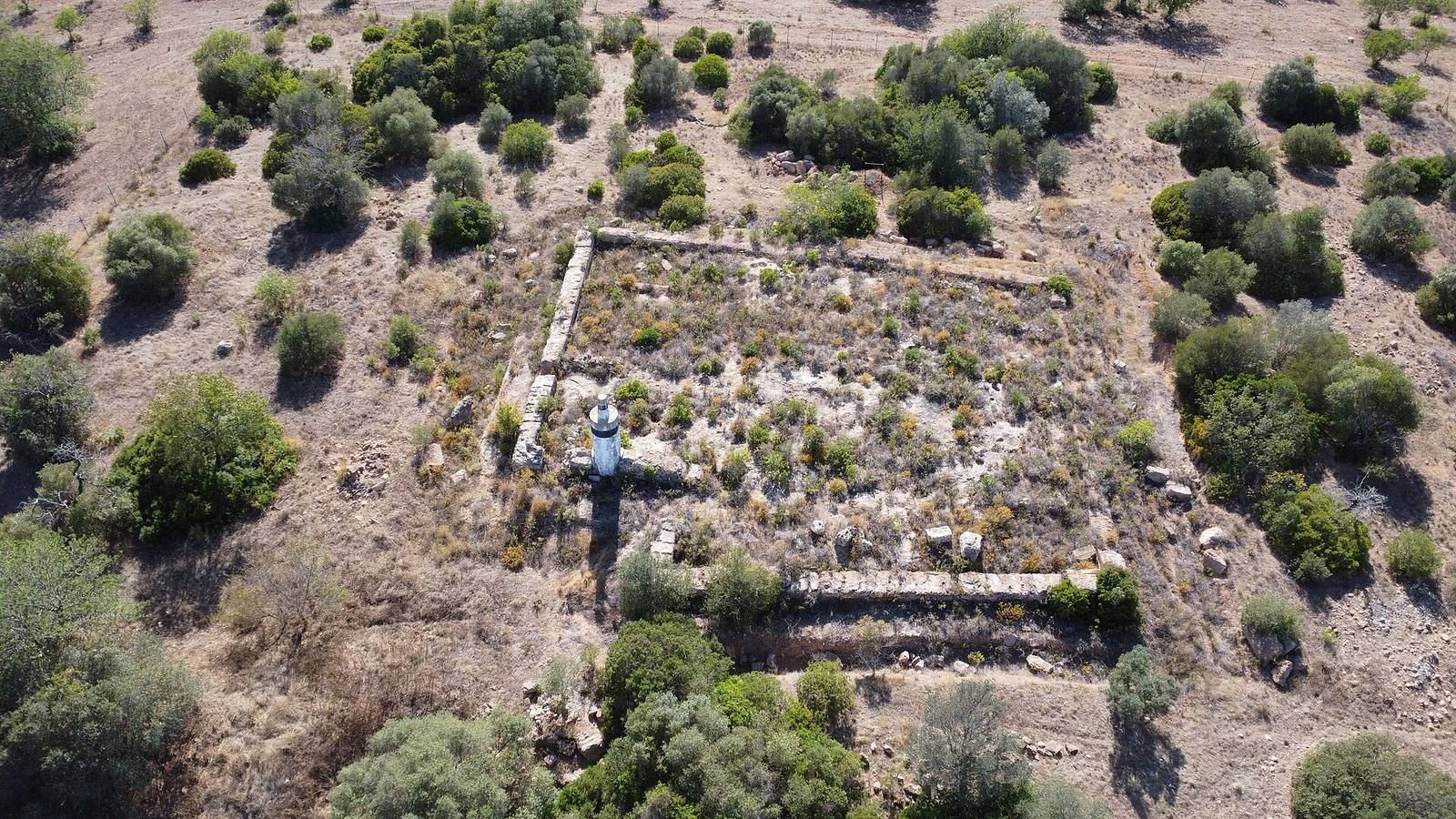
The site’s main physical groups are traces of a Neolithic settlement and burial ground, together with a later Islamic fortified rural house. The prehistoric buildings are identified by holes for their wooden supports; the medieval house was built directly on bedrock using compacted, lime-rich earth.
Landscape and setting
The site lies on the southern foothills of the Serra de Monchique between two watercourses. The Ribeira de Boina runs about one kilometre to the east and flows into the Arade River; roughly the same distance to the west, the Barranco dos Álamos drains toward the Ribeira da Torre. The area has mainly red Mediterranean soils, and the underlying geology includes limestone and Miocene calcarenite.
Neolithic settlement and burial ground
Buildings and storage pits
Holes left by supporting posts reveal ten buildings, apparently long structures held up by wooden posts. The largest footprint measured about 16 by 3 metres, covering 48 square metres. Several storage pits, sometimes called silos, also formed part of the settlement.
Graves and associated finds
Nearly twenty burials were cut into bedrock. The graves were oval in plan and silo-shaped, and the dead were placed in a curled, fetal posture. Nearby pits contained human remains along with remains of mammals and molluscs. The burial position may have evoked the maternal womb and related to a belief in resurrection.
One adolescent male grave contained 22 sea-shell bracelets arranged on the arms. At the time, this was the largest group of bracelets found in a single burial in the Iberian Peninsula. Rosa Varela Gomes interpreted the rich adornment as an indication of high social standing; a role connected with magic has also been considered possible.
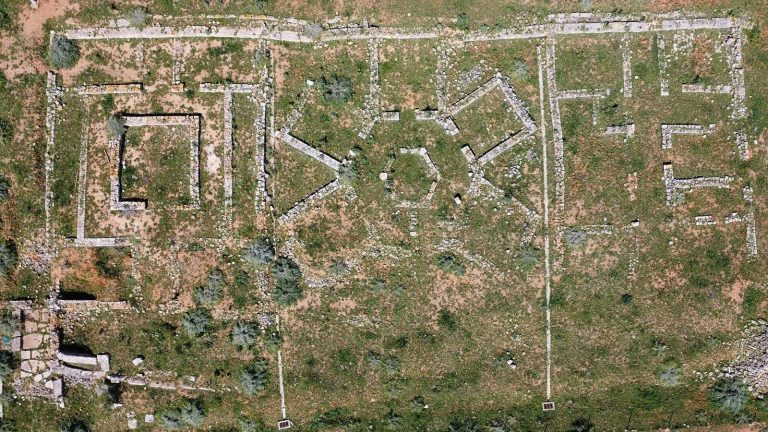
Islamic fortified manor
The rural house had a roughly trapezoid-shaped plan and stood directly on limestone bedrock. Its walls were made by compacting lime-rich earth within temporary formwork. Defensive walls and a surrounding ditch, cut into the limestone, protected the building.