Gothic Bridge in Kłodzko: A Medieval Stone Arch Bridge
Site at a Glance
- Popularity
- High
- Country
- Poland
- Primary era
- Medieval
- Eras represented
- Medieval, Early Modern, Modern
- Civilizations
- German, Habsburg, Holy Roman Empire, Kingdom of Bohemia
- Site type
- Infrastructure
- Remains
- Bridge
On this page15 sections
History
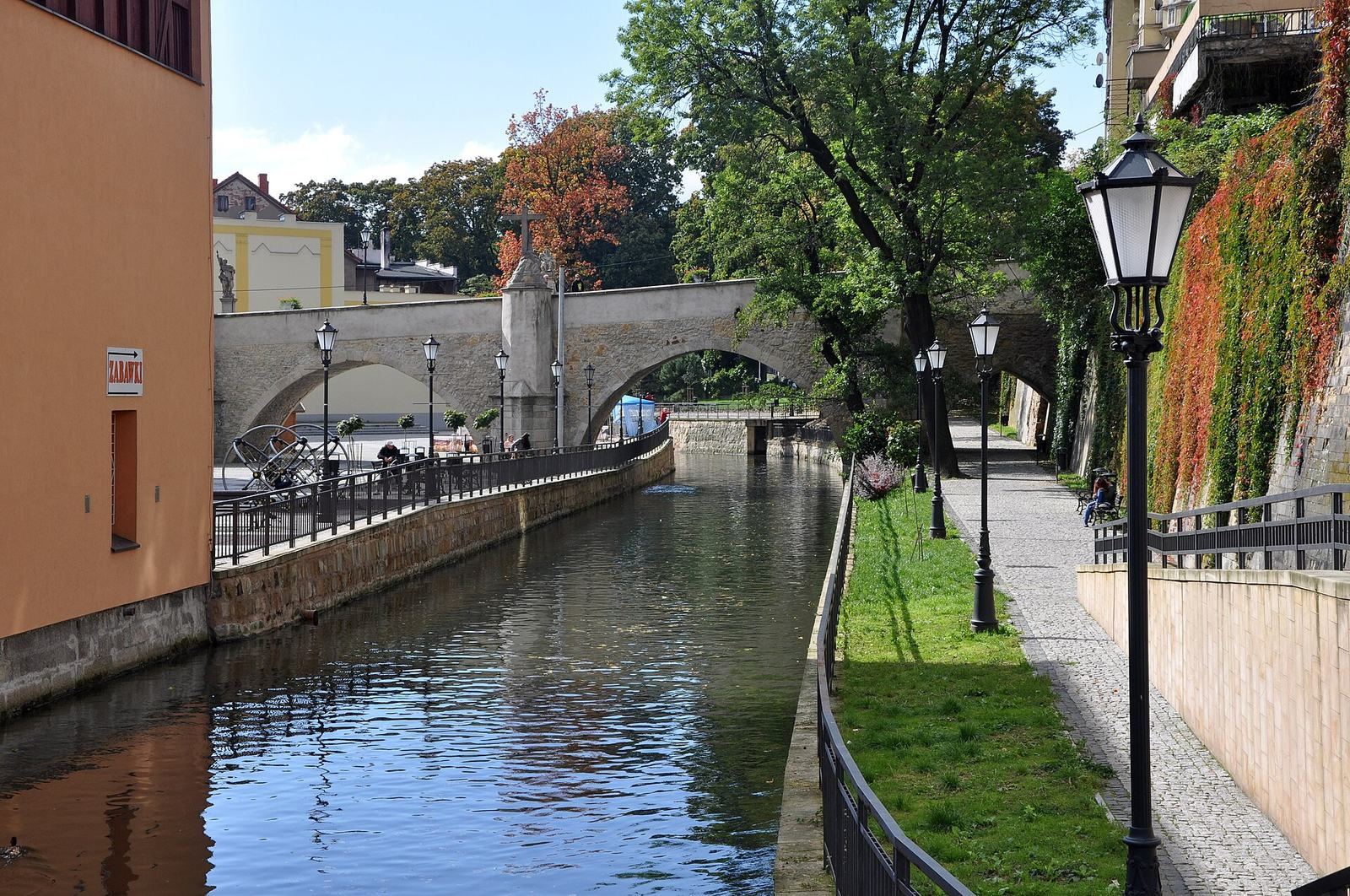
The Gothic Bridge in Kłodzko, Poland, is a late-medieval stone arch crossing of the Młynówka, generally dated to around 1390 and built under a Bohemian king named Wenceslaus. A wooden crossing probably preceded it, and the stone structure replaced that bridge between 1376 and 1390. It is among the region’s oldest stone arch bridges of its type. The bridge formed part of Kłodzko’s defenses and a major route through the city, connecting the old town on Fortress Hill with the marketplace and fortress, and linking the city to Piasek Island, home to a horse market and Franciscan monastery.
Repairs and sculptural program
Warfare, floods, and ordinary wear led to repeated repairs, strengthening, or rebuilding. Work is recorded in 1626, 1701, and 1750. Alterations in the seventeenth and eighteenth centuries included a balustrade and brickwork above the piers.
Six sculptures in the Baroque style, a European movement known for elaborate decoration and dramatic forms, were added over roughly 80 years. Their installation took place during re-Catholicization, efforts to restore or strengthen Roman Catholic practice and institutions, following the Thirty Years’ War, the major European conflict fought from 1618 to 1648. Patrons included wealthy townspeople and owners of knightly estates.
Fortifications and later conservation
A gate once stood at each end of the bridge. The upper gate, built in the late thirteenth century, began as a three-storey defensive building with a hipped roof and was later converted into a residential tenement. The lower gate, built before 1469, controlled access. After the city’s fortifications were dismantled following 1877, both gates were demolished in 1903 and 1904. The bridge entered the Lower Silesian register of historic monuments on 25 November 1949. Major restoration took place in 2009, followed by further work in 2013. In 2014, the bridge received an award for conservation that maintained its historic character while emphasizing its successive phases and its place in the urban ensemble.
Remains
Bridge structure
Layout and setting
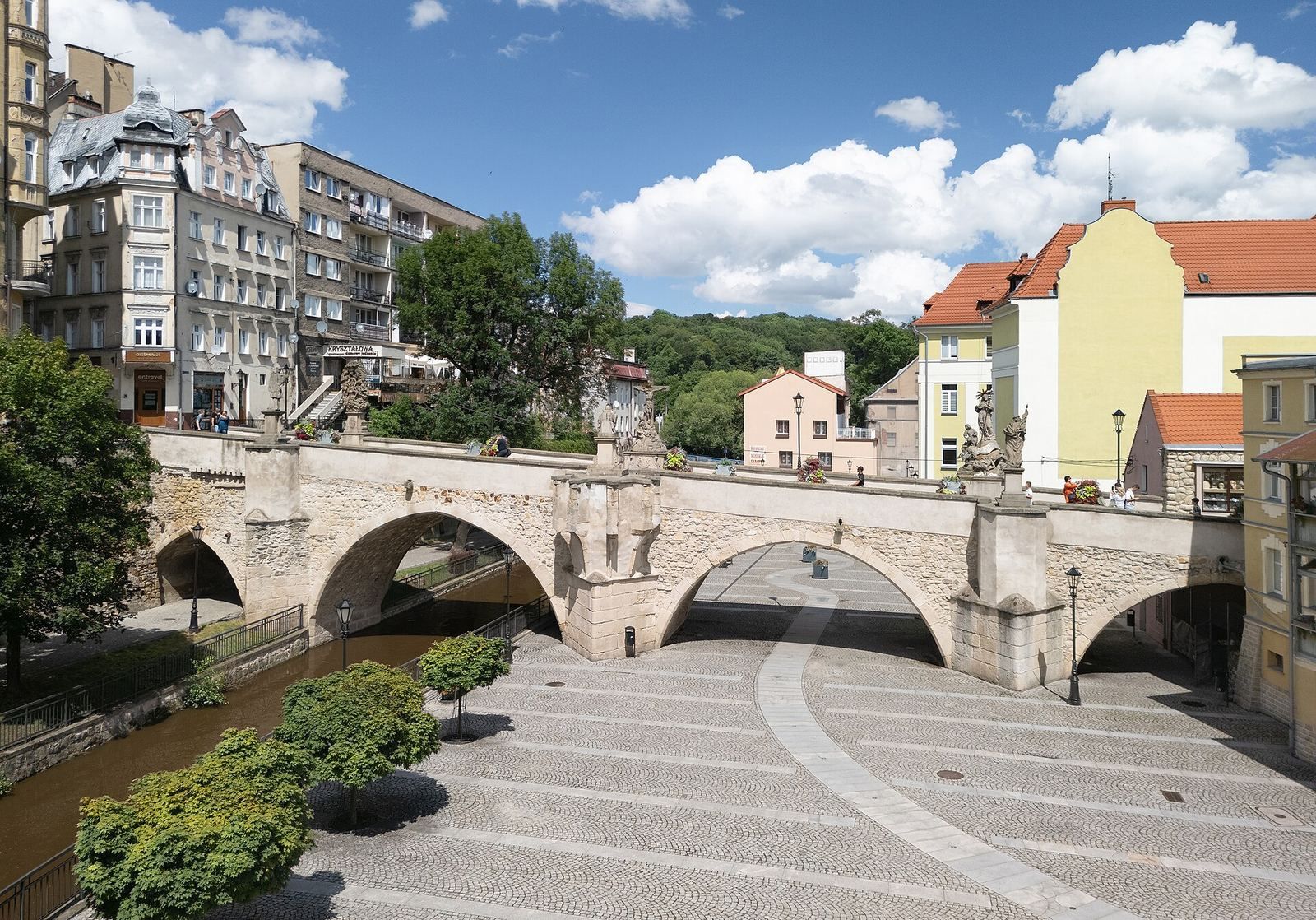
The four-span stone structure is about 52.2 metres long and 4 metres wide. It crosses the Młynówka, an artificial, walled channel branching from the Nysa Kłodzka that once carried water to two Kłodzko mills. Two abutments, the supports at either end, and three piers, supports between the spans, carry the bridge. It lies on Wita Stwosza Street, with Partner Cities Square below its eastern side. A footpath runs under the northern arch along the line of the former city defensive wall.
Arches and supports
The arches are built from sandstone blocks, including cut wedge-shaped stones, and the two narrower outer arches are pointed. The mortar may have included chicken egg white, lime, and sand. Massive stone parapets line both sides. Projections at the bases of the piers served to break ice, while their upper portions have projecting bay-shaped features. Six ribs rise above the central pier’s base and support a flat platform shaped like an incomplete star, designed for chapels.
Roadway and surface
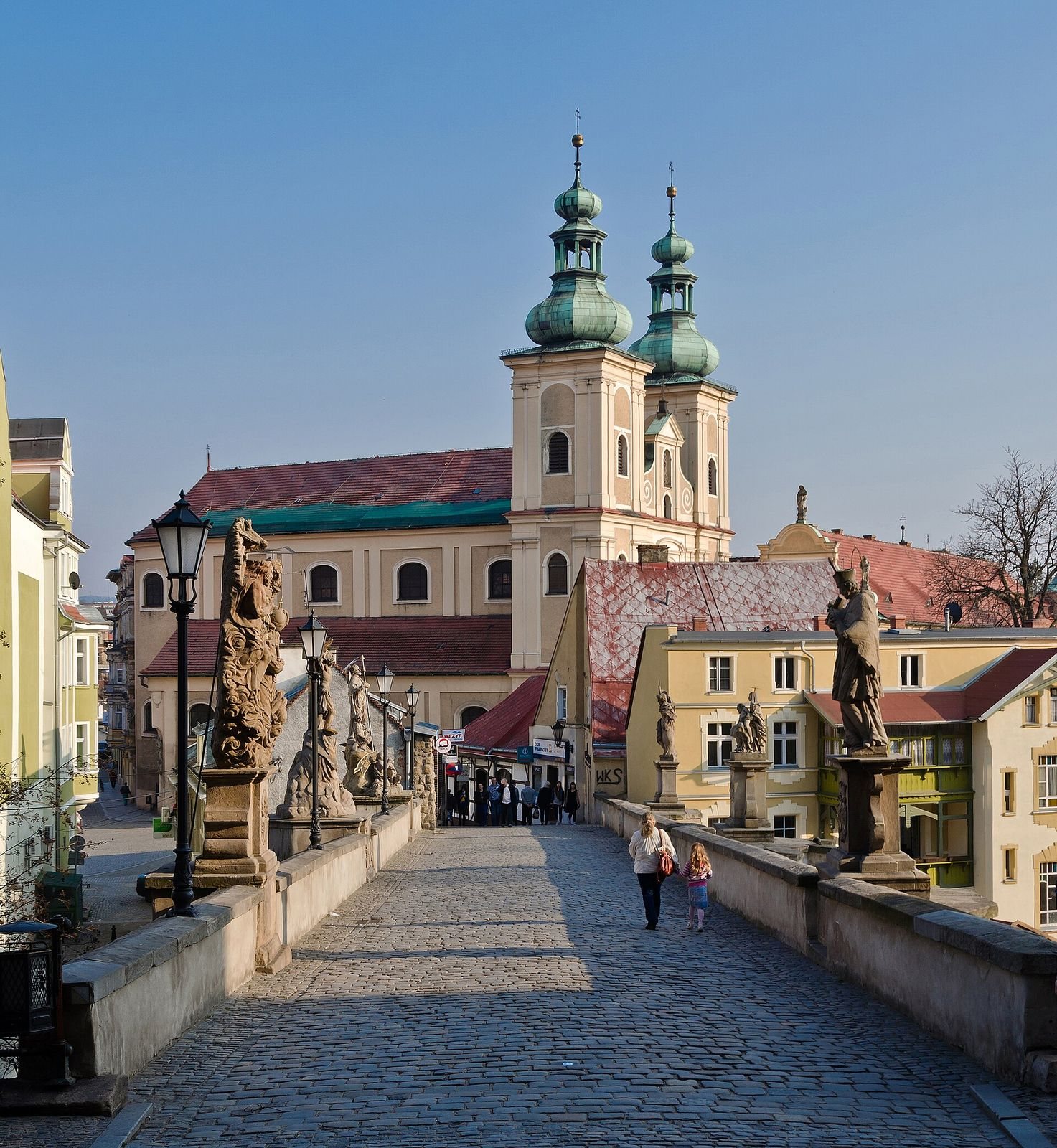
The bridge rises by about eight percent toward the old town. The road on this slope was formerly called Brücktorberg, meaning Bridge Gate Hill. Granite cobbles were laid in 2007. Lamps were installed on the bridge in the early twentieth century, and gas lighting followed the removal of the gates.
Sculptures
Six stone figures stand on the parapets above the piers. On the eastern side are St Francis Xavier, the Crucifixion, and the group of the Holy Trinity crowning Mary. The western side carries St Wenceslas, the Pietà, and St John Nepomuk.
St Francis Xavier
St Francis Xavier, a sixteenth-century Spanish Jesuit missionary and priest, is shown above three sick people and a figure described as Indian, who holds a shield bearing Kłodzko’s coat of arms. The city funded the statue in 1714 as an offering after the plague epidemic of 1713–14, which may have killed as many as 100 people a day. Its inscription presents the statue as the city’s appeal to its chosen protector and encodes the years 1713 and 1714. The original porous sandstone sculpture deteriorated despite repairs; in 1920, German sculptor Bruno Tschötschl made a close copy to replace it.
Crucifixion group
The stone group shows Christ on the cross and Mary Magdalene standing below him. She holds a heavily worn chalice identified with the Holy Grail, the cup associated in Christian tradition with the Last Supper. The group replaced a wooden cross on 5 October 1734 and was probably paid for by Count Johann Hieronymus von Herberstein or his wife. It bears the founder’s coat of arms and the year 1734. A badly eroded German inscription claims that the bridge was built in 1281 and renewed on 22 August 1701. The 1281 date conflicts with the bridge’s fourteenth-century chronology.
Holy Trinity crowning Mary
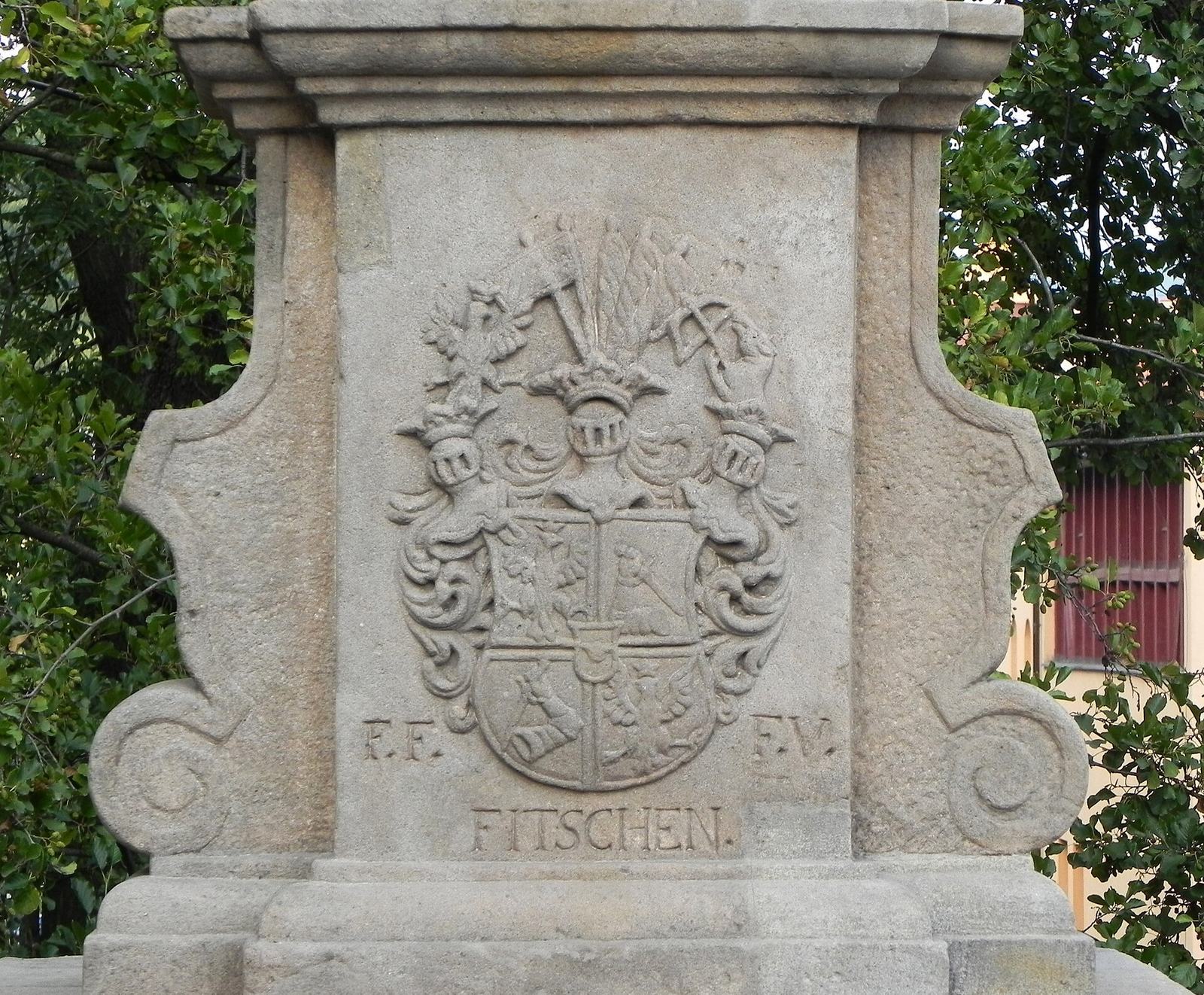
This detailed late-Baroque group shows the Holy Trinity, the Christian belief in one God as Father, Son, and Holy Spirit, crowning Mary. Its composition appears large in relation to the pedestal, which bears the arms of its patron, Baron Franz Ferdinand von Fitsch. He funded the sculpture in 1714 in connection with a family tragedy involving a wrongful act by his father.
St Wenceslas
St Wenceslas, the tenth-century duke of Bohemia later venerated as its patron saint, appears in armor holding a banner. His other hand carries a shield with a single-headed Bohemian eagle.
Pietà
The Pietà, a depiction of Mary mourning Christ’s body, dates to 1655. Count Johann Georg von Götzen, governor of the County of Glatz, the historic territory around Kłodzko, funded it with his wife, Maria Elisabeth. Their coats of arms and an inscription naming them and the date appear on the pedestal; the rest of the inscription is worn away. The sculpture is relatively small compared with the others and stands on a particularly large pier, at the position planned for a bridge chapel. One hypothesis is that it was originally made for a different purpose or location.
St John Nepomuk
St John Nepomuk, a fourteenth-century Bohemian priest traditionally venerated as a martyr, stands above a pedestal bearing the arms of his patrons, Johann Ernst von Götzen and his wife, Maria Franziska, Countess von Liechtenstein-Kastelkorn. Johann Ernst was the son of Johann Georg von Götzen. The statue follows a conventional Baroque depiction of the saint familiar in Silesia and Bohemia.