Kłodzko Fortress: A Bohemian Stronghold and Prussian Defensive Complex in Poland


Site at a Glance
- Rating
- 4.6
- Popularity
- Very High
- Country
- Poland
- Primary era
- Early Modern
- External website
- Open
- Eras represented
- Medieval, Early Modern, Modern
- Civilizations
- German, Habsburg, Holy Roman Empire, Kingdom of Bohemia, Kingdom of Prussia
- Site type
- Military
- Remains
- Fort
On this page20 sections
History
Kłodzko Fortress is a historic military complex in Kłodzko, Poland, built on Castle Hill above the town’s market square. It developed from a Bohemian border stronghold first mentioned in 981 and was transformed over the centuries from a fortified residence into a major Habsburg and Prussian fortress.
Bohemian frontier stronghold
The earliest reference to the site appears in the chronicle of Cosmas, a Bohemian writer who described it in 981 as a frontier fortress directed against Poland. The first defenses probably consisted of wooden buildings enclosed by a palisade. In 1114, Bohemian Prince Sobiesław captured and burned the stronghold. He rebuilt it in 1129 and appointed Groznata as its castellan, the official responsible for governing and defending the fortress.
Between the thirteenth and fourteenth centuries, probably during the rule of Duke Henry IV Probus, the stronghold was rebuilt as a fortified castle. It became the seat of representatives of the Silesian Piast dynasty, a branch of the medieval Polish ruling house that governed several Silesian territories. Henry VI the Good held authority in the Kłodzko region from 1327 to 1335, followed by Bolko II of Ziębice from 1337 to 1341.
Residential castle and ecclesiastical foundation
Under George of Poděbrady, the castle became a substantial residence for the ruler of the County of Kłodzko. From 1477, the Counts of Kłodzko also lived there. Its status as a political and residential center continued into the sixteenth century. Count Palatine Ottheinrich stayed at the castle in 1536, and Bohemian King Ferdinand I spent a night there in September 1546.
The hill also acquired an important religious institution. In 1349, Ernst of Pardubice, the first Archbishop of Prague and the son of Kłodzko’s burgrave, established an Augustinian monastery and collegiate institution on the slope of Castle Hill. The residential complex included a chapel and the Church of Saint Wenceslaus and Saint Martin, while the earlier Gothic castle was gradually reshaped into a palace-like residence.
Renaissance rebuilding and Habsburg fortification
During the reign of Ernst of Bavaria, the castle was rebuilt in the Renaissance style between 1557 and 1560. The court architect Lorenz Krischke, also recorded as Ernest Lorenz Kirschke, directed the work. The project added the Middle Castle and Lower Castle and joined them to the Upper Castle and the town’s fortifications, creating a more unified defensive and residential complex.
The Battle of White Mountain, fought in 1620 during the conflict that strengthened Habsburg control in Bohemia, had serious consequences for Kłodzko. Imperial forces seized the town and fortress in 1622. Fighting caused extensive damage, and the unsafe collegiate church, together with sections of the castle defenses, had to be demolished. The castle was then repaired under Johann Georg Semling, its castle captain.
Further military changes took place from 1690 to 1702 under the direction of the Italian military architect Jacopo Carove. Medieval walls were replaced by curtain walls, meaning fortified walls between projecting defenses, and bastions, projecting structures designed to provide flanking fire along the walls. These works brought the medieval site into a more modern defensive system under Habsburg rule.
Prussian conquest and reconstruction
Prussia captured Kłodzko in 1742 during the First Silesian War, a conflict in which Prussia seized Silesian territories from the Habsburg monarchy. Frederick II, commonly known as Frederick the Great, incorporated the fortress into a Prussian defensive line protecting the newly acquired lands in Silesia.
In 1743, Gerhard Cornelius de Wallrave prepared new plans based on the French school of fortification. Friedrich Christian von Wrede later continued the works, while Heinrich August de la Motte Fouqué became fortress commander. The Prussian expansion also produced an auxiliary fort on Owcza Góra, known in German as Schäferberg, east of the Kłodzko Nysa. This position protected the main fortress from the direction of the river.
Imperial forces under Field Marshal Gideon Ernst von Laudon recaptured Kłodzko on 26 June 1760 during the Seven Years’ War, a major European conflict fought between 1756 and 1763. Prussia modernized the fortress again after the war. Although plans for reconstruction existed by May 1763, fundamental rebuilding began in 1770 under the Piedmontese military engineer Franz Ignatz von Pinto.
The new works removed the remaining residential castle, chapel, and church. Under Colonel Ludwig Wilhelm von Regler, then fortress commander, a large donjon was constructed. A donjon is a massive fortified tower or keep. The rebuilding gave Kłodzko a predominantly military character and adapted the summit defenses to the demands of eighteenth-century warfare.
The Napoleonic campaign
Kłodzko played an important part in the Prussian defense of Silesia during the Napoleonic campaign of 1806 and 1807. Friedrich Wilhelm von Götzen the Younger, the Prussian general governor of Silesia, used the fortress as his principal base for mobile operations. The garrison numbered about 4,070 soldiers, while Götzen commanded approximately 10,000 men across the region.
Prussian forces fought near Złoty Stok, Jaszkowa Dolna, Kłodzko, and Jaszkowa Górna. On 17 April 1807, Götzen launched an operation with 2,800 infantry, 300 cavalry, and 18 guns. On 14 June, the garrison was reinforced by 416 infantry, 165 cavalry, four guns, and one howitzer from Srebrna Góra.
After Nysa fell, French and allied forces advanced toward Kłodzko. Jaszkowa Dolna was captured on 23 June 1807, and an assault followed during the night of 23 to 24 June. Götzen decided to surrender, although the attackers suffered about 1,000 killed and wounded. Two squadrons of Polish lancers from the Polish-Italian Legion participated in the fighting.
The capitulation document was signed on the following day, but the fortress was not actually handed over because the Peace of Tilsit was concluded on 9 July 1807. Hieronim Bonaparte, Napoleon’s younger brother, commanded French and Confederation of the Rhine forces in the campaign for Silesia. Napoleon himself was campaigning elsewhere during the events connected with Kłodzko’s proposed capitulation.
Prison, disarmament, and twentieth-century wartime use
After the rebuilding associated with Frederick II, the fortress served both military and penal purposes. Its prisoners included the Prussian officer and adventurer Friedrich von der Trenck, who escaped, and the Austrian general Wilhelm Reinhard von Neipperg. Neipperg was imprisoned after concluding the unauthorized Treaty of Belgrade in 1739 and was later pardoned following the death of Emperor Charles VI.
In 1864, Prussian authorities imprisoned participants in the January Uprising, a Polish insurrection against Russian rule that began in 1863. Among those held at Kłodzko were Wacław Koszutski, Walerian Hulewicz, Stanisław Sczaniecki, Włodzimierz Wolniewicz, Erazm Wolniewicz, and Jan Rymarkiewicz. French prisoners of war were held there in 1870. In 1873, the Prussian authorities imprisoned the Greater Polish social and economic activist Augustyn Szamarzewski, as well as Wojciech Kętrzyński and Karl Liebknecht.
The Prussian government decided to disarm the fortress in 1867 because it was considered obsolete. It was formally abolished as a fortress in 1877, although military and penal functions continued. In 1911, French intelligence captain Charles Lux was imprisoned there and sentenced to six years for espionage. He later became known for escaping and described the event in a book published in 1932.
Before the Second World War, the complex had been converted into a Wehrmacht prison. From 1940 to 1943, during the Nazi occupation of Europe, it also operated as a branch of the Groß-Rosen concentration-camp system. Groß-Rosen was a Nazi camp network established in occupied Poland. The Kłodzko branch held prisoners of war, German army deserters, people suspected of opposition to the Third Reich, political prisoners, and forced laborers. Prisoners came from Russia, France, Italy, Belgium, the Czech lands, Finland, and Britain. The site also contained an execution area, and the Polish activist Władysław Planetorz was imprisoned and executed there.
In 1944, an AEG factory evacuated from Łódź because of the advancing front began operating inside the fortress. It produced components for V-1 weapons and electrical equipment for submarines and aircraft. In February 1945, the Germans began moving the factory to Thuringia. During the final months of the war, prison functions were transferred to the auxiliary fortress on Owcza Góra, while the main fortress was used for armaments production.
Polish protection and archaeological work
After the Second World War, Kłodzko and the surrounding area became part of Poland, and Festung Glatz was renamed Twierdza Kłodzko. The fortress was officially recognized as a protected monument in 1960 and opened to visitors. Its military fabric had already been repaired and modernized repeatedly during the Prussian period. In 1930, concrete was used to reinforce the slopes of Castle Hill.
Conservation and restoration have continued in modern times. The Luneta Żuraw section has undergone regular community renovation since 2006. In July 2018, a historical path was created from the southern entrance on Czech Street eastward through the area planned for the Commander’s Garden, past a viewpoint and the Bateria Skazamatowana, to Wróbel Gate. Associated plans included repairs to walls, slopes, and vaults and the reconstruction of the Commander’s Garden.
In 2022, a previously unknown network of eighteenth-century counter-mine passages was discovered beneath the fortress. A counter-mine gallery is an underground passage intended to detect or disrupt enemy mining operations. The discovery added new evidence for understanding the defensive engineering beneath the visible fortifications.
Remains
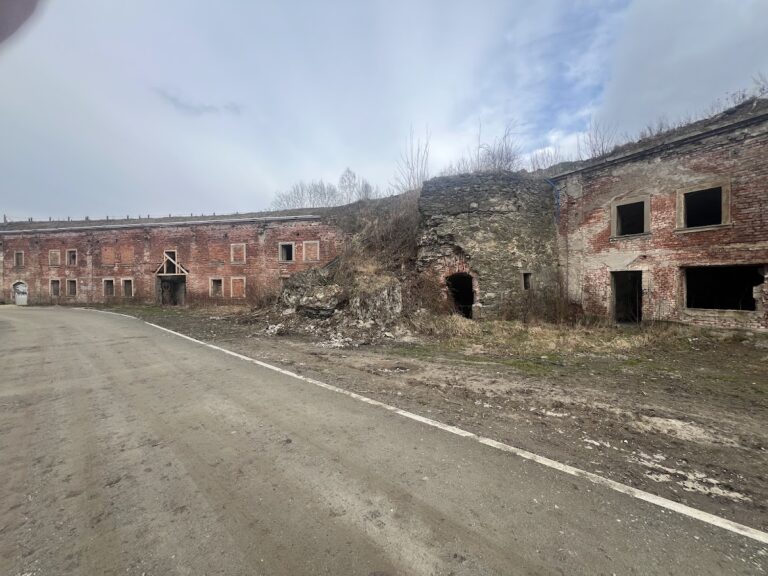
Kłodzko Fortress occupies the 369-metre-high Castle Hill on the western side of the Kłodzko Nysa, above the town’s market square. The main hill area covers about 17 hectares, while the wider complex extends over more than 30 hectares. Its surviving elements include the Main Fortress, the auxiliary Owcza Góra Fortress, fragments of the town defenses, and field fortifications. Together they preserve the changing relationship between a medieval hilltop castle and the bastioned military system that replaced it.
Castle Hill and the former residence
Upper, Middle, and Lower Castles
The original stronghold probably occupied the summit as a group of wooden buildings protected by a palisade. It later became an elevated fortified residence divided into Upper, Middle, and Lower Castle sections. The residential complex contained living quarters, a chapel, and the Church of Saint Wenceslaus and Saint Martin. The former Gothic castle was gradually given a palace-like character before its remaining residential elements were incorporated into the later fortress or demolished during the eighteenth-century rebuilding.
Wells and early religious structures
Five wells supplied water to the castle and fortress. The oldest, the Tumska Well, dates to 1393, while the deepest, the Piekarska Well, occupied a shaft 60 metres deep. The Heidenturm, or Heathen Tower, and the Marian Chapel, also called the Heathen Chapel, probably originated around the period of the early medieval fortification. The chapel is first documented in 1194.
Bastioned defenses
Northern and eastern works
The Renaissance rebuilding of 1557 to 1560 added the Middle Castle and Lower Castle and connected them with the Upper Castle and the town defenses. Later modernization replaced medieval walls with curtain walls and bastions. On the northern and eastern sides, the crownwork included the Jabłonka, Ludmiła, and Wacław bastions, which protected the hill from those directions.
Southern and western works
The southern and western defenses included the Alarm Bastion, Bell-Ringer Bastion, and Eagle Demi-Bastion. A demi-bastion is a half-bastion with one full flank and one partial flank. The Polny and Jabłonka ravelins, outworks placed in front of a wall or bastion, and a moat provided additional protection. The fortifications surrounded the summit castle, which was partly adapted to the bastioned layout and rebuilt in a more contemporary military form.
Donjon and casemates
The post-1763 reconstruction produced new bastions and a partly three-storeyed donjon. It replaced the demolished remains of the residential castle, chapel, and church. The donjon contained as many as 42 artillery casemates. A casemate is a vaulted chamber used for protected artillery, storage, or military accommodation. The surviving structure reflects the fortress’s transformation from a residence into a purpose-built defensive installation.
Auxiliary forts and underground defenses
Owcza Góra Fortress
The auxiliary fort on Owcza Góra, or Schäferberg, protected the main fortress from the direction of the Kłodzko Nysa. During the 1806 to 1807 conflict, a fortified camp was also constructed on the southern and southeastern approaches. In the final months of the Second World War, prison functions were transferred from the main fortress to Owcza Góra.
Counter-mine passages
Underground passages form an important part of the complex. An accessible route through the fortress extends for approximately 1 kilometre and passes through sections of the bastions, courtyards, and casemates. Counter-mine galleries were extended during the 1806 to 1807 war, with work continuing in 1807 before the arrival of the French IX Corps. The eighteenth-century network discovered beneath the fortress in 2022 provides additional evidence of this subterranean defensive system.
Gates, batteries, and commemorative monument
The present complex includes Luneta Żuraw, Bateria Skazamatowana, and Wróbel Gate. The historical path established in 2018 links the southern entrance on Czech Street with the area of the planned Commander’s Garden, the Bateria Skazamatowana, and Wróbel Gate, which forms an entrance to the fortress. Repairs associated with the project addressed walls, slopes, and vaults.
A stone monument near the fortress bears a relief of a hat. It was unveiled on 19 September 1937 on the initiative of the local section of the German Colonial League and originally carried the inscription “Remember our colonies.” The monument commemorated German territorial acquisitions in Africa, while the hat represented the tropical headgear of German colonial troops. Its purpose is therefore colonial rather than connected with Napoleon. The story that Napoleon lost his hat at the site is a later urban legend, contradicted by the monument’s form and its 1937 inscription.
Nearby sites