Church of the Nativity of Christ in Pronyukhlovo: An Orthodox Parish Church
Site at a Glance
- Popularity
- Very Low
- Country
- Russia
- Primary era
- Modern
- Eras represented
- Modern
- Civilizations
- Russian
- Site type
- Religious
- Remains
- Church
On this page7 sections
History
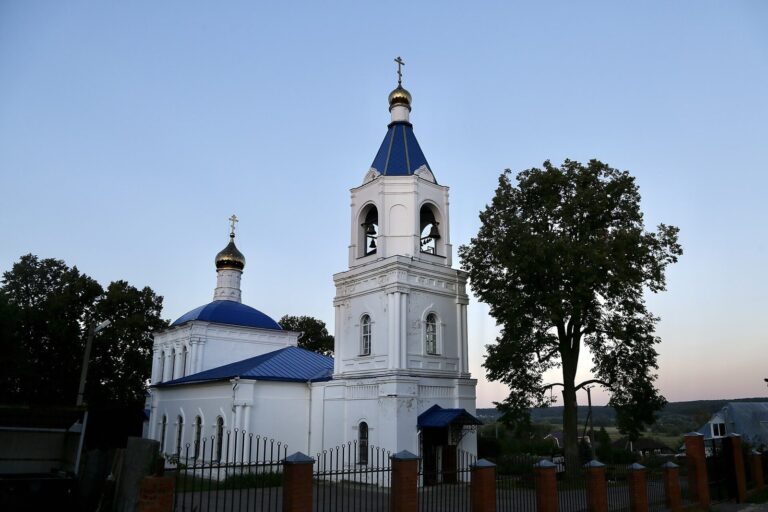
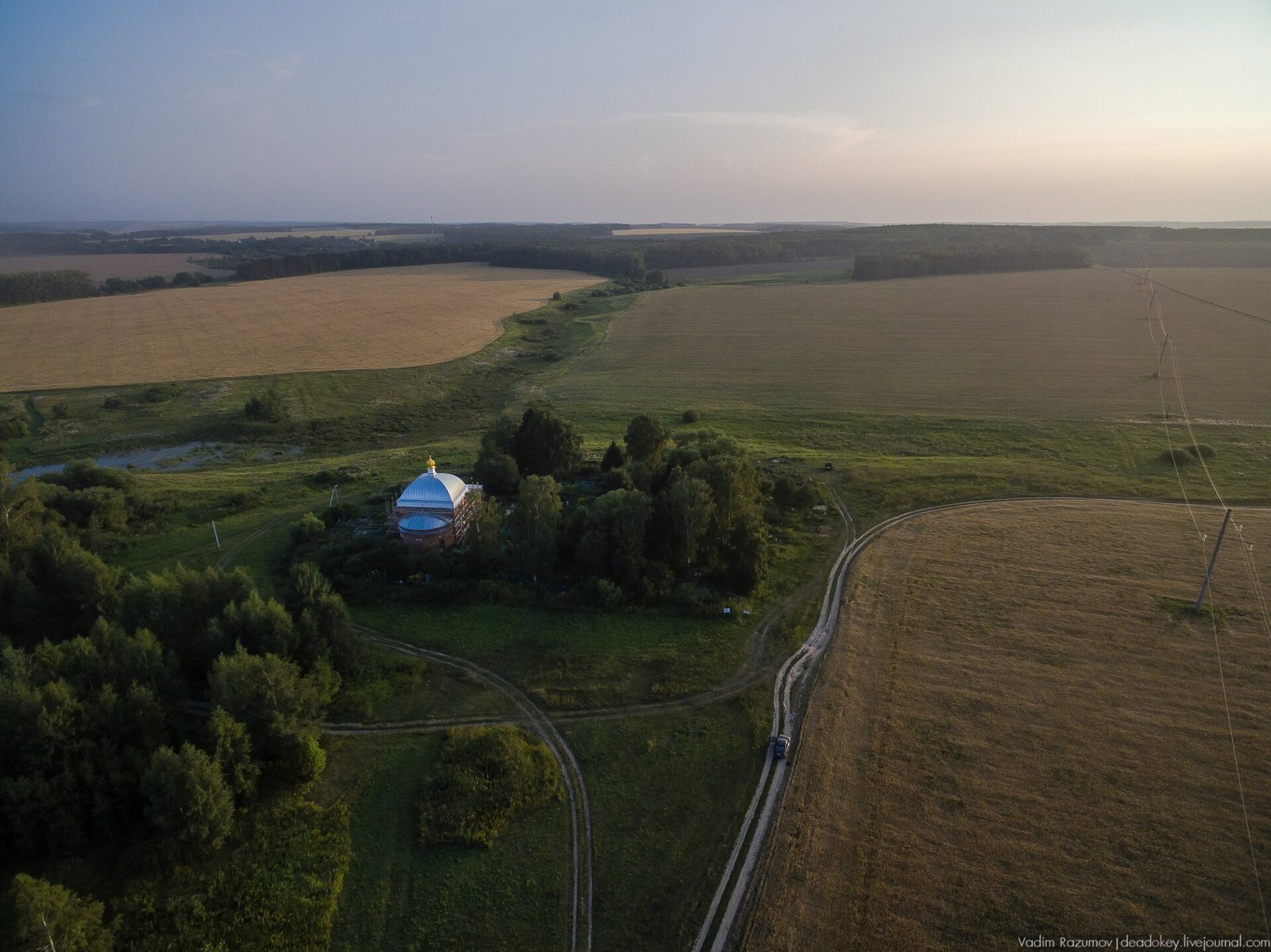
The Church of the Nativity of Christ in Pronyukhlovo, Russia, is an Orthodox parish church in the Zaraysk urban district of Moscow Oblast. Its present stone building was erected in 1836 and consecrated in 1839. Its architecture combines Russian Classicism, the Russian adaptation of Neoclassicism, Empire-style forms associated with the Napoleonic era and its aftermath, and features from before Peter the Great’s reforms.
Early churches and parish records
A wooden church dedicated to the Nativity of Christ stood at Pronyukhlovo by the sixteenth century. Lithuanian forces destroyed it in 1608. A replacement was built and consecrated by 1615, but Lithuanian raiders damaged it the following year. The church was consecrated again, and in 1628 a stone building took the place of the wooden one.
Records from 1676 list two priests’ households and one household each for a deacon, a church reader, and a sacristan, who assisted in services, read religious texts, and cared for sacred objects. The church lands comprised 133 quarters, a traditional Russian measure of land, in each of three fields and yielded 50 haystacks of hay. The parish had 159 households, including 20 noble households, three belonging to household servants, 10 landless households, and 115 peasant households.
Nineteenth-century rebuilding and parish life
The stone church had become dilapidated by 1836, when it was demolished and replaced on the same site. The new building included a side chapel dedicated to Saint Nicholas, an early Christian bishop venerated as a saint, and was consecrated in 1839. In 1873, the church had a priest and two psalm readers, who read psalms and other texts during Orthodox services. Its parish extended across seven other settlements, four described as hamlets and three as villages.
Before the October Revolution, the church held a small relic known as the Life-Giving Cross. A local tradition related that the cross was stolen and later discovered by a princess of the Obolensky family at the foot of the rise where the church stands. After piercing it to see what was inside, she lost her sight. Prayer restored it, and she returned the cross to the church.
Soviet persecution and renewed worship
The church’s rector, Hieromartyr John Lebedev, and its psalm reader, Andrei Shershnev, are honored as New Martyrs and Confessors of Russia, an Orthodox designation for people who suffered or died for their faith, especially under Soviet persecution. Both men were arrested in 1937 and shot at the Butovo firing range near Moscow, a site of Soviet executions and mass burials. The church closed in the late 1930s, and its bell tower was subsequently destroyed. The building was used first as a club and later as a seed store.
A church community was re-established in 1999, when the building was returned to the faithful. Restoration continues, and prayer services are held regularly. The church belongs to the Zaraysk Deanery, a district within the Kolomna Diocese of the Russian Orthodox Church, and is protected as a regionally significant cultural heritage site.
Remains
Church building
The stone church is a four-sided, pillarless building with a single dome and one apse, the sanctuary end of the church. A blind cloister vault covers the interior: its curved surfaces meet at the corners, and the vault has no openings. The building also includes a side chapel dedicated to Saint Nicholas.
Life-Giving Cross
Before the October Revolution, the church held a small cross made from relatively thick copper sheet with an added alloying material. It contained particles associated with the Cross of Christ, the tomb and its stone, and the relics of saints.