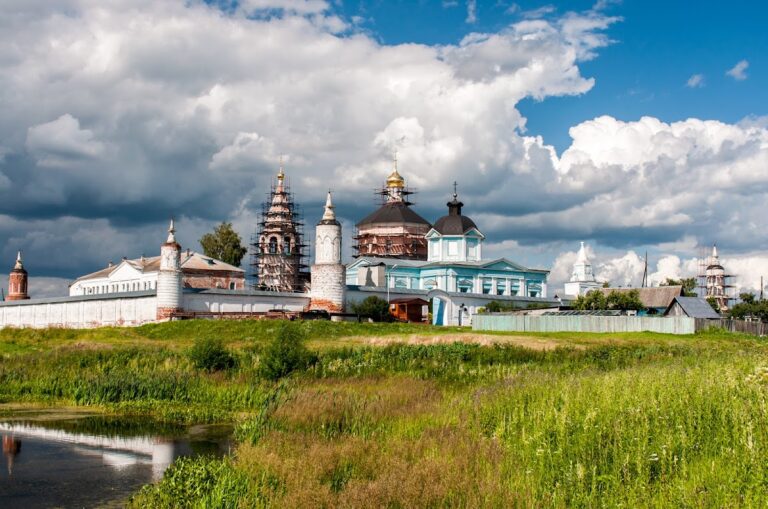
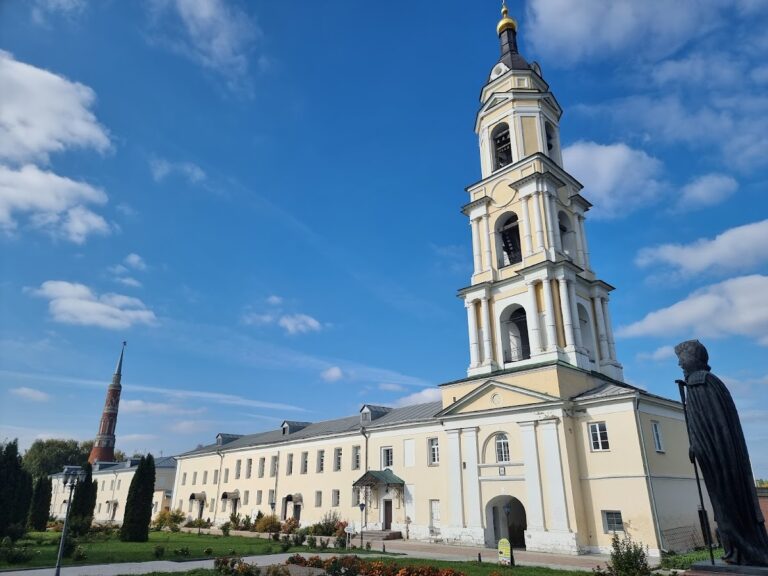
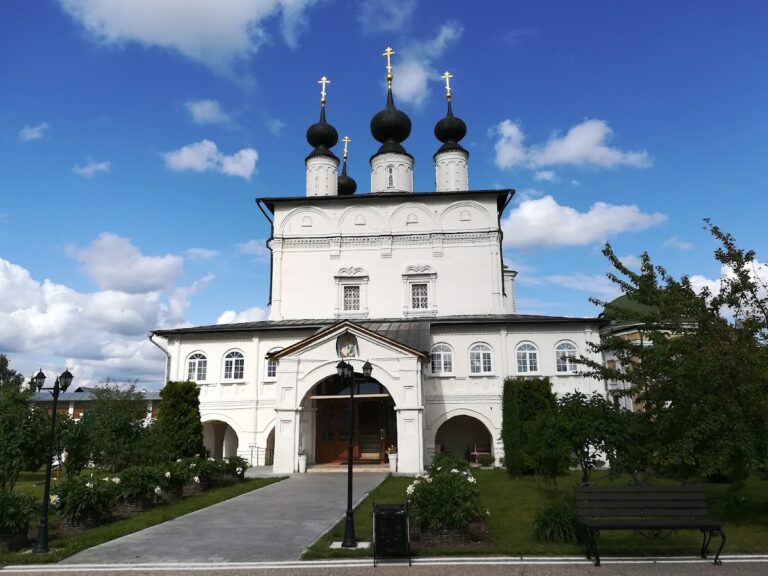
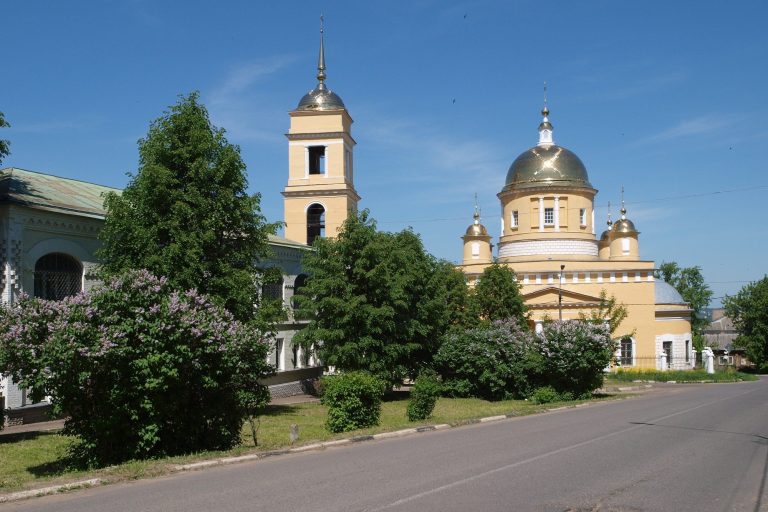
Cathedral of the Dormition of the Theotokos, Kolomna: A Russian Orthodox Cathedral


Site at a Glance
- Rating
- 4.9
- Popularity
- Low
- Country
- Russia
- Primary era
- Early Modern
- External website
- Open
- Eras represented
- Early Modern
- Civilizations
- Russian
- Site type
- Religious
- Remains
- Cathedral
On this page11 sections
History
The Cathedral of the Dormition of the Theotokos is a Russian Orthodox cathedral in Russia, standing on Cathedral Square within the Kolomna Kremlin. The Theotokos is a Christian title for Mary, the mother of Jesus, while the Dormition refers in Eastern Christian tradition to her death and assumption into heavenly glory. The present building was constructed between 1672 and 1682 and serves as the cathedral of the Kolomna Diocese, a territorial administrative district of the Russian Orthodox Church. It also effectively serves the Moscow metropolitanate, a larger ecclesiastical province headed by a metropolitan.
The first cathedral
A white-stone cathedral stood on the site by the second quarter of the fourteenth century, possibly around 1329. Medieval chronicles do not mention this building, but excavations in the 1980s revealed parts of its foundations and separate carved stone blocks. These remains establish an early phase of monumental construction at the site before the cathedral associated with Grand Prince Dmitry Donskoy.
Dmitry Donskoy’s cathedral
In 1379, Dmitry Donskoy founded a second and larger cathedral. He was the fourteenth-century grand prince of Moscow who led Russian forces in conflicts with the Golden Horde, the Mongol-Tatar state that exercised political dominance over much of medieval Rus. The new foundation probably followed the first Russian victory over the Horde at the Battle of the Vozha River, an important success before the later Battle of Kulikovo. The victorious forces returned to Kolomna around the feast of the Dormition of the Theotokos.
The building collapsed the following year, but construction was completed in 1382. It became one of the largest stone buildings in the medieval Grand Duchy of Moscow, the East Slavic principality centred on Moscow that later formed the core of the Russian state. Tradition or scholarly interpretation places it on a basement level or high podium, and Archdeacon Paul of Aleppo wrote that worshippers reached it by a high staircase.
The cathedral’s lower principal church had altars dedicated to the Dormition of the Mother of God and Saint Demetrius of Thessaloniki, the heavenly patron of Dmitry Donskoy. The upper church contained altars dedicated to Saint Nikita the Martyr and Saint Leontius of Rostov. Theophanes the Greek, a major Byzantine-born painter active in medieval Rus, probably participated in the fresco decoration, although those paintings have not survived. A Deesis, an Orthodox composition centred on Christ with the Virgin Mary and John the Baptist interceding, was probably made by Theophanes for the cathedral and was later transferred to the Annunciation Cathedral in the Moscow Kremlin.
Construction of the present cathedral
Structural deterioration led to the dismantling of Dmitry Donskoy’s cathedral in 1672. Between that year and 1682, the architect Meletius Alekseev built the present cathedral on the same site. White-stone blocks from the dismantled building were incorporated into its brick walls, linking the surviving church physically with the earlier foundation.
The cathedral continued to be associated with important figures in the Russian Orthodox Church. Bishop Job of Kolomna served there from 1581 to 1586 and later became the first patriarch of the Russian Orthodox Church. Bishop Theophylact Gorsky of Kolomna was buried in the cathedral in September 1788. In the early nineteenth century, its rector was Mikhail Drozdov, the father of Metropolitan Philaret of Moscow and Kolomna, who later served and preached there repeatedly.
Suppression and restoration
During the 1920s, Dmitry Vdovin served as the cathedral’s churchwarden. The Russian Orthodox Church canonized him in 2002 as one of the New Martyrs and Confessors of Russia. The cathedral was closed in 1929, plundered, and its bishops’ burials were desecrated.
The building was returned to the Russian Orthodox Church in 1989. A ten-year restoration followed, including the recreation of more than 1,500 square metres of wall painting. Patriarch Alexy II of Moscow and All Rus solemnly consecrated the restored cathedral on 29 August 1999, and a new marble floor was installed in 2001. The cathedral is now a functioning Orthodox church and a federally significant cultural-heritage site of the Russian Federation. The nearby Church of the Tikhvin Icon of the Mother of God and Church of the Resurrection are its dependent churches.
Remains
Exterior and structural form
The present cathedral has a monumental square-plan main block crowned by five domes. Four supporting piers, three apses, and brick walls define the structure, while white-stone blocks salvaged from the second cathedral remain within the masonry. The side drums, the cylindrical structures supporting the domes, are only slightly lower than the central drum. Each drum carries arcaded-and-columned bands and profiled cornices.
The eastern sanctuary projects strongly from the main block. It consists of a rectangular volume and three semicircular apses, which are altar-end projections. Pilaster-like vertical strips divide these two parts on the north and south facades. The west facade is divided into three bays, or facade sections, by similar strips. The upper east facade follows the same three-part division, while each side facade is divided into four bays.
Portals and window surrounds
The cathedral’s base resembles an Attic base, a classical moulded base used beneath a column or pier. Windows in both the main block and sanctuary have elaborate surrounds formed from vertical half-columns with bead-like ornament. The lower windows end in semicircular forms, while the upper ones have keel-shaped terminations. The west and north portals contain numerous carved elements, whereas the south portal is more restrained.
Bell tower
A bell tower was built at the same time as the present cathedral. It is a tent-roofed structure, meaning that it is crowned by a pyramidal or conical roof, and now adjoins the nearby Church of the Tikhvin Icon of the Mother of God.
Interior arrangement
The worship space is nearly square and contains round piers, supporting arches, and vaults set at one level. Unlike the six-pier Dormition Cathedral in the Moscow Kremlin, the Kolomna cathedral has four piers. Its interior arrangement was based substantially on the Moscow cathedral, although the exterior does not show a comparable resemblance.
The iconostasis, the screen of icons separating the sanctuary from the main worship space, stands farther east than is usual in a four-pier church. It is not placed directly beside the western faces of the eastern piers. As a result, the eastern transverse nave remains part of the worship space. All four piers and all five domes stand within that space, while the sanctuary is confined to the strongly projecting apses.
Earlier cathedral and sacred furnishings
The second cathedral probably had four piers, although a six-pier plan has also been proposed, and it had three apses. Its interior width along the north-south axis was 10.4 metres. The earlier building’s surviving material includes fragments of foundations and carved stone blocks found during excavation, while its probable frescoes have disappeared.
The cathedral’s principal shrine was the Don Icon of the Mother of God, attributed to Theophanes the Greek. Before his campaign against Kazan, Tsar Ivan the Terrible prayed before the icon and then took the wonder-working image to Moscow. He ordered two exact copies for the Kolomna cathedral, while the original is now held by the Tretyakov Gallery, Moscow’s principal museum of Russian art.
The cathedral historically held particles of the relics of Saint John the Baptist and Saint Stephen the Sabbaite. Its furnishings also included silver-covered icons, costly embroidered cloths, one of them embroidered personally by Grand Princess Sophia Palaiologina, and an extensive library.