Old Golutvin Monastery: A Historic Russian Orthodox Monastery in Kolomna


Site at a Glance
- Rating
- 4.8
- Popularity
- Low
- Country
- Russia
- Primary era
- Early Modern
- External website
- Open
- Eras represented
- Medieval, Early Modern, Modern
- Civilizations
- Russian
- Site type
- Religious
- Remains
- Fortified Monastery
On this page14 sections
History
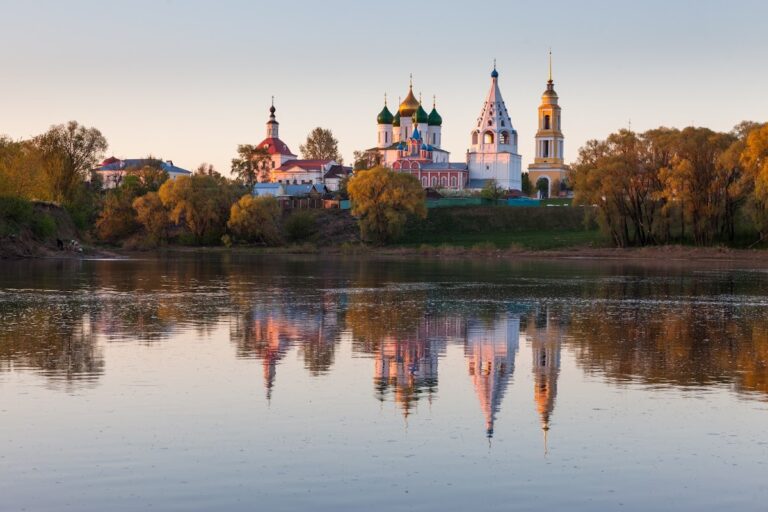
Old Golutvin Monastery is a Russian Orthodox monastery in Kolomna, Russia, founded in the late fourteenth century near the confluence of the Moskva and Oka Rivers. Its exact foundation date is uncertain: the Second Sophia Chronicle gives 1374, while most historians associate its establishment with 1385. The monastery became an important religious and economic center in the Kolomna area, and its buildings preserve successive phases of Russian ecclesiastical architecture.
Foundation traditions
A fifteenth-century Trinity Chronicle connects the monastery with a lasting peace between the Moscow and Ryazan principalities. According to this tradition, Sergius of Radonezh, a major fourteenth-century Russian Orthodox monastic founder and spiritual leader, travelled to Ryazan and persuaded Prince Oleg of Ryazan to make peace with Moscow.
Another tradition links the foundation with Dmitry Donskoy, the grand prince of Moscow who led Moscow’s forces at the Battle of Kulikovo in 1380. Before the battle, Dmitry is said to have chosen the site and asked Sergius to bless it. Sergius then established a church dedicated to the Epiphany and, at Dmitry’s request, sent the hieromonk Gregory, a monk who was also an ordained priest, to build the new monastery. Gregory soon became its abbot and is traditionally regarded as its first leader.
Growth and prominence
The monastic community expanded during the fifteenth century. In 1480, Grand Prince Ivan III visited before his campaign against the Tatar khan Akhmat. The resulting confrontation on the Ugra River marked the end of the Golden Horde’s political supremacy over Moscow.
By the middle of the sixteenth century, Old Golutvin possessed 49 villages, hamlets, and other settlements, together with stone compounds in Kolomna and Moscow. It also held a substantial library. Tsar Ivan the Terrible, also known as Ivan IV, visited the monastery in 1552. At the beginning of the seventeenth century, Old Golutvin was the wealthiest and most influential monastery in the Kolomna district. An embassy sent by Patriarch Macarius of Antioch visited in 1654, and its secretary, Archdeacon Paul of Aleppo, recorded the visit.
Rebuilding and administrative change
In 1697, Avraamy, formerly abbot of Andreevsky Monastery, was exiled to Old Golutvin after criticizing the reforms of Peter I. He financed the rebuilding of the dilapidated Epiphany Cathedral. An archimandry, an institution headed by a senior Orthodox monastic leader, was established at Old Golutvin in 1707. From then on, its abbots held the rank of archimandrite. A new Epiphany Cathedral was built at the beginning of the eighteenth century.
The secularization of church lands in 1764 transferred extensive ecclesiastical estates to state administration and deprived the monastery of much of its economic independence. Old Golutvin was assigned to the second class, retained the archimandrite’s rank for its head, and became almost impoverished. Empress Catherine the Great visited in 1775 and donated land beyond the southern wall. The area was later laid out as a fruit orchard.
After the Kolomna Diocese was abolished in 1799, Metropolitan Platon Levshin ordered the brotherhood to move into the former bishop’s residence on the cathedral square of the Kolomna Kremlin. This protected the residence from demolition or conversion into military barracks and led to the creation of the Holy Trinity Novo-Golutvin Monastery. The original monastery consequently became known as Old Golutvin, while monastic life there ceased and its buildings gradually deteriorated.
In 1800, Metropolitan Platon revived Old Golutvin by administratively joining it to the Bogoroditse-Rozhdestvensky Bobrenev Monastery, whose estates were intended to support it. Hieromonk Samuel Kolesnitsyn of the Peshnoshsky Monastery was appointed builder and arrived with six monks. Under his direction, the Epiphany Cathedral was roofed, its iconostasis was gilded, and its walls were strengthened and painted. The Sergius Church was also extensively rebuilt, and Metropolitan Philaret Drozdov consecrated it in 1833.
Emperor Alexander II separated Old Golutvin from Bobrenev Monastery by an edict issued in 1861, officially restoring its historic name. In April 1912, the Optina elder Barsanuphius Plikhankov became abbot. He addressed disorder in the monastery’s spiritual life and repaired the buildings through donations before his death on 1 April 1913.
Closure and revival
In 1926, the locality of the monastery contained 109 households and 290 residents, including 161 men and 129 women. The monastery closed in 1929. About 50 monks were removed by truck, and their subsequent fate is unknown. The buildings were used first for artillery storage, then converted into workers’ dormitories for the Kolomzavod plant in 1933. During the Second World War, a motor-rifle regiment occupied the complex, and the gallery of the Epiphany Cathedral was destroyed in 1947.
In 1986, the complex was transferred to the Otechestvo Center for Social Initiatives for youth work. The former stable yard became a carpentry workshop, the carriage shed a forge, the Epiphany Cathedral a warehouse, and the Sergius Church a sports hall.
The complex returned to the Moscow Diocese in 1994, and the monastery officially reopened on 18 December that year. A Moscow diocesan theological school moved there in 1995 and became the Kolomna Orthodox Theological Seminary in 1996. The Vvedensky Gate Church was the first monastery church restored after the revival, and Metropolitan Juvenaly of Krutitsy and Kolomna consecrated it in 1996. The Sergius Church was consecrated in 2004, and the revived Epiphany Cathedral was consecrated on 15 May 2007. Old Golutvin is now an active Orthodox institution and a cultural-heritage site of federal significance in the Russian Federation.
Remains
Churches and bell tower
The surviving complex combines brick churches, stone foundations, nineteenth-century monastic buildings, service structures, and enclosing walls. Its principal buildings occupy a historic monastery layout near the Moskva and Oka Rivers. The churches preserve evidence of repeated rebuilding, while the crypt and lower levels retain elements of earlier structures.
Epiphany Cathedral
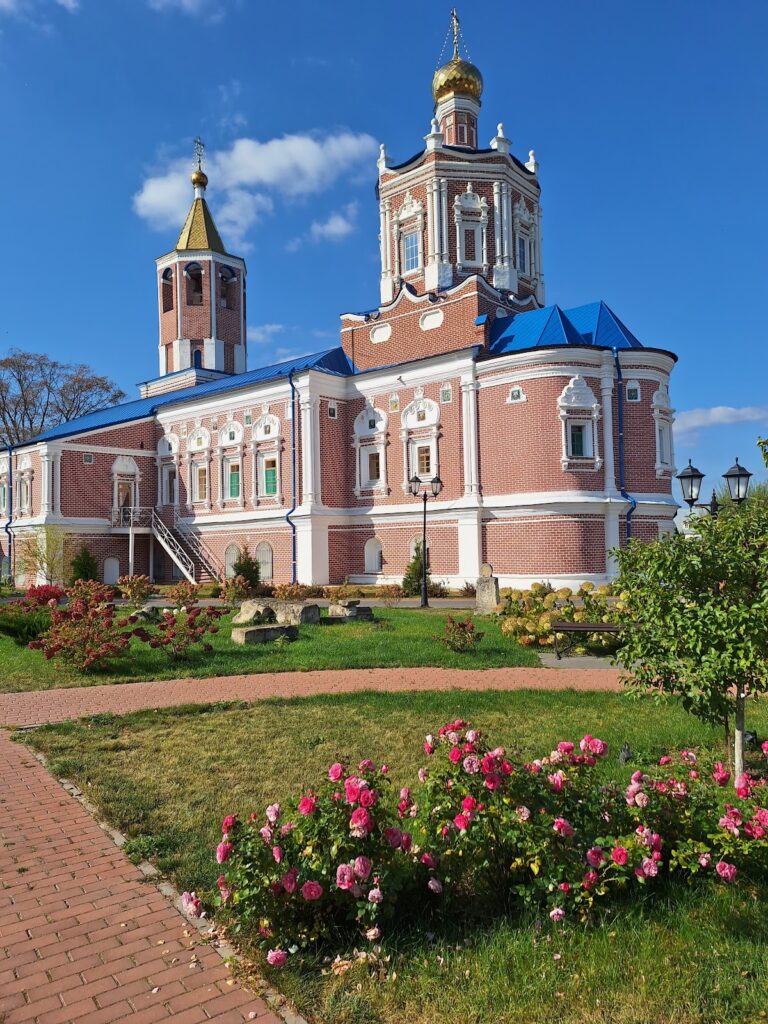
The Epiphany Cathedral, the monastery’s principal church, stands on the site of an earlier fourteenth-century stone cathedral. Its present form developed during the late seventeenth and early eighteenth centuries. Built on a new foundation, it is a four-pier brick cathedral in the Old Russian style, with its interior supported by four substantial piers.
The cathedral crypt preserves the foundation and lower plinth of the church traditionally attributed to Sergius of Radonezh. These surviving elements are popularly known as the “stones of Sergius.” The crypt also contains the tomb of Gregory of Golutvin, traditionally regarded as the monastery’s first abbot. The relics of Theodosius, Confessor and Bishop of Kolomna, are kept in the cathedral.
Sergius Church
The original Sergius Church was built of stone at the beginning of the fifteenth century. It stood above a high basement and was accompanied by a large one-column stone refectory, kitchen, and bakery. The present building developed through construction phases from the sixteenth to the nineteenth century.
A major rebuilding completed in 1825 produced a brick church in the Empire style, a monumental neoclassical form associated with the Napoleonic era and its later influence in Russia. Chapels dedicated to Saint Nicholas and the Tikhvin Icon of the Mother of God form part of the composition, which a rotunda, a circular or polygonal structure, helps unite. The church occupies the upper floor, while the lower floor contains the refectory, kitchen, prosphora bakery, and bread bakery. The basement preserves remnants of the earlier refectory’s white-stone walls. A further chapel is dedicated to Gregory of Golutvin.
Four reliquaries containing particles of relics of numerous saints are kept in the Sergius Church. The building was restored and consecrated in 2004.
Vvedensky Gate Church and bell tower
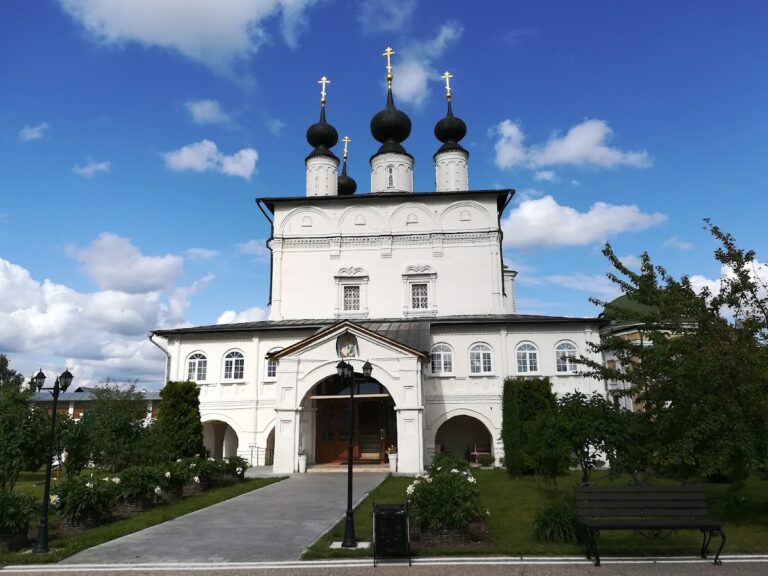
A high bell tower originally stood between the Epiphany and Sergius churches. A replacement three-tier tower was begun at the end of the eighteenth century and completed in 1809 in the Classical style. Its design includes paired white-stone Tuscan columns and cornices.
The second tier contains the Vvedensky Gate Church, dedicated to the Entrance of the Theotokos into the Temple. The church and bell tower are nineteenth-century structures. The church was restored and consecrated in 1996, while the bell tower was restored in 2007. Particles of saints’ relics are kept in the gate church.
Enclosures and monastic buildings
Walls and orchard
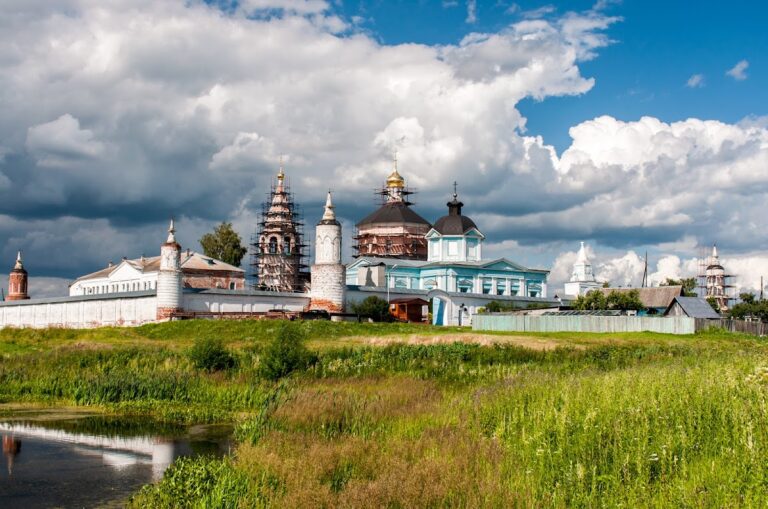
The large enclosure was designed by Matvei Kazakov at the end of the eighteenth century. It has six towers in the Russian pseudo-Gothic style. A smaller enclosure with four towers was built during the first half of the nineteenth century in the Romanesque style. Beyond the southern wall, the land donated by Catherine the Great in 1775 was later arranged as a fruit orchard.
Residential and service buildings
The abbot’s building and the eastern and western buildings date from the nineteenth century. The western building, formerly a hotel, was restored in the early 1990s. The eastern building was restored in 1999, and the abbot’s building in 2002.
The monastery also retains a group of service buildings that formerly included a kvass brewery, a malt-drying building, a carriage shed, a stable yard, and a drying barn. Their historic functions reflect the practical facilities that supported the monastic community and its daily operations.
Spring and sacred remains
A monastery spring is traditionally associated with Sergius of Radonezh. According to the tradition, the brethren asked him for a well, and he struck the ground with his staff. A spring then appeared at the place.
The crypt of the Epiphany Cathedral preserves the lower remains of the earlier church associated with Sergius, while the cathedral and Sergius Church continue to hold relics connected with the monastery’s Orthodox religious life.
Nearby sites