Bobrenev Monastery: A Russian Orthodox Monastic and Defensive Complex


Site at a Glance
- Rating
- 4.8
- Popularity
- Low
- Country
- Russia
- Primary era
- Early Modern
- External website
- Open
- Eras represented
- Early Modern, Modern
- Civilizations
- Russian
- Site type
- Religious
- Remains
- Fortified Monastery
On this page14 sections
History
Bobrenev Monastery is a Russian Orthodox monastery in Russia, located at Staroye Bobrenevo about 3 km from Kolomna on the opposite bank of the Moscow River. Formally known as the Bogoroditse-Rozhdestvensky Bobrenev Monastery, it is conventionally dated to 1381, although the circumstances and date of its foundation remain uncertain. The monastery is traditionally associated with the victory of Grand Prince Dmitry Ivanovich Donskoy over Mamai at the Battle of Kulikovo in 1380, a battle remembered as a major victory for Moscow. According to the most popular tradition, Dmitry Donskoy vowed to establish a monastery dedicated to the Nativity of the Mother of God and fulfilled that vow the following year.
Foundation and early role
A different tradition attributes the foundation to a repentant robber named Bobrenya. The place-name may come from Bobren or Bobrenya, diminutive forms of a word meaning “beaver.” The monastery is documented from 1578. It served as a guard post for Kolomna and may have formed part of the defensive line protecting Moscow from the southeast, although surviving records do not mention it before the end of the sixteenth century.
The monastery’s cathedral was mentioned in 1654 by Paul of Aleppo. By the beginning of the eighteenth century, the building had become badly dilapidated. A replacement brick cathedral was begun in 1757 and was completed in 1790. In that same year, under Athanasius, Bishop of Kolomna, a new church dedicated to Alexis the Man of God replaced the earlier church. The monastery later acquired an abbot’s residence and a bishop’s house, which became the summer residence of the Bishop of Kolomna.
Changes in the eighteenth and nineteenth centuries
After the Kolomna episcopal see, the institutional seat and jurisdiction of a bishop, was transferred to Tula in 1800, the vacant episcopal house in Kolomna became Trinity Novo-Golutvin Monastery. Monks from Staro-Golutvin Monastery were moved there, while Bobrenev Monastery and its associated lands were placed under Staro-Golutvin Monastery.
In 1830, the church built in 1790 was changed from two stories into one. Its main altar, dedicated to the Nativity of the Mother of God, was moved to the lower level. The upper floor was removed, its windows were blocked, and the altar dedicated to Alexis the Man of God was abolished. Since the church was unheated, two winter chapels were established in the refectory, dedicated to the Kazan and Feodorovskaya Icons of the Mother of God.
Bobrenev Monastery regained its independence in 1850. In 1861, the benefactor Dmitry Khlyudov, with the blessing of Saint Philaret, sponsored a separate heated church dedicated to the Feodorovskaya Icon of the Mother of God. It included chapels dedicated to the Kazan Icon and Venerable David of Thessalonica. Two stone brotherhood buildings replaced a deteriorated residential building, and Khlyudov also donated arable land.
The monastery was formally elevated to an independent religious community on 29 July 1865, with an abbot, a treasurer, and fifteen monks. Additional utility buildings were probably erected during the second half of the nineteenth century, and the enlarged grounds were enclosed by a new stone wall modeled on the late-eighteenth-century enclosure. By the turn of the twentieth century, the monastery was known for providing medical assistance to people from the surrounding area and Kolomna. An Orthodox parish school opened there under Abbot Varlaam on 14 April 1903. Until the monastery closed, daily prayers were offered for soldiers who had fallen at Kulikovo Field.
Closure and revival
The monastery was closed and desecrated in 1929. The Cathedral of the Nativity of the Mother of God and the Feodorovskaya Church were used for many decades as warehouses for mineral fertilizers. The buildings and other structures then deteriorated. By 1987, the complex was in an emergency condition. The stables and hay barns had been dismantled, while parts of the fortification walls, the cathedral, and two brotherhood buildings remained.
In 1989 and 1990, Patriarch Pimen and Patriarch Alexy II corresponded with the Council of Ministers of the Russian Soviet Federative Socialist Republic about returning the monastery to the Church. After Alexy II blessed its reopening in March 1991, repairs and restoration began. The parish community of All Saints Church in Sokol, led by its lay head Boris Kudinkin, undertook the work. A house church was established in one of the brotherhood buildings, and restoration of the cathedral and Feodorovskaya Church commenced.
Abbot Ignatius Krekshin became the first abbot after the reopening. The revived community included Hieromonk Ambrose Timrot, Hieromonk Philip Simonov, and Hierodeacon Dmitry. Metropolitan Juvenaly of Krutitsy and Kolomna celebrated the first Divine Liturgy in the restored monastery on 18 July 1992. Boris Kudinkin died on 4 September 1992, after which the funds he had provided for restoration were exhausted. Patriarch Alexy II visited the monastery on 7 June 1993.
During the 1990s, the monastery gradually resumed parish work and restoration. Its community was associated with the legacy of Alexander Men and emphasized openness to the wider world, service to young people, and reconciliation among Christians. Several monks became among the first teachers at the Kolomna Theological School, later the Kolomna Seminary. By the middle of the decade, however, the monastery had begun to decline. In 1998, Abbot Ignatius Krekshin was removed from office, and he and the community left the monastery.
Ignatius Zhidkov became abbot in 1998 and changed the monastery’s appearance and internal life. Restoration accelerated under his leadership, although much of the complex remained in ruins and could not yet be repaired. Abbot Peter Dmitriev served as superior from 2013 to 2023. A Society of Church-History Enthusiasts named for Theodosius, Bishop of Kolomna, was established at the monastery in 2014 and became a local branch of the Union of Local Historians of Russia in 2016. Restoration continues alongside a Sunday school and church-historical activities.
The monastery entered the Moscow Region’s Culture of the Moscow Region program in 2017. Design work followed, and restoration of the main cathedral began in 2019. Metropolitan Juvenaly performed the cathedral’s great consecration on 22 September 2020. John Zheleznov became abbot on 23 October 2023 and was released from the office on 15 May 2025 after being transferred to another monastery. Bobrenev Monastery remains an active monastery and a federally significant cultural-heritage site of the peoples of the Russian Federation.
Remains
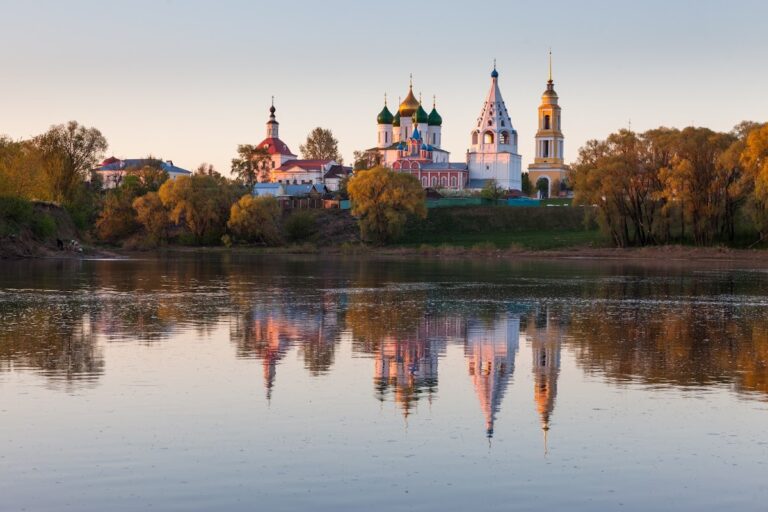
The surviving complex combines brick churches and monastic buildings with an enclosed system of walls and towers. Its appearance reflects construction and rebuilding from the late eighteenth century through the nineteenth century, followed by severe deterioration after the monastery’s closure and restoration from the 1990s onward.
Churches and bell tower
Cathedral of the Nativity of the Mother of God
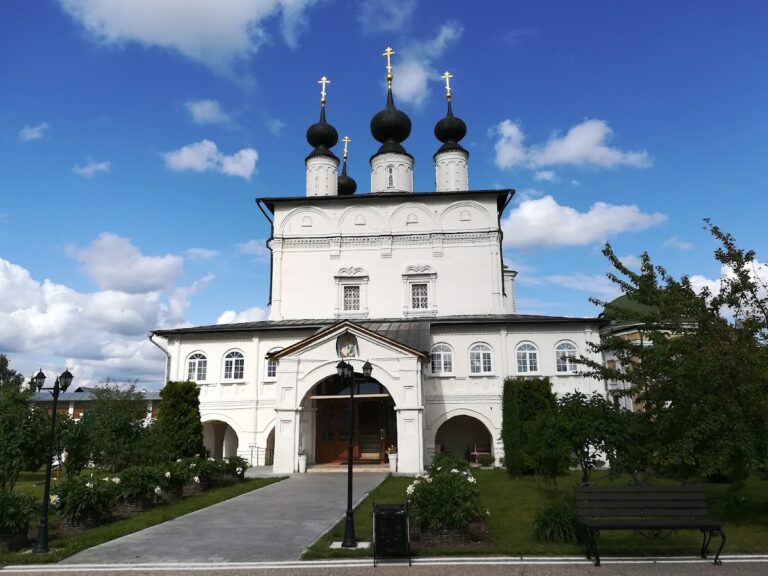
The Cathedral of the Nativity of the Mother of God was built as a two-story brick church between 1757 and 1790. In 1830, its upper level was removed and the windows belonging to that level were blocked. The principal altar was moved to the lower floor, where the church continued in a single-story form. By the end of the nineteenth century, the cathedral contained a carved and gilded three-tier iconostasis, the screen separating the sanctuary from the main worship space in an Eastern Orthodox church, with icons of old pictorial workmanship. Restoration began after the monastery reopened, and the cathedral was restored and reconsecrated in 2020.
Feodorovskaya Church
The Feodorovskaya Church is a separate heated brick church built in 1861. It contains chapels dedicated to the Kazan Icon of the Mother of God and Venerable David of Thessalonica. The church was used as a warehouse for mineral fertilizers after the monastery closed in 1929 and later deteriorated. Restoration began after the community returned in 1991 and continued with the work across the monastery complex.
Entry into Jerusalem Church and bell tower
In the eighteenth century, the Entry into Jerusalem Church retained the ancient appearance of a refectory combined with a church crowned by a tent roof, a tall pyramidal roof rather than a conventional dome. A stone set of Holy Gates also stood within the monastery at that time, while the other recorded structures were wooden.
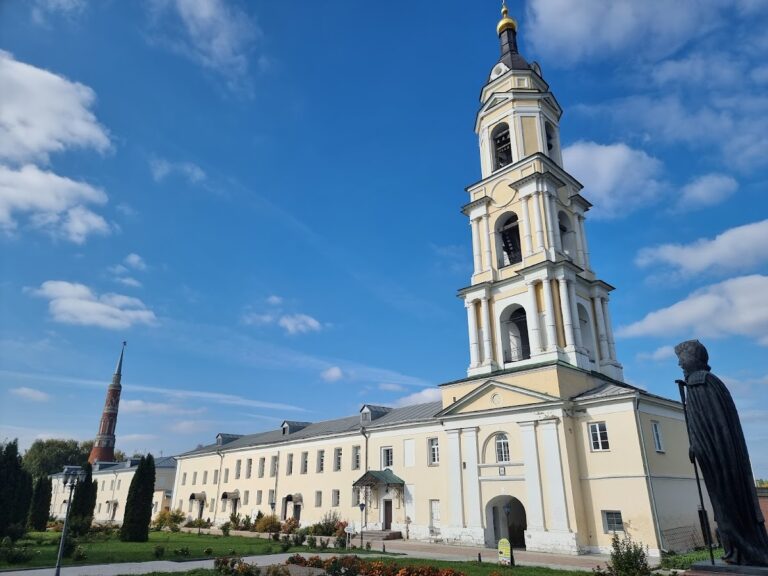
The bell tower stands on a square base and has an octagonal upper stage crowned by a tent roof. Its form derives typologically from seventeenth-century examples, while its architectural treatment and Baroque details indicate construction at approximately the same time as the cathedral.
Residential buildings and enclosure
Abbot’s building
The abbot’s building is a two-story brick structure. Its first floor belongs to the late-eighteenth-century episcopal house, the residence associated with the Kolomna episcopal see. The upper floor was added in 1861, linking the building’s earlier institutional use with the monastery’s nineteenth-century expansion.
Brotherhood buildings and service structures
The two-story brick brotherhood building contains late-eighteenth-century abbot’s cells on its lower floor, while its upper floor was constructed in 1861. After the monastery reopened in 1991, one of the brotherhood buildings received a house church. The single-story cell and stable buildings were modest brick structures whose window and door openings had triangular tops. The stables were later dismantled.
Walls and towers
The monastery walls were built in the Russian Gothic style, a late-eighteenth- and nineteenth-century Russian architectural vocabulary combining Gothic-inspired forms with local building traditions. White towers contrast with the red-brick walls. The western and northern sections of the enclosure were constructed in the mid-nineteenth century and reproduce the architectural character of the eighteenth-century walls.
Sacred objects
The monastery’s sacred objects include the Feodorovskaya Icon of the Mother of God, a cross containing a particle of the True Cross, and an icon containing a particle of the relics of Saint Spyridon of Trimythous. They also include an icon of Saint Sergius of Radonezh and the Vladimir Icon of the Mother of God.