Church of the Nativity of the Mother of God in Klishino: An Orthodox Parish Church
Site at a Glance
- Popularity
- Very Low
- Country
- Russia
- Primary era
- Early Modern
- Eras represented
- Early Modern
- Civilizations
- Russian
- Site type
- Religious
- Remains
- Church
On this page7 sections
History
The Church of the Nativity of the Mother of God in Klishino is an Orthodox parish church in Moscow Region, Russia. Its parish was recorded in the seventeenth century, and the present stone building dates to the latter half of the 1680s. The church was rebuilt in 1746.
Village and church origins
A 1616 record describes Klishino as a wasteland and an inherited estate of the Maslov family. The church appears in a record from 1676, when its parish included 16 households, among them one belonging to a boyar, a member of the high-ranking Russian nobility. The church then had no land or hay meadows.
Parish in the eighteenth and nineteenth centuries
In 1797 the parish comprised 34 households and 489 people, 236 males and 253 females. Its prescribed allotment for fields, homestead land, and hay meadows was 36 desyatinas, a historical Russian measure of land. In 1873 the church was listed as attached to K. S. Protasov.
Closure and return to worship
The church closed in the 1930s. Soviet authorities planned to demolish it with explosives and take its bricks, but villagers prevented this. The building was later used as a warehouse and a rural market.
Worship resumed in 1998, and restoration work began the following year. A permanent priest was appointed in August 2000, and the church is active today. It is designated a cultural heritage property of federal significance.
Remains
Plan and worship spaces
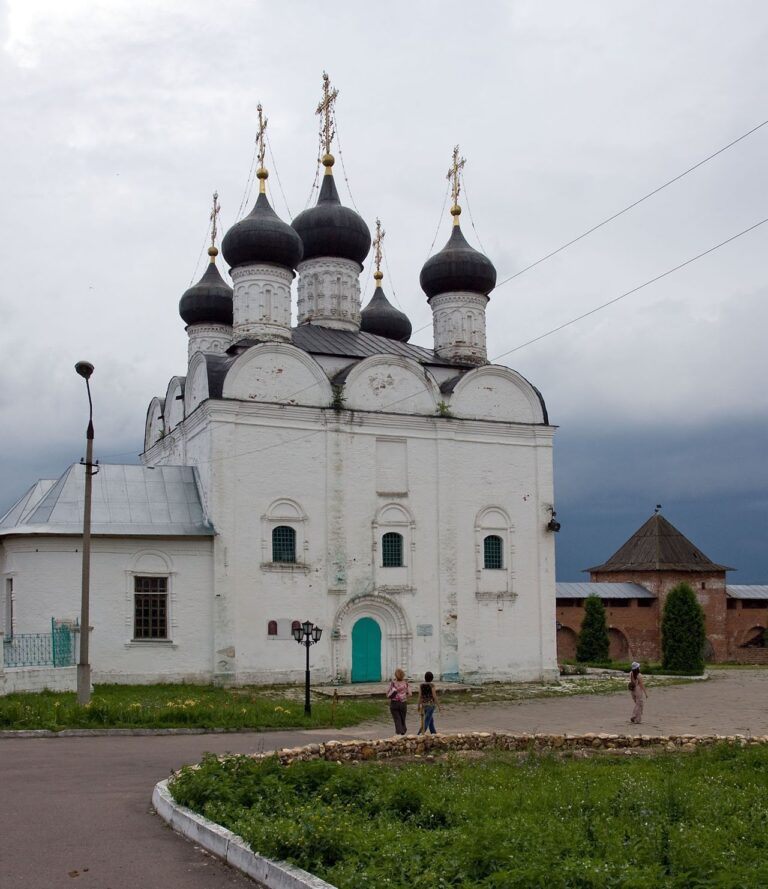
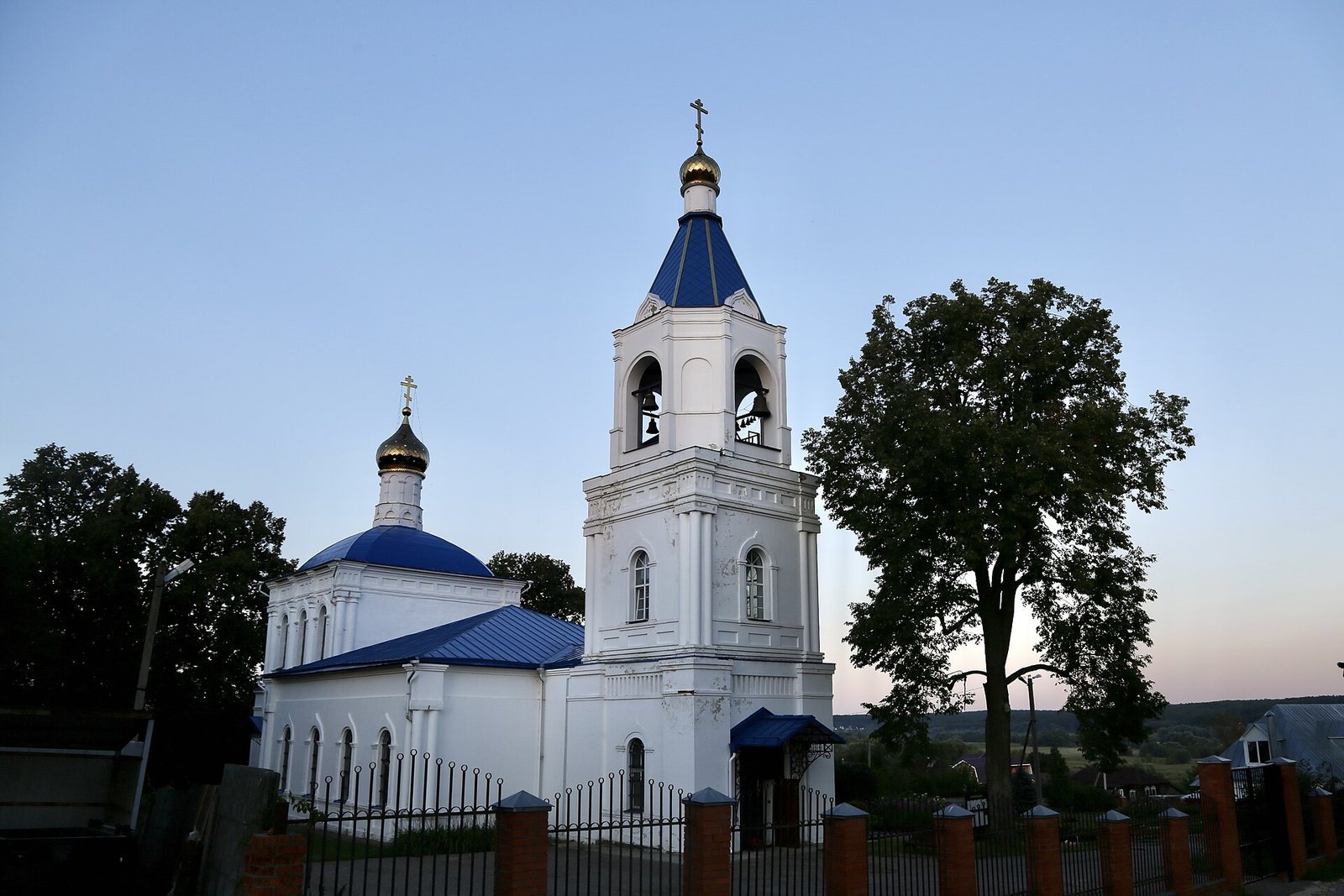
The stone church has five domes and a small bell tower. Its interior was divided into a summer section and a winter section. The main quadrangular block formed the summer section, while the vestibule, or entrance hall, served as the winter section and was the only part heated. The main altar was dedicated to the Nativity of the Mother of God, the Christian feast celebrating Mary’s birth. The winter altar honored All Saints, a dedication to the saints collectively. Services were held mainly in the summer section during summer and in the heated winter section during the rest of the year.
In 1797 the church’s stone walls and roof were described as sound inside and out, and its liturgical equipment as adequate.
Exterior decoration
Repairs led to the loss of the church’s seventeenth-century exterior decoration. It included kokoshniks (curved, gable-like ornaments), groups of half-columns, window casings, shoulder moldings, and decorative surrounds at the entrances.