Churches in Dymkovo, Veliky Ustyug: An Orthodox Church Ensemble
Site at a Glance
- Popularity
- Low
- Country
- Russia
- Primary era
- Early Modern
- Eras represented
- Early Modern, Modern
- Civilizations
- Russian
- Site type
- Religious
- Remains
- Church
On this page11 sections
History
Early churches at Dymkovo
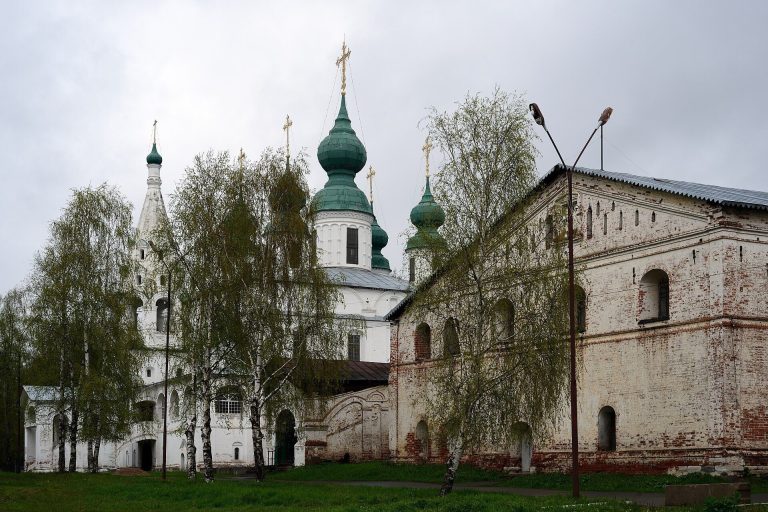
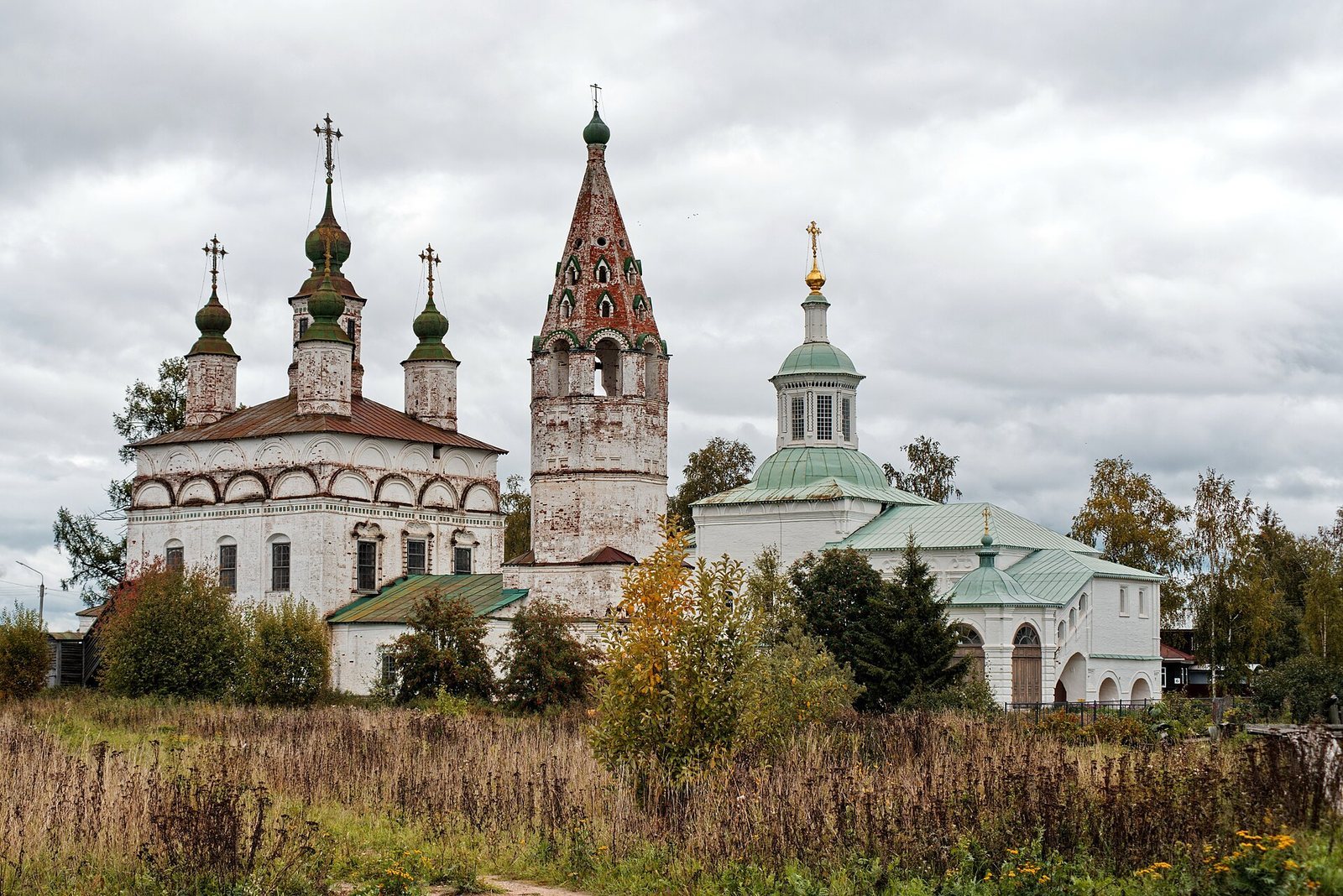
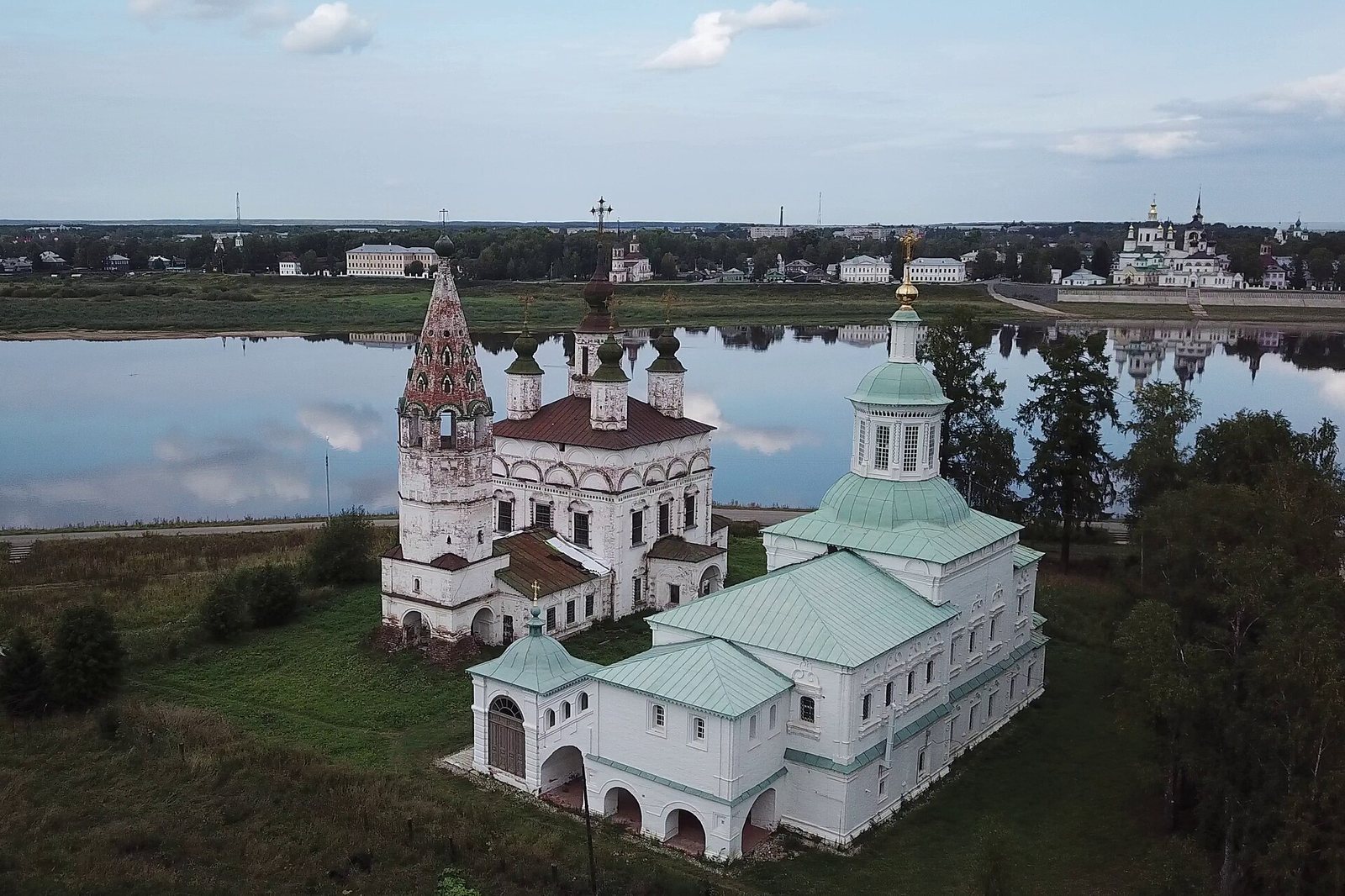
The Churches in Dymkovo, Veliky Ustyug, form an Orthodox ensemble on the right bank of the Sukhona River in Russia. Its principal building, the Church of Saint Demetrius of Thessaloniki, was built from 1700 to 1708 in a transition from local 17th-century traditions to Baroque forms.
Some local historians associate wooden churches at Dymkovo with the late 14th century and with a commemoration of Ustyuzhans’ participation in the Battle of Kulikovo. Fought in 1380 between forces associated with the Principality of Moscow and the Golden Horde, the battle became an important event in Russian historical memory. In 1539, Tatars burned two wooden churches at the site.
Stone churches and enclosure
Construction of the Church of Saint Demetrius began on 6 April 1700 and was completed in 1708. After finishing work, Joseph, Archbishop of Veliky Ustyug and Totma, consecrated it on 6 July 1709. The church honors Saint Demetrius of Thessaloniki, an early Christian martyr venerated in Eastern Orthodox Christianity. A heated church dedicated to Saint Sergius of Radonezh, a major Russian Orthodox monk and spiritual leader, was built nearby in the mid-18th century.
In 1859, merchants Ilya Yakovlevich Gribanov and Pavel Maksimovich Zhilin provided funds for a stone enclosure around the churches.
Closure and later history
The Church of Saint Demetrius closed in 1929. During the Soviet period, it was used at different times as a library, museum, club, sanatorium, and storage space. The stone enclosure was dismantled during this period.
In 1984, ten icons from the festive tier of the church’s iconostasis, the screen of icons separating the sanctuary from the main worship space, were stolen and taken abroad. The festive tier contains images of major religious feasts. The icons later turned up in a private collection; Mikhail Yuryevich Abramov bought them and donated them to the Veliky Ustyug State Museum-Reserve in 2012. The Church of Saint Demetrius is now managed by the museum-reserve, which preserves cultural heritage sites and collections. The ensemble is affiliated with the Vologda Metropolia, a regional church administration, and the Veliky Ustyug Diocese, a territorial church district. The Church of Saint Demetrius is a federal-level cultural heritage monument of the Russian Federation.
Remains
The ensemble is arranged around the five-domed Church of Saint Demetrius, with the heated church dedicated to Saint Sergius to its south. The surviving features include the principal church and parts of the former stone enclosure.
Church of Saint Demetrius
Plan and exterior
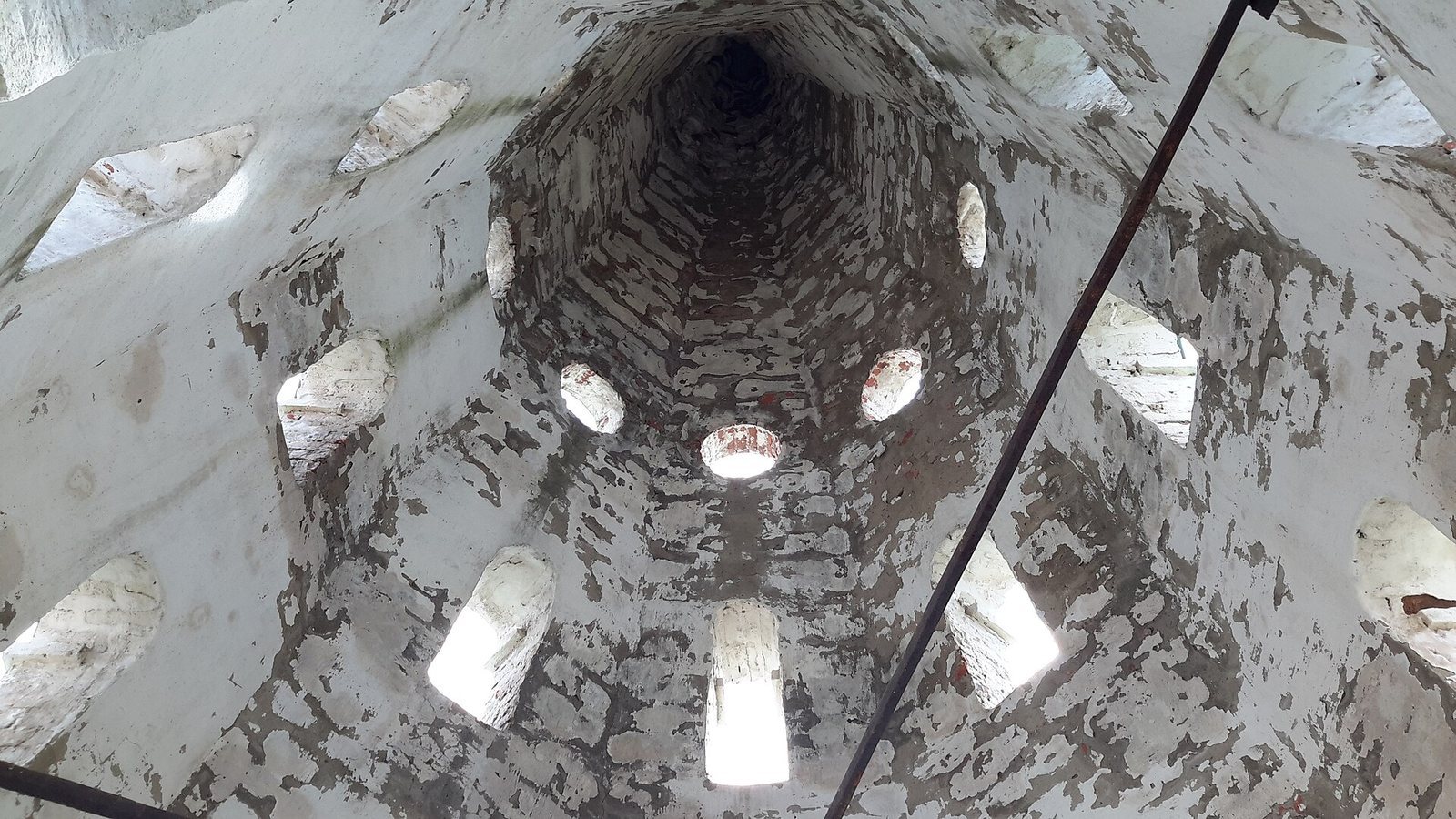
The church’s main body is a square block rising through two storeys, topped by two rows of curved, gable-like roof forms and decorated tile friezes. Five domes rest on eight-sided drums, each crowned with a wrought-iron cross bearing radiating ornament. On the east, an altar end with three projecting sections adjoins the main block. A single-storey refectory and a tall bell tower with a tent-shaped roof extend to the west.
Facades and entrances
The north facade is plain, while the other exterior walls have pilasters decorated with paired half-columns and recessed panels. Shaped bricks frame the windows and form deeply recessed entrances on the south and west. A porch canopy supported by twisted columns stands at the south entrance. The bell tower has restrained panel and cornice ornament.
Interior and iconostases
The interior is well preserved. The main church contains an 18th-century gilded, carved Baroque iconostasis with five tiers, horizontal cornices, and vertical columns. A separate two-tier iconostasis, made in the 19th century, stands in the refectory.
Altar fresco
Above the altar, a five-metre fresco is set within an icon case on the eastern facade. Christ, shown as ruler of all, occupies the center of the multi-figure scene. Above him appear the Lord of Hosts, the Holy Spirit, and two angels among clouds.
Stone enclosure
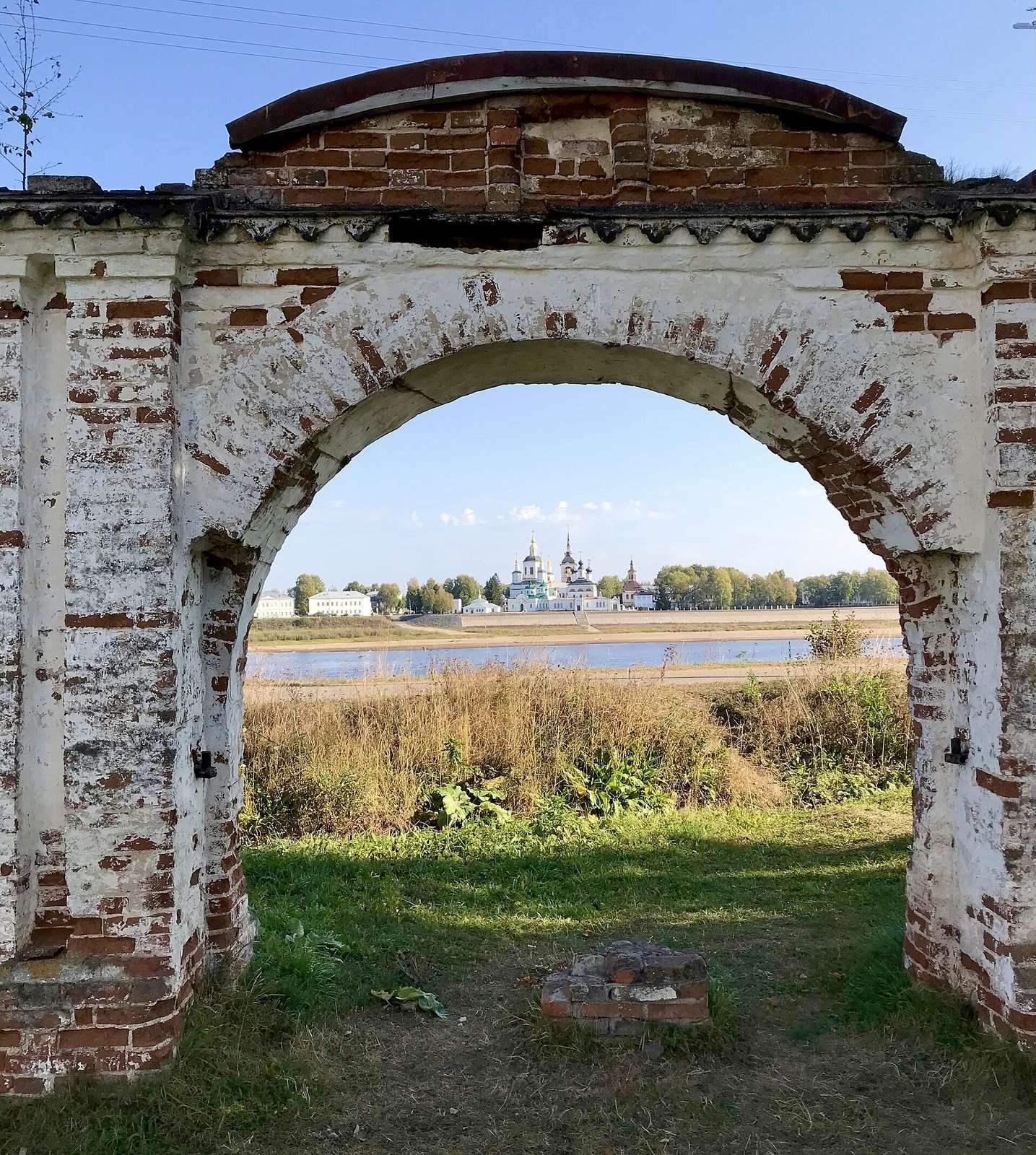
The former enclosure had gates on its east and south sides, with small towers at the southeast and northeast corners. The gates and part of the southeast tower survive.