Palazzo Gabrielli-Borromeo: A Baroque Palace and Jesuit Educational Residence in Rome
Site at a Glance
- Popularity
- Medium
- Country
- Italy
- Primary era
- Early Modern
- Eras represented
- Early Modern
- Civilizations
- Papal States
- Site type
- Domestic
- Remains
- Elite Residence
On this page8 sections
History
Palazzo Gabrielli-Borromeo is a Baroque palace on Via del Seminario in Rome, Italy, established in the mid-sixteenth century by Girolamo Gabrielli. A member of the noble Gabrielli family associated with the counts of Gubbio, Girolamo served as an advocate of the Sacred Consistory, the pope-and-cardinal assembly that also exercised judicial functions.
From family residence to Jesuit college
Girolamo left the palace to his nephew Carlo. Since Carlo had no sons, the property passed to his daughter. She married an heir of the Mignanelli family and moved to the family palace in Piazza di Spagna, after which the Gabrielli palace was sold.
In the early seventeenth century, the Jesuits, a Catholic religious order, acquired the building for 20,000 scudi. They made it the home of the Roman Seminary, which trained clergy, and the College of Nobles, a boarding institution for young men from aristocratic families. These educational uses ended on 11 September 1772, when Pope Clement XIV ordered the institution’s closure, shortly before the Jesuit order was suppressed in 1773.
New owners and renewed educational use
In 1774, Rome’s Monte di Pietà, a charitable lending institution, purchased the palace for 32,000 scudi and rented it to various tenants. Cardinal Vitaliano Borromeo later renovated and decorated the building. On 26 August 1796, it was granted to the Fabbrica di San Pietro, the body responsible for St Peter’s Basilica, under a perpetual, inheritable form of tenure. The Fabbrica used the palace for offices.
At the direction of Pope Leo XII, the palace returned to the Jesuits in 1824, after the order was restored. Its educational function resumed with a seminary affiliated with the Collegio Romano, a Jesuit educational institution. The palace also housed the College of Nobles, whose students included sons of Italy’s noble families.
Colleges and the Gregorian University
The political upheavals of 1848 brought another expulsion of the Jesuits, and Vatican offices took over the building. After Pope Pius IX fled to Gaeta, Rome’s republican government entrusted the palace to Giuseppe Mazzini, a leading Italian republican and nationalist. The Roman Republic, established in 1849, fell soon afterward, and the Ministry of Public Works occupied the palace until 1850.
The College of Nobles reopened there in 1851, and the Collegio Germanico-Ungarico, a college for German and Hungarian clergy and students, joined it in 1853. After the breach of Porta Pia in 1870, during the Kingdom of Italy’s capture of Rome, the College of Nobles moved to Tivoli. Legislation dissolving religious orders later brought its closure. The Collegio Germanico-Ungarico remained in the palace until 1886, when it moved to Palazzo Costanzi in Via di San Nicola da Tolentino.
From 1873, the Collegio Romano also occupied the palace, sharing it with the German-Hungarian college until 1886. A rescript issued by Pius IX on 4 December 1873 authorized the Collegio Romano to take the name Pontifical Gregorian University. After the other college moved, its students and professors assembled at the palace under Jesuit Father Vincenzo Roccatelli, who managed the community’s practical affairs.
Pope Leo XIII, a former student of the Collegio Romano, sought to develop the Gregorian University as a model for Catholic universities and ecclesiastical colleges. During his pontificate, it added professorships held by prominent scholars and drew students from around the world. The university remained at the palace under Pius X and Benedict XV, becoming an international center of ecclesiastical learning. In 1930, the need for larger premises led it to move to Piazza della Pilotta.
Jesuit residence since 1930
Since 1930, the palace has housed the Collegio San Roberto Bellarmino of the Roman Province of the Society of Jesus. It serves as a Jesuit scholasticate, a residence for advanced religious and academic formation, and as an international home for Jesuit priests pursuing further studies at the Gregorian University or other pontifical universities in Rome.
Remains
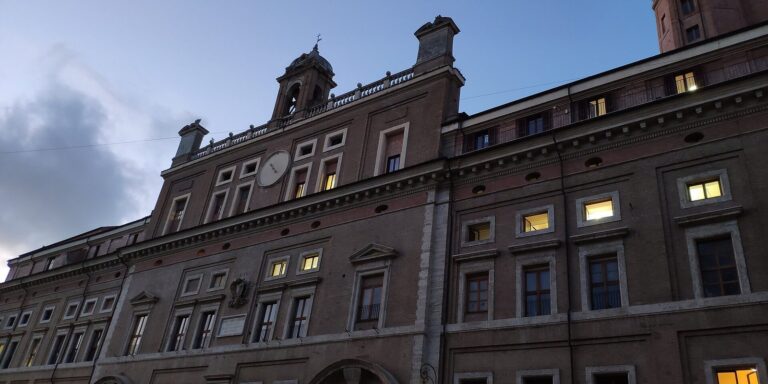
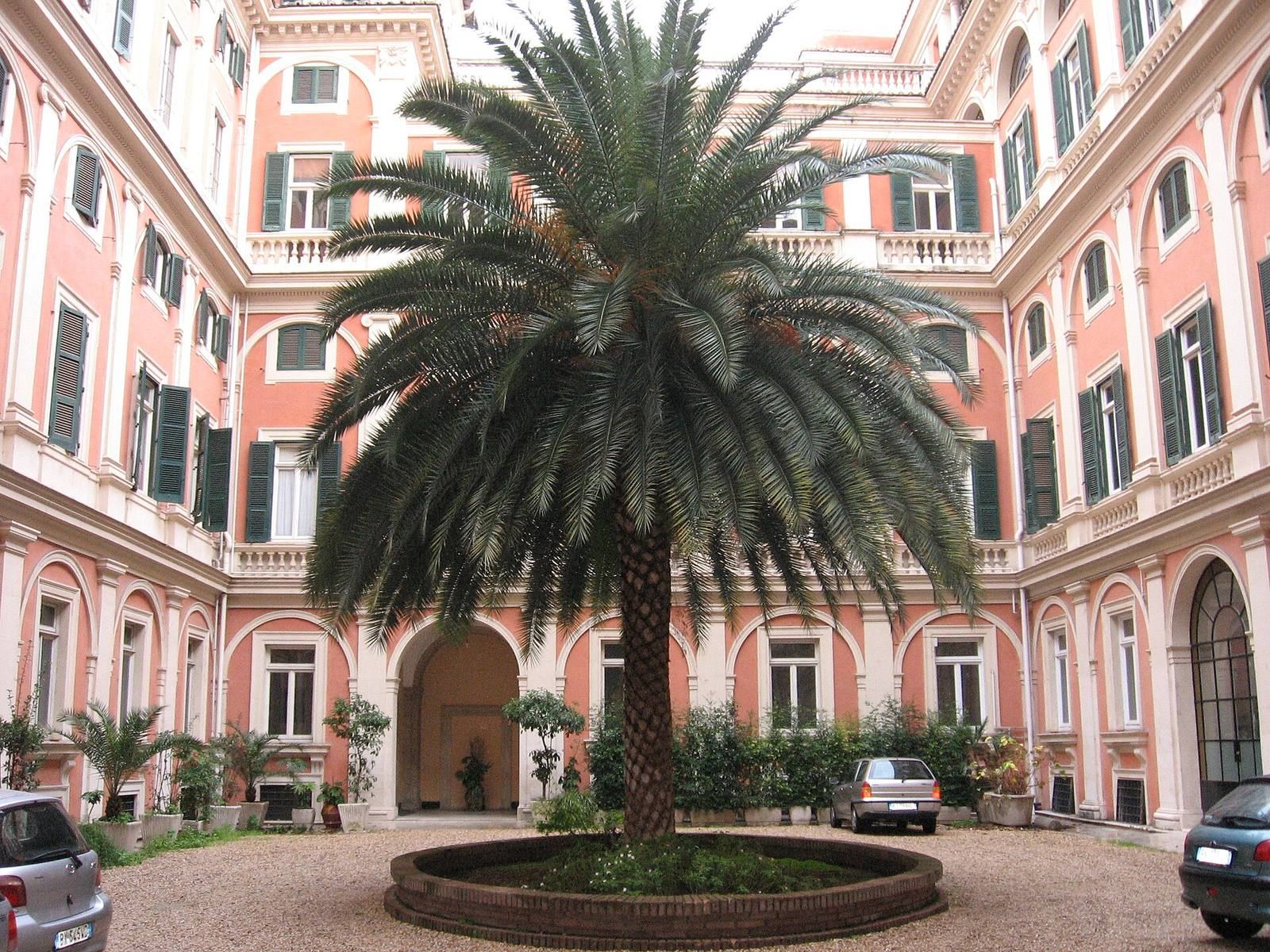
The Baroque palace stands on Via del Seminario, between Piazza di Sant’Ignazio and the Pantheon, in the ancient Campus Martius and the Colonna district. Its street-facing façade fronts an interior organized around a central courtyard enclosed by a four-sided portico.
Street façade
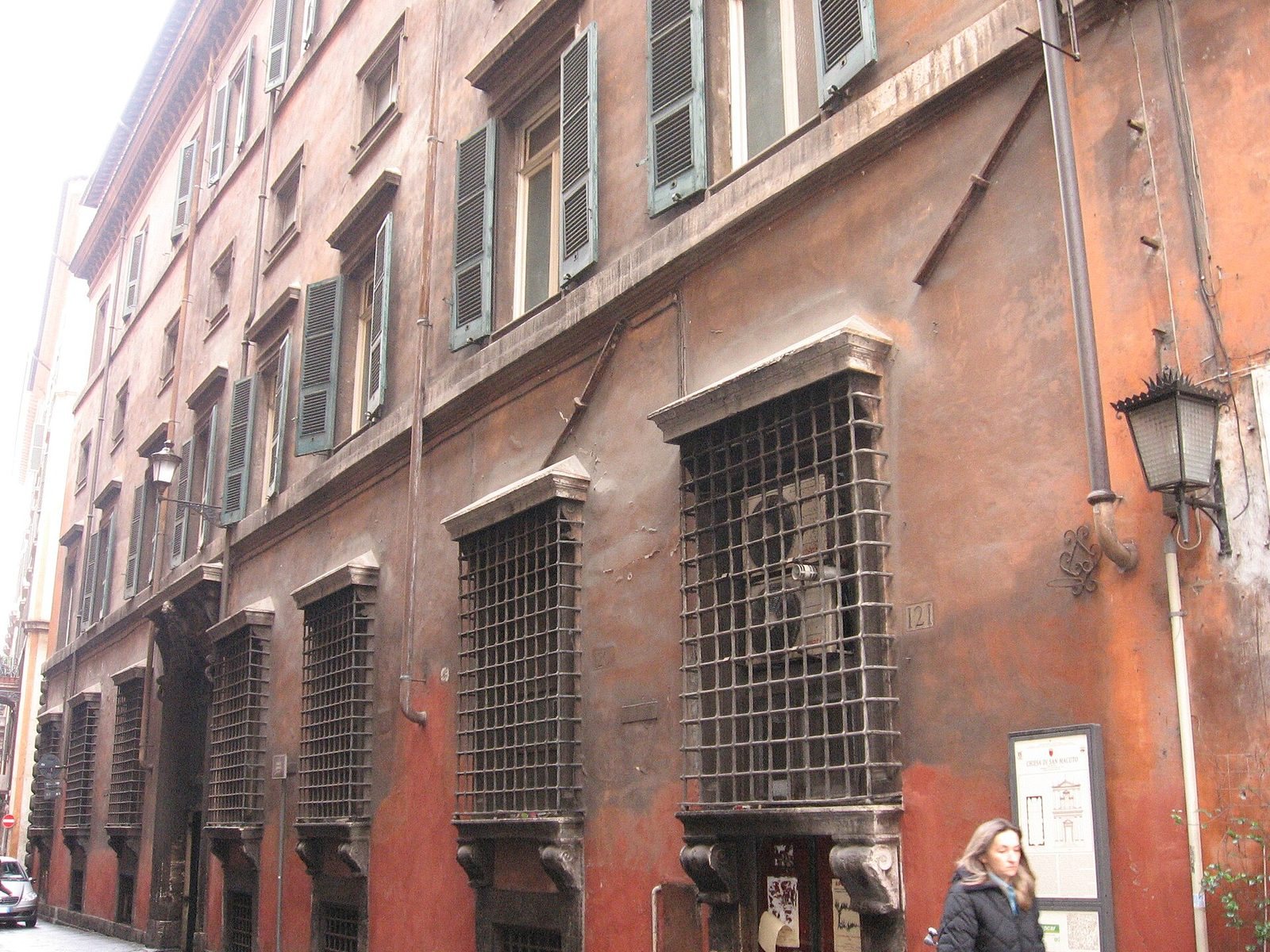
Seven windows occupy the ground floor. Their horizontal top frames rest on brackets, and iron grilles protect the windows, with smaller openings below them. The central entrance portal bears the coat of arms of Pope Leo XII. Above, the second storey has nine windows with horizontal frames, while the third has nine windows, each topped by a smaller one.
Courtyard and staircase
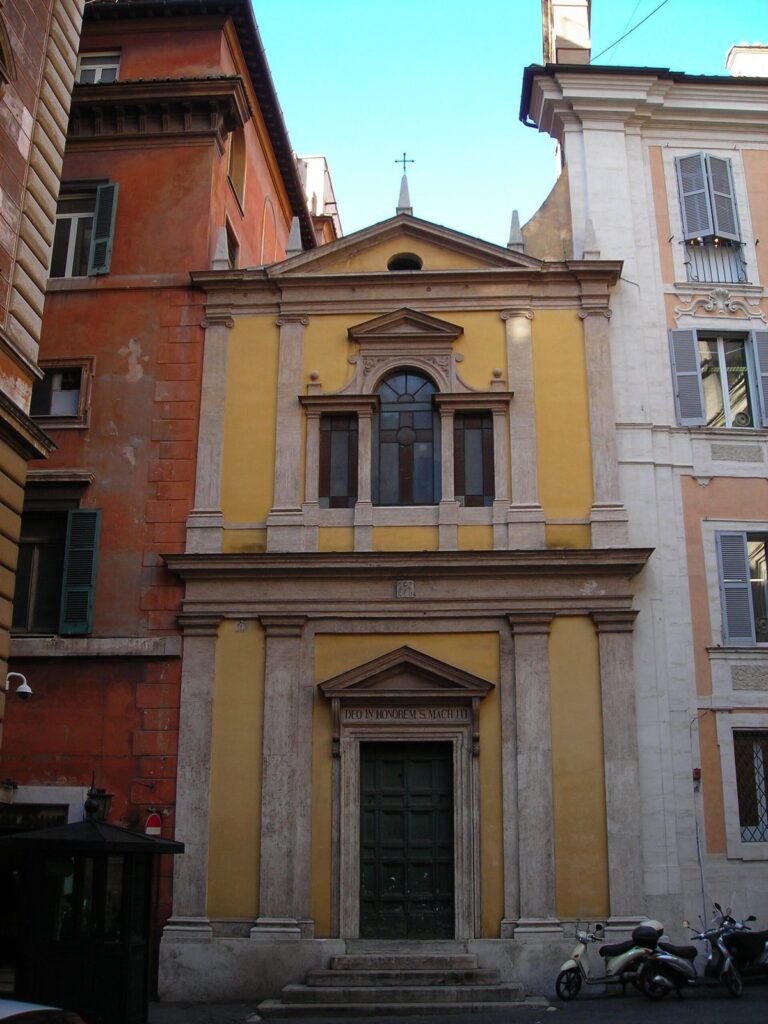
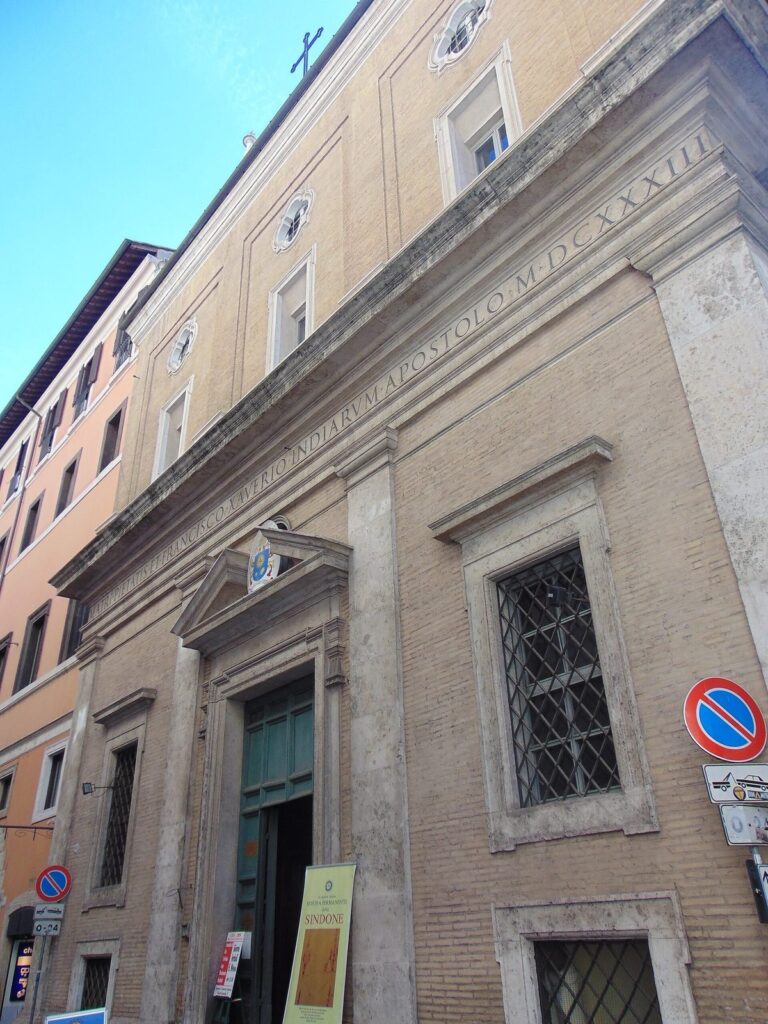
The four-sided portico encloses the central courtyard. A large staircase runs along the right wing from the entrance; a door on its landing opens into the attached church of San Macuto.