Oratory of San Francesco Saverio del Caravita: A Jesuit Centre for Worship and Lay Formation
Site at a Glance
- Popularity
- Medium
- Country
- Italy
- Primary era
- Early Modern
- Eras represented
- Early Modern
- Civilizations
- Papal States
- Site type
- Religious
- Remains
- Chapel
On this page13 sections
History
The Oratory of San Francesco Saverio del Caravita is a Catholic place of worship in Rome, Italy, built by Jesuits between 1631 and 1633 in the Baroque and Rococo styles, European artistic traditions with Rococo known for ornate decoration. It became Rome’s first oratory for nighttime devotions and a centre for Jesuit lay associations and charitable outreach.
Before the Jesuit oratory
The oratory stands over the site of the Church of San Nicola de Forbitoribus, which dates to the late twelfth century. Its earliest known reference is in the 1192 Ordo of Cencius Camerarius. The church’s name appears to refer to a confraternity, a religious association, of scissors-makers and knife-makers. Craft associations commonly supported churches in the twelfth century. A bull of Pope Urban V also referred to San Nicola.
On 1 September 1405, lightning struck the church and its bell tower, causing considerable damage. In 1551, Pope Julius III entrusted the church to the Camaldolese, a Benedictine monastic congregation. They established a monastery beside a church dedicated to Saint Anthony of Egypt.
Jesuit foundation and ministry
By 1631, the Jesuits had established themselves beside the Collegio Romano, their educational institution in Rome, and needed space for the lay groups that gathered there. They obtained the Camaldolese property in exchange for a site near Piazza Venezia. The Camaldolese moved to Saint Romuald, and the Jesuits demolished the older church and monastery to make way for the new oratory.
The Jesuit priest and architect Pietro Gravita oversaw construction from 1631 to 1633, with financial support from noble families living near the Pantheon. Work began on 8 September 1631 with a blessing by Emilio Altieri, then Bishop of Camerino. The oratory was consecrated that year and first dedicated to both Santa Maria della Pietà and Saint Francis Xavier. It drew as many as 20,000 communicants a day.
One purpose of the new oratory was the Missione Urbana, or Urban Mission, a charitable effort that brought evangelization and catechesis, instruction in Christian teaching, to farmers and others arriving for Rome’s markets from places with limited pastoral care. The building also hosted confraternities, sodalities (lay devotional associations), and other congregations. These included the Mantelloni, a penitential association of the Collegio Romano whose members practiced severe self-mortification.
The Sodality of the Blessed Virgin, founded in 1563 by the Belgian Jesuit Jean Leunis, met at the oratory. In 1584, Pope Gregory XIII recognized the Roman College sodality as the leading unit in a wider system of affiliated groups. The oratory became a centre for Jesuit-backed lay associations called the Congregations of General Holy Communion. They encouraged frequent Communion, Eucharistic processions, meditation, reflection on conscience, and charitable work among farmers, artisans, students, lawyers, and aristocrats.
At the height of their activity, nine of these groups met at the oratory, including the first to admit women. Each had its own meeting place, while members came together on Friday evenings for devotions and formation led by Jesuits from the neighboring college. Their work followed the pastoral approach of Ignatius of Loyola, founder of the Jesuits. Alongside preaching, teaching, and hearing confessions, it included help for poor people and plague victims, as well as efforts to guide prostitutes into houses of reformation.
The oratory was entirely rebuilt between 1670 and 1677, probably under the direction of Baroque architect Giovanni Antonio de’ Rossi. It was rededicated to Saint Francis Xavier and the Madonna della Pietà. Gravita’s surname was apparently pronounced “Caravita” by Romans, perhaps because of his Terni dialect. After his death in 1658, the oratory came to be known by that name.
Suppression, renewed use, and reopening
After the Society of Jesus, the Jesuit Catholic order, was suppressed in 1773, the Fathers of the Holy Faith, later called the Fathers of the Faith of Jesus, took charge. With help from the Vincentians, Catholic religious communities inspired by Vincent de Paul, they sought to continue the Jesuit mission. Following the Society’s restoration in 1813, the oratory again became the centre of Jesuit lay associations in Rome. It fell into disuse in 1925.
In 1832, the Roman poet Giuseppe Gioachino Belli referred to the oratory in two ironic sonnets, L’ineggno dell’Omo and Li frateli Mantelloni, written on 18 and 19 December. In 2000, Jesuits responsible for the Church of Sant’Ignazio sought to provide English-language worship for Jubilee pilgrims and renew the oratory’s work in lay formation and outreach. The Caravita Community formed, and the oratory reopened on 15 October. It became home to an international English-speaking Catholic community in Rome.
On 14 April 2013, the community entered an ecumenical covenant, an agreement for cooperation among Christian traditions, with the Anglican Centre in Rome. Its work includes joint services and an annual Ash Wednesday service with Churches Together in Rome. The oratory is a Catholic institution in the Diocese of Rome and a subsidiary church of the parish of Santa Maria in Aquiro.
Remains
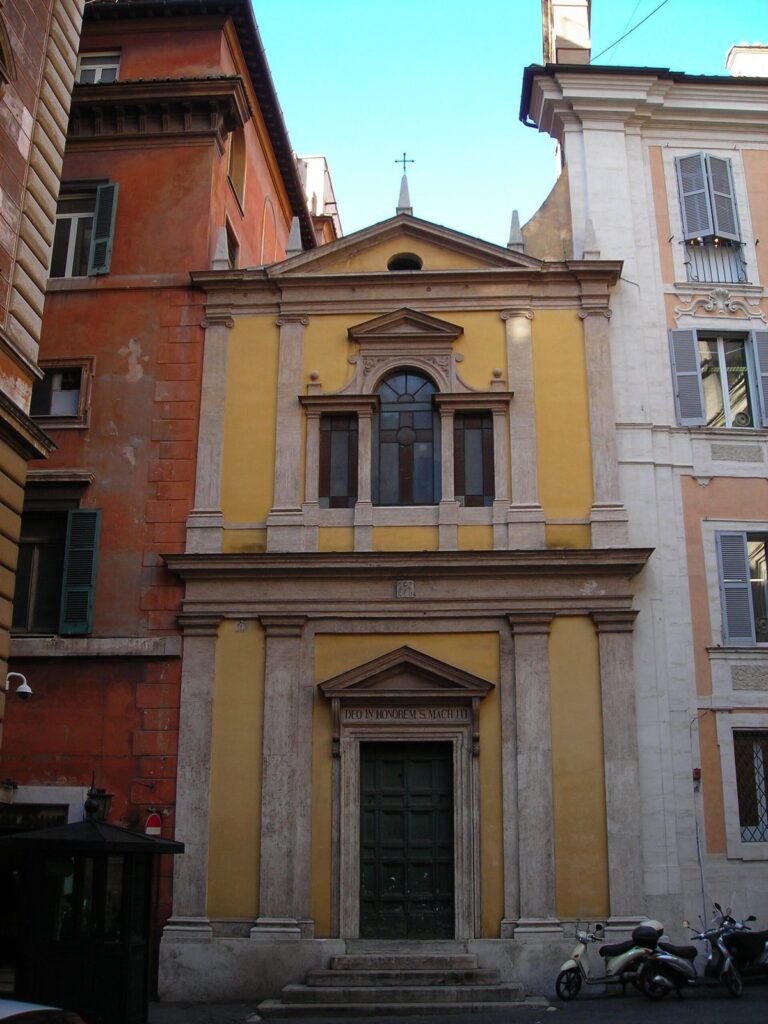
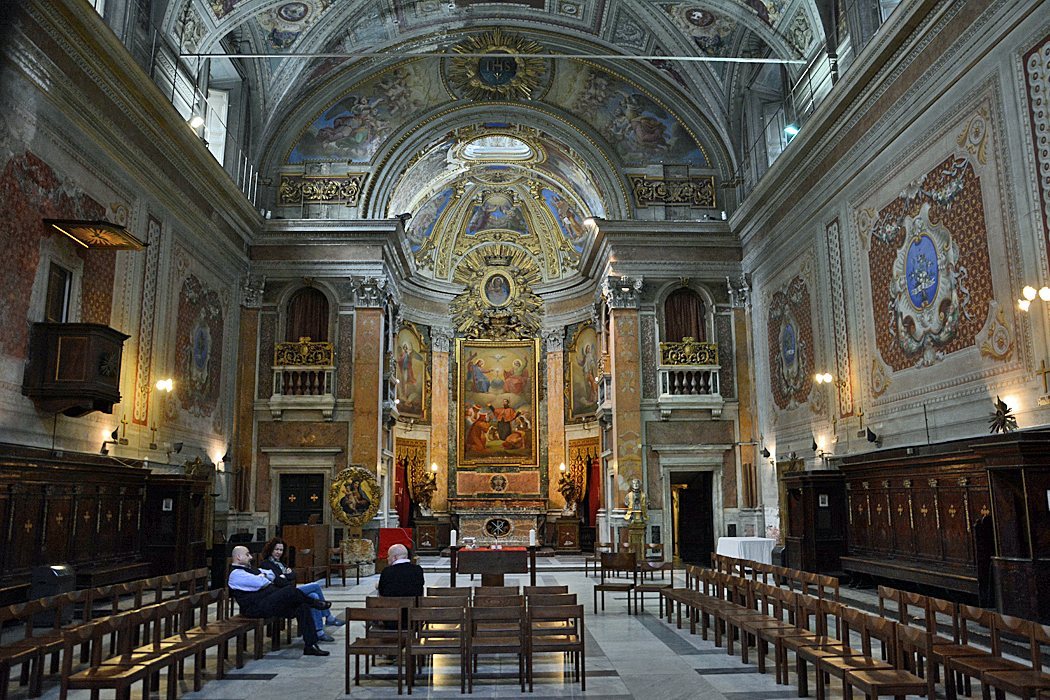
Set in Rome’s historic Pigna district near the Church of Sant’Ignazio, the oratory stands above the ruins of San Nicola de Forbitoribus. Its interior is arranged around a single nave, the main central space of a church, preceded by an atrium, or entrance hall. Smaller rooms open from the oratory.
Exterior and urban connections
Façade
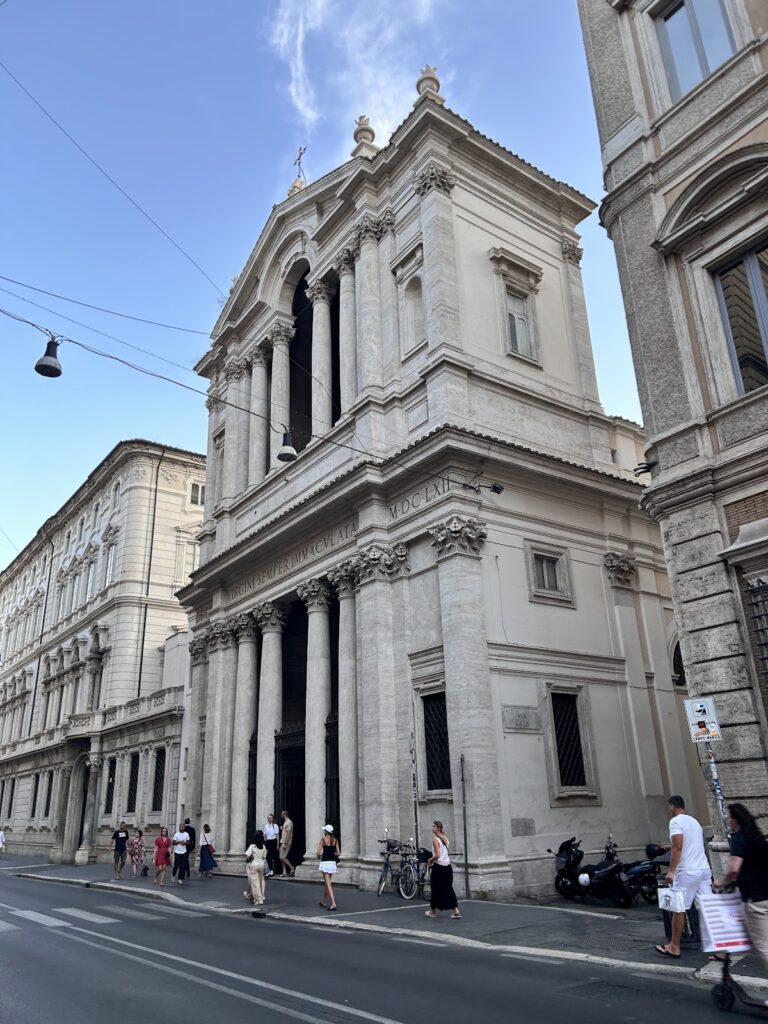
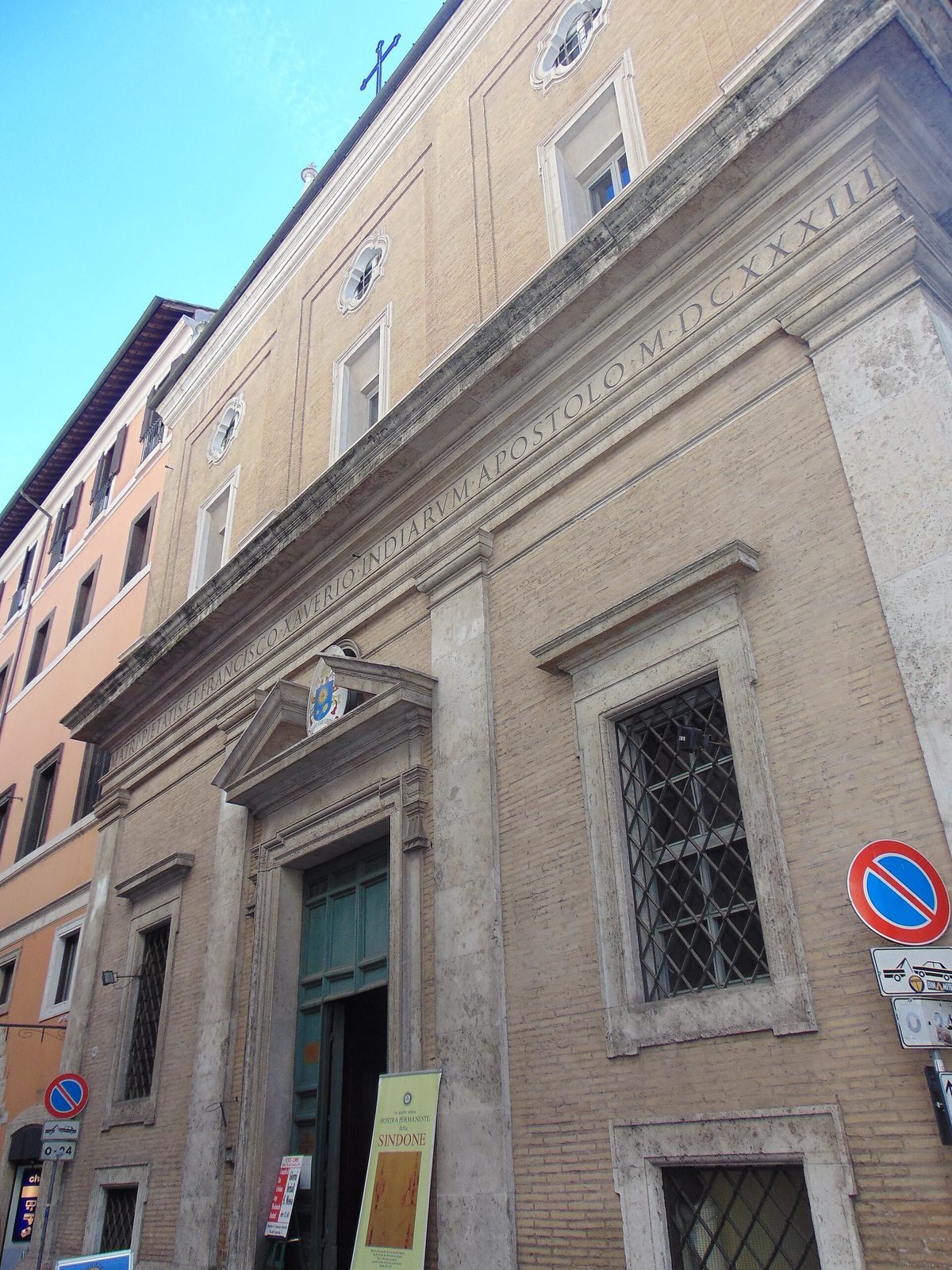
The façade is arranged in two levels of pilasters, shallow, column-shaped projections attached to a wall. On the upper level, windows sit beneath unusual oval openings with four lobes. Above them, a balustraded upper wall carries an iron cross between four elaborate vases made of travertine, a limestone used widely in Rome.
Arch and crossing
The Arco dei Gesuiti, or Arch of the Jesuits, spans Via del Collegio Romano and links the oratory with the old Roman College. A skybridge was built in 1716 to let Jesuits cross the street between the college and the oratory.
Interior and furnishings
Nave, atrium, and devotional objects
The interior’s layout gives clear views of the altar and Eucharist and supports the audibility of preaching and catechesis. Seventeenth-century sculpted-walnut benches run along the walls. Two holy-water fonts in the atrium take the form of crabs, each holding a bronze crucifix in a claw, a symbol of Saint Francis Xavier. Near the room used for clergy preparations is a silver reliquary, a container for a holy relic, holding a relic of the saint.
Painted decoration
Frescoes in the atrium depict the Life of Saint Francis Xavier. Various artists painted them to a design by Lazzaro Baldi. The main altarpiece, created in the eighteenth century by Sebastiano Conca, shows the Holy Trinity and Saint Francis Xavier. Another fresco, attributed to painter and architect Baldassarre Peruzzi, came from the former Church of San Rocco all’Augusteo and was donated to the oratory in 1670. It was placed in the apse, a recess at the end of a church, and crowned by the Vatican Chapter in 1677. It is now near the organ, just left of the old sanctuary.
Gallery organ
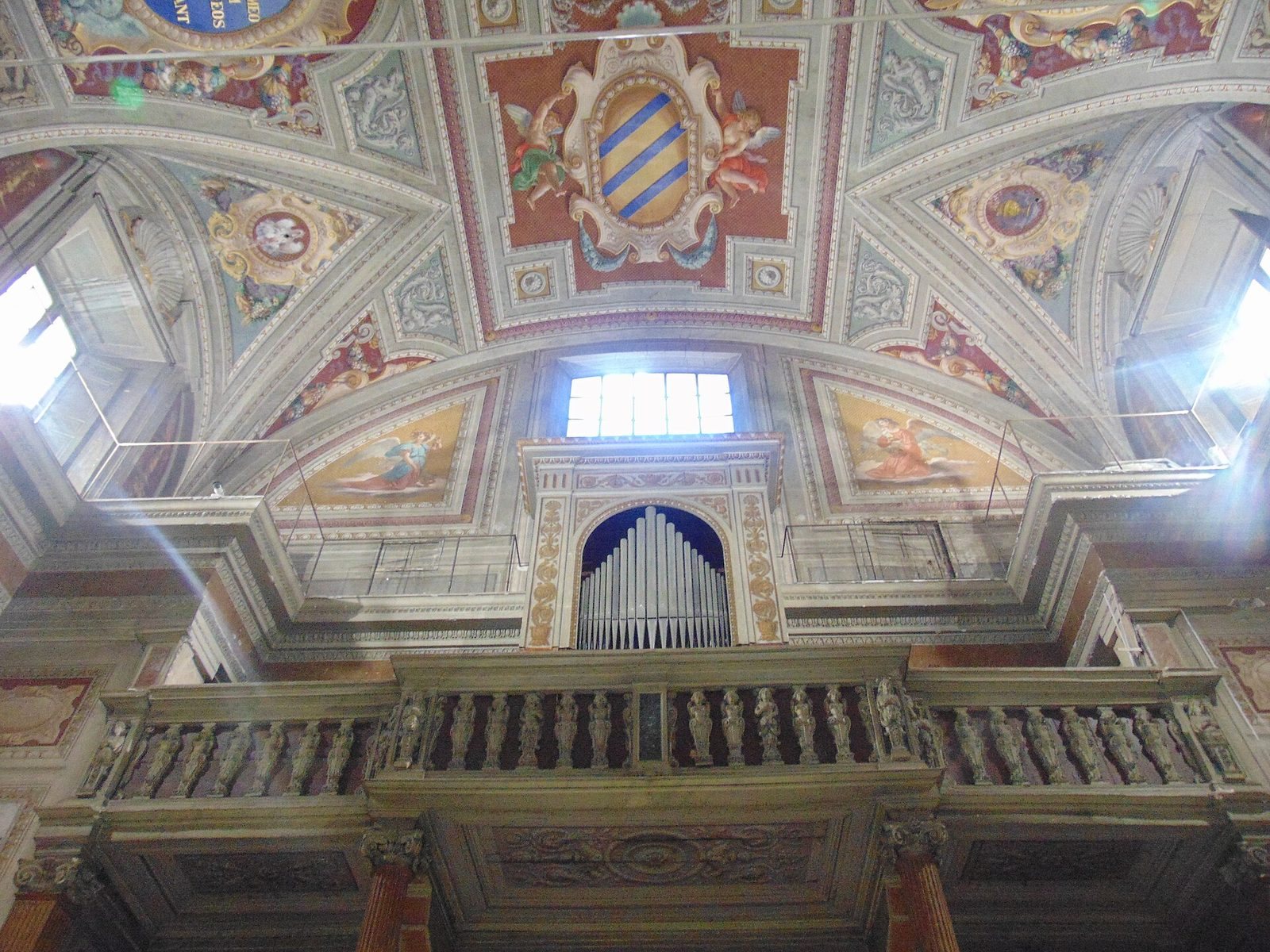
The gallery organ was made in 1790 by the Priori family of Roman organ builders. Described as pre-Romantic, a transitional style in relation to Baroque organs, it has one keyboard with 23 keys and eight pedals. Mozart performed at the oratory in 1770 as a teenager, using an earlier organ that predates this instrument. The gallery organ was renovated and tuned in 2012.
Rooms above the atrium
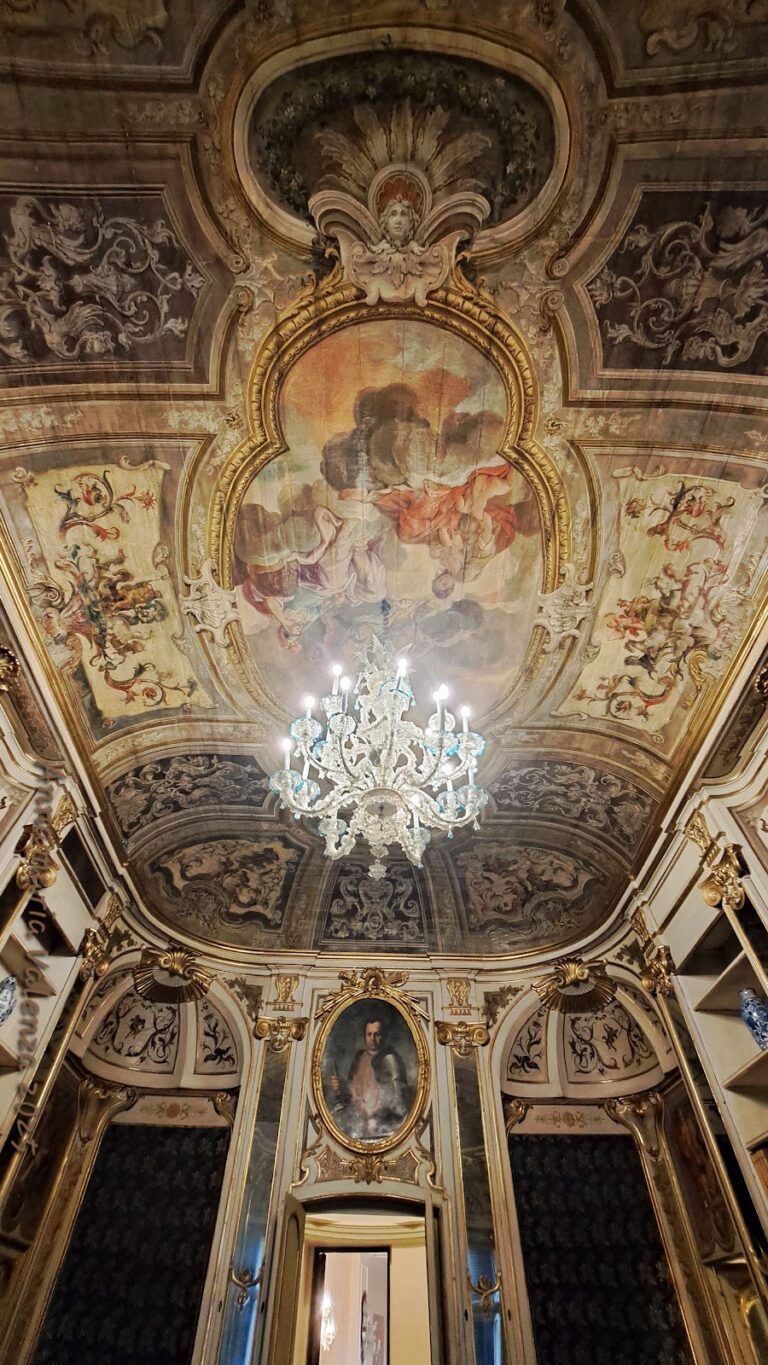
The Ristretto degli Angeli, a room above the atrium, once hosted meetings of the Roman College Sodality. Sculptor and decorative artist Giovanni Battista Maini completed its stucco, or decorative plaster, work in 1745 and 1746. The room and several other upstairs spaces are occupied by the Roman choral group Il Coro del Lunedì.