Chiusa di Casalecchio di Reno: Medieval Weir and Waterworks
Site at a Glance
- Popularity
- Medium
- Country
- Italy
- Primary era
- Medieval
- Eras represented
- Medieval, Modern
- Civilizations
- Italian, Papal States
- Site type
- Infrastructure
- Remains
- Dam
On this page15 sections
History
The Chiusa di Casalecchio di Reno is a medieval weir, a low barrier that regulates river water and directs it into a channel, on the Reno in Italy. Here the river leaves its natural mountain course and is diverted into the human-made Reno Canal, which carried water across the plain. The complex is securely recorded from 1183, when the weir and canal officially opened. For centuries, its water supplied Bologna’s silk mills, an important part of the local economy.
Origins and the canal
The installation’s beginnings remain uncertain. A nineteenth-century manuscript gives an unspecified reference to 1000, leading some scholars to suggest that a simple weir existed in the eleventh century. The builders are unknown. One possibility is that canons, clergy attached to a church community, at the canonry of St Mary of the Reno initiated the work. Founded in 1130, the institution may have had the resources and expertise required. The first barrier was modest and was later enlarged as demands on its water supply grew.
The weir probably came before a branch of the Reno Canal built in 1191 to carry water to Bologna’s city walls. The branch followed Via del Pratello and was partly held by the Ramisani, a group originally numbering 41 who formed a consortium to maintain the canal and weir. On 29 May 1208, they transferred to Bologna’s municipal government their rights to water beyond their own requirements.
Medieval rebuilding and flood damage
In 1250, Bologna commissioned a stone weir upstream of the earlier wooden one, along with a newly excavated link to the existing canal, called the old channel. A technical commission supervised the project, which was completed in 1278. Flooding and erosion soon required repairs, in 1288, 1289, 1294, 1295, and 1299. The wooden barrier also received occasional repairs, perhaps serving as a secondary structure, before it was almost completely dismantled in 1309.
A major Reno flood on 29 April 1310 broke the weir and left the canal dry, cutting off water to Bologna’s mills. Repairs were in progress by June. Dominican and Franciscan friars, members of two Catholic religious orders, supervised the work, and the municipality placed the weir and canal complex in their care. Further structural work followed in 1317. In 1324, Cardinal Bertrando del Poggetto, a senior Catholic cleric, commissioned two friars, Giacomo and Bartolomeo, to make what was intended as a lasting repair.
The following year, after the Battle of Zappolino, a conflict between Bologna and Modena, the weir was damaged and Bologna’s water supply was interrupted. Troops led by Passerino Bonacolsi, ruler of Mantua, may have caused the damage while devastating the Casalecchio area. A severe flood may instead have been responsible. Between 1360 and 1363, papal legate Egidio Albornoz, the pope’s representative, ordered the weir rebuilt about 200 metres upstream, where the river’s greater natural fall improved the waterworks. This established its enduring location. Later interventions mainly adjusted and reinforced the complex. Corrections in 1403 also drew on lessons from earlier failures as engineers planned future works.
Early modern repairs
After the work of 1403, the weir escaped flood damage until 1567, though it continued to receive routine maintenance and improvements. That year, a section failed and threatened the whole structure. Pope Pius V commissioned Jacopo Barozzi da Vignola, an architect of the Renaissance, the European cultural and artistic movement. Repairs began in 1567 and continued until 1574, addressing two other parts of the structure as well. Its basic construction remained substantially unchanged into the eighteenth century. Further repairs in 1763 and 1790 presented no major difficulty.
Water management and custodians
From the thirteenth through the eighteenth century, the weir was Bologna’s principal water supplier for silk production. Its custodian controlled the flow that powered local industry and, in threatening weather, warned workers to adjust heavy wooden gates to lessen flood risk in the city. The custodian also tried to anticipate floods by judging changes in the river’s colour and smell, which varied with its tributaries and the ground they crossed. For major public ceremonies, a formally dressed stand-in sometimes represented the custodian in processions.
The Chierichi family oversaw the weir from 1768 to 1966. Giovanni I Chierichi (1753–1833), the first family custodian, had previously worked in the silk trade and was considered technically knowledgeable. His son Serafino I (1812–1879) followed him, then Serafino’s eldest son Giovanni II (1843–1921), who managed the 1893 flood crisis. Giovanni II’s son Serafino II (1883–1966) succeeded him and became known for rescuing people in danger of drowning. Serafino II was followed by his younger son, Cesare II (1924–2007).
From the canal’s establishment until the outbreak of the Second World War, a committee of technicians commonly inspected its banks from Bologna to the weir during the dry season. The custodian’s wife traditionally hosted the group for a meal; in return, she received the right to cut and sell grass along the weir’s access avenue.
The 1893 flood and recovery
An exceptional storm over the Reno basin in late September 1893 led to a major flood and a breach on 1 October. The water peaked at 11 a.m. The gauge showed 4.70 metres above hydrometric zero, the reference level for measuring river height, and the flow reached 2,200 cubic metres per second. Both readings were unprecedented. The flood swept away houses and animals and broke through the protective wall on the river’s left bank. The Reno left its bed, leaving the weir and canal dry and stopping Bologna’s industry.
City authorities inspected the damage on 7 October and considered how to restore the canal supply quickly before carrying out permanent bank repairs. Work contracts were signed on 16 January 1894, and crews began two days later. Another flood interrupted their efforts; they resumed on 23 January, 114 days after the breach. The urgent demand for labor brought workers from outside the area, causing tensions with local laborers. Disturbances led to intervention by the Royal Carabinieri, while public-security guards watched over the worksite. Repairs to the weir were completed in 1894.
In December 2010, UNESCO recognized the weir as a “Heritage Messenger of a Culture of Peace for Young People.” A commemorative plaque was placed at the Pracinino guardhouse on 26 March 2011.
Remains
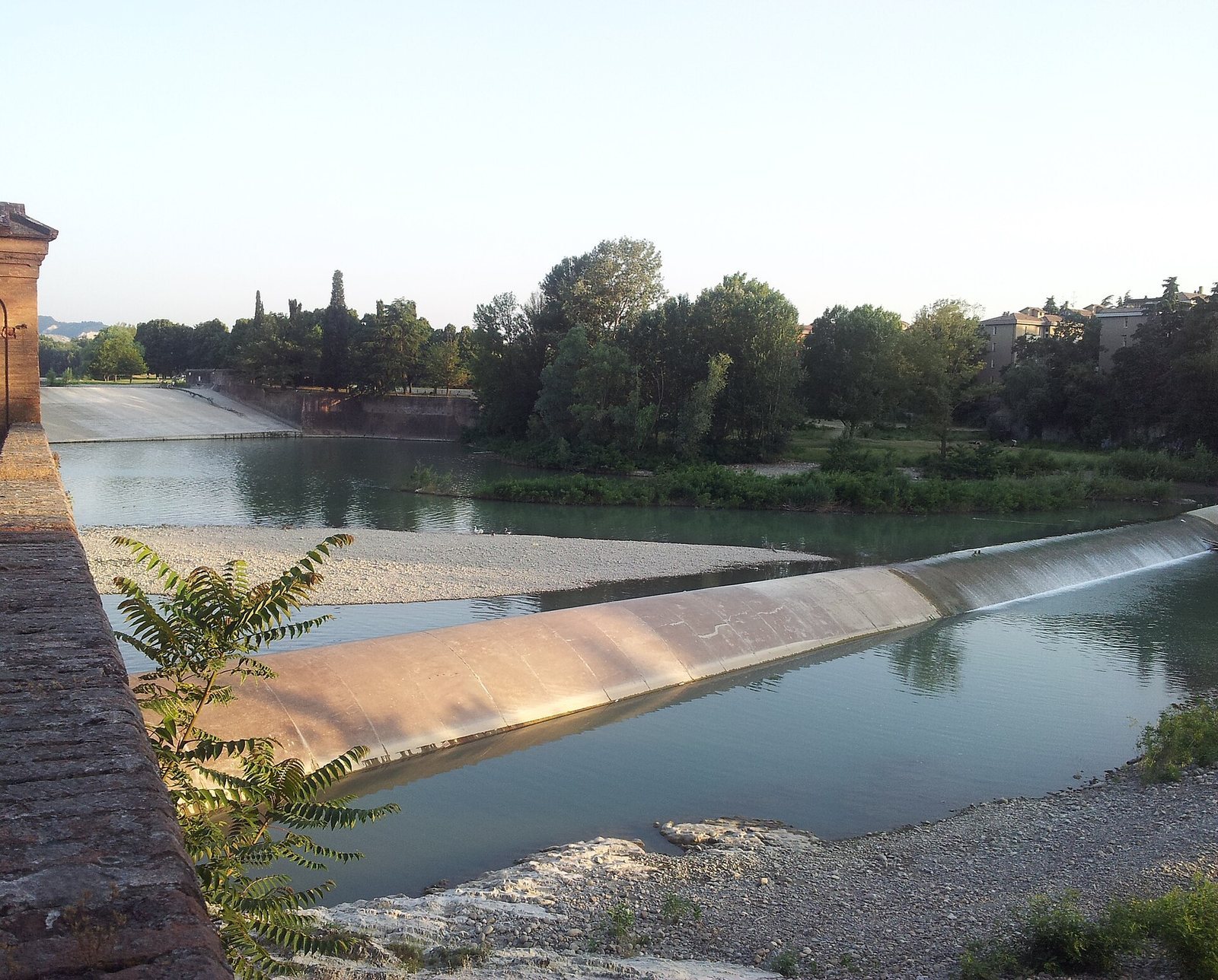
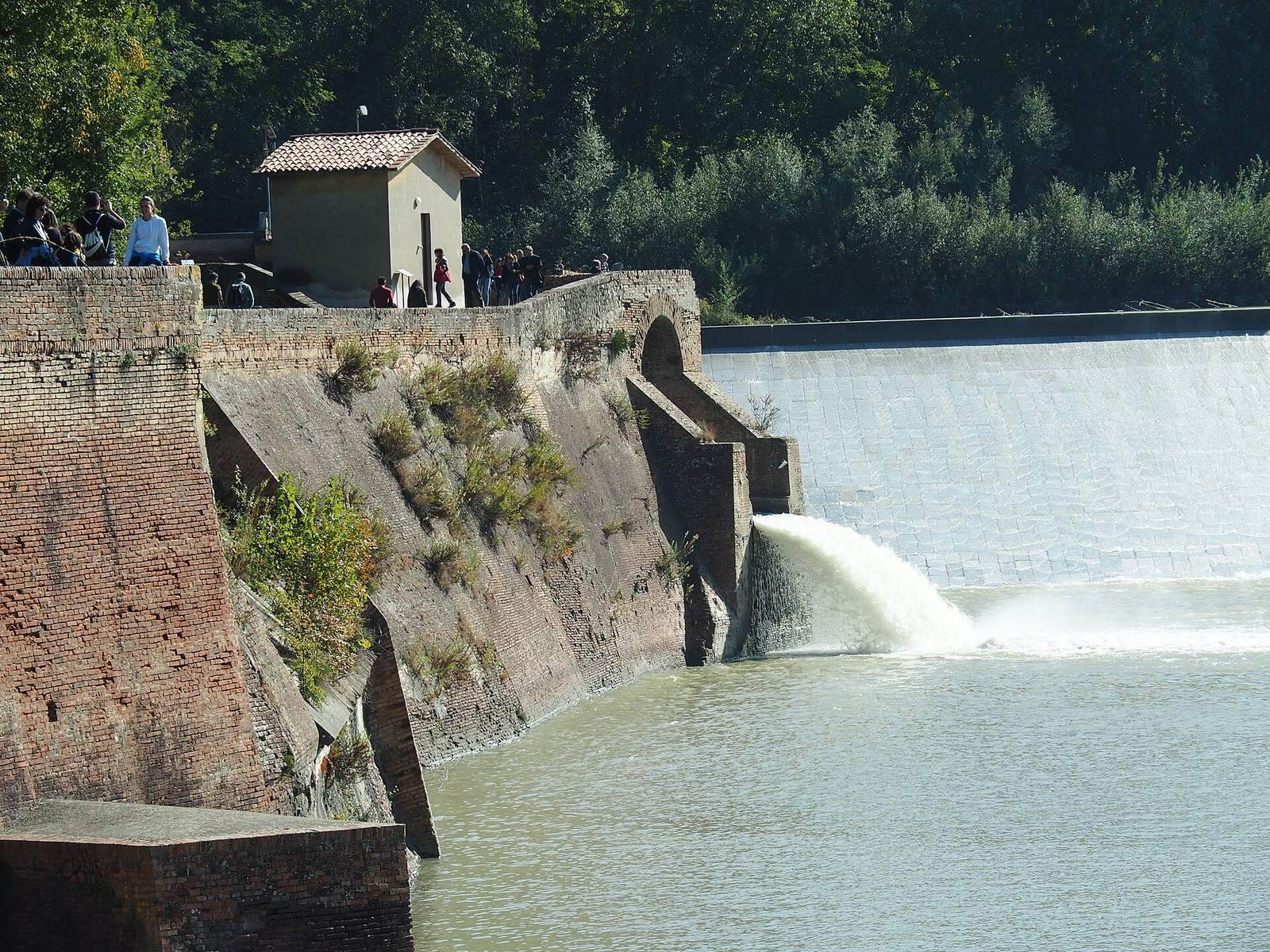
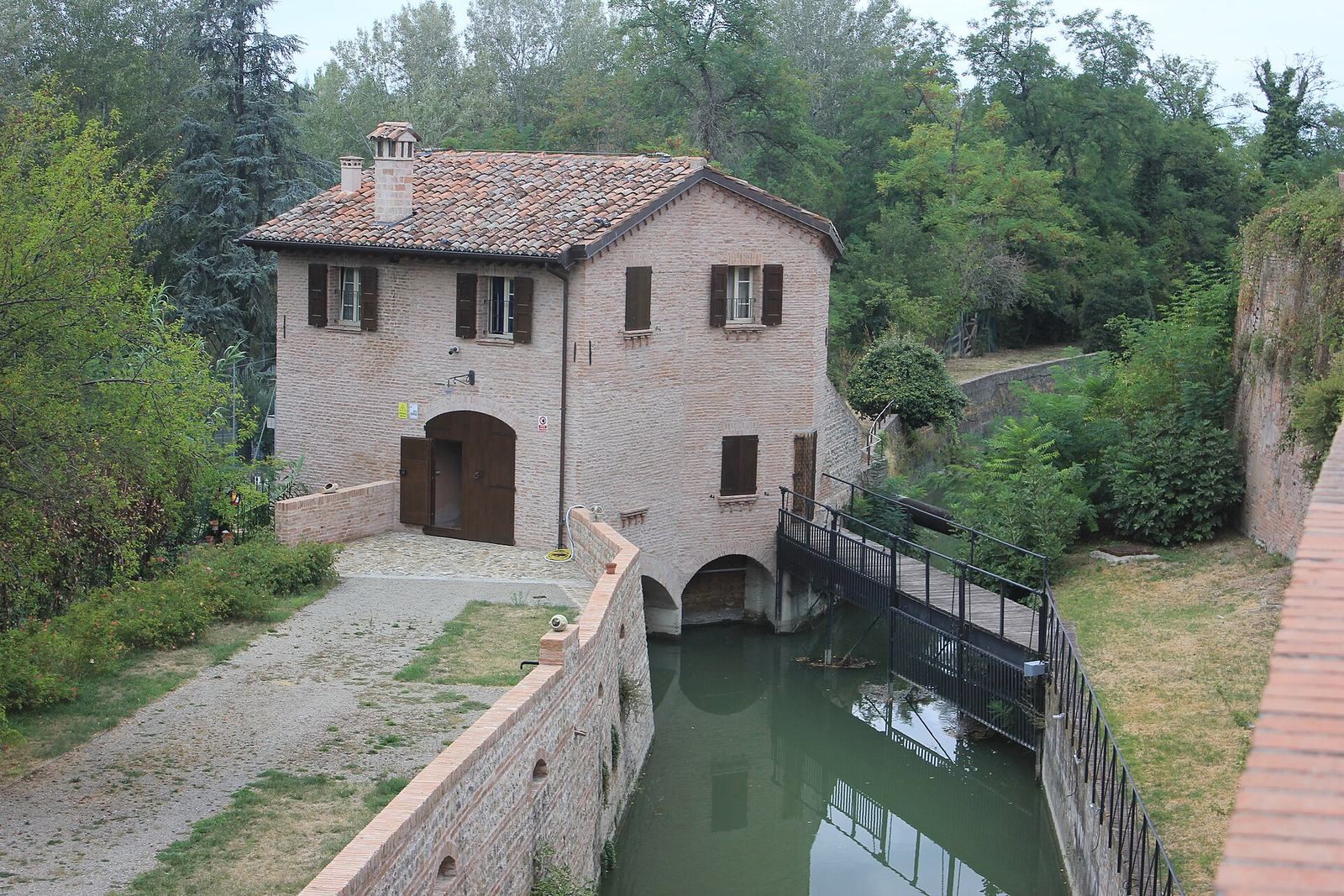
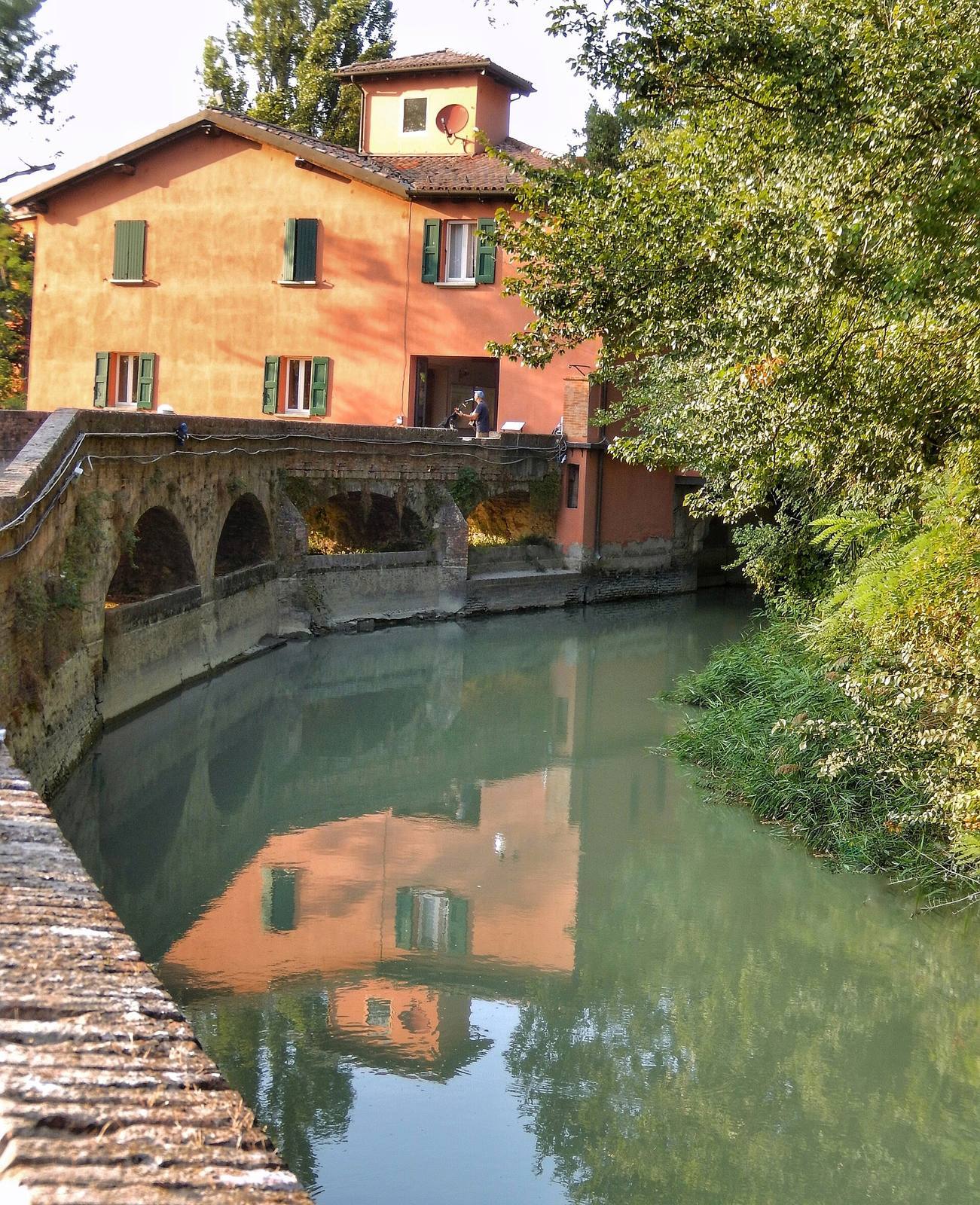
The waterworks occupy the point where the Reno is diverted from its mountain course into the canal across the plain. The present barrier crosses the river, while remains of an earlier weir lie downstream. The site also includes the Pracinino guardhouse and features built during the response to the 1893 flood.
The present weir
The weir at the location established in the fourteenth century was repaired after the 1893 flood and covered in successive stages. Its earlier oak-beam covering had deteriorated. White granite slabs were laid in 1895, and red granite was used for a further section in 1907 when white granite could not be obtained. The covering was completed in 1950 with ordinary cut stone. The repaired weir remains intact and functional.
Earlier medieval structures
The wooden weir
Until the mid-thirteenth century, the barrier was probably a low wooden structure, formed from large posts driven into the riverbed and joined with crosspieces, other timbers, and hemp ropes. Large boulders may have provided a protective facing. The vulnerable construction needed frequent, costly maintenance.
The downstream ruins
Ruins of the weir that failed in 1325 remain visible below the present structure. Locally called Pracinino, meaning “little meadow,” and i Masgnòn, meaning “the boulders,” they consist of stones and pebbles bound with lime. Ophiolitic rock, derived from ancient oceanic crust and the upper mantle, covers at least part of the sloping face. Timber traces suggest wood may have raised the upper sections, while charcoal marks in the lime may come from workers’ fires. The unusually long structure rested directly on bedrock, with its foundations extending into thick, unstable gravel. These weaknesses are associated with its collapse. Some of the ruins were destroyed in 1985 during confusion over river works.
Structures from the 1893 flood response
Bank dam and river deflector
To return the Reno to its bed and restore the canal, workers placed stone-filled wire-mesh baskets along the left bank. A 252-metre dam was built against this line, mainly from additional baskets holding 3 to 4 cubic metres each. Earth-filled jute sacks were used in other places to limit seepage. Upstream, a deflector, a barrier designed to steer the current, extended for about 100 metres along the riverbank. It had a topsoil core and stepped layers of baskets along its sides and top, with added protection on the river-facing side.
Embankment closing the breach
An embankment 102 metres long and 7 metres high closed the breach. Its core was topsoil, covered in stepped layers of baskets. On the river-facing slope, earth-filled sacks protected by wire mesh added further support. At its right end, the embankment joined the earlier dam. The flood-recovery works used 2,900 baskets, which also drew interest from university scientists.
Pracinino guardhouse
Engineer Ghedini built the guardhouse at Pracinino in 1829 to house the weir’s custodian. The commemorative plaque there bears the inscription: “Water is a source of life; its conservation and sharing with our neighbors are sources of peace.”
A related depiction is preserved in the Farnese Room of Bologna’s Municipal Palace. Painted by Antonio Catalani, known as “Il Romano,” between 1658 and 1660, the fresco shows Cardinal Albornoz examining plans for the weir’s construction.