Sanctuary of the Madonna di San Luca: Bologna’s Pilgrimage Church and Portico


Site at a Glance
- Rating
- 4.7
- Popularity
- High
- Country
- Italy
- Primary era
- Early Modern
- External website
- Open
- Eras represented
- Medieval, Early Modern, Modern
- Civilizations
- Papal States
- Site type
- Religious
- Remains
- Sanctuary
On this page18 sections
History
The Sanctuary of the Madonna di San Luca is a Roman Catholic Marian sanctuary in Bologna, Italy, on the Colle della Guardia southwest of the historic centre. Its documented origins lie in the late twelfth century, while the present building belongs chiefly to the Baroque period. The church became a pilgrimage destination centred on an icon of the Virgin and Child traditionally attributed to Saint Luke.
Legend and foundation
A medieval tradition says that a Greek pilgrim-hermit received the icon from priests of Hagia Sophia in Constantinople and carried it to the Mount of the Guard near Bologna. The fifteenth-century Bolognese jurist Graziolo Accarisi gave the earliest known written account of this story. Later versions named the pilgrim Euthymius or Teocle Kmnya, dated the arrival to 1160, and connected it with Bishop Gerardo Grassi. These additional details were partly based on a document now considered forged.
The institutional history of the sanctuary instead begins with Angelica Bonfantini. In 1192 she chose to live as a hermit on the hill and established an oratory and church. On 24 August 1193, Pope Celestine III instructed Bishop Gerardo de Gisla to lay the foundation stone of a new church. A stone brought from Rome and blessed by the pope was laid on 25 May 1194.
Ownership and religious communities
Angelica linked her foundation with the women’s branch of the canons of Santa Maria in Reno. She transferred land on the hill while retaining usufruct, income, and other economic rights. A long dispute followed over control of the hermitage, church, offerings, and donations, leading Angelica to seek papal intervention several times.
Celestine III issued a favourable judgment in 1195 and placed the church, its community, and its possessions under papal protection in 1197 in return for an annual tribute of one pound of incense. Pope Innocent III confirmed this protection and ruled that Angelica’s agreement with the canons had been a promise rather than a religious profession. The dispute ended on 13 March 1206, when the canons surrendered the land, church, and related rights to Angelica.
In 1210 Angelica claimed that the dispute had caused financial losses, including 1,000 Bolognese lire in missed offerings. The figure was probably exaggerated, but it conveys the scale attributed to the sanctuary’s donations. After Angelica’s death around 1244, Cardinal Ottaviano Ubaldini entrusted the church to Augustinian nuns from the hermitage of Ronzano. Pope Alexander IV exempted it from the authority of the Bishop of Bologna in 1258, although another dispute briefly arose in 1271.
The Augustinian community became affiliated with the Dominican order in 1278. In 1290 the nuns received permission to establish the monastery of San Mattia outside Porta Saragozza. After its destruction in 1357, San Mattia was rebuilt within Bologna’s walls in 1376. The communities at San Mattia and on the Monte della Guardia were administered together, and in 1438 Pope Eugene IV placed Santa Maria della Guardia under San Mattia’s authority.
The 1433 procession and renewed pilgrimage
Political instability in Bologna and the hill’s peripheral position brought a period of decline. Pilgrimage increased after the so-called “miracle of the rain” on 5 July 1433. During a procession intended to stop rains that threatened the harvest, the rain ceased as the image entered Bologna. A three-day celebration followed, and the city thereafter repeated the observance each year by civic vow.
The annual descent of the icon became both a religious ceremony and a civic practice. At different times, transport was entrusted to the Jesuates of San Girolamo and Sant’Eustachio, a religious order later suppressed, and to the Compagnia di Santa Maria della Morte, a Bolognese religious confraternity. From 1629 the confraternity also carried the image from the hill under rules established by the Dominican nuns of San Mattia.
Before the Napoleonic suppressions, the icon was taken first to the former church of San Mattia, then to Santa Maria della Morte and other churches, before reaching the Basilica of San Petronio. From 1799, it was taken to Bologna Cathedral instead. Since 1588, the city has received a solemn blessing from the forecourt of San Petronio during the celebrations. The annual observance changed dates more than once: Giovanni II Bentivoglio moved it in 1476, and Cardinal Giacomo Boncompagni moved it to Saturday in 1718. The modern celebration begins on the Saturday before the fifth Sunday after Easter, with the icon remaining in Bologna for about a week before returning to the sanctuary.
The descent could not take place in 1849, when Austrian forces occupied the hill, or in 1944 during the Second World War. The tradition nevertheless continued to connect the sanctuary, the city, and the icon through a recurring religious and civic ceremony.
Rebuilding from the Renaissance to the Baroque
Private donations and support from the Compagnia di Santa Maria della Morte financed a complete rebuilding in 1481. The sanctuary remained associated with the Dominican nuns of San Mattia, who oversaw its custody. The major chapel was enlarged and decorated between 1603 and 1623, and the bell tower was rebuilt between 1609 and 1616. A bequest from Cardinal Lazzaro Pallavicini financed a further enlargement and the addition of four side chapels.
From 1708, Carlo Francesco Dotti and Donato Fasano directed work on a new major chapel. Its polychrome-marble Baroque altar was designed by Giovanni Antonio Ferri and executed by Angelo Rangheri, with the campaign ending in 1713. A more radical rebuilding began in 1723 under Dotti, following an oval-plan concept associated with the Servite friar Andrea Sacchi. The new walls rose around the old church, allowing pilgrims to continue entering the sanctuary while construction proceeded. The older building was demolished after the new structure was completed in 1743. Interior decoration was finished in 1748, and the major chapel was refitted the following year.
Archbishop-Cardinal Vincenzo Malvezzi inaugurated the new sanctuary on 25 March 1765, after forty-two years of work. The dome, facade, and lateral exterior tribunes were completed in 1774 by Giovanni Giacomo Dotti, using designs left by his father. The resulting church combined a strongly curved Baroque exterior with an elliptical interior organized around a Greek-cross arrangement.
Changes in administration and heritage status
Napoleonic legislation abolished the Dominican monastery of San Mattia on 11 February 1799, forcing the nuns responsible for the sanctuary to leave. Dominican administration continued until 1824, when Cardinal Carlo Opizzoni placed the church directly under the archbishop. Since then, diocesan priests have managed it under an archiepiscopal vicar. Works in 1815 added marble cladding to the major chapel and new marble altars designed by Angelo Venturoli.
The sanctuary became a national monument in 1874 and received the honorary status of minor basilica from Pope Pius X in 1907. This ecclesiastical title is granted to churches of particular religious or historical importance and does not mean that the building is a bishop’s seat. A women’s orphanage operated at the sanctuary from 1930 to 1994, first in rooms beneath the church and later in a building along the portico.
The Porticoes of Bologna, including the Portico di San Luca, were inscribed on the UNESCO World Heritage List in 2021. The sanctuary’s institutional and architectural history is closely connected with this protected route, which links the hilltop church with Bologna.
Construction of the portico
The route to the sanctuary was paved in 1589. In 1640, the vicaria Olimpia Boccaferri began constructing fifteen chapels after pilgrims had started hanging images of the Mysteries of the Rosary from trees along the path. Camillo Saccenti prepared a design for a covered walkway in 1655, but lack of funds halted the project. In 1673, a committee of private supporters revived the plan, including Lodovico Zenaroli and the marquis Girolamo Albergati.
Citizens from every social class took part in constructing the portico between 1674 and 1721. Gian Giacomo Monti directed the principal work, which was continued by Francesco Monti Bendini and Carlo Francesco Dotti. Dotti designed the Arco del Meloncello in 1721, while the crossing itself dates from 1732. The covered route was intended to shelter the religious procession carrying the icon as well as other pilgrims.
Consolidation was needed in 1791 because shops had been built above the level section. Further restoration took place in 1819 and 1955. Work begun in 2019 followed the loss of many painted coats of arms from the arch lunettes during earlier restoration.
Remains
The sanctuary occupies the summit of the partly wooded Colle della Guardia, approximately 280 to 300 metres above sea level. Its dominant architectural language is Baroque, expressed through curving volumes and alternating projections and recesses. A large, compact elliptical tiburium, the architectural body that encloses or supports a dome, rises above the church and carries a dome and lantern. The lantern includes an observation level about 42 metres above the ground.
The sanctuary building
Facade and exterior structures
The facade projects like a classical pronaos, or porch-like entrance zone. Giant Ionic pilasters support a pediment above a large central arch. Curving portico wings join the facade, enclose the forecourt, and end in two pentagonal, shrine-like exterior tribunes. Statues of Saint Luke and Saint Mark by Bernardino Cametti flank the entrance portal. Made in 1716, they originally stood in the presbytery.
The former Dominican monastery and the fifteenth-century bell tower are incorporated into the southern side of the sanctuary. The tower contains five principal bells: four smaller bells cast by Giuseppe Brighenti in 1835 and a larger bell added by Clemente and Giuseppe Brighenti in 1893. A small older bell stands outside the main peal. The bells are mounted in the Bolognese manner and operated entirely by hand.
Interior and decoration
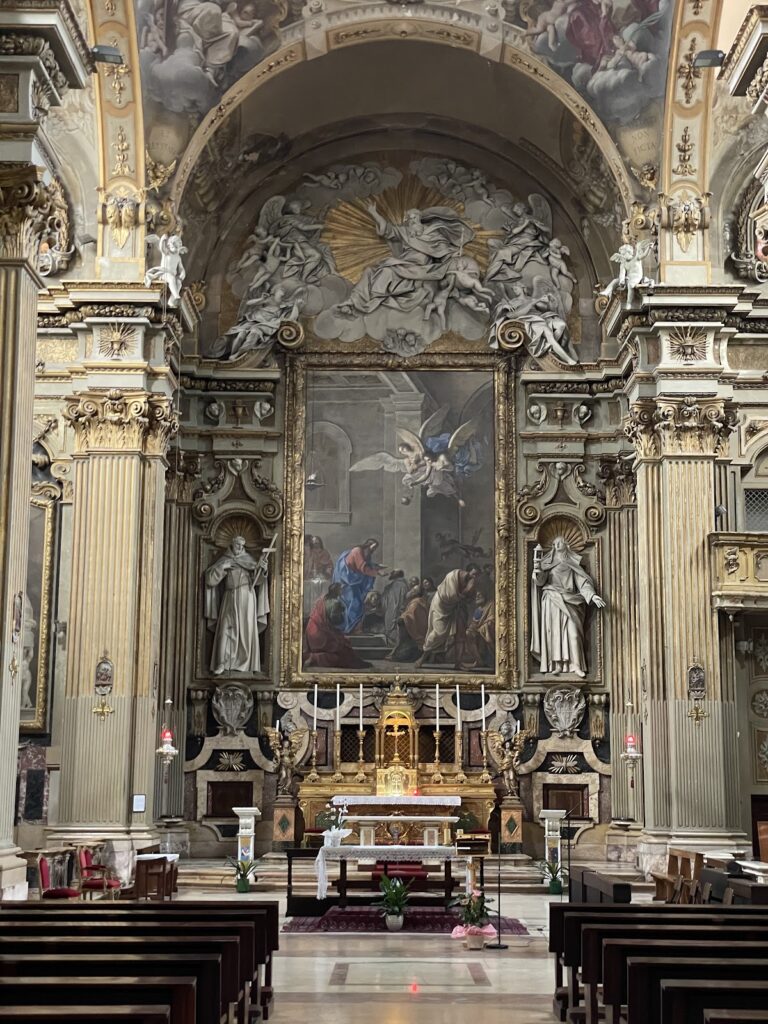
The interior combines an elliptical plan with a Greek cross, a layout whose four arms are approximately equal in length. The central axis and two large lateral chapels form the cross, while a raised presbytery carries the icon of the Virgin and Child. The principal arches rest on grouped piers made up of three giant Corinthian columns.
Altarpieces by Donato Creti include The Coronation of the Virgin in the second chapel on the right and The Virgin and the Patron Saints of Bologna in the second chapel on the left. Guido Reni’s Madonna of the Rosary is in the third chapel on the right. The major sacristy contains a version of Guercino’s Christ Appearing to His Mother and work by Domenico Pestrini.
Vittorio Maria Bigari painted the frescoes of the major chapel, while Giuseppe Cassioli decorated the dome. Antonio Borrello and Giovanni Calegari produced the stucco work, and Angelo Gabriello Piò made the statues. The dome had originally been intended to emphasize its architecture without painted decoration. Cassioli’s commission was made in 1918, and he executed the work between 1922 and 1924 as part of a wider twentieth-century campaign.
Cassioli’s allegorical composition centres on Pope Benedict XIV invoking the Madonna. It includes numerous prelates, among them Giovanni Battista Nasalli Rocca, and shows the evangelist Luke holding the icon attributed to him by tradition. Cassioli used a low viewpoint and aligned the painted composition with Bigari’s earlier frescoes.
The icon and crypt
The Madonna and Child icon
The icon follows the Eastern Christian Hodegetria type, in which the Virgin presents Christ as the way to salvation. The visible painting probably dates from the late twelfth or early thirteenth century and appears to be by a Western artist working in a Byzantine-influenced environment.
It measures 65 by 57 centimetres and is about 2 centimetres thick. Tempera and silver leaf cover a central poplar panel, supplemented by two upper panels of elm and chestnut. The Virgin appears half-length, wearing a blue-green robe over a red undergarment and holding the blessing Christ Child. Interlocking rows of small ivy leaves, separated by small pearls, fill the background. Floral side bands about four centimetres wide frame the panel, whose upper part appears to have been cut.
Radiographic and other studies revealed an older painting beneath the visible image. The underlying image is Byzantine in style and has affinities with surviving copies of the Virgin associated with Hagia Sophia in Constantinople. It has been provisionally dated to the tenth or eleventh century. Its possible eastern origin is also supported by the use of indigo in the Virgin’s robe, a pigment associated with Asia Minor but not with Italy.
The underlying image differs from the visible painting in facial and bodily proportions. The Virgin has a thinner nasal septum, smaller raised nostrils, fuller lips, and a larger, more elongated eye. The Child is more solidly formed and less proportionate, with a more emphatic blessing gesture of apparently Greek character.
Archbishop Alfonso Paleotti crowned the icon in 1603. Since 1625, a silver casing made by Jan Jacobs of Brussels has covered it, leaving only the faces visible. Pope Pius IX gave it a valuable diadem in 1857.
The crypt collection
Cardinal Giovanni Battista Nasalli Rocca requested the construction of the crypt. It contains his monumental tomb by Bruno Boari, tombs of families who donated to the sanctuary, an eighteenth-century scale model of the building, and a wax bust of Carlo Francesco Dotti. Sacred objects preserved there include the mantle placed around the icon and the flowered canopy used during its processions.
The Portico di San Luca
Route and construction
The Portico di San Luca links Porta Saragozza with the sanctuary through the Arco del Meloncello, which crosses Via Saragozza. The route is approximately 3,796 metres long and is generally counted as having 666 arches and fifteen chapels. Italian counts vary between 658 and 666 according to the method used.
The level section extends from the Arco Bonaccorsi near Porta Saragozza to the Arco del Meloncello. It contains 316 arcades and measures about 1.52 kilometres. From the Meloncello to the sanctuary, the hill section contains 350 arcades, including fifteen chapels placed at regular intervals of roughly twenty arches, and measures about 2.276 kilometres.
Inscriptions and religious meaning
Commemorative plaques and inscriptions line the portico, including devotional ex votos and expressions of gratitude for donations. A traditional interpretation connects the count of 666 arches with the serpent or Devil, symbolically defeated beneath the Virgin’s foot at the sanctuary.
Former cableway
A panoramic aerial cableway operated between Bologna’s outskirts and the summit from 1931 to 1976. It covered approximately 1,328 metres in seven minutes, with a vertical difference of about 220 metres. After its closure, the upper station remained intact but abandoned, the lower station was converted into apartments, and the single supporting pylon remained standing.
Nearby sites