Church of San Girolamo alla Certosa: A Carthusian Monastery Church in Bologna
Site at a Glance
- Popularity
- Medium
- Country
- Italy
- Primary era
- Medieval
- Eras represented
- Medieval, Early Modern
- Civilizations
- Papal States
- Site type
- Religious
- Remains
- Monastery
On this page12 sections
History
Foundation on an ancient burial ground
The Church of San Girolamo alla Certosa is a fourteenth-century church in Bologna, Italy, built for a Carthusian monastery. The monks belonged to a Catholic order that combined solitary life with communal worship. The ground had earlier served as a necropolis for Etruscan Felsina, the settlement that preceded Bologna, from at least the fifth century BC.
In 1332, Giovanni d’Andrea, a canon lawyer and University of Bologna professor, was inspired to establish a Carthusian house after visiting a monastic farm at Tetti Pesio. He donated the land at Casara, outside Bologna’s walls. The first stone was blessed on 17 April 1334. Construction, supported by donors including Francesco de Sero di Gainago, a canon from Parma, was interrupted by events in Bologna and resumed in 1336.
The monastery was nearly complete by 1350. Bishop Giovanni Nasio consecrated its church on 2 June 1359, and the enclosing walls were finished by 1367. The house belonged to the Carthusian order’s Tuscan province, a regional grouping of monasteries, and was dedicated to Saint Jerome, the Virgin Mary, and Saint John the Baptist.
Growth and artistic campaigns
During the fifteenth century, prior Niccolò Albergati raised the monastery’s standing. Pope Nicholas V, who had formerly served as Albergati’s secretary, granted the house extensive privileges and paid to enlarge its cloister and refectory. Plans for further expansion also took shape during this period.
A building campaign lasting about thirty years began toward the end of the sixteenth century. It made the monastery one of the largest and most refined Carthusian houses. Prior Giovan Battista Capponi, who led the community from 1588 to 1613, promoted church decoration in keeping with the Counter-Reformation, the Catholic Church’s response to the Protestant Reformation and its effort to reinforce Catholic teaching and practice. Another major campaign of paintings followed under prior Daniele Granchio, whose term lasted from 1644 to 1660.
Suppression and cemetery conversion
From 1792 to 1797, San Girolamo served as the Carthusian order’s headquarters in place of the Grande Chartreuse. In 1796, French general Napoleon Bonaparte took works by the Vivarini, the Carracci, and Guercino to Paris. They returned in 1815 and were deposited in Bologna’s National Art Gallery.
In 1797, the remains of Pope Alexander V, elected during the Western Schism, a period of rival claims to the papacy, were moved from his tomb at San Francesco del Borghetto and temporarily buried beneath a monastery portico. After the 1797 Treaty of Tolentino and the political changes that brought Bologna into the French-backed Cispadane Republic, monastic orders were suppressed and the monks left. The monastery’s closure is dated to 1804. Its buildings first served as military quarters and were then converted for use as Bologna’s public cemetery, which opened in 1801.
Necropolis remains came to light during the cemetery conversion in the early nineteenth century. In 1869, construction of the Galleria degli Angeli revealed another Etruscan burial ground, dated from the sixth to the third century BC.
Remains
Monastic layout
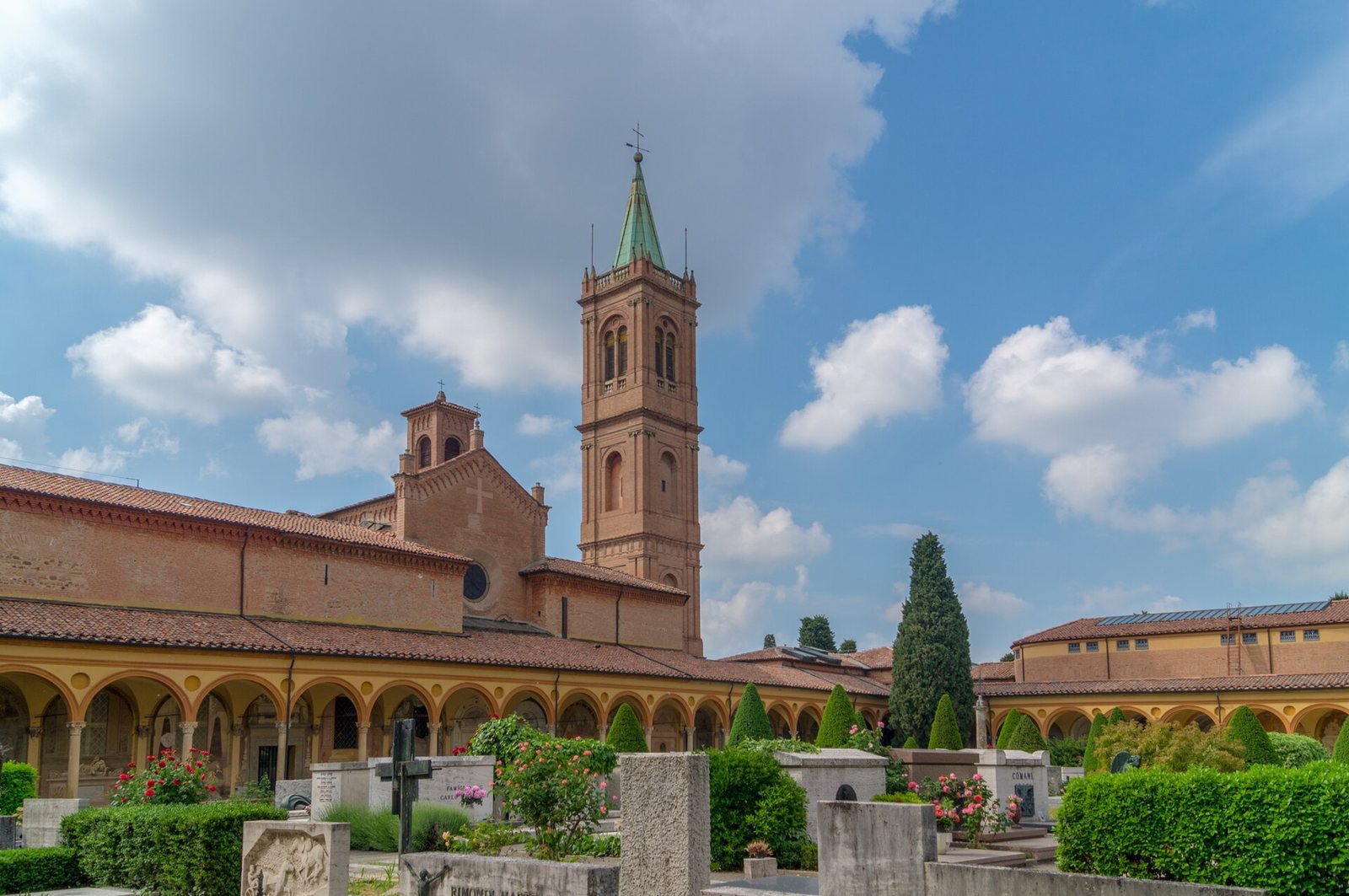
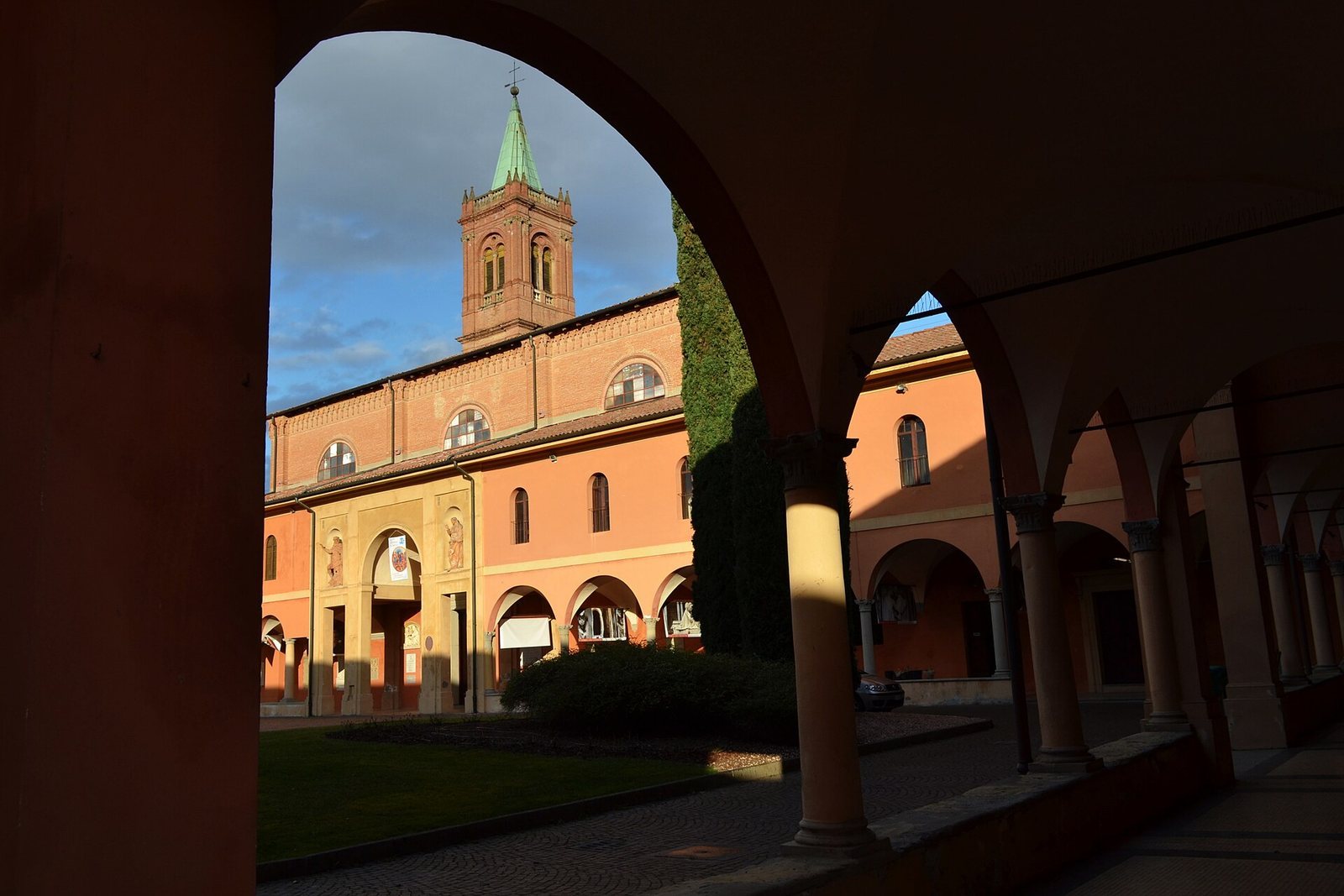
The monastery’s original arrangement is still partly legible in its courtyards, covered passages, and rows of cell-houses, the individual dwellings of Carthusian monks. The Renaissance and smaller cloisters remain largely intact. The former chapter house, where the community met, is partly recognizable in the present Sala della Madonna dell’Asse; the former chapter cloister corresponds to the Cloister of the Madonnas, also called the Ossuary Cloister. The old refectory, or communal dining hall, became the Sala della Pietà. A sixteenth-century Chapel Cloister enlarged the original fourteenth-century cloister, while another courtyard is known as the Cinquecento Cloister. Traces also survive of the enclosure for nuns and priests and of the small church of the Madonna in the entrance cloister. Some cell-house roofs remain visible above the porticoes linking the dwellings. The cemetery’s initial adaptation retained much of the monastery’s arrangement, although later changes were more extensive.
Church
Facade and entrance
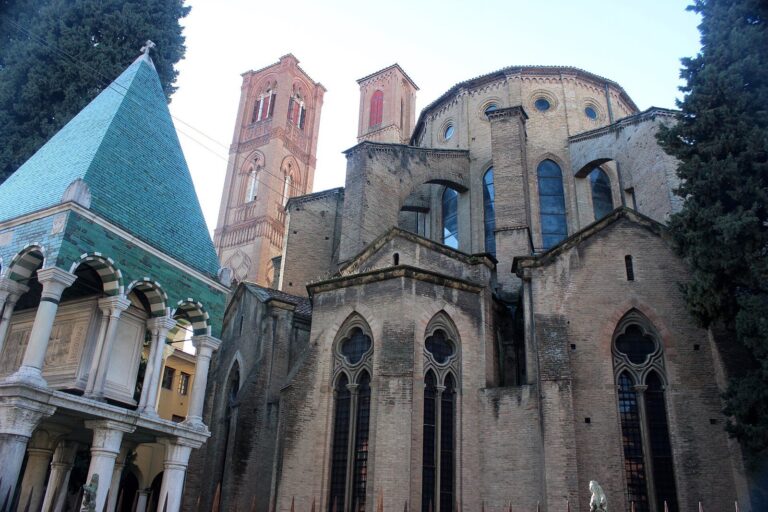
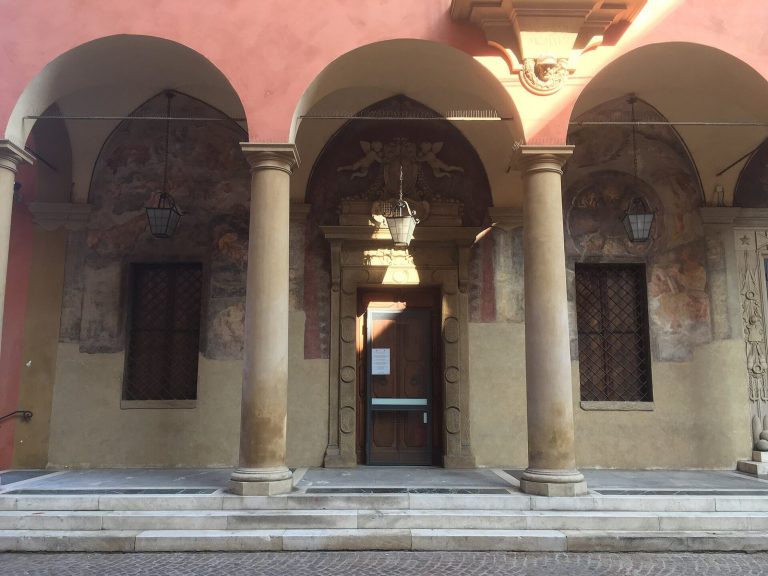
The church has a medieval brick facade decorated with three-lobed arches resting on small hanging columns. Large circular windows replaced the original single pointed-arch windows. A portico partly screens the facade. Enlarged in 1768, it has a five-arched monumental entrance designed by Gian Giacomo Dotti, with columns in the Tuscan order, a simple classical style. Terracotta statues of King David and Queen Esther occupy niches in the facade. Made by Gabriele Brunelli, they came from the suppressed Confraternity of the Good Jesus.
Plan and chapels
The church has an unusual inverted T-shaped plan. Two chapels added beside the entrance in the sixteenth century create a cross-arm at the end opposite its usual position. Chapels along the north side were probably added in the early fifteenth century. Ribbed cross vaults, ceilings shaped by intersecting arched ribs, cover the church; their decoration dates to the fifteenth century and is repeated in the sixteenth-century chapels.
Bell tower and bells
A small fourteenth-century bell tower gave way to a monumental tower built by Tommaso Martelli in the early seventeenth century. Broad corner pilasters, shallow supports attached to the walls, and rectangular windows mark its lower level. The three storeys above have paired pilasters in the Doric, Ionic, and Composite classical orders. Blind arches appear on these levels, apart from paired windows on the third storey in a fifteenth-century style. A Composite cornice, balustrade, paired pinnacles, and pyramidal spire crown the tower.
Four bells hang in the bell chamber in a wooden frame. The largest, cast by Giovanni Domenico Dinarelli in 1666, is 121.3 centimetres across and weighs about 1,200 kilograms. Giacomo Calderari cast the 102.4-centimetre, roughly 700-kilogram middle bell in 1607; Luigi Censori and Giovanni Battista Bonettini made the 88.8-centimetre, roughly 500-kilogram bell in 1683; and Antonio Censori cast the 77.7-centimetre, roughly 350-kilogram small bell in 1597. Their tuning is in a minor key. They can be rung manually in the local a doppio style, and the three largest also have chain-operated electrification that can be disengaged for manual ringing. Electric hammers provide struck signals, especially funeral tolls.
Altarpieces and chapels
The main altar received a multi-panel altarpiece of the Virgin and several saints by Antonio and Bartolomeo Vivarini in 1450. Pope Nicholas V commissioned it in honor of Albergati, replacing an earlier medieval altarpiece. The work is now in Bologna’s National Art Gallery.
The entrance chapels were dedicated to Saint Jerome and Saint John the Baptist. Agostino Carracci’s Communion of Saint Jerome, made for the Saint Jerome chapel in 1592, is now in the National Art Gallery; a nineteenth-century copy by Clemente Alberi occupies its former place. Ludovico Carracci’s signed and dated Preaching of the Baptist (1592), originally made for the other chapel, is also in the gallery. That chapel was dedicated to Saint Bruno in 1623, after Pope Gregory XV extended the saint’s cult throughout the Church. The Preaching was moved to the present Saint Joseph chapel and replaced by Guercino’s Vision of Saint Bruno (1647), now in the gallery. A painting of Saint Bruno with six Carthusian blesseds, attributed to Bartolomeo Cesi and repainted in the nineteenth century by Filippo Pedrini, is also associated with the chapel.
In the chapel at the church’s curved end, Cesi painted three scenes from the Passion: the Prayer in the Garden, the Crucifixion, and the Deposition. His decoration, dated to 1616, also includes biblical scenes and full-length portraits of Carthusian monks painted directly onto wet plaster. Saints Peter and Paul appear on the front of the entrance arch, with other saints on its underside.
Choir and other paintings
A choir made by Melchiorre Provenzale in 1488 was destroyed during the 1527 attack by the Landsknechts serving Charles V. Biagio de Marchi rebuilt the wooden choir in 1538–1539, probably following the earlier design and possibly reusing some surviving pieces. Its inlaid decoration gives the reconstructed work a more fifteenth-century than sixteenth-century appearance. Two paintings by Ludovico Carracci, the Flagellation and the Crowning with Thorns, once hung on the screen between the outer and inner churches; both are now in the National Art Gallery.
Works made for the church during the mid-seventeenth-century campaign included Francesco Gessi’s Expulsion of the Merchants from the Temple and Miraculous Catch of Fish for the nave. The Saint Jerome chapel received Giovan Andrea Sirani’s Supper at the Pharisee’s House (1652) and Elisabetta Sirani’s Baptism of Christ (1658). Lorenzo Pasinelli painted Christ Appearing to His Mother with the Holy Fathers Freed from Limbo (1657) and Entry of Christ into Jerusalem (1658) for the nave. For the Saint Bruno chapel, Giovanni Maria Galli da Bibiena made the Resurrection of Christ (1657), and Domenico Maria Canuti painted the Last Judgment (1658).
Nunzio Rossi’s Nativity, painted in 1644 for the inner facade, is now in Palazzo d’Accursio after restoration. The eighteenth-century sacristy contains Giovan Girolamo Bonesi’s Virgin and Child in Glory with Mary Magdalene and Saint Hugh and Ercole Graziani’s Blessed Niccolò Albergati Appearing in a Dream to Tommaso Sarzana. Other paintings once associated with the monastery include Giovanni Maria Viani’s Saint Bruno, made for the refectory, and Blessed Rosolina, made for the chapter house, where Ubaldo Gandolfi’s Saint Francis of Paola was also located. Three small works by Giuseppe Maria Crespi, a Trinity, a Madonna and Saints, and Saint Ursula, were also connected with the monastery. These works were transferred to the National Art Gallery.