Riotinto-Nerva Mining Basin: A Historic Mining Landscape in Spain
Site at a Glance
- Popularity
- High
- Country
- Spain
- Primary era
- Modern
- Eras represented
- Stone Age, Bronze Age, Classical, Modern
- Civilizations
- Roman, Spanish
- Site type
- Economic
- Remains
- Mine
On this page19 sections
History
The Riotinto-Nerva mining basin in northeastern Huelva province, Spain, is a mining landscape shaped by extraction from prehistoric times through the modern industrial era. Mining was already under way by about 3000 BCE, and the district became one of antiquity’s leading silver-producing areas. Under Roman rule, operations grew into an organized industry, reaching their greatest intensity between the second century BCE and the second century CE, particularly during the reign of Augustus, Rome’s first emperor.
Prehistoric and Roman production
Mining in the Copper and Bronze Ages preceded the large-scale Roman enterprise. Analysis of the metals indicates that extraction was already substantial by at least 366 BCE. Roman operators developed the mines and their supporting activities, producing copper and silver. Production continued until the final quarter of the second century CE, when the Iberian Pyrite Belt became less important to the Roman mining economy than deposits in Dacia and Britannia.
In the medieval period, extraction was limited. Under Islamic rule, activity focused mainly on copper and iron sulfates. Ore may have travelled either along a challenging route over the mountains to the Guadalquivir River or down the Tinto River.
Royal interest and renewed leasing
The mines were rediscovered in 1556. During the sixteenth century, Philip II’s government considered reopening them, but chose the Guadalcanal mines instead, judging them more promising. Roman-era extraction had left the Huelva deposits with a reputation for exhaustion.
In 1725, the Swedish entrepreneur Liebert Wolters Vonsiohielm obtained a 30-year lease and began by draining old Roman galleries. After his death in 1727, his nephew Samuel Tiquet and a Spanish partner took over. Their work concentrated on Filón Sur. Following Tiquet’s death, Francisco Thomas Sanz became responsible for the enterprise. Production increased under his management, and the town of Riotinto developed beside the mine.
The Peninsular War, the conflict in Spain and Portugal against Napoleonic France, brought operations to a halt. After engineer Fausto Delhuyar visited in 1823, the facilities were repaired and extraction restarted. The Marquess of Remisa leased the deposits from 1829 to 1849. His period of management was associated with irregularities, concern about future ground subsidence, and extensive tree felling to provide fuel.
State management and British expansion
In 1849 the Spanish Royal Treasury resumed direct control. Outdated technology and inadequate infrastructure limited production, while the government’s financial difficulties prevented major modernization. After the political upheaval of the 1868 revolution, minister Laureano Figuerola put forward a sale proposal in 1870. The Rothschild house bought the deposits from the government of the First Spanish Republic in 1873; months later, ownership passed to the newly established British Rio Tinto Company Limited (RTC).
RTC rapidly increased extraction, beginning at La Mina, also known as Filón Sur, and expanding to other parts of the basin by 1881. Copper and pyrite were central products. The resulting industrial growth made the district one of Spain’s major mining regions and turned Riotinto into an international mining center under British management. From 1877 to 1891, the Rio Tinto mine led the world in copper production.
Population growth and labor conflict
RTC’s expansion drew workers to new settlements and British managers and engineers to Bellavista. Minas de Riotinto grew from 4,957 residents in 1877 to 11,603 in 1900; Nerva had 16,807 inhabitants by 1910. Working conditions were harsh, and repeated disputes with the company culminated in general strikes in 1888, 1913, and 1920.
The protests of 1888 challenged both labor conditions and pollution from teleras, heaps used to roast ore in the open air. On 4 February, troops violently suppressed a demonstration by miners and agricultural workers. Estimates place the number killed above 200, and the events became known as the Year of the Shootings.
A strike involving about 11,000 workers lasted nine months in 1920 but failed to secure its aims. RTC reprisals weakened local unions for years, until they reorganized during the Second Spanish Republic. Labor unrest rose again in the 1930s as the effects of the 1929 economic crisis spread.
War, Spanish ownership, and industrial decline
After the Spanish Civil War began in July 1936, the basin initially remained in Republican hands and was administered by workers’ committees. Forces commanded by Luis Redondo entered the region a few weeks later and encountered little resistance.
In 1954, a change described as nationalization under the Franco regime transferred ownership to Spanish investors, who formed the Compañía Española de Minas de Río Tinto (CEMRT). Three of its four main deposits, Filón Sur, Filón Norte, and Planes, were close to exhaustion, while San Dionisio continued in full operation. CEMRT modernized equipment and facilities, mechanized extraction, and adjusted the workforce.
Exploration by CEMRT located Masa San Antonio in Nerva between 1960 and 1962; workers mined it through Pozo Rotilio. A consortium began exploring and extracting copper at Cerro Colorado in 1966. CEMRT continued to manage other deposits, and its growth plans led to the creation of the Unión Explosivos Río Tinto group in 1970. Work at Corta Atalaya expanded to recover remaining pyrite. More of that mineral was used within Spain, including at factories in the Huelva Chemical Park, founded in 1964, while some Riotinto plants were dismantled and moved there.
The downturn began in the late 1970s as international copper prices fell and mining in Huelva entered a crisis. In 1977, the basin recorded its first operating loss in more than two decades. Poor results led to labor disputes, general strikes in 1978 and 1986, and a gradual end to copper production. Río Tinto Minera (RTM) remained the main operator into the 1990s, but local facilities closed in succession: regular railway service ended in 1984, Pozo Alfredo shut in 1986, and Corta Atalaya closed in 1992. Gossan extraction continued at Cerro Colorado for a time. Mining finally stopped in 2001 after RTM workers’ attempt to restart operations failed.
Heritage conservation and renewed extraction
Concern about the loss of the basin’s industrial and environmental heritage prompted conservation proposals in the 1980s. Plans included a mining park and museum, as well as protection of the historic railway. The Fundación Río Tinto helped restore industrial heritage and establish a mining train. After unsuccessful efforts to restart mining in the first decade of the twenty-first century, Atalaya Mining resumed extraction in 2015 with administrative permits. Work has since centered on Cerro Colorado, while the company’s Spanish subsidiary, Atalaya Riotinto Minera, has also participated in conserving and presenting the historic mining landscape.
In 2005, the Riotinto-Nerva mining area received Spain’s Bien de Interés Cultural designation as a Historic Site. This legal category protects property judged to have cultural importance.
Remains
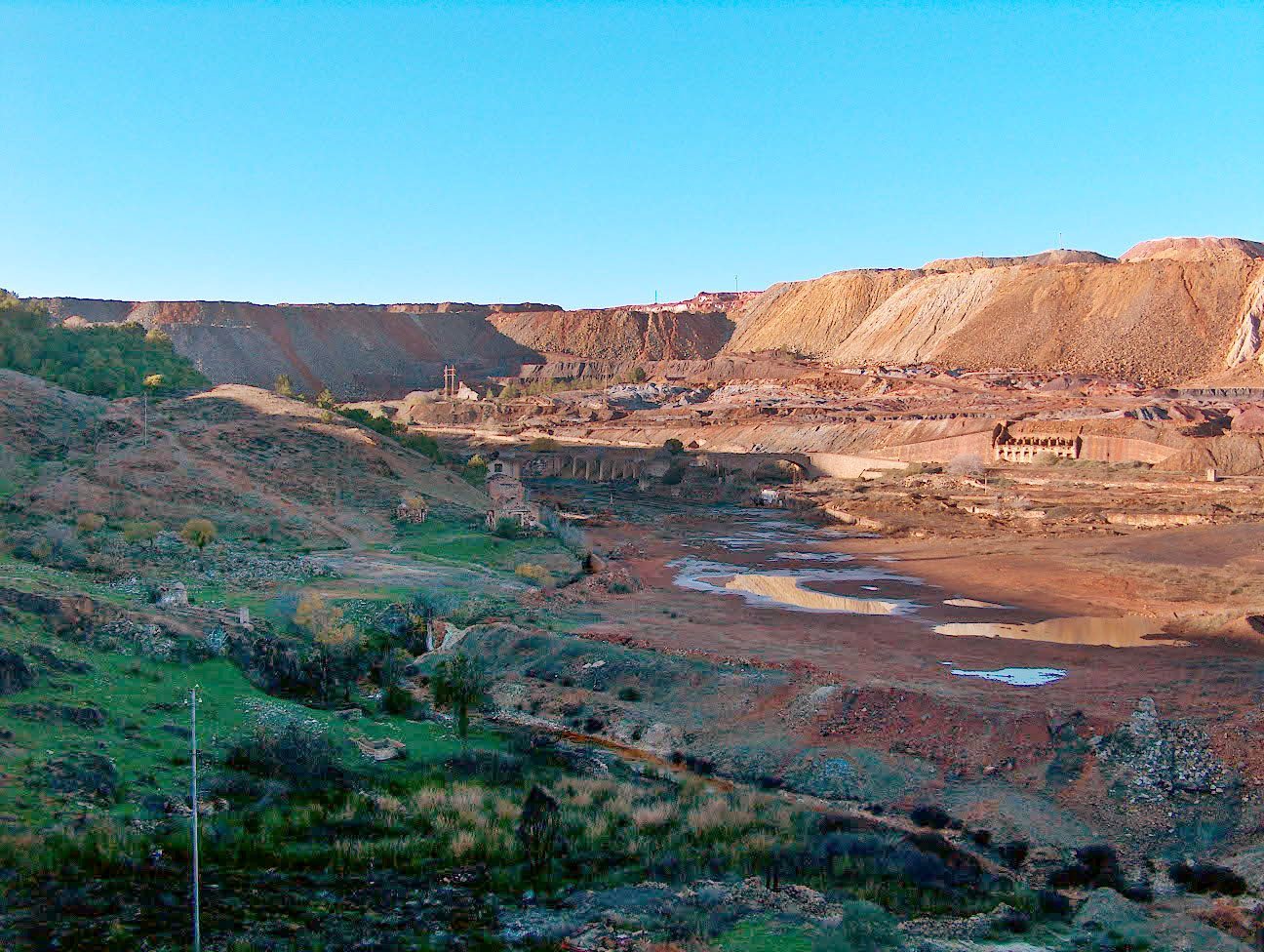
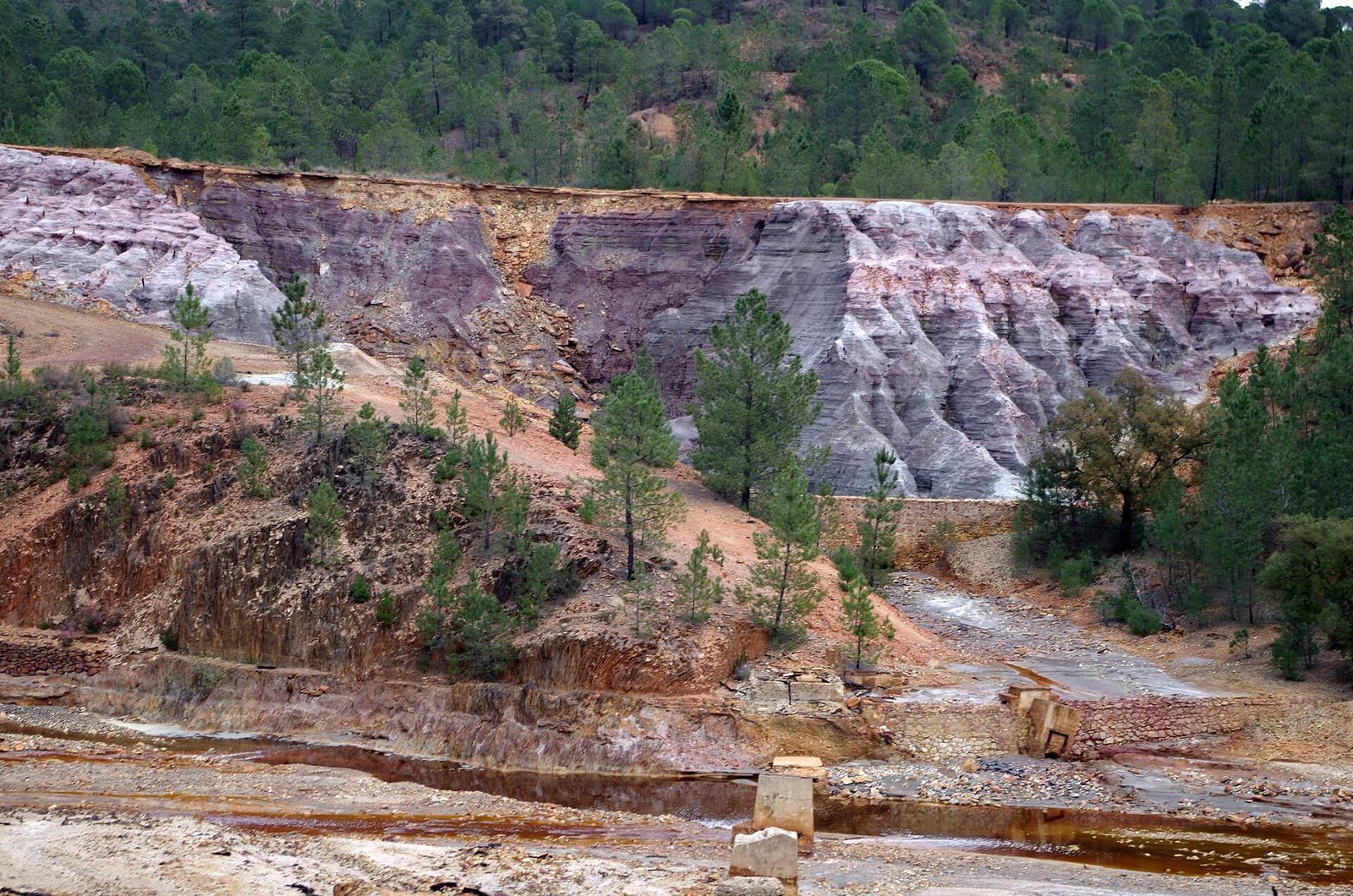
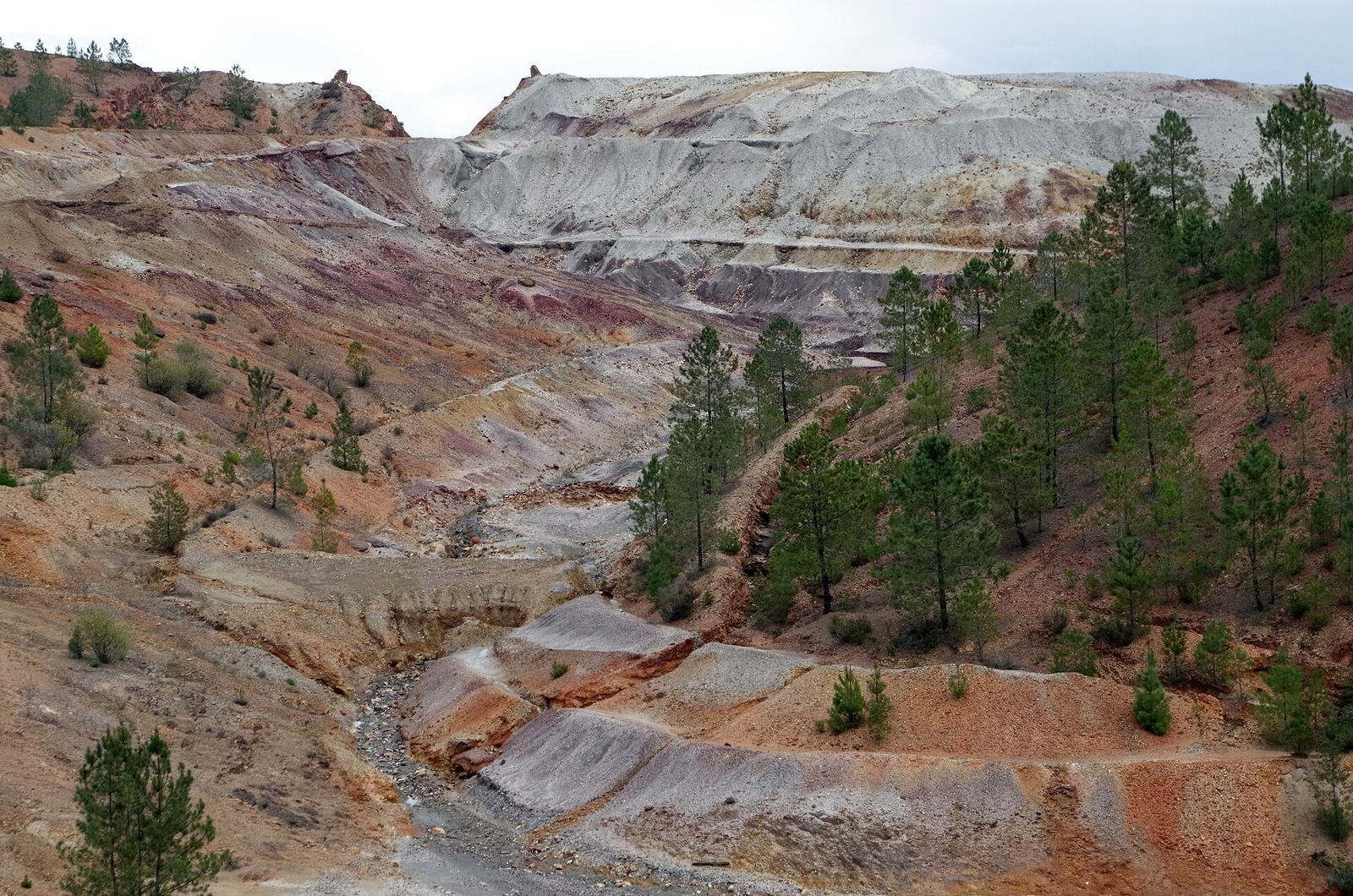
The basin covers about 170 square kilometers and includes the principal population centers of El Campillo, Minas de Riotinto, and Nerva. It lies within the eastern Andévalo, amid gently rolling low mountains, hills, and eroded surfaces. The basin is recorded at 418 meters above sea level, while surrounding elevations reach about 500 to 700 meters. Centuries of extraction have substantially changed the terrain.
Mining landscape and Roman remains
The Riotinto mineral complex occupies about four square kilometers and contains an estimated 500 million tonnes of ore. The principal deposits are Filón Norte, Filón Sur, Masa Planes, Masa San Dionisio, and Masa San Antonio. The wider basin belongs to the Iberian Pyrite Belt, a mineral-rich geological zone in southwestern Iberia. Its reserves include pyrite, an iron sulfide ore, and chalcopyrite, a copper-bearing mineral. The Peña del Hierro deposit also lies within Nerva.
Open pits and underground workings
The mining landscape includes Corta Atalaya, Filón Sur, Filón Norte, and the workings at Peña del Hierro, some of which comprise several separate deposits. Traditional underground galleries continued alongside open pits introduced from the late nineteenth century to increase extraction. Together, these excavations shaped the basin’s present terrain. The historic Rio Tinto copper mine is an open pit that closed in 2001 and has since been partly filled with water.
Roman mining and settlement
Filón Norte contains the oldest known extraction workings and remains of human settlement in the district. Roman mining used underground galleries and water-powered scoopwheel systems to move water; furnaces, metalworking facilities, and roads supported production. Extensive slag heaps altered the landscape, and material from them was later reused in smelting. The principal Roman settlement lay in the present-day Corta del Lago area and was known in classical writings as Urion or Urium. Burial grounds at Huerta de la Cana and La Dehesa belong to the Roman imperial period.
Industrial and processing works
Smelters and chemical processing
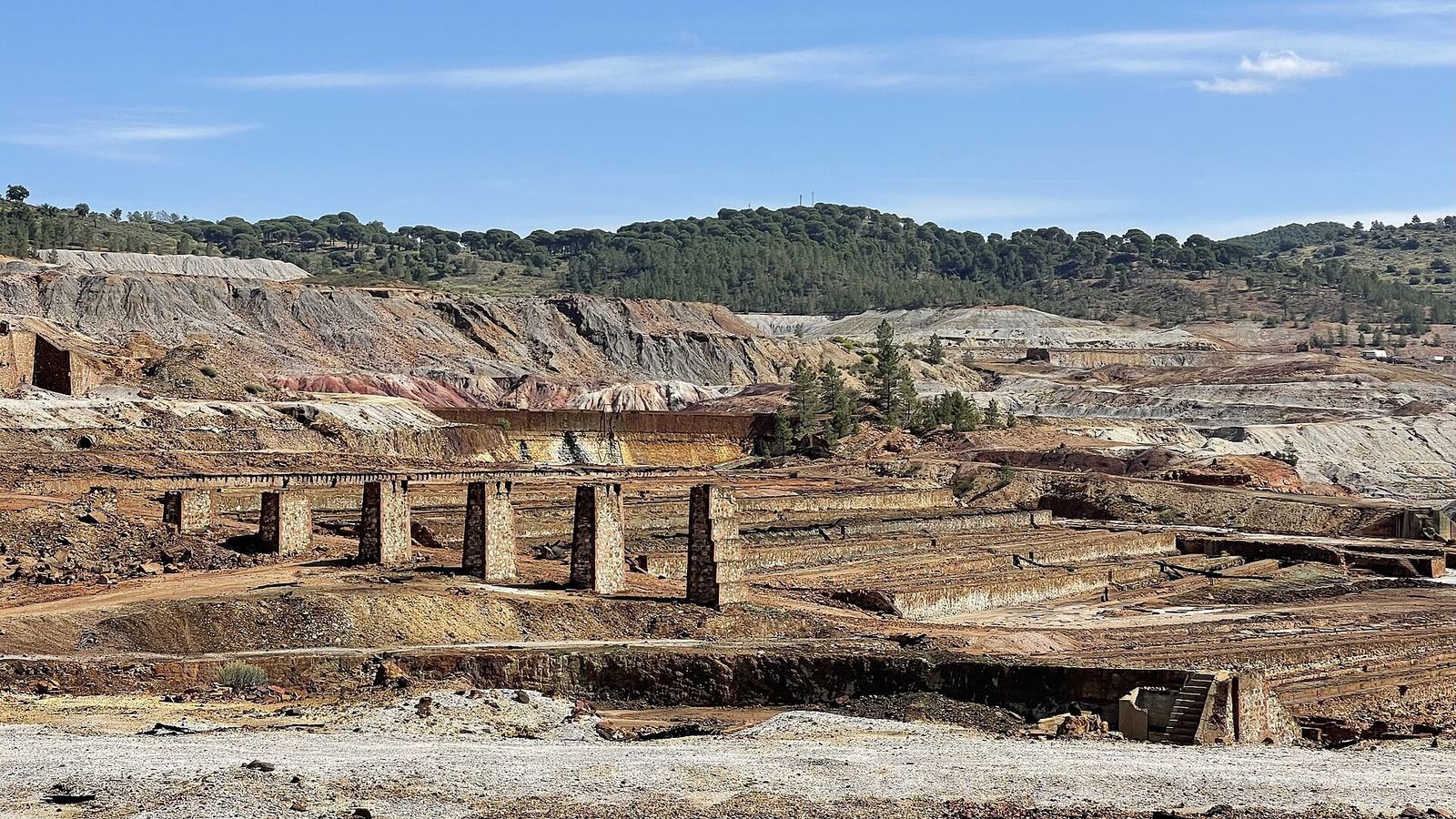
The San Luis Smelter, built beside Filón Sur in 1832 for metalworking, is among the oldest surviving industrial installations. RTC later constructed the Fundición Mina in 1879, Fundición Huerta Romana in 1889, and Fundición Bessemer in 1901. The company also established the Cerda and Planes cementation plants for wet-process copper recovery. Processing facilities included furnaces, foundries, ore-washing plants, factories, power stations, and warehouses.
From the 1880s, ore-processing installations at Zarandas-Naya made it the basin’s main processing center and practical industrial hub. The site included the Naya cementation plant and, from 1932, ponds for ferrous sulfate. A pyrite smelter began operating there in 1907; it later took the place of the Bessemer Smelter and remained active until 1970. A crushing plant also handled pyrite from Corta Atalaya. The basin had an acid factory from 1889 and a second sulfuric-acid plant, built in 1929. At Cerro Colorado, an industrial plant processed gossan, the oxidized, iron-rich material above some sulfide deposits, to recover gold and silver.
Power and water supply
A power station built at Huerta Romana in 1907 began operating in 1909 and remained in service until 1963. RTC supplied electricity to industrial facilities, British staff housing, and workers’ settlements.
The South Dam beside Riotinto and the Marismilla reservoir south of Nerva were built in 1878; the Campofrío reservoir followed in 1881. Campofrío provided temporary relief from shortages and supplied drinking water to municipalities in the basin. The Peña del Hierro company built the Tumbanales I and II reservoirs upstream on the Tinto River for industrial use. After a severe drought worsened supply problems in 1904, RTC built the Zumajo reservoir between 1907 and 1908. North of La Dehesa, the Gossan and Cobre dams held waste from ore processing.
Open-air ore roasting
Open-air roasting heaps, known as teleras, were used from the early nineteenth century and became more widespread under British management. An estimated 500 tonnes were roasted each year. Smoke from the process polluted a broad region, at times reaching the mountains of Seville, Ayamonte, and Portugal, and damaged agricultural land.
Railways and residential settlements
Riotinto railway
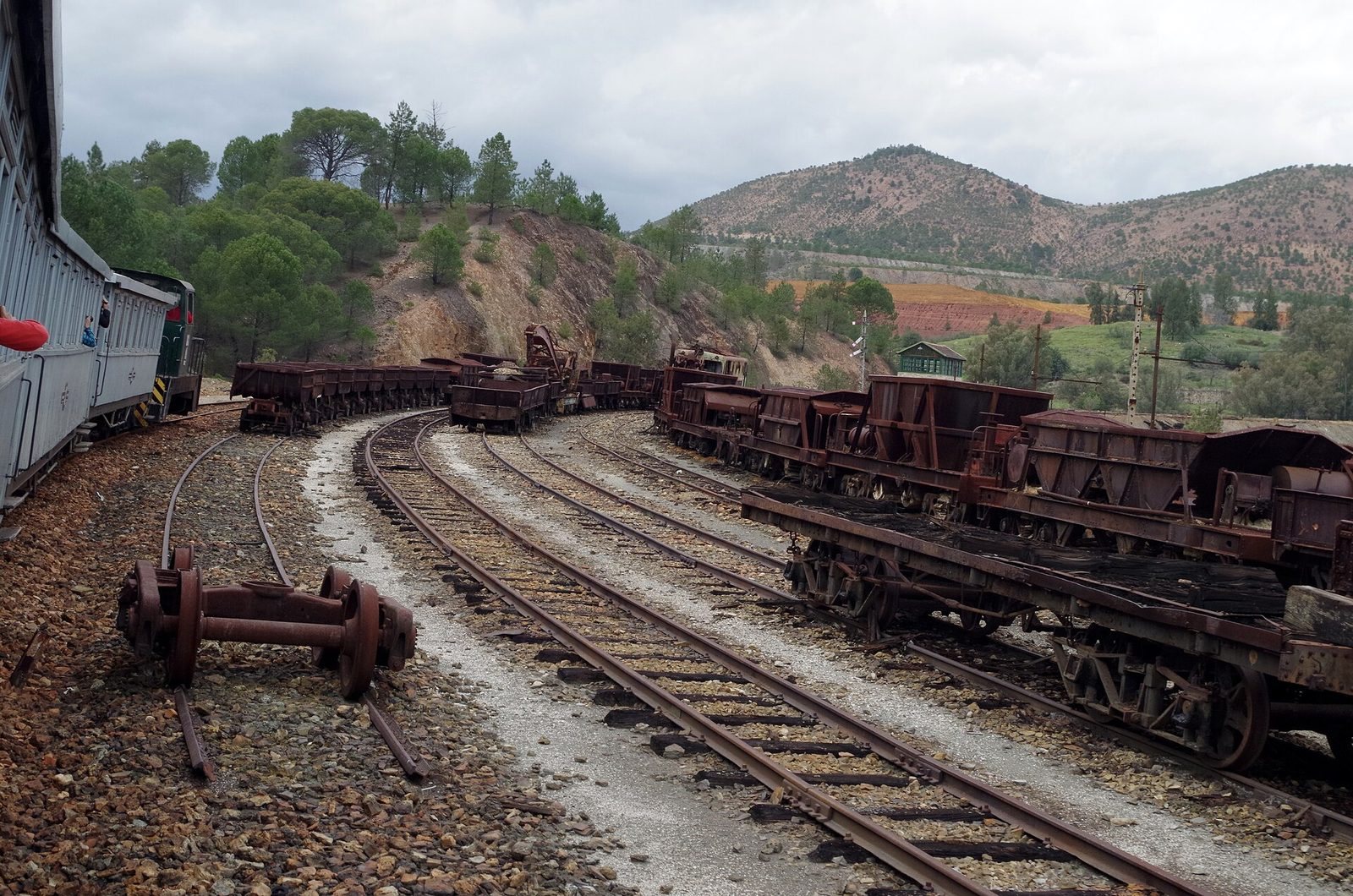
Built between 1873 and 1875, the RTC railway linked the mines with Huelva and its port, where a loading pier handled minerals. Its main line and branches eventually extended for nearly 360 kilometers, connecting mining and industrial sites, including Filón Norte and Corta Atalaya. A branch reached Peña del Hierro in 1883, and lines to Zalamea la Real and Nerva followed in 1904. The Naya tunnel provided an underground connection from 1916. Río Tinto-Estación and Zarandas-Naya developed as rail complexes with extensive yards for receiving and sorting trains. Near Huelva, the Polvorín mineral depot handled heavy traffic. By track length and rolling stock, the railway ranked among Spain’s major rail systems.
Peña del Hierro railway
A separate railway operated from the Peña del Hierro mine between 1914 and 1954. Its 21-kilometer route connected with the Cala mines railway and carried ore toward a loading pier on the Guadalquivir River. It followed the breakdown of an earlier transport arrangement with RTC, amid disputes over charges and construction of the Tumbanales reservoir.
Mining settlements
Mining growth produced worker settlements at Alto de la Mesa, El Valle, La Atalaya, La Naya, Río Tinto-Estación, and La Dehesa. Bellavista was a separate residential development for British managers and engineers, built in the Victorian style. Its residents lived apart from the Spanish population.