Brigetio: A Roman Military and Urban Center in Hungary
Site at a Glance
- Popularity
- Medium
- Country
- Hungary
- Primary era
- Classical
- Eras represented
- Classical
- Civilizations
- Roman
- Site type
- City
On this page30 sections
History
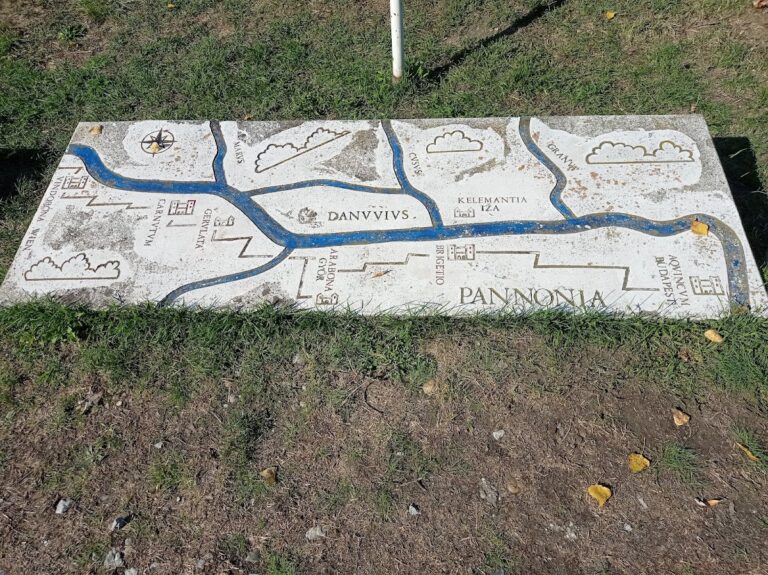
Brigetio was a Roman military and urban center at modern Komárom-Szőny, Hungary, on the Pannonian Limes, Rome’s frontier system along the middle Danube. The Romans established a military post there around AD 49–50, and the settlement grew into a strategic base and town at the meeting of the Danube and Váh rivers. It stood on an important military and trading route between Carnuntum and Aquincum. The surrounding region was associated with the Azali, an ancient people with Illyrian and Celtic influences. The name Brigetio has been connected with the Celtic root brig-, meaning “fortress.”
Roman establishment and military development
Roman control of the area followed the end of Augustus’s reign or began under his successor, Tiberius. Around AD 49–50, during the reign of Claudius, Rome established an auxiliary fort amid unrest north of the Danube. After the Quadi king Vannius was driven from power, Claudius instructed Pannonia’s governor, Sextus Palpellius Hister, to station a legion and selected auxiliary troops by the river. Their presence was intended to protect Vannius’s defeated supporters and discourage incursions. A road connecting Sirmium and Singidunum with Brigetio was built during this period.
The first fort, probably founded around the middle of the first century during the Claudian or Neronian period, was built for an auxiliary cohort, a unit that served alongside Roman legions. It was abandoned toward the end of that century. A legionary fortress was then established farther west. Its construction date remains uncertain: Legio I Adiutrix began the work, while a building inscription from the headquarters that names Hadrian has been dated to after AD 128. Legio I Adiutrix later became Brigetio’s principal long-term garrison.
Inscriptions and brick stamps connect the base with a succession of legions, including XI Claudia, XXX Ulpia Victrix, and I Adiutrix. Other legions associated with the site were XIIII Gemina, X Gemina, IV Flavia Felix, XIII Gemina, XV Apollinaris, and II Augusta. Some supplied detachments, construction labor, or building materials. Auxiliary units included Cohors I Britannica milliaria civium Romanorum equitata, Cohors I Noricorum equitata, and Cohors I Thracum civium Romanorum. The cavalry unit Ala milliaria Flavia Domitiana civium Romanorum may have been in the area temporarily in AD 92–93, though its status as a permanent garrison is not established. Brigetio also supported a substantial Danube fleet, associated with Classis Flavia Pannonica and Classis Flavia Histrica. The Ala Osrhoenorum sagittariorum is another unit linked to the site.
Military settlement and Roman town
A civilian settlement grew beside the legionary base, while a separate civilian town developed about two kilometres west of the camp. Brigetio had municipal status by AD 205 and was raised to the higher Roman town status of a colony around AD 214. As Rome reorganized its Pannonian provinces, the settlement belonged first to Upper Pannonia, later to Lower Pannonia, and in late antiquity to Valeria.
During the Marcomannic Wars, conflicts between Rome and Germanic and Sarmatian peoples along the Danube frontier from AD 166 to 180, Brigetio and its civilian town suffered near-total destruction, probably in AD 169 or soon afterward. The town recovered during the last 10 to 15 years of the second century, although imported fine tableware from the Rhineland continued to reach the area during the conflict. A timber-and-earth fort on the opposite bank, built early in the war, was destroyed in AD 179. Brigetio served as an important base for Roman operations beyond the frontier in the 170s. Marcus Aurelius may have been there in AD 179; he had also returned in late AD 178, before the campaign of the following spring.
Third-century conflicts and civic life
Around AD 213, an inscription concerning a Dacian interpreter may relate to Roman punitive expeditions against free Dacians. In AD 214, Caracalla campaigned along the Danube after Quadi and Iazyges incursions between Brigetio and Aquincum. He secured an alliance with the Marcomanni against the Vandals, executed the Quadi king Gabiomarus, and defeated the Iazyges. At this time Brigetio became part of an enlarged Lower Pannonia, and its civilian center received colony status.
Quadi attacks are noted around AD 245 and 252. Fighting resumed after Emperor Probus died in AD 282. In AD 283, Emperor Carinus defeated forces that had broken through the Pannonian frontier, and in AD 285 Emperor Diocletian defeated the Quadi and Iazyges. A further destruction layer at Brigetio dates to AD 293 and was probably caused by a Quadi attack. A hoard of 118 gold coins, found south of the fortress in 1959 in an area that had not been inhabited, runs from the reign of Nero to that of Julian and may also relate to a barbarian incursion.
Jupiter Dolichenus, a Roman god especially associated with military worship, was among the deities honored at Brigetio. After the Severan dynasty ended in AD 235, devotion to him declined and many sanctuaries were abandoned or burned. The destruction of his principal sanctuary at Doliche by Shapur I, a king of the Sasanian Empire, in AD 253 or 256 may have further weakened the cult. The interpretation of possible early Christianity at Brigetio remains contested. Archaeologist Edit B. Thomas regarded six graves around a small cemetery building as evidence of an early Christian site and read a fragmentary brick inscription as referring to unnamed Christian martyrs. András Mócsy and, later, Dorottya Gáspár instead interpreted the inscription as relating to military life.
Late Roman period
Renewed incursions in AD 357 brought Emperor Constantius II to Brigetio, where he established his headquarters and addressed the Quadi through military action and diplomacy. The Quadi leader Vitrodorus, son of King Viduarus, and the vassal Agilimundus submitted with other nobles, gave their sons as hostages, and pledged to keep the peace.
After further Quadi and Iazyges incursions in AD 374, Emperor Valentinian I campaigned in the region and the fortress was renovated for the final time. He died at Brigetio in AD 375, probably after a stroke during peace negotiations with the defeated peoples. The legion was still recorded at the fort around AD 400. The settlement had contracted by the end of the fourth century but remained inhabited into the fifth. The Huns under Attila occupied Pannonia in AD 433.
Rediscovery and investigation
Antonio Bonfini, an Italian humanist and poet, noted antiquities at the site in the fifteenth century. Later, Wolfgang Lazius described Roman finds unearthed during work on Komárom’s defenses; many were shipped to Vienna. Luigi Ferdinando Marsigli, Richard Pococke, and Jeremiah Milles identified Brigetio and produced early drawings of its fortress, town, and amphitheater. Matthias Bel also described the aqueduct.
Nineteenth-century attempts to protect the remains were frustrated by stone-robbing and grave looting. Flóris Rómer, a founder of Hungarian archaeology, investigated the site. In 1885, fortification work placed a battery over part of the fortress. Officer Miloš Berkovics-Borota recorded walls threatened by the work and published observations and excavation results. István Paulovics conducted the first scientific excavations in 1927–28 and returned in the early 1940s.
Construction of an oil refinery and nearby buildings in 1942 damaged the prospect of large-scale excavation behind the fortress, especially to its south and southeast. Allied bombing later devastated the refinery and disturbed archaeological deposits; records of excavations at the fortress gates were also lost. After the Second World War, Aladár Radnóti and László Barkóczi carried out small rescue excavations amid modern construction, followed by further rescue work through 1992. Systematic investigation of the civilian town began in 1992 under archaeologists László Borhy and Emese Számadó. A 2001 Hungarian monument-protection law classifies Brigetio’s remains among nationally valuable cultural assets and makes archaeological finds state property.
Remains
The remains extend across a military complex, its associated civilian settlement, and a separate town to the west. The legionary fortress had a rectangular plan with rounded corners, measuring 430 by 540 metres and covering about 23 hectares. An earlier fort stood nearer the Danube, while the military settlement developed around the later fortress and the civilian town lay about two kilometres farther west. Roads, cemeteries, pottery-making areas, and river facilities formed part of this wider landscape.
Fortifications
Early cohort fort
The earlier fort stood directly beside the Danube, east of the legionary fortress. It was about 200 metres wide and protected by two ditches. Erosion by the river has removed its forward section, so its full length cannot be determined.
Legionary fortress and walls
The later fortress stood farther west, away from the riverbank. Its northern defensive wall was 1.8 to 2 metres thick. An earth bank made from turf rose behind the wall, sloping inward to support it and provide a walkway along the defenses. A ditch in front of the fortress measured 10 metres across and 3 metres deep.
Gates and towers
A gate stood on each side of the fortress, each flanked by two square towers measuring 10.30 by 7.90 metres. The towers projected at least 0.80 metres beyond the outer wall. The north gate had a single passage; the south gate had two passages divided by a central barrier. Three building phases were identified at the south gate. In the second, the tower walls were made 0.45 metres thinner on all four sides; in a probable third phase, the eastern passage was blocked.
Corner and late defenses
Each corner had an internal tower. Intermediate towers are considered probable, although none has been identified. Late Roman changes may have added outward-curving, U-shaped towers, probably four along each short and long side. The corner towers may also have been converted to fan-shaped or U-shaped forms, but that reconstruction is uncertain.
Buildings, water, and river facilities
Barracks and buildings inside the fortress
Remains of wooden barracks were found near the fortress center. Masonry near the southeast corner has an uncertain function. In the rear part of the fortress, excavators investigated a building with richly painted walls and a heating system that circulated hot air beneath floors. They also uncovered the commander’s residence, a workshop, and ovens. Two life-size statues of Jupiter and Minerva may have stood in the shrine where military standards were kept.
Aqueduct and water distribution
An aqueduct carried spring water from the Tata area, passing the south gate and supplying the fortress and baths in its northern part. Historical depictions show water moving through clay pipes and, over long distances, along aqueducts and raised embankments. Those structures no longer survive. A building south of the fortress contained several hundred kilograms of lead and may have served to distribute water to both the fort and the civilian town.
Harbor and Danube crossing
The river harbor occupied a formerly square, walled enclosure. Excavations revealed landing places and warehouse remains. Two late Roman wall lines ran parallel to the Danube from the northern corners of the fortress enclosure and may have protected warships moored along the river. An ancient bridge near Brigetio served military and commercial traffic and connected with the bridgehead fort at Iža-Leányvár, on the far side of the river beyond the Roman frontier.
Military settlement and civilian town
Settlement beside the fortress
The civilian settlement around the legionary base, known as the canabae legionis, had buildings especially along the fortress’s west and south sides. Its remains include residential and other structures associated with the military community.
Amphitheater and decorated house
An amphitheater stood west of the fortress ditch. It was once described as well preserved but is no longer visible at the site. North of it, excavators investigated a richly decorated house with stucco and painted walls.
Western town
The civilian town, about two kilometres west of the military settlement, had a planned rectangular layout. A city wall enclosed it, with an earth bank supporting a defensive walkway. Excavations have identified richly furnished houses and public buildings, including the temple of Apollo Grannus and Hygieia. An Augustalis, a civic priest associated with the imperial cult, dedicated the temple and later added a portico. The dedication dates to AD 217, the final year of Caracalla’s reign and life.
Sacred buildings and burial grounds
Sanctuary of Jupiter Dolichenus
Excavated south of the fortress in 1899, the sanctuary measured 8 by 4 metres and was aligned from west to east. Three columns of rubble stone divided the interior into two nearly equal spaces, though their structural purpose is uncertain. Three more columns, with simple capitals, stood in front of the single entrance on the east. Finds included a bronze statuette of Jupiter Dolichenus and a limestone relief showing the god riding a bull in the military dress of an emperor. An inscription identifies the relief as a second- or third-century work commissioned by a decurio, a title that could refer to a cavalry officer or town councillor, from Zeugma in Asia Minor.
Other finds from the sanctuary include dedication inscriptions, among them one made by Valerius Hermes, a donor from Greece, in the first half of the third century. Military personnel dedicated further images of the god. The objects also include two bronze statuettes of Victoria, the Roman personification of victory, a shaft for a standard-holder, figures of Sol and Luna, a bull and a bird, fire-damaged bronze figurines, votive sheets, other cult objects, and a bronze victory wreath. Archaeologist Endre Tóth proposed that one Victoria figure may once have crowned a triangular offering plaque. The civilian settlement also had a sanctuary of Mithras.
Cemeteries and graves
Burial grounds lay along the road between the civilian town and the military settlement, and beside roads leading south and east from the fortress. More than 100 graves were found in the Gerhát cemetery, between the pottery district and the main frontier road; its finds include two second-century horse burials. The Járóka cemetery lay east of the town, with two other burial grounds to its west. Cemeteries linked to the military settlement lay southwest and south of the fortress, and their use ended around AD 260. The late antique Cellás cemetery was 200 metres southeast of the fortress’s southeast corner and was excavated in 1929.
Six isolated graves south of the fortress formed a cluster around a small building whose plan remains uncertain. A fragmentary brick inscription from Brigetio has also figured in debate about early Christianity at the site.
Pottery-making areas
Gerhát district
The Gerhát pottery district lay east of the fortress, north of the frontier road and beside the Danube. Its workshops made mass-produced striped and marbled wares, moulded vessels that imitated metal shapes, and moulds for lamps and terracotta objects. They also produced glossy Pannonian wares decorated with patterns inspired by fine Roman tableware. A three-phase villa was investigated immediately west of the district, with other Roman-period foundations farther east.
Kurucdomb and workshops west of the town
Another pottery district at Kurucdomb, east of the fortress, yielded a uniform group of stored tableware concealed in the second half of the second century. Civilian ceramic workshops west of the town were destroyed during railway construction in the late nineteenth century.
Military camps and archaeological finds
Temporary earth camps
Temporary earth camps of varying sizes occupied the area around the legionary base. By 2003, 18 had been distinguished, 12 of them within an area about two kilometres across, especially south of the frontier road. The group included one camp considered suitable for a unit of variable size and organization, seven for cohorts, and four for cavalry units. Some camps overlap, and they have been interpreted as places for marching or training.
Bronze military laws
A bronze law tablet found in cultivated ground in the fortress area in 1930 and 1934 measures 78.5 by 68 centimetres and carries 38 lines. It preserves a decree of Constantine and Licinius dated 9 June 311. The decree addressed soldiers’ tax privileges and discharge papers, requiring immediate delivery to honorably or medically discharged soldiers while excluding dishonorably discharged men from the privileges. It also ordered the law displayed on a bronze tablet near the standards in each military camp. A later addition supplied the emperors’ titles. Scholars differ on whether the decree ended military diplomas or changed how confirmations of immunity were issued.
Fragments of a second bronze law tablet were found in the same area in 2014, and an excavation in 2015 recovered a fragment that joined one of them. It also concerned soldiers’ privileges, but its surviving text is too incomplete to establish the details; the emperor’s name had been erased. The fragments probably came from near the original display place by the standards shrine, although the headquarters building has not been located.
Coins, sculpture, and other objects
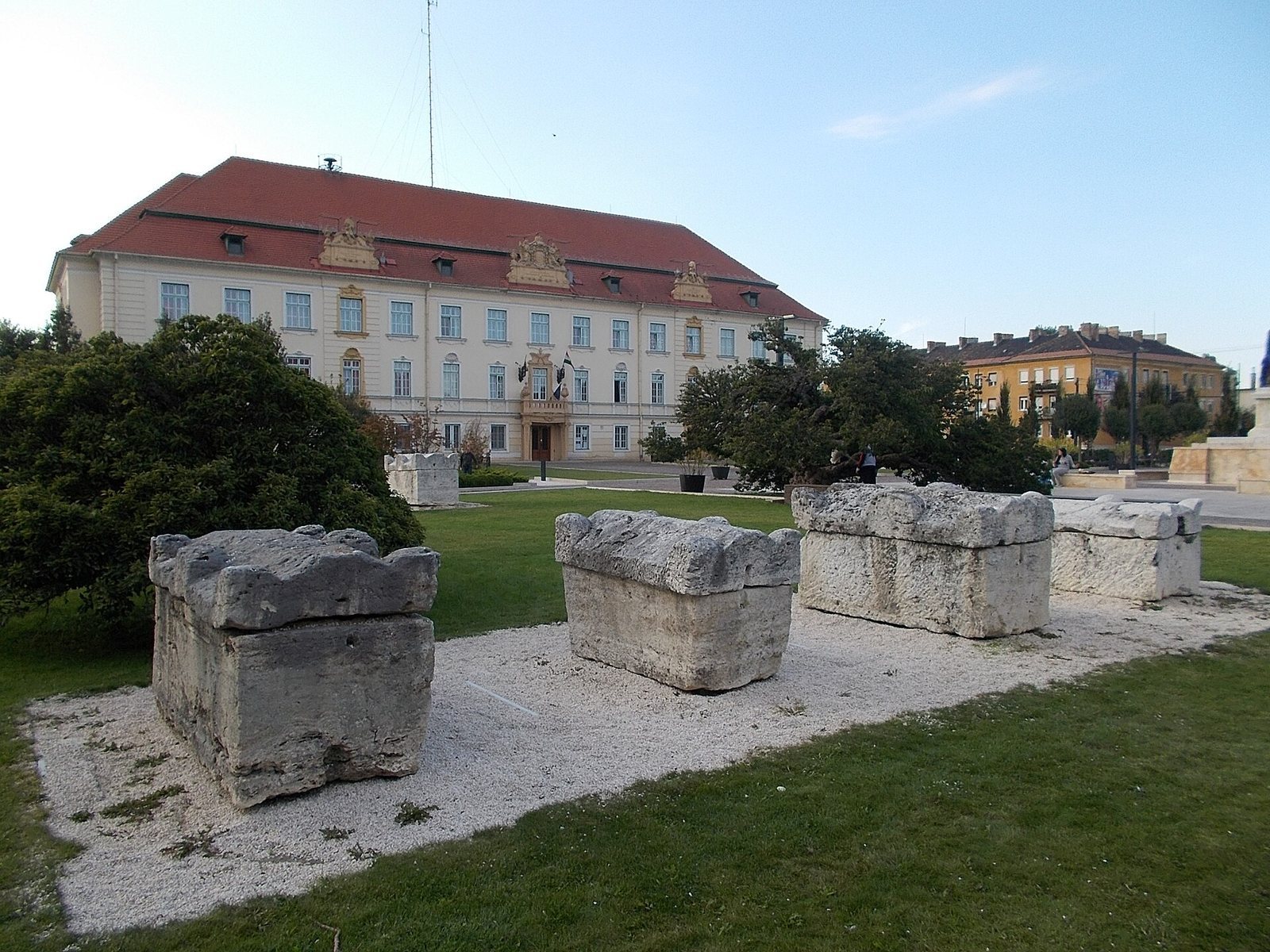
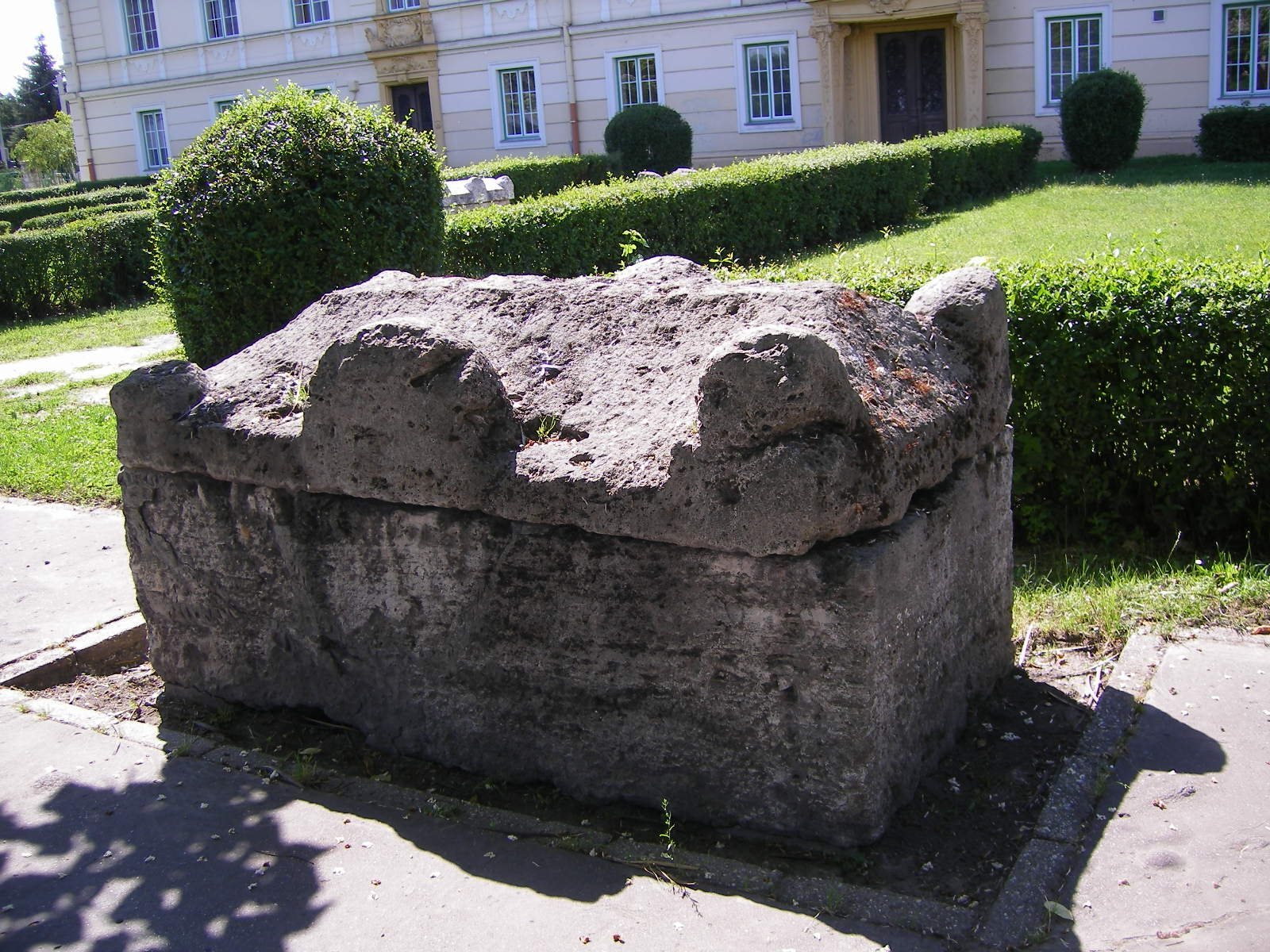
The 118 gold coins discovered south of the fortress in 1959 range from the reign of Nero to that of Julian and may be connected with a barbarian incursion. A relief-decorated bronze helmet, once covered in white metal, was found near the commander’s residence in 1942. It had been crushed and apparently was intended for melting in a fourth-century furnace beside it. Brigetio has also yielded fragments of a luxury Roman glass vessel with an openwork outer cage and a terracotta medallion depicting Meleager. A possible connection between the medallion and a performance of a play by Euripides in a local theater remains hypothetical. A tombstone dating to around AD 173 is held by the Hungarian National Museum in Budapest; two milestones, sarcophagi, and a bull statue are also associated with the site.