Flawinne Castle: A Renaissance Seigneurial Residence in Belgium
Site at a Glance
- Popularity
- Low
- Country
- Belgium
- Primary era
- Early Modern
- Eras represented
- Early Modern
- Civilizations
- Holy Roman Empire, Spanish
- Site type
- Domestic
- Remains
- Manor House
On this page7 sections
History
Flawinne Castle is a Renaissance-style seigneurial residence in Flawinne, near Namur, Belgium. A seigneurial residence was the home of a lord who held land and authority under the feudal system.
Construction and ownership
Building began in the seventeenth century, when Jean-Jacques d’Hinslin started work on the site of the Cense rouge farm. D’Hinslin was ennobled in 1678, and his son Albert Nicolas completed the château in 1711. About two centuries later, David de Lossy, a man holding the traditional rank of knight, acquired the property. It was known as Château David for about a century.
Protection and renewal
In 1980, the château and its surroundings were listed as protected built heritage in Wallonia. Olivier de Spoelberch, a viscount, a European noble title ranked below a count, acquired the property in 1986 and began renovating the buildings and gardens. The château is now a private residence.
Remains
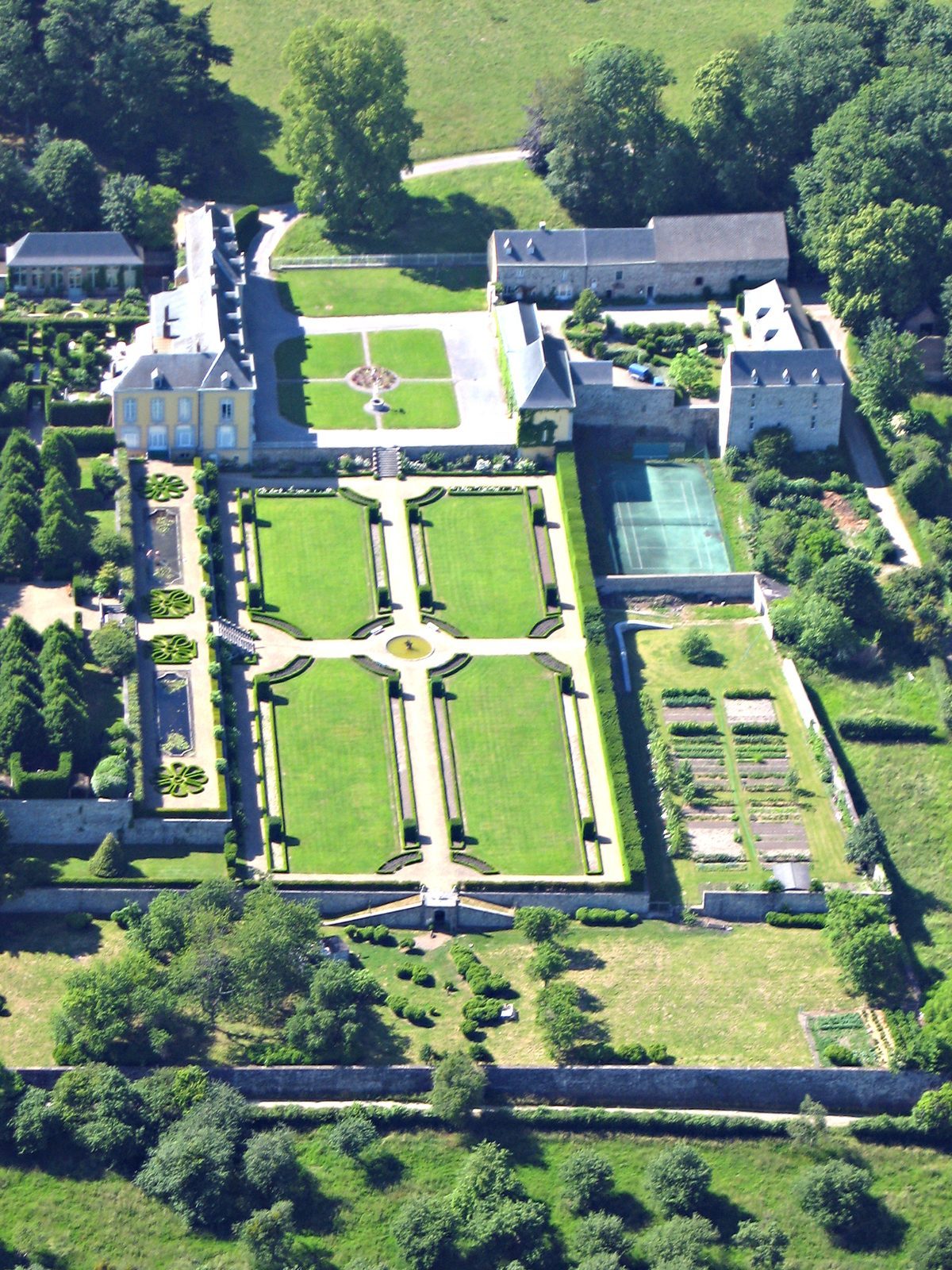
The site combines the château, its terraced formal gardens, an adjoining farm courtyard, and a tree-lined approach. The château is built of brick and blue stone, while the farm buildings use limestone rubble.
Château and gardens
The château’s principal wing and pavilions form the main architectural group. Its square inner courtyard also serves as the first terrace of the French formal gardens, which continue across several additional terraces.
Farm courtyard and well
Facing the château, the farm’s outbuildings form one side of the adjoining farm courtyard. A well in the courtyard has notable ironwork. The farm is built from limestone rubble, including stone from quarries exposed along the slopes beside a nearby secondary channel of the Meuse.
Approach avenue
Large trees line the approach to the château, forming the Flovana tree-lined avenue. The avenue can be seen from buildings in central Namur.