Fort de Malonne: A Nineteenth-Century Fort of Namur


Site at a Glance
- Rating
- 4.1
- Popularity
- Very Low
- Country
- Belgium
- Primary era
- Modern
- Eras represented
- Modern
- Civilizations
- Belgian
- Site type
- Military
- Remains
- Fort
On this page17 sections
History
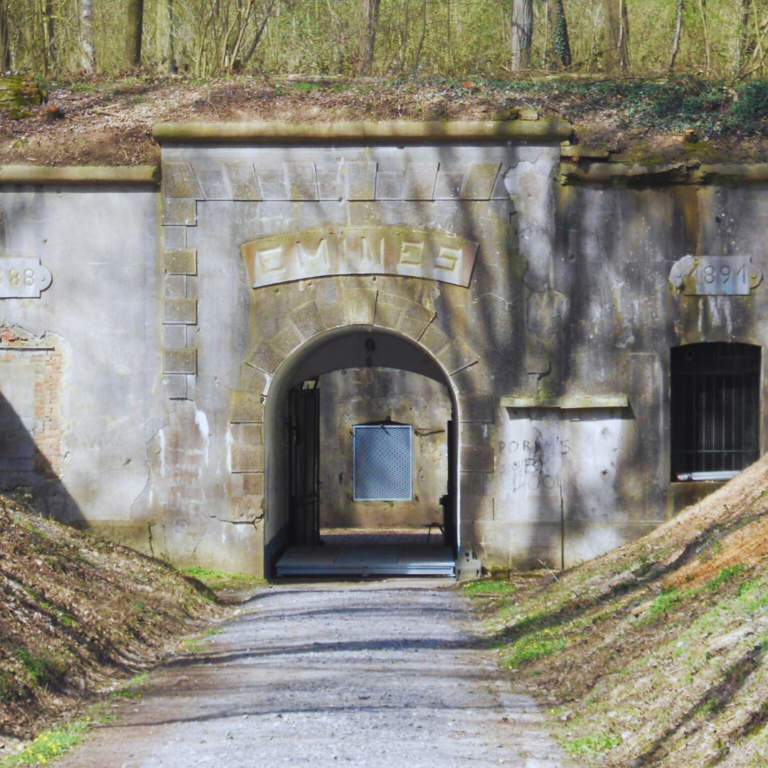
Fort de Malonne is a late-nineteenth-century Belgian concrete fort near Namur, built between 1888 and 1892 as part of the fortified ring around the city. Designed by General Henri Alexis Brialmont, it defended Namur’s southwestern approaches, including routes toward the Sambre valley, the railway to Charleroi, and the roads leading to Châtelet and Mauberge. Its strategic purpose also included preventing a renewed occupation by French troops.
Construction and military role
Construction began in 1888 on a hill about 4.5 kilometres southwest of Namur. Fort de Malonne was one of nine detached forts intended to operate as a coordinated defensive system around the city. Belgian troops occupied it shortly after completion, and it remained in military use until 1940.
Brialmont was a Belgian general and military engineer whose system of detached concrete forts shaped the defensive rings constructed around several Belgian cities during the late nineteenth century. At Malonne, the principal guns were concentrated in a heavily protected central massif, while the surrounding ditch and counterscarp defenses guarded the fort at close range.
The Battle of Namur in 1914
During the Battle of Namur in August 1914, the breakdown of communications and the withdrawal of Belgian units disrupted the coordinated defensive line for which the forts had been designed. Fort de Malonne had not yet come under the main German bombardment and had fired only two shots toward Spy.
Reports from soldiers arriving from Fort Marchovelette alarmed the garrison. They described the effects of German heavy artillery on other forts, while Captain Damseaux could obtain no further information because the telephone lines had been cut. Most of the garrison withdrew in an effort to rejoin the Belgian army. Damseaux initially remained with about 80 soldiers and distributed them among the gun positions, but he soon ordered the weapons sabotaged so that German forces could not use them.
Further withdrawals reduced the defenders to officers, medical personnel, and a small number of soldiers. Shortly after 1 a.m. on 24 August 1914, a four-man patrol from the German 5th Imperial Guard Infantry Regiment approached the fort under Lieutenant Otto von der Linde. After prolonged negotiations, during which Damseaux tried to conceal the weakness of his remaining forces, the Belgian commander capitulated. No more than 20 men, and possibly as few as nine, were taken prisoner. German forces regarded the fort as captured by 8 a.m.
Otto von der Linde, a German Imperial Guard infantry officer, received the Pour le Mérite for the capture. The order was a high Prussian and later German military decoration awarded for exceptional military achievement. The surrender was later used for propaganda and became surrounded by legendary accounts.
Modernization and the Second World War
During the 1930s, Fort de Malonne was extensively modernized within the Fortified Position of Namur. This twentieth-century defensive system updated Namur’s older detached forts so that mutually supporting artillery positions could slow or deter an invading army. The work brought new weapons, stronger protection, improved ventilation and sanitary facilities, upgraded communications, and electrical power.
When Germany invaded Belgium in 1940, Captain-Commandant Demaret commanded the fort. Fort de Malonne supplied fire support to Belgian troops and neighboring forts after the German capture of Fort Eben-Emael. By 21 May, however, its ammunition was nearly exhausted and it could no longer maintain effective resistance. The garrison sabotaged the remaining weapons before surrendering to German forces.
Protection and later history
Fort de Malonne now lies within a nature preserve and has been closed to the public since 1991 because its underground spaces provide protected habitat for bats. The preserve is associated with the Walloon nature and forests administration, while the site is also linked to the Amicale pour la sauvegarde du Fort Malonne.
Remains
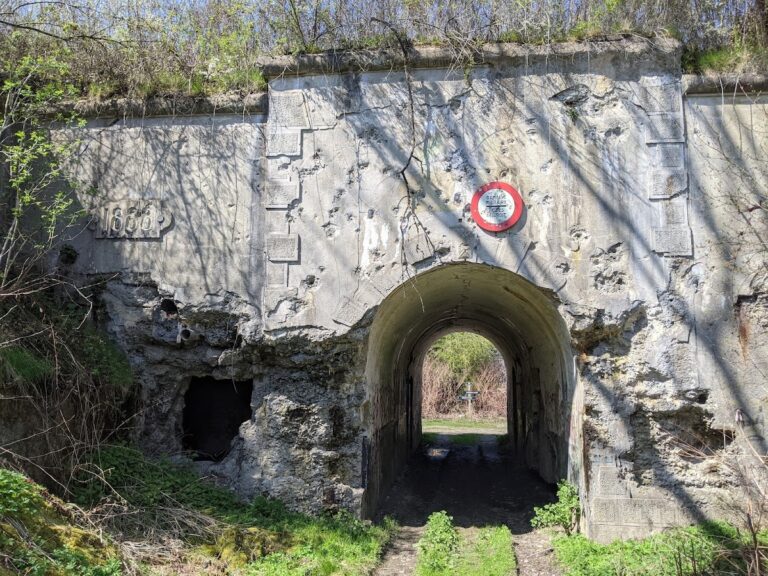
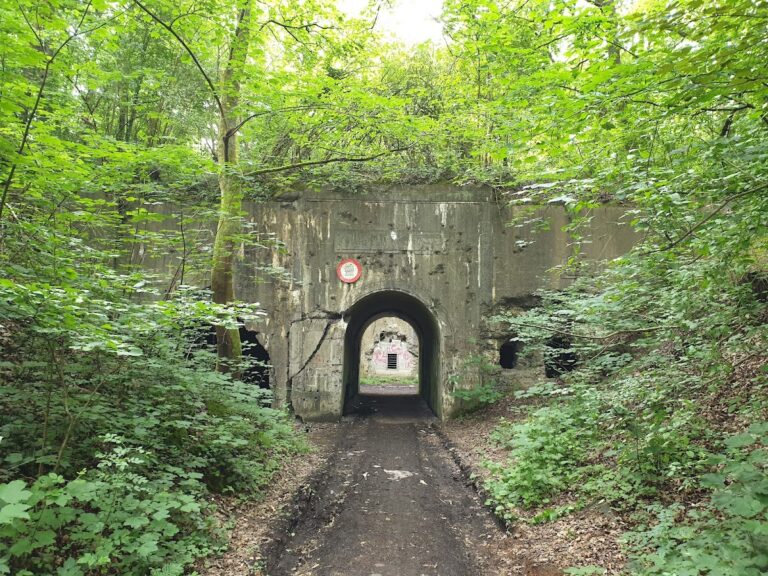
Fort de Malonne stands on a hill about 195 metres above sea level in the locality of Malonne, roughly 4.5 to 4.7 kilometres southwest of central Namur. Its irregular rectangular or trapezoidal plan follows the terrain. Straight sides of unequal length surround the fort, while a straight rear barracks line faces Namur. The entire structure is built of concrete rather than masonry.
Plan and ditch defenses
Ditch and counterscarp
A ditch approximately 6 metres deep and 8 metres wide encircles the fort. Its outer slope was flattened, while the steep counterscarp, the outer wall or slope of a defensive ditch, was faced with masonry. Counterscarp casemates, which are protected chambers for weapons or military use, and caponiers allowed the defenders to fire lengthwise along the ditch toward firing traps. This arrangement provided enfilade fire, meaning fire directed along the length of a ditch against troops moving through it.
Close-defense positions
One description identifies three counterscarp caponiers, each armed with four 57 mm guns. Six heavy machine guns were also installed in counterscarp casemates for the close defense of the ditches and the rear entrance. The fort additionally had six rapid-fire machine guns in these casemates and two mobile guns.
Central armament
Original artillery turrets
The central massif held the principal artillery and was protected by about 4 metres of solid, unreinforced concrete. The less exposed casemate walls were approximately 1.5 metres thick. The original long-range armament included a Grusonwerke turret with a 21 cm Krupp howitzer, a Schneider-Creusot turret carrying two 15 cm guns, and two Châtillon-Commentry turrets, each armed with one 12 cm Krupp gun.
Four corner turrets mounted 5.7 cm Maxim-Nordenfelt guns. These were retractable turrets, a type that could be lowered behind the fort’s concrete protection when not firing. The 15 cm guns had a range of approximately 8.5 kilometres, and the 12 cm guns reached about 8 kilometres. The 21 cm Krupp howitzer had a stated indirect-fire range of about 6.9 kilometres.
Turret construction and crews
The 15 cm turrets were about 4.8 metres in diameter, weighed approximately 224 tonnes, and required crews of around 25 men. The 12 cm turrets had the same diameter and crew but weighed about 188 tonnes. The 21 cm turret was about 3.6 metres in diameter, weighed about 100 tonnes, and required 13 crew members. The 57 mm turrets measured about 2.1 metres across, weighed approximately 34 tonnes, and required six operators.
The guns originally used black powder rather than smokeless powder. The resulting gases were intended to create choking conditions in the ditches, but they also collected in the enclosed firing chambers and spread through the fort.
Communications and internal facilities
Observation and signals
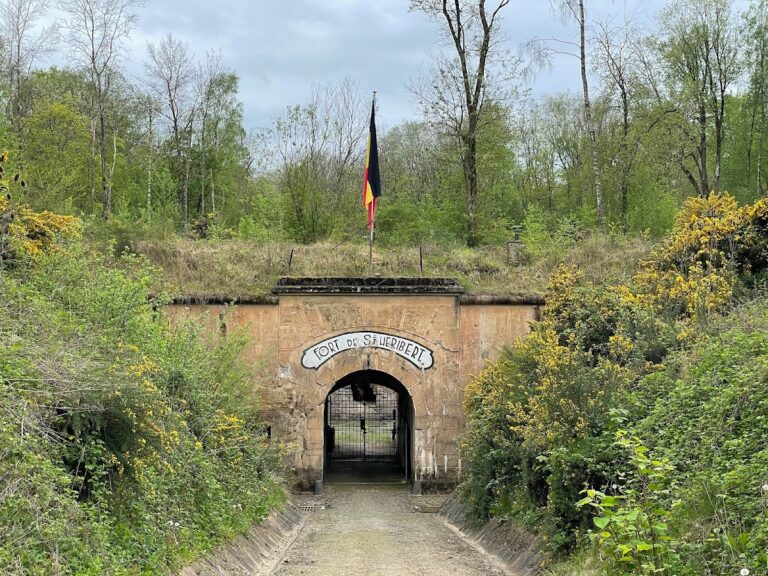
An observation turret equipped with a searchlight and signal lights supported communication with the neighboring forts of Saint-Héribert and Suarlée. Its position formed part of the fort’s wider role within Namur’s interconnected defensive system.
Barracks and service areas
The barracks opened toward the rear ditch on the side facing Namur, giving that side less protection than the front and salient sides. Latrines, showers, the kitchen, and the morgue occupied the counterscarp, while the service area stood directly opposite the barracks. These facilities formed the fort’s daily support areas and were also exposed to the dangers of a prolonged bombardment or siege.
Interwar alterations
Modernized weapons
The modernization of the 1930s replaced the original 57 mm weapons with 75 mm guns and installed machine guns in the caponiers. The 21 cm howitzer was replaced by a longer-range 15 cm howitzer. The former 15 cm turret was replaced by a turret carrying machine guns and two grenade launchers, while the 12 cm guns gave way to 10.5 cm guns.
The modernized arrangement is also described as including four 75 mm howitzer turrets, one 105 mm gun turret, two turrets with machine guns and a mortar, and a combined ventilation-and-observation turret. These changes altered the fort’s armament and internal systems for the conditions of twentieth-century warfare.