Temple of St Michael the Archangel, Uličské Krivé: A Wooden Greek Catholic Church
Site at a Glance
- Popularity
- Very Low
- Country
- Slovakia
- Primary era
- Early Modern
- Eras represented
- Early Modern
- Civilizations
- Habsburg, Hungarian
- Site type
- Religious
- Remains
- Church
On this page12 sections
History
Foundation and religious use
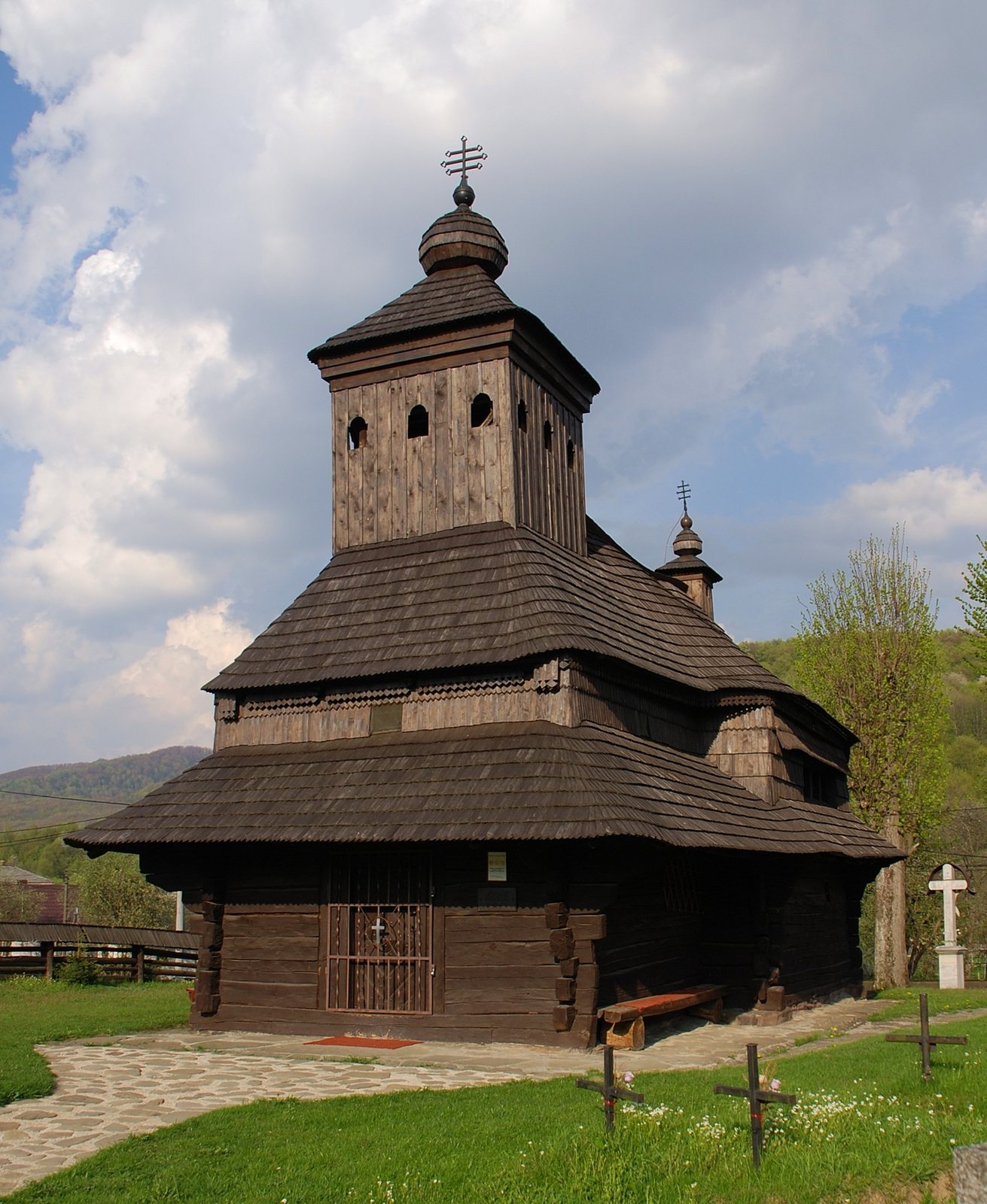
The Temple of St Michael the Archangel, Uličské Krivé, is a wooden Greek Catholic church in Slovakia, built in 1718 in a distinctive Carpathian form associated with the Snina area. The Slovak Greek Catholic Church is an Eastern Catholic church that follows the Byzantine rite. The temple remains in use as a dependent church of Ulič parish.
Twentieth-century changes and restoration
During the 1950s, the church was used for Orthodox worship before later returning to the Greek Catholics. It sustained serious damage in the Second World War and was repaired in 1944. Further repairs took place during the 1950s, in 1985 and 1987–91, and in 1997, 2002, 2004, 2007, 2009, and 2011. The iconostasis was completely restored in 1988–92.
The church is a National Cultural Monument of Slovakia. In 2011, the churchyard was added to the protected monument.
Remains
Layout and exterior
Plan and construction
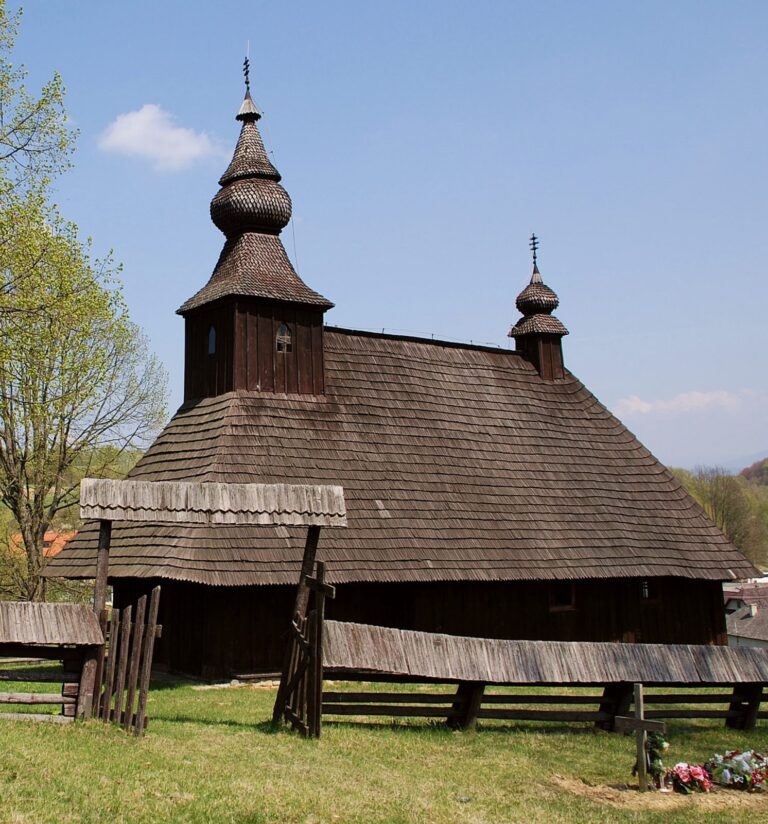
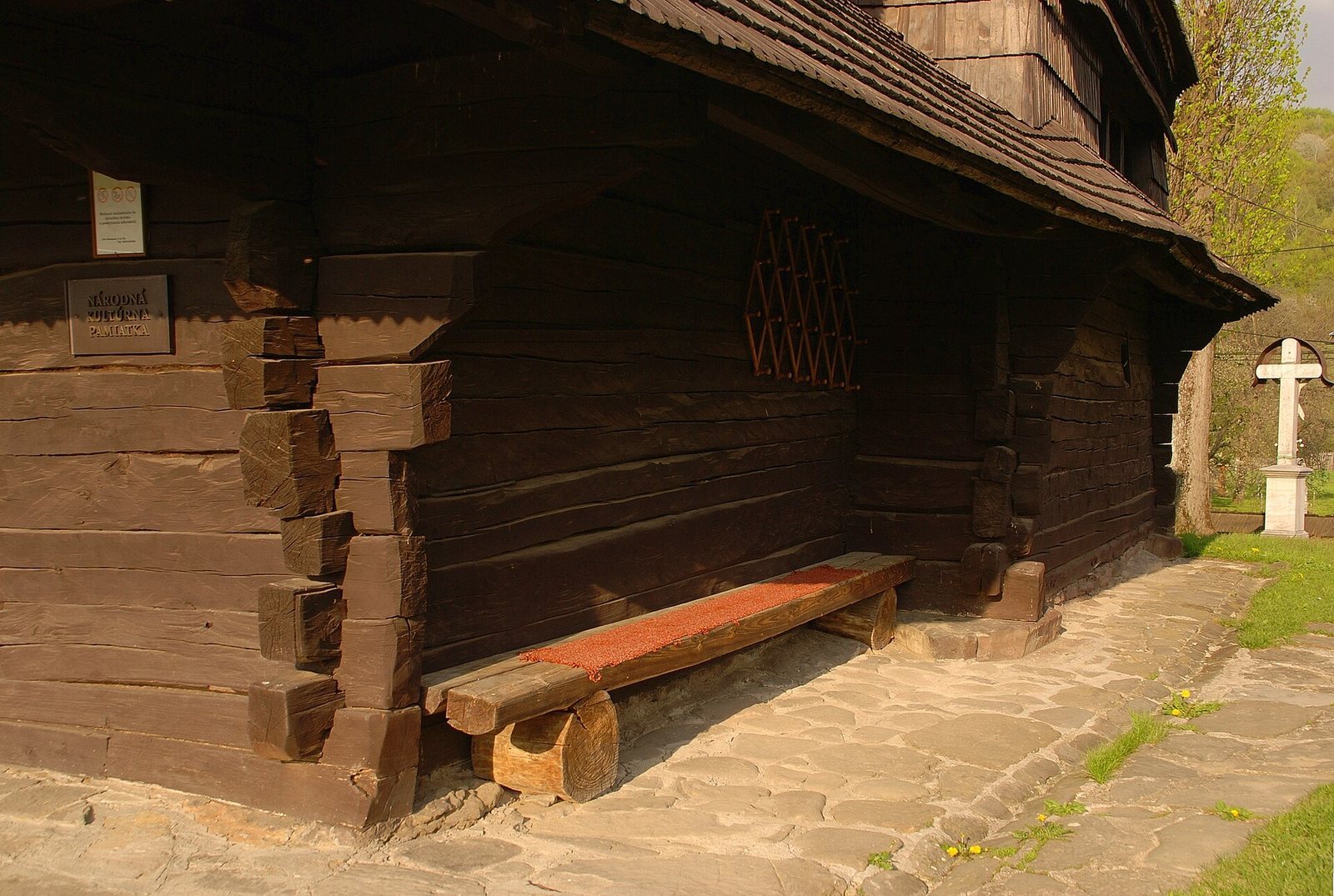
Set on a slight rise in the village center, the east-facing church is built from birch and ash logs on a low stone base. Its three-part plan consists of a polygonal sanctuary, a wider rectangular nave, and a western vestibule. A log partition separates the vestibule from the nave.
Towers and roofs
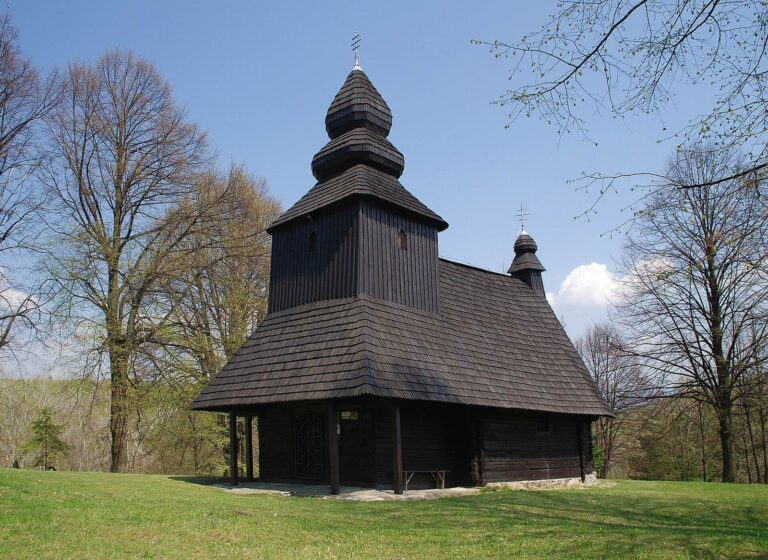
A tall tower rises above the vestibule, while a smaller one stands over the sanctuary. Both have domes on truncated-pyramid bases, topped by three-armed iron crosses. The taller tower holds three bells, the oldest cast in 1811. Shingles cover the shared roof over the nave and sanctuary, which has a single ridge; the sanctuary roof is hipped. A lower shingled canopy, supported by carved brackets, runs around the building, and a covered shingled walkway surrounds it.
Churchyard
A wooden fence on a stone base encloses the churchyard. Its gate is sheltered by a shingled canopy.
Interior and furnishings
Sanctuary altar
The sanctuary contains an eighteenth-century Baroque high altar and an eighteenth-century Pietà, an image of Mary grieving over Christ’s dead body.
Iconostasis
The nave’s five-tier iconostasis, an icon screen separating the sanctuary from the main worship space, is in the Baroque style and reflects features associated with the eighteenth-century Rybotycze icon-painting workshop in Poland. Its first tier includes St Nicholas, a sainted bishop, the Hodegetria, an image of the Virgin Mary with the Child Jesus, Christ the Teacher, and St Michael the Archangel. Feast-day images in the second tier are divided by the Last Supper. The third shows Christ as High Priest among the apostles, with the Virgin Mary and John the Baptist, a biblical prophet; prophets occupy the fourth tier. The fifth includes St Nicholas appearing to three dukes, the praying Virgin Mary, and the apostles Peter and Paul. The central royal doors show the Tree of Jesse, a representation of Christ’s genealogy. Their side panels depict Basil the Great and John Chrysostom, influential early Christian bishops and theologians.
Wall icons and other furnishings
Icons from an older church include a Passion of Christ dated 1834, sixteenth-century images of St Michael, the Virgin and Child in the Hodegetria form, and the Crucifixion, as well as seventeenth-century images of St Nicholas and Christ Pantocrator, which presents Christ as ruler of all. An image of Christ’s face, known as a Mandylion, is set on the choir-gallery railing. The furnishings also include two Baroque candlesticks and two processional crosses.