Church of the Transfer of the Relics of St. Nicholas (Ruská Bystrá): An Eighteenth-Century Wooden Greek Catholic Church
Site at a Glance
- Popularity
- Low
- Country
- Slovakia
- Primary era
- Early Modern
- Eras represented
- Early Modern
- Civilizations
- Hungarian
- Site type
- Religious
- Remains
- Church
On this page12 sections
History
Construction and religious use
The Church of the Transfer of the Relics of St. Nicholas (Ruská Bystrá) is an eighteenth-century wooden church in Slovakia, built by parishioners in 1730. It was consecrated that same year, during the reign of Charles VI, a Habsburg ruler and Holy Roman Emperor from 1711 to 1740.
The church belongs to the Slovak Greek Catholic Church, an Eastern Catholic church that follows the Byzantine rite while remaining part of the Catholic Church. It is linked to the Eparchy of Košice, an Eastern Catholic diocese, and the parish of Ruský Hrabovec, and is associated with the Sobrance deanery. The building was used by the Orthodox Church from the 1950s before returning to Greek Catholic worship. It remains an active Greek Catholic church.
Restoration and heritage recognition
A major renovation, focused mainly on the interior, was completed in 1989. Work in 2002 replaced some structural elements and the shingle roofing. In 1968 the church became a Slovak national cultural monument as part of the East Slovak Wooden Churches ensemble, alongside 26 other churches. On July 7, 2008, it was added to the UNESCO World Heritage List as part of the Wooden Churches of the Slovak part of the Carpathian Mountain Area.
Remains
Plan and timber construction
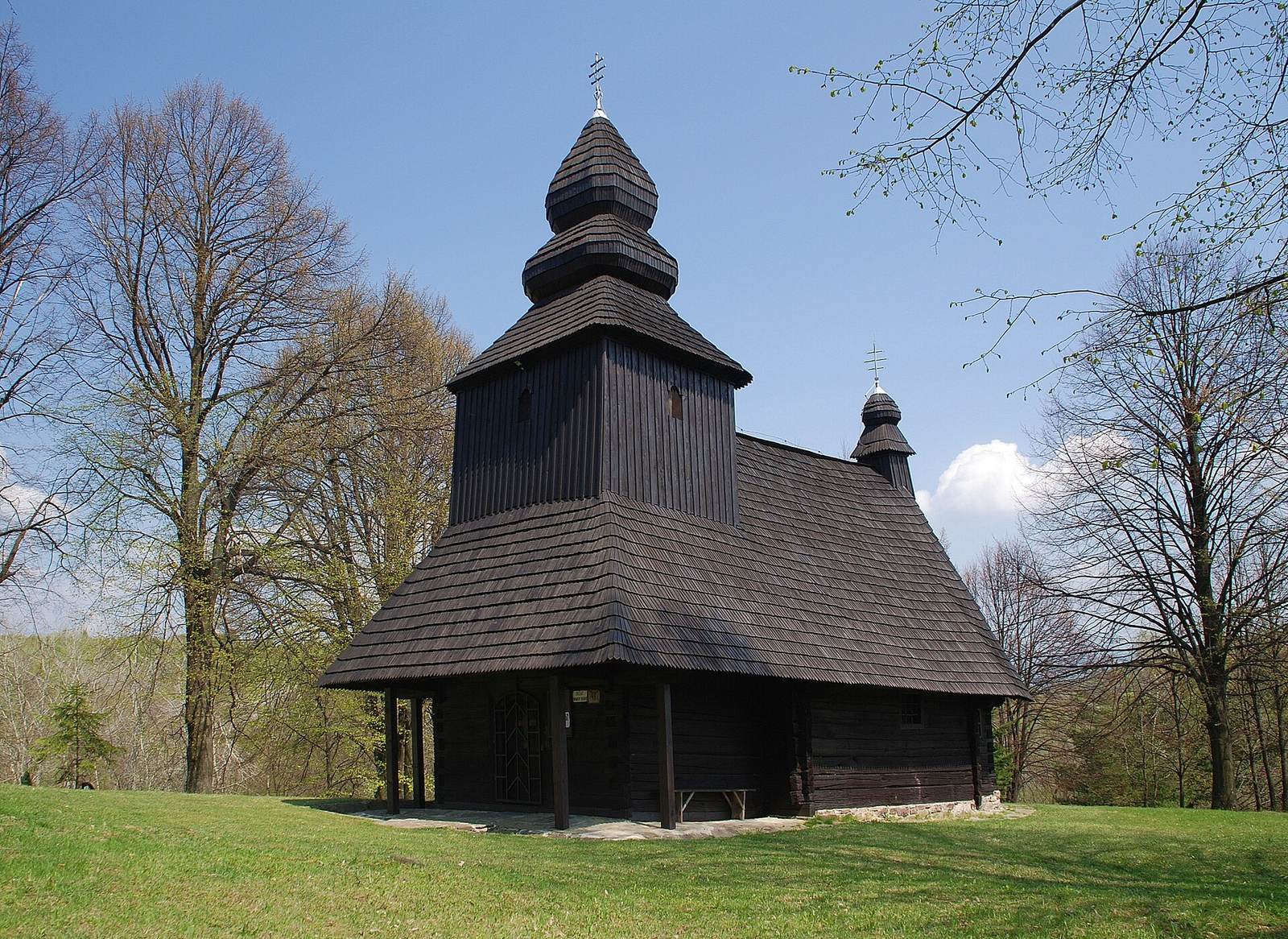
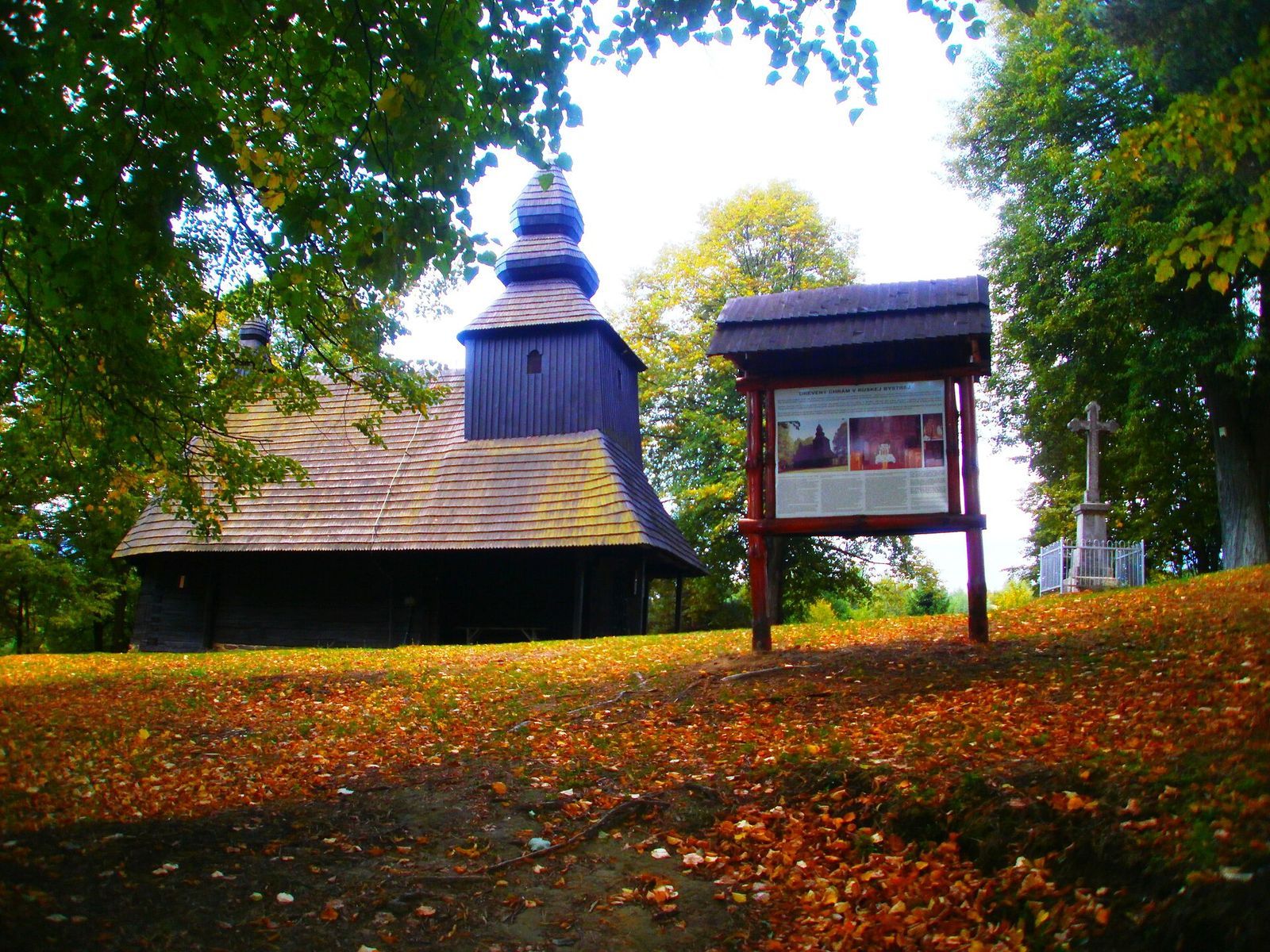
The church stands on a hill in central Ruská Bystrá and has three main parts arranged from west to east: an entrance vestibule (entry space), a larger square nave (main worship area), and a narrower sanctuary (altar area) at the east end. The sanctuary is closed on three sides and has a small, east-facing double-leaf window. The nave has an uninterrupted north wall, while the iconostasis separates it from the sanctuary on the east. The building is made from hand-hewn conifer beams joined with carpentry joints and rests on a stone foundation. Its lower beams are blackened to protect them from wood-boring insects, and the exterior log walls remain uncovered by boards or shingles. Inside, flat plank ceilings cover the spaces rather than exposed logs rising into a truncated-pyramid form.
Roof and towers
Roof
A simple roof with a single ridge slopes down on all sides and is covered with shingles. Its broad eaves rest on posts, and the lower shingles have toothed edges.
Western bell tower
The bell tower rises above the western vestibule. It is built on a post frame rather than from logs, and its exterior is clad in vertical conifer boards. A tent roof, which slopes upward to a point, supports an irregular octagonal shingle ornament and an almost conical, octagonal upper element. The forms pass gradually into one another, beneath a wrought-metal cross.
Eastern turret
A smaller turret stands above the eastern sanctuary. It has a tent roof, a small shingled onion-shaped top, and a wrought-metal cross. Together, the turret and western bell tower give the church two towers.
Interior and furnishings
Iconostasis
The eighteenth-century wooden Baroque iconostasis is an icon-bearing screen that separates the sanctuary from the nave. Its five tiers are arranged around central royal doors, the screen’s main doors, which have hand decoration and partly transparent panels. Six colored oil-painted medallions depict the four Evangelists, traditionally associated with the Gospels, and the Annunciation, the announcement to Mary that she would bear Jesus. An oil painting of St. Nicholas as a bishop is set in a door jamb. Openings for the deacons’ doors, side entrances used by deacons, lie to the north and south. The principal tier includes the Mother of God Hodegetria, an image of Mary pointing to Christ, and Christ the Teacher; icons of St. Nicholas and St. Paraskeva are also on a side wall. The feast tier centers on the Last Supper. In the apostolic tier, Christ the High Priest is flanked by the Mother of God and St. John the Baptist. Old Testament prophets occupy a higher tier, above which a Calvary scene, depicting the Crucifixion, is placed on the ceiling. Some outer icons are on side walls, reflecting the limited interior space.
Altars
The main altar has a carved retable, the ornamental structure behind an altar, painted in several colors and depicting the Crucifixion, as well as an ornate tabernacle. A smaller altar holds an eighteenth-century Pietà icon showing Mary mourning the dead Christ. A Crucifixion icon on the altar has been completely restored.