Levnov: A Medieval Hilltop Castle Ruin in Czechia


Site at a Glance
- Rating
- 4.7
- Popularity
- Low
- Country
- Czechia
- Primary era
- Medieval
- External website
- Open
- Eras represented
- Medieval
- Civilizations
- Holy Roman Empire, Margraviate of Moravia
- Site type
- Military
- Remains
- Castle
On this page7 sections
History
Levnov is a ruined medieval hilltop castle in Czechia, near Ketkovice in the Brno-venkov District. It was probably built in the mid-thirteenth century, although another interpretation places its construction at the beginning of the reign of Charles IV, whose rule as King of Bohemia began in 1346. The castle may have been founded by the Templar Order, a medieval military-religious organization that held land and administered dependent settlements before its suppression in the early fourteenth century.
Origins and the Lords of Levnov
The villages of Čučice, Ketkovice, Sudice, and Rapotice are thought to have belonged to Levnov’s lordship. These settlements had previously been subject to the Templars. The surrounding territory was held by the Lords of Leipa in 1346, while Levnov itself first appears in written records in 1358 as the possession of Lev of Levnov. He is regarded as the principal builder of the castle and expanded it into a major Moravian stronghold and the seat of the Lords of Löwenau.
From 1378, Levnov belonged to Ulrich of Löwenau and his children Eliška, Anežka, and Oldřich. Eliška had been married since 1365 to Jimram Kralický of Kralice. The Lords of Levnov died out around the end of the fourteenth century or the beginning of the fifteenth, after which the castle returned to the Lords of Leipa.
Conflict and demolition
During conflicts between the Moravian margraves Jobst and Prokop, territorial rulers in Moravia, several patrician families from Kuttenberg acquired Levnov. The Pirkner family of Pirknštejn later sold it back to the Lords of Leipa.
At the end of the Hussite Wars, fifteenth-century religious and political conflicts centered in Bohemia and Moravia, Burghart Kienberger and German mercenaries occupied Levnov after Albrecht of Austria failed to pay their contracted wages. They raided the war-torn surrounding region, taking livestock and grain from villages and attacking merchant wagons.
The Moravian Estates, the representative political body of the period, decided that Levnov and several other occupied castles should be redeemed from their occupants and demolished so that robber bands could not use them. Bertold, also called Pertold, of Leipa redeemed Levnov from Kienberger. The mercenaries probably then left for Austria under an assurance of safe conduct. In November 1442, a force raised by the Znojmo burghers, with participation from surrounding villages, demolished the castle. Brno, Ivančice, Znojmo, Třebíč, and Jihlava compensated Bertold of Leipa for the demolition. The details of a siege and capture are not securely established.
Rediscovery and protection
Levnov’s name gradually disappeared from common use, and the remains became known as Ketkovský hrad or Ketkovický hrad. During the nineteenth century, castle researchers incorrectly identified a ruin above the Saint Stanislaus chapel near Osiky as Levnov. Vladimír Voldán reidentified the castle in 1970 and 1971 using archival map records and local field names, including Levnovská louka, Levnovský les, Levnovské pole, and Na Levnovci. These names were associated with parcels belonging to the miller Vydra of Ketkovský Mlýn. The reidentification disproved the Osiky location, whose ruin may instead be the still-unlocated castle of Zuzinov.
Levnov’s remains are protected as a cultural monument of the Czech Republic and lie within the Oslava and Chvojnice Valley Nature Reserve.
Remains
Promontory and approach
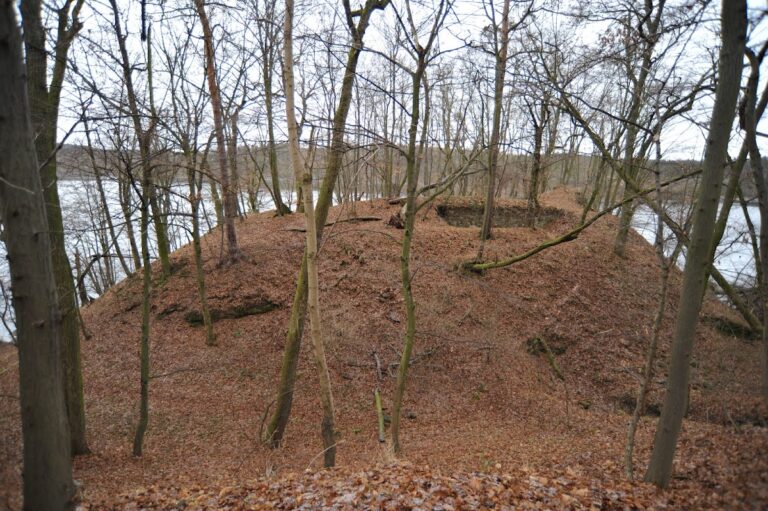
Levnov occupies a rocky promontory rising about 120 metres above the Oslava and Chvojnice valleys near their confluence. The landform projects from the left bank above the mouth of the Chvojnice, while a southern cliff descends 120 metres toward the Oslava valley. Deep valleys, cliffs, and the rivers protected the castle on several sides, leaving the northeast as its landward approach from the Ketkovice upland.
From the northeast, the approach crossed a ditch and entered through a towered gate into the outer bailey, the enclosed part of a castle containing subsidiary buildings and defenses. Ketkovický Mill stands in the Oslava valley below the castle rock. Across the Chvojnice is the ruin of Kraví Hora, while the Oslava’s largest meander, known as the Devil’s Tongue, lies to the east.
Fortifications and residential core
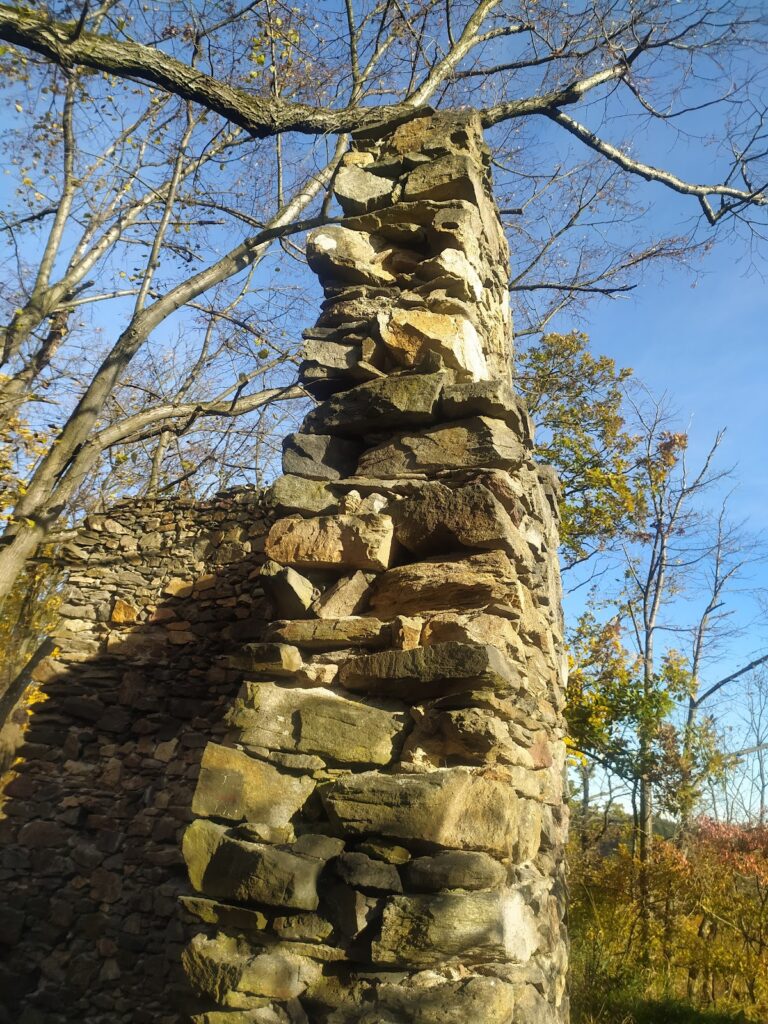
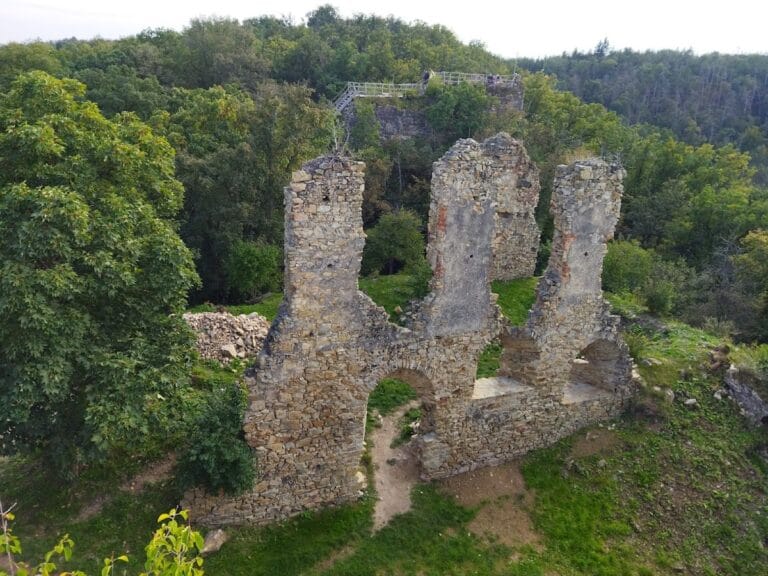
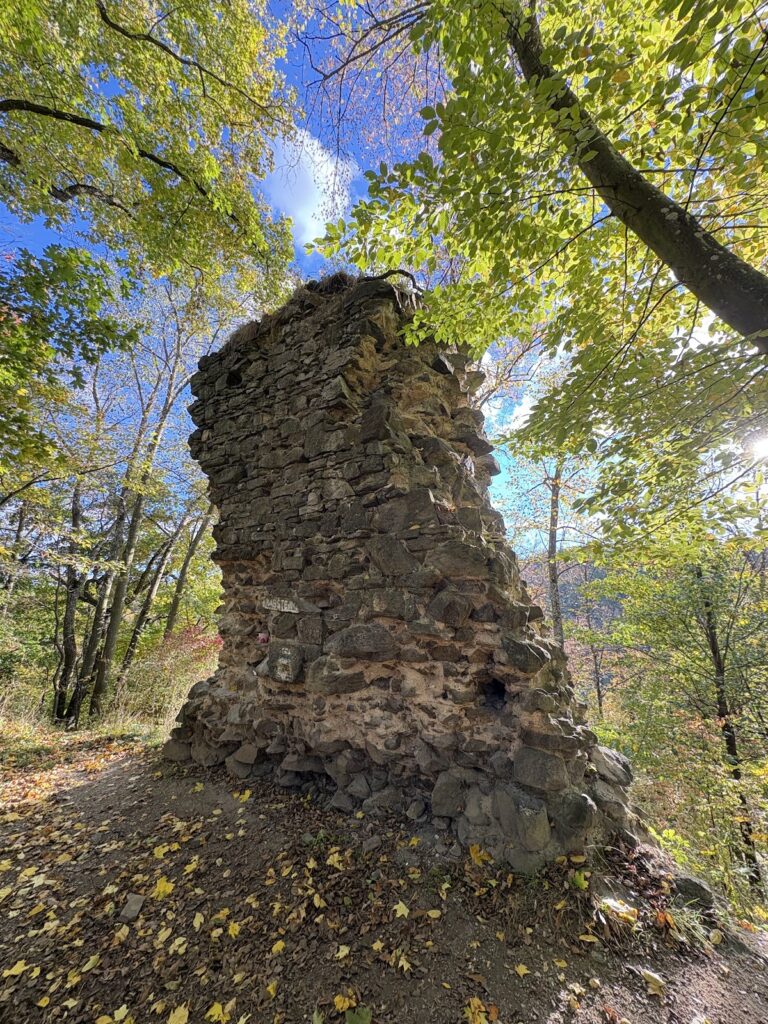
The divided palas, the principal residential building of a medieval castle, occupied the western part of the complex. Its elongated ground plan was enclosed by walls approximately 2.5 metres thick. A massive fortification wall and reinforced ramparts survive as the principal remains of the castle.
The elevated ruin overlooks the Oslava valley, the rock formation on the opposite bank, and the Dukovany nuclear power station. These surviving landform relationships help define the castle’s position above the river valleys and its enclosed rocky setting.
Nearby sites