Templštejn: A Gothic Castle Founded by the Knights Templar in Czechia


Site at a Glance
- Rating
- 4.7
- Popularity
- Low
- Country
- Czechia
- Primary era
- Medieval
- External website
- Open
- Eras represented
- Medieval
- Civilizations
- Crusader, Holy Roman Empire, Knights Templar
- Site type
- Military
- Remains
- Castle
On this page8 sections
History
Templar foundation
Templštejn is a ruined Gothic spur castle in Czechia, near Jamolice in Moravia, founded by the Knights Templar between 1281 and 1298. The Knights Templar were a medieval Christian military-religious order that maintained fortified religious and administrative houses across Europe. The castle was built in the Gothic style and became one of the few Templar foundations in Moravia.
King Wenceslas I, king of Bohemia, authorized the order to establish houses in Bohemia and Moravia in 1232. A Templar commandery, meaning a local administrative establishment managing estates and church patronage rights, existed at nearby Gomolitz by 1279. Under Commander Dietrich, the order built Templštejn and transferred the commandery, its possessions, and its church patronages to the completed castle. The new commandery was first explicitly mentioned on 16 July 1298.
There are no further records of the Templar commandery after 1303. The frequently repeated claim that the Templars sold the estates of Templštejn to the Knights Hospitaller is not supported by documentary evidence. The Templar Order was dissolved in 1312, after which its property was confiscated.
Noble ownership and rebuilding
In 1318, Berthold Pirkner of Pirkenstein acquired Templštejn together with Jamolitz, Dobřensko, Biskupka, and Řeznowicz. The northern villages were assigned to Levnov Castle. Wenceslas and Ulrich Pirkner sold the Templštejn estate to Přibík of Schellenberg in 1349. In 1379, Přibík’s sons Drslaw and Johann sold the castle and its associated estates to Henry of Leipa for 3,200 marks. The transaction included vineyard rights in Mispitz and Spanitz.
Templštejn belonged to the sovereign from 1397, when Marquard of Pechtitz served as burgrave, and it returned to the Lords of Leipa in 1410. The Lords of Leipa rebuilt the castle and added a new residential palace. On 24 April 1417, Čeňek of Leipa concluded an agreement at Templštejn with the abbot of Saar Abbey, settling a dispute over the church tithe of Nowa Wes.
After the Lords of Leipa regained the lordship of Moravský Krumlov in 1434, they incorporated the Templštejn estate into Krumlov. Wenceslas of Tulleschitz was the burgrave in 1439. Jan Boček of Kunstadt owned the castle in 1475 and 1476, while from 1482 it served as the seat of the Lords Osovský of Doubravice. The Lords of Leipa later acquired it again.
Fire and abandonment
Templštejn was never conquered. Fire damage to the buildings and metal objects, together with charred beam remains, indicates that a major fire took place during the first half of the sixteenth century. Stones bearing the date 1552 suggest that the Lords of Leipa began rebuilding the castle, but the work was soon abandoned. Templštejn has been regarded as deserted since the middle of the sixteenth century.
Later ownership and conservation
Following the Battle of White Mountain, the 1620 defeat near Prague that consolidated Habsburg authority in Bohemia and Moravia, the estates of Berthold Bohuslaw of Leipa were confiscated in 1621. Gundaker of Liechtenstein acquired the Krumlov lordship in 1625. The ruin remained with the House of Liechtenstein until 1908, then passed to the Counts Kinsky until their property was expropriated in 1945.
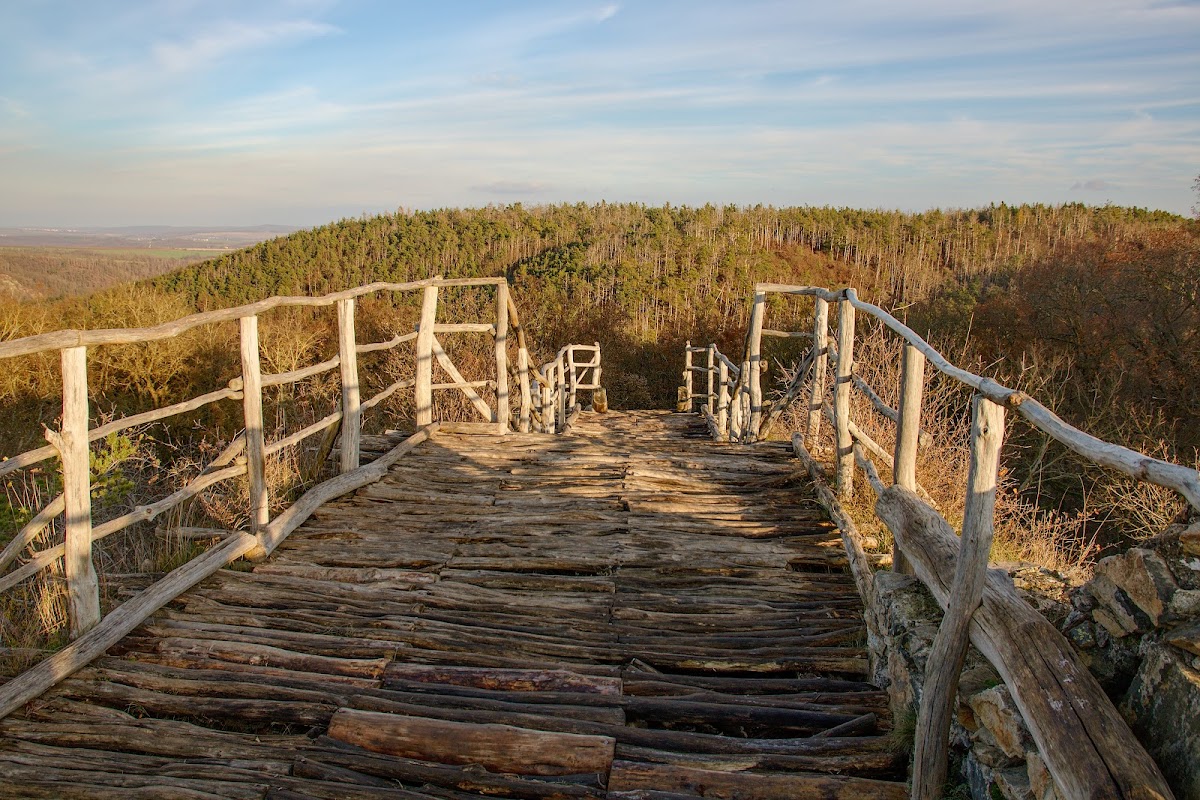
For more than 450 years, no preservation measures were undertaken. Vegetation, wind, and weather progressively weakened the masonry and caused parts of the ruin to collapse. The Forests of the Czech Republic offered the castle for public sale in 2011, and David Hamza became its private owner. From 2014, repair work included stabilizing the ruin, removing damaging vegetation, building a stone staircase to the castle core, and repairing the deteriorating shield wall. The approach favors natural materials and traditional construction methods rather than extensive rebuilding.
Volunteer groups, including the Brontosaurus Movement between 2014 and 2023 and CK Kudrna, have taken part in the repairs. A rescue archaeological investigation has been carried out at the castle since 2017 under the direction of archaeologist Miroslav Dejmal. Templštejn is protected as a cultural monument.
Remains
Rocky spur and fortifications
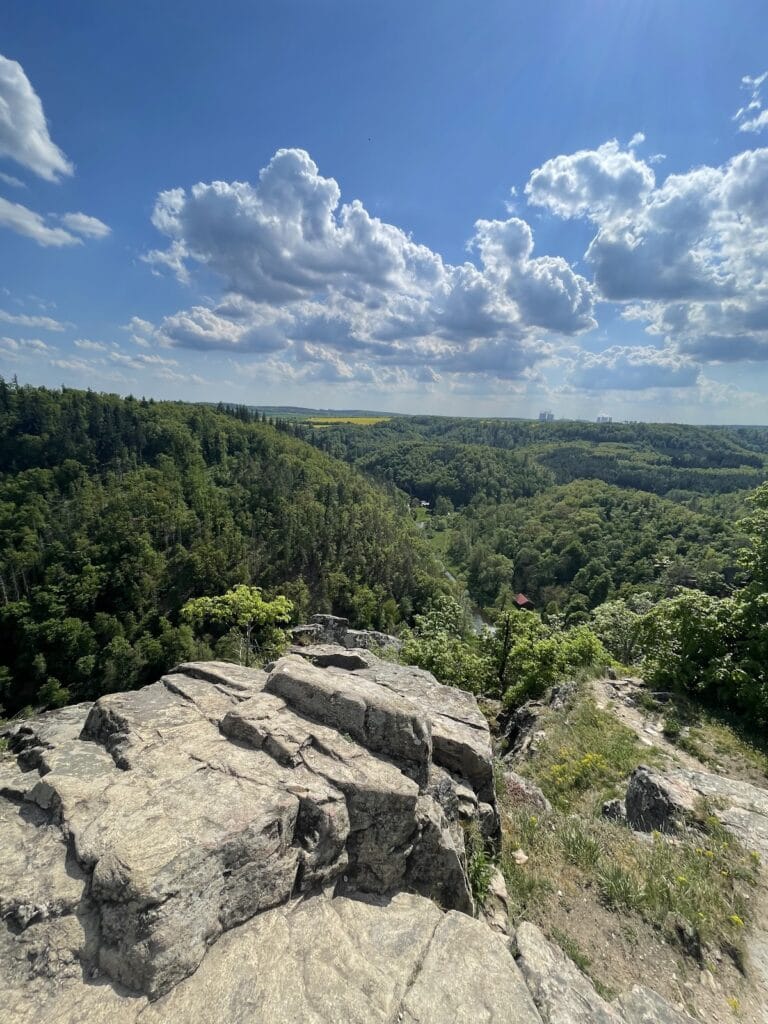
The ruin occupies a wooded rocky spur on the right bank of the Jihlava River, opposite a bend in the river and more than 100 metres above it. It lies in the Jevišovická pahorkatina, within the Střední Pojihlaví Nature Park and the Templštejn Nature Reserve. Vrabčí kopec rises to the southwest. This setting made use of the projecting ridge and its natural slope as part of the castle’s defenses.
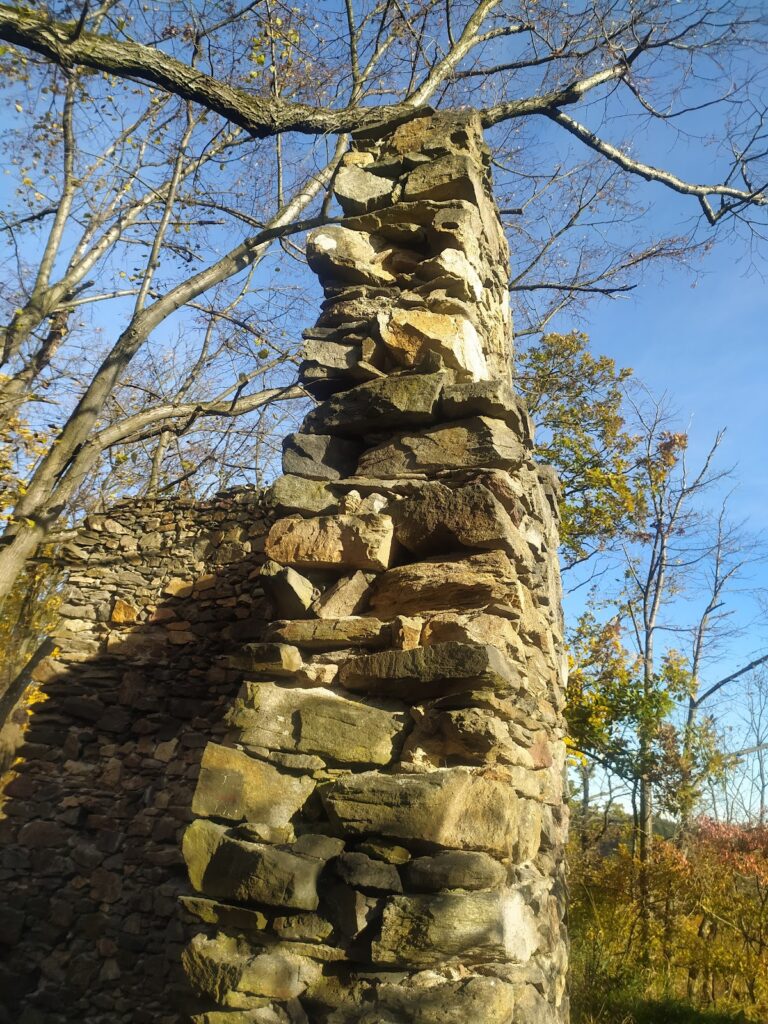
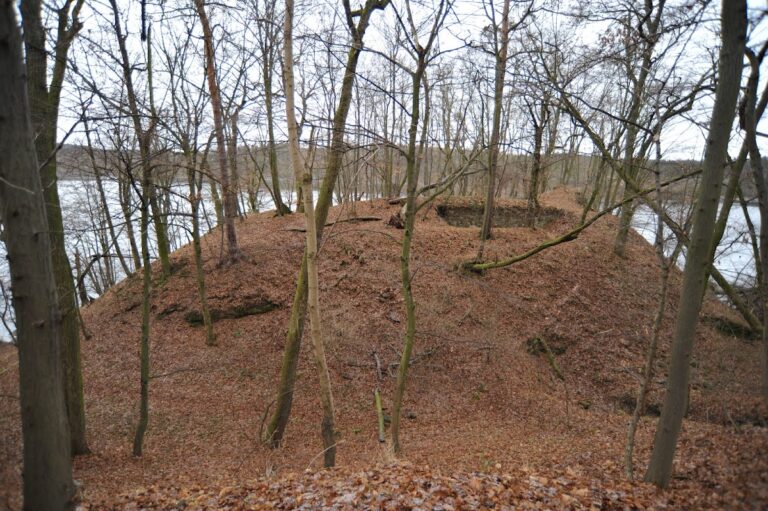
The original castle core measured approximately 40 by 30 metres. Its thirteenth-century enclosure was formed by a powerful mantle wall, a substantial wall surrounding and protecting the central part of a castle, with a circular plan. A large pillar strengthened the wall on the side facing the access route. After the core was completed, a partly double belt of fortifications was added around it. In the mid-fifteenth century, a shield wall was begun on the hill in front of the castle to protect the stronghold from direct artillery fire, but the work remained unfinished. Extensive ramparts and ditches survive as part of the defensive layout.
Castle core and surviving buildings
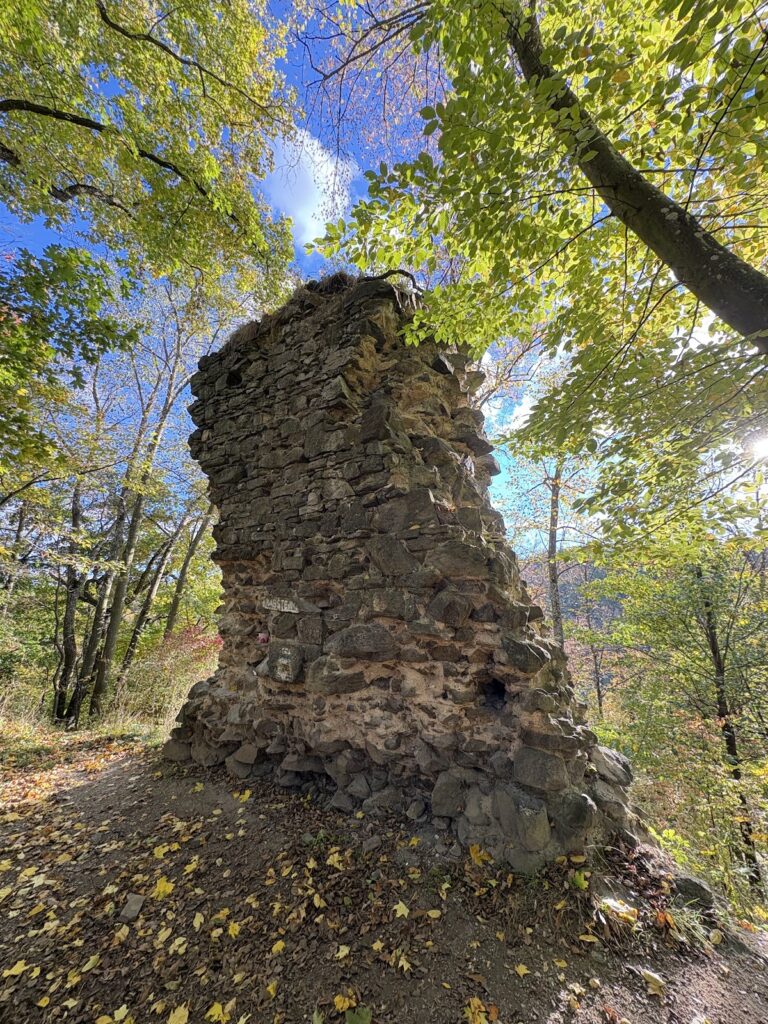
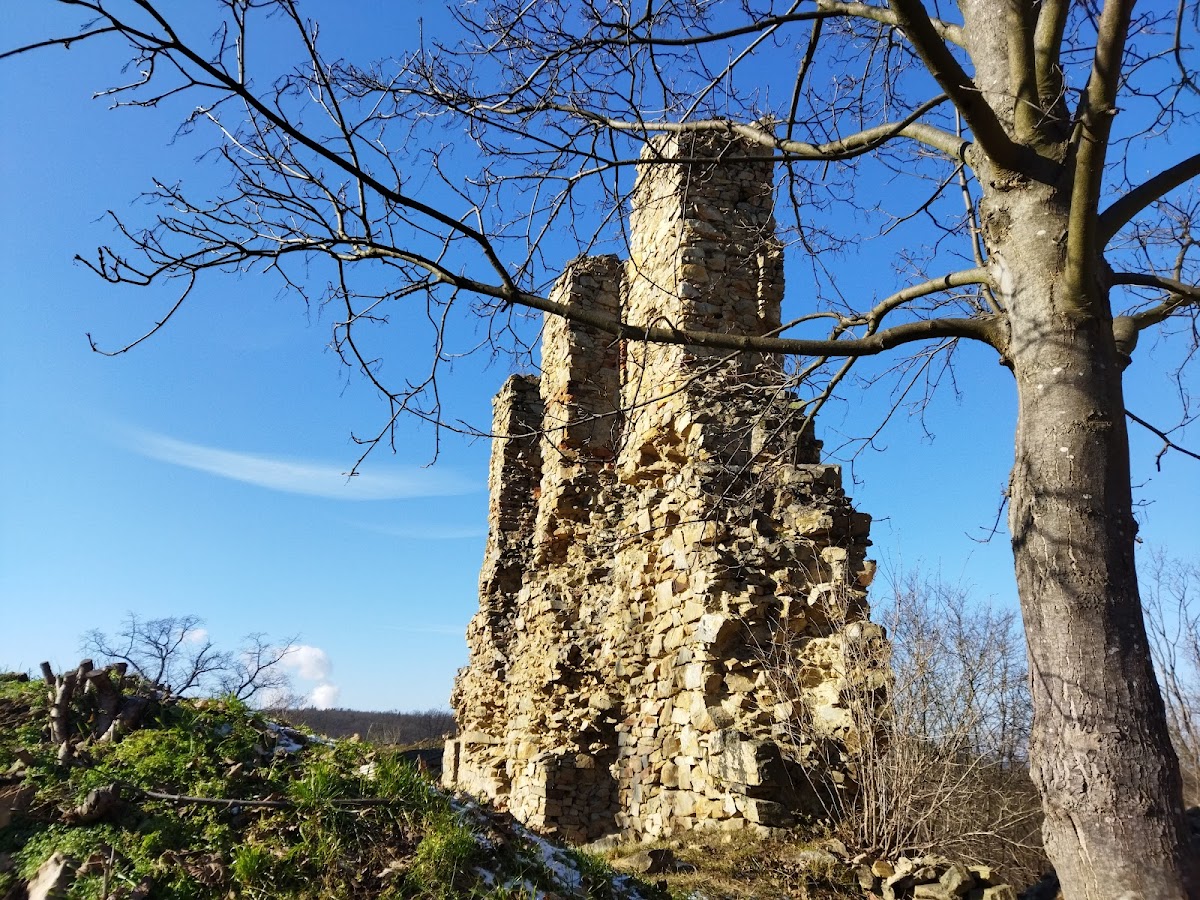
The surviving remains include the ruins of the palace, sections of the mantle fortification, the castle gate, a well, and the remains of a Gothic castle chapel. The palace belongs to the later residential development associated with the Lords of Leipa, while the chapel and enclosing defenses preserve elements of the castle’s medieval religious and military functions. The castle was constructed in the manner of English castles, within the wider Gothic architectural tradition.
Several metres of rubble cover the courtyards, and vegetation has damaged the masonry. Later conservation has therefore included the removal of vegetation and repairs to vulnerable structures. The surviving walls, gate, well, chapel remains, ditches, ramparts, and palace ruins together show the successive enlargement of the original Templar core and the continued rebuilding of the castle by later owners.
Nearby sites