Rabštejn Castle: A Medieval Fortress and Castle Ruin in Czechia


Site at a Glance
- Rating
- 4.5
- Popularity
- Very Low
- Country
- Czechia
- Primary era
- Medieval
- Eras represented
- Medieval
- Civilizations
- Holy Roman Empire
- Site type
- Military
- Remains
- Castle
On this page11 sections
History
Rabštejn Castle is a medieval fortress in Czechia, founded by the Lords of Janovice during the first half of the fourteenth century. Its first written mention dates to 1358, when Vok of Holštejn and Drslav of Šelmberk bought it from Pešík of Janovice. At that time, the Rabštejn estate consisted of the villages of Dukovany and Horní Dubňany.
Dynastic Transfers
After 1360, Rabštejn came into the possession of Jan Jindřich, a Luxembourg prince and Margrave of Moravia. A margrave was the ruling prince or governor of a border territory. The castle was intended for his son Jan Soběslav, but it instead passed to his younger son Prokop, who transferred it to his ally Hynek Jevišovský of Kunštát, known as the Dry Devil. Hynek was first recorded as Rabštejn’s lord in 1402.
Raiding and Destruction
Until his death in 1408, Hynek used Rabštejn as a base for raiding expeditions. His associate Vilém Sudlice of Litovany continued these activities, while further raids were attributed to Jindřich and Petr of Kunštát. Moravian nobles intervened against them in 1409.
During the Hussite Wars, the fifteenth-century religious and political conflicts in Bohemia and Moravia associated with the reform movement founded by Jan Hus, the Lords of Kunštát maintained a Hussite garrison at Rabštejn. Jan of Pernštejn supported a raiding band there until at least 1436, and the castle continued to shelter raiding groups afterward.
Because of this military use, the assembly at Velké Meziříčí decided in 1440 that Rabštejn should be bought out and demolished. An army of the Moravian estates captured and partly destroyed the castle in 1446. By 1476, Rabštejn was described as a demolished castle.
Protection and Archaeology
The remains near Dukovany in the Třebíč District of the Vysočina Region are protected as a cultural monument of the Czech Republic. Surface prospection, a non-invasive archaeological survey based on examining material visible on the ground, was carried out at the castle in 2017.
Remains
Castle Core
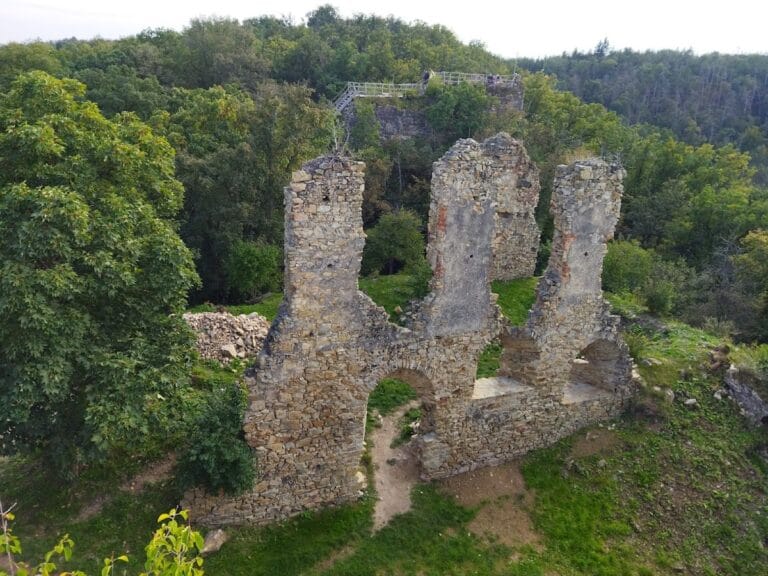
The rectangular castle core measures approximately 40 by 24 metres. Its plan probably included two principal palace buildings, a two-palace arrangement within the fortified centre. The surviving remains consist of small masonry sections and traces preserved in the terrain.
Palaces and Connecting Wall
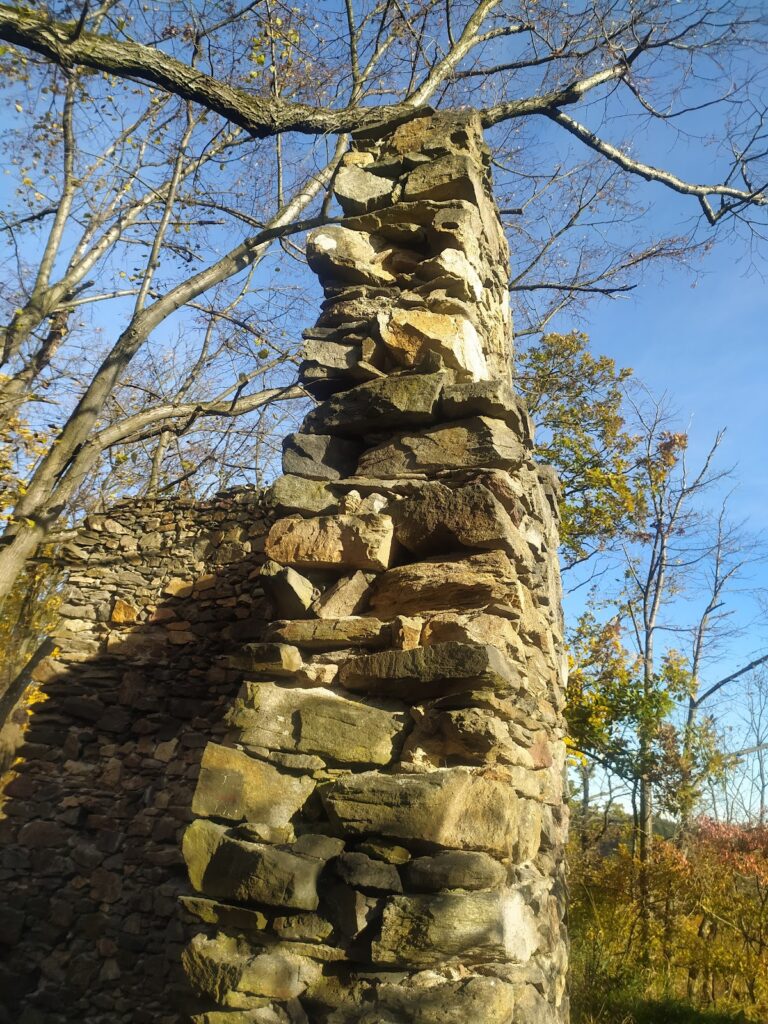
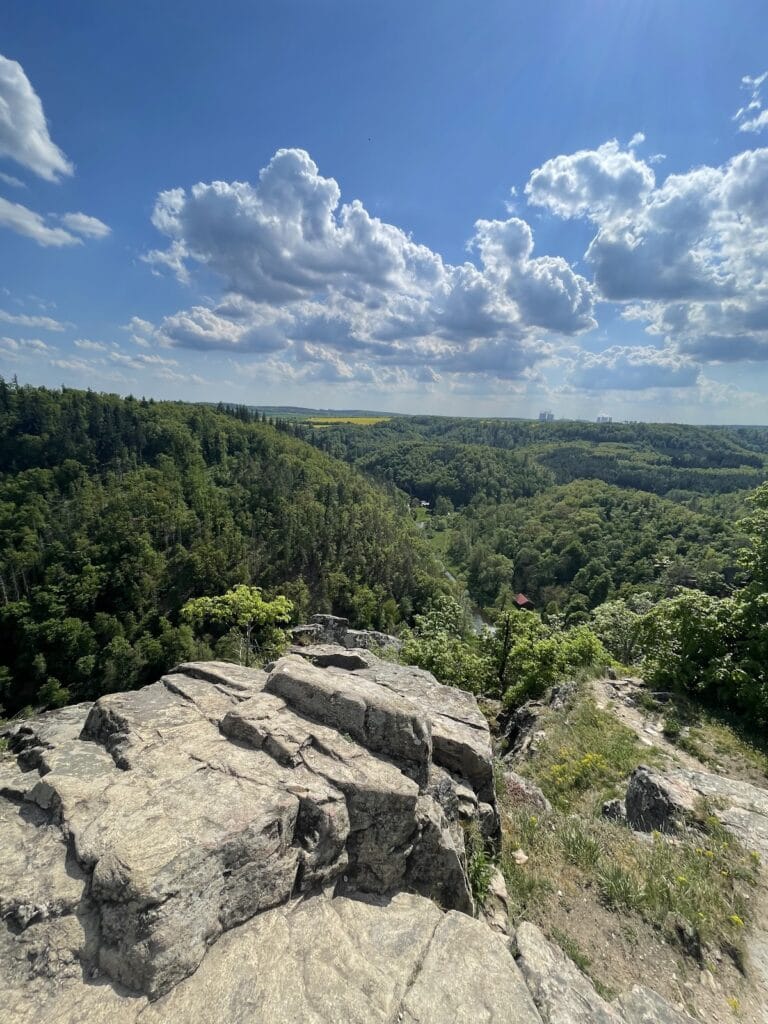
The rear palace was divided into two parts and now survives mainly as slight terrain traces with small sections of masonry. A second palace probably stood on a rock formation at the front of the core. The two buildings were joined by a wall approximately two metres thick, a short section of which remains on the southern side.
Outer Defensive Area
A zwinger, an outer defensive area between the main fortification and an external wall or earthwork, surrounded the castle core on three sides. Platforms on the northern and western outer sides were originally bordered by a wall and functioned as outer baileys, or fortified external yards. The gate to the northern outer bailey stood below the front palace.
Ditches and Eastern Fortifications
Castle Ditches
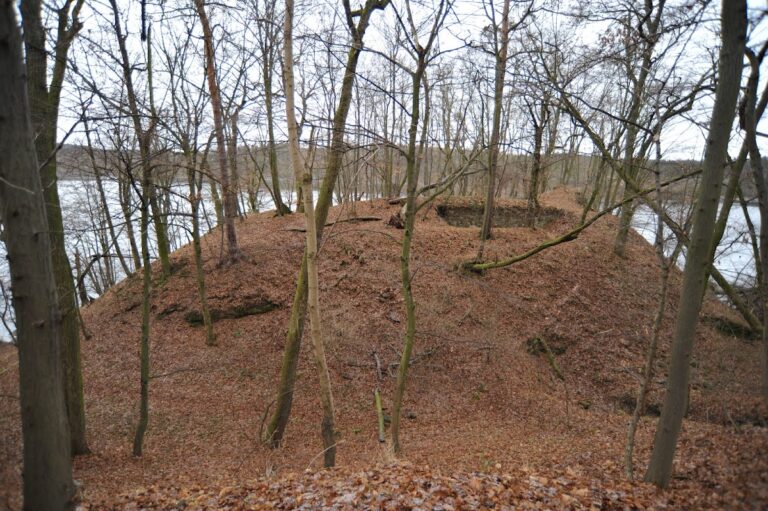
Ditches followed the side walls of the castle. On the eastern approach, the neck ditch, a defensive ditch cut across the narrower approach to a castle site, is approximately 19 metres wide.
Advanced Eastern Fortification
An advanced fortification was added east of the castle during the first third of the fifteenth century. It comprised an outer neck ditch, a platform, and then a pair of shallow ditches and banks. These earthworks probably protected a tower-like structure with a rounded eastern side, positioned at the edge of the inner neck ditch.
Rabštejn is now a castle ruin. Its surviving physical features include masonry fragments, earthworks, ditches, platforms, and banks. The 2017 surface survey recovered 42 ceramic fragments dating from the later fourteenth century and possibly extending into the fifteenth century.
Nearby sites