Waldeck Ruins: A Medieval Castle Complex in Germany


Site at a Glance
- Rating
- 4.4
- Popularity
- Low
- Country
- Germany
- Primary era
- Medieval
- External website
- Open
- Eras represented
- Medieval, Early Modern
- Civilizations
- Holy Roman Empire
- Site type
- Military
- Remains
- Castle
On this page7 sections
History
Waldeck Ruins are the remains of a medieval castle complex in Germany, at Stammheim near Calw. Built by the noble Waldeck family, the castle is generally assigned to the period from 1150 to 1250, although its exact construction date is uncertain. The oldest surviving building remains date from no earlier than around 1200. The site occupied a strategically elevated position above the Nagold valley and served as the seat of the Waldeck family.
The Waldeck Family and Regional Power
Ortwin von Waldeck was first mentioned in 1140. During the thirteenth century, the family expanded its territory and held a count-like social rank. Several grants of property to monasteries reflect their prosperity, which may also have been supported by the exploitation of nearby silver mines at Neubulach.
The family’s growing influence brought it into conflict with its overlords, the Counts of Hohenberg. Hohenberg forces besieged several Waldeck castles in 1279 and again in 1284. The second siege was supported by Rudolf of Habsburg, the medieval German king and a member of the Habsburg dynasty, and ended with the destruction of the castles.
Rebuilding and Later Ownership
After the destruction, Albrecht of Hohenberg acquired Waldeck Castle and rebuilt it. He appointed members of the Waldeck family as bailiffs, or local administrative officials. They secretly allied themselves with the lords of Baden and defeated the Hohenbergs in 1287, after which they became free nobles.
The extinction of Waldeck family lines in 1417 and 1553 transferred the castle to Württemberg. Historical records consistently described five castles on the same mountain, a claim that was long considered doubtful. Investigations around the ruins later established that three additional castles had existed on the western part of the rocky spur. A possible fifth castle may have been a separate tower on a rock in front of the western castle.
Several castle units were rebuilt after the destruction, but they had been abandoned by no later than the fifteenth century. The surviving Waldeck complex continued to expand and remained inhabited until the seventeenth century. It was probably finally destroyed in 1688 by French troops during the War of the Palatine Succession, a late-seventeenth-century European conflict involving France and several powers of the Holy Roman Empire. Eagle owls bred in the ruins until 1900.
Remains
Ridge and Castle Group
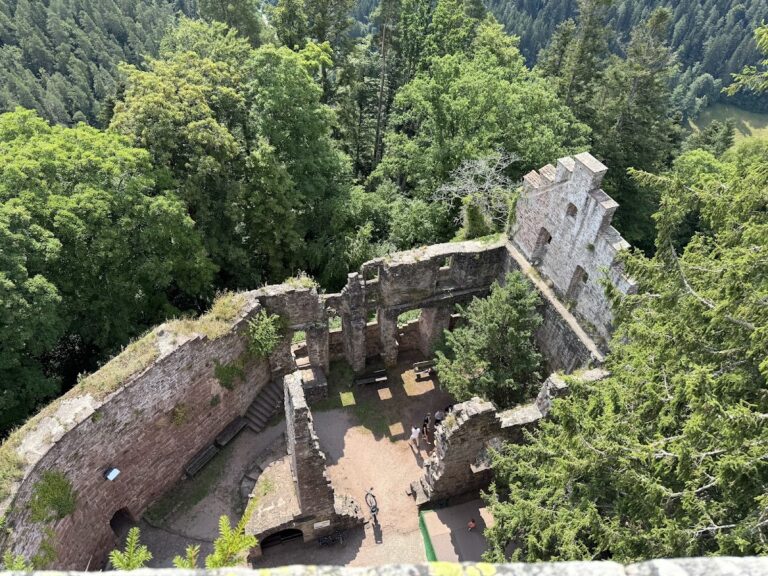
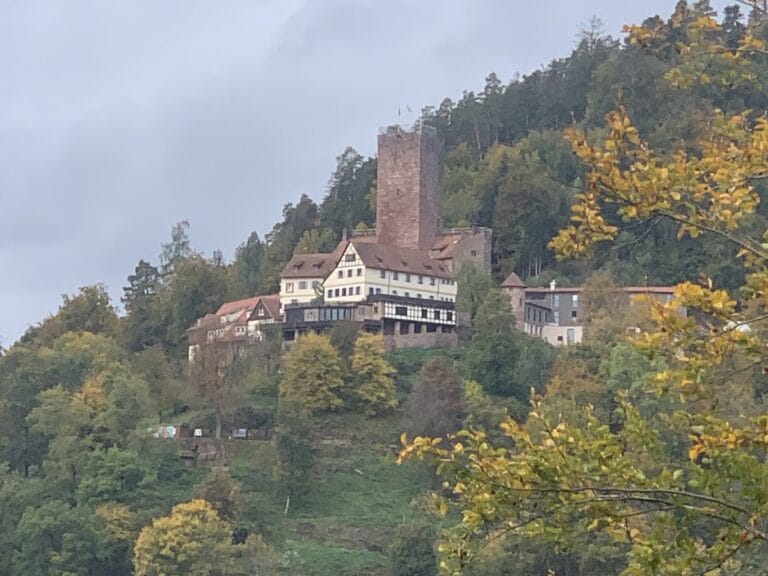
Waldeck Ruins form a group of spur castles, fortified sites built on a projecting ridge or rocky promontory, approximately 410 metres above sea level. The complex overlooks the Nagold valley and the small settlement of Kohlerstal near Calw. The main castle and its outer castles extend for about 180 metres along a rocky ridge. Bossed ashlar masonry, made from carefully cut stone blocks with projecting or roughly worked outer faces, appears across the complex. Forest partly covers the ruins, while a clearly defined structure remains visible.
Main Castle
The principal ruin occupies a central rock. It preserves a compact complex containing a residential building and a keep, probably constructed after the destruction of 1284. These remains form the central architectural core of the site and survive as part of the connected castle group.
Western Outer Castles
The three additional castles on the western part of the rocky spur survive mainly as foundation walls. Some sections retain bossed ashlar construction. Together with the central ruin, these outer castles form a connected complex, although only their foundations remain. Extensive outer works belong to several building phases of the Late Middle Ages and the early modern period.