Zavelstein Castle: A Württemberg Hill Castle in Germany


Site at a Glance
- Rating
- 4.7
- Popularity
- Medium
- Country
- Germany
- Primary era
- Medieval
- Eras represented
- Medieval
- Civilizations
- Holy Roman Empire
- Site type
- Military
- Remains
- Castle
On this page8 sections
History
Zavelstein Castle is a former Hohenstaufen hill castle in Germany, on the southeastern edge of Bad Teinach-Zavelstein. Traditionally dated to around 1200, it is now placed by archaeological evidence probably in the middle of the thirteenth century. The late Romanesque castle helped the counts of Württemberg maintain influence over newly acquired territories in the northeastern Black Forest.
Foundation and Württemberg control
The first documentary mention dates from 1303, when Richelin, a knight in Zavelstein, was probably living at the castle from about 1280. By 1311, Zavelstein was recorded as a Württemberg castle owned by the counts of Württemberg. Along with Neuenbürg, Calw, Fautsberg, Wildberg, and Nagold, it formed part of a network supporting Württemberg authority in the region.
During the fourteenth century, control of the castle repeatedly changed through feudal grants and debt agreements. In 1342, Paul of Giltlingen sold its fief, property held under feudal obligations, for 1,530 pounds of hellers to Count Götz of Tübingen. In 1345, Counts Ulrich IV and Eberhard II of Württemberg pledged Zavelstein as security for a debt of 5,000 pounds of hellers to Count Palatine William of Tübingen. William died without heirs in 1346, and the castle returned to Württemberg under the agreement. In 1365, it became a life interest for William’s brother, Götz of Tübingen, who gave it up the following year.
Changing pledges and aristocratic ownership
In 1367, Count Eberhard II of Württemberg, known as the Greiner, and his son Ulrich fled to Zavelstein after an ambush at Wildbad by the Martinsvögel, an aristocratic society. The financial difficulties of the House of Württemberg contributed to further changes in control. A deed from 1396 states that a pledge held by Gerhard of Straubenhardt had passed to his legal successors, Straub of Straubenhardt and Schimpf of Gültlingen.
In 1468, the revenues of Zavelstein Castle and the town were pledged for 2,600 guilders to Burkhard von Ehingen. The knightly family of Ehingen retained the ownership rights until 1552, when Duke Christopher of Württemberg redeemed the pledge from Hans von Ehingen. The castle was damaged but not occupied during the Peasants’ War, a major uprising of rural communities in the German lands, in 1525.
Repairs and transformation into a palace
In 1554, Jordan of Braitenbach of Roßnitz received Zavelstein as a fief and repaired the castle complex between 1554 and 1589. Construction accounts record expenditure of 3,500 guilders. After his death in 1593, his widow Agnes von Braitenbach probably continued to live there.
Following Agnes’s death in 1612, Duke John Frederick of Württemberg granted the fief to Baron Benjamin Buwinghausen von Wallmerode. The baron purchased Zavelstein in 1620 and began extensive building work that continued until 1630, changing the medieval castle into a palace. The complex was plundered in 1634 after the Battle of Nördlingen, a major conflict of the Thirty Years’ War.
Benjamin Buwinghausen von Wallmerode died of the plague in Stuttgart in 1635. His son Jakob Friedrich then took possession of the property and later became Obervogt of Calw, a high Württemberg administrative and judicial official. He became particularly associated with witch trials. In 1686, Eberhard Friedrich Buwinghausen inherited the estate and his father’s offices.
Destruction and conservation
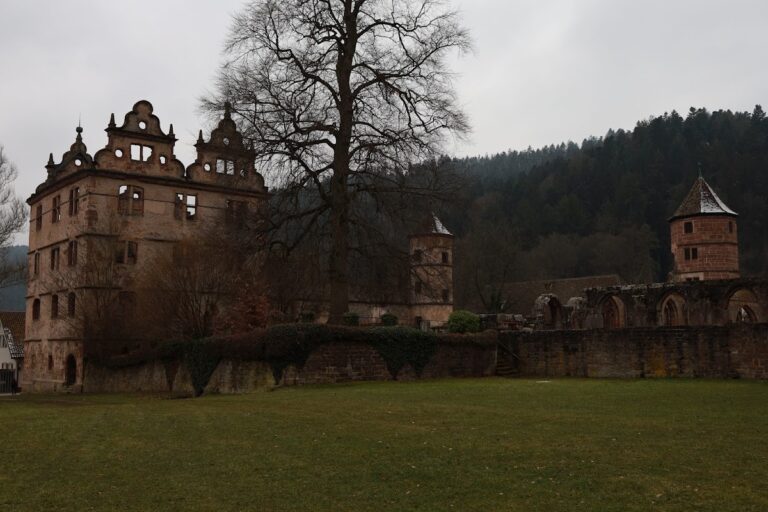
After French troops under Melac destroyed Hirsau and Calw, they destroyed Zavelstein in 1692. Only a few parts of the palace remained habitable, and the Buwinghausen family abandoned it. Eberhard Friedrich Buwinghausen sold the property in 1710 to Duke Eberhard Ludwig of Württemberg for 20,000 guilders. The palace was not rebuilt and remained a ruin.
The stairs inside the bergfried, the principal defensive and lookout tower of a medieval German castle, were renewed in 1844. The tower has served as a viewing tower since then. Conservation work at the ruins was accompanied by archaeological investigations in 1991.
Remains
Hilltop setting and surviving enclosure
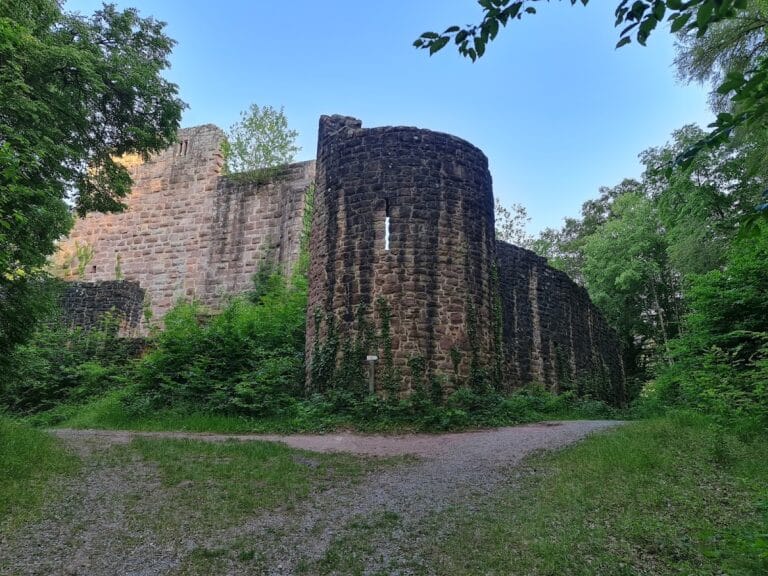
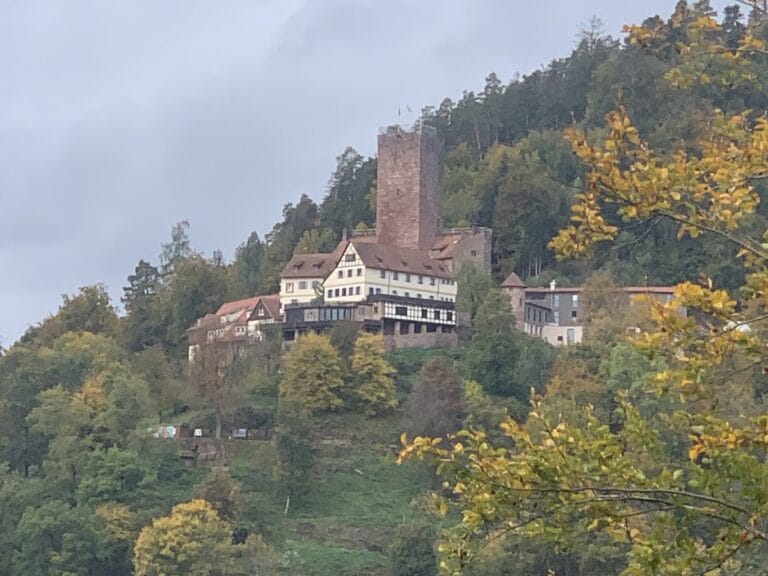
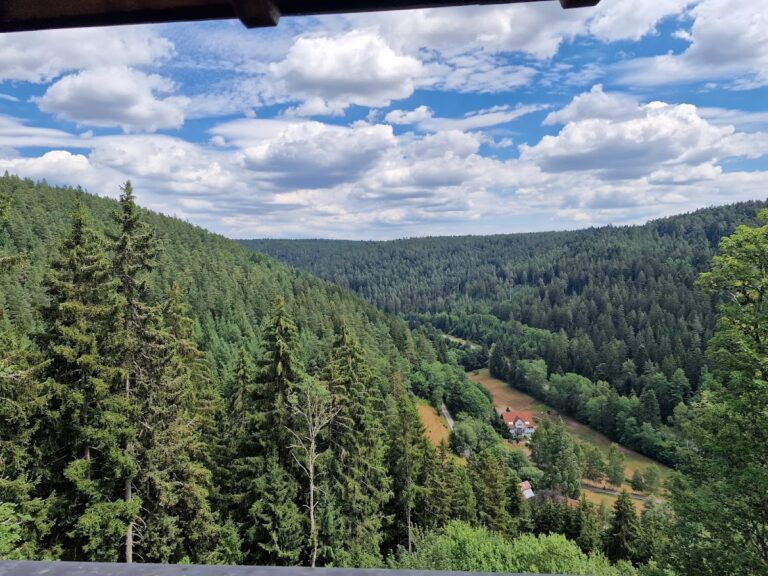
The ruins occupy a hill spur above the Teinach valley at an elevation of 560 metres above sea level, on the southeastern edge of Bad Teinach-Zavelstein in the county of Calw, Baden-Württemberg. The castle stood in a settlement setting and was formed as a hill castle. Only the late Romanesque inner ward survives as the principal medieval core.
Two neck ditches cut across the approach to the spur. A neck ditch is a defensive ditch designed to isolate a hilltop position from the surrounding ground. The surviving defensive layout also includes the gate complex, parts of the shield wall, and additional remains of the enceinte, the enclosing defensive wall, and the zwinger, an outer defensive enclosure or passage between fortification lines.
Tower and palace remains
The bergfried survives to a height of 28 metres. Its renewed stairs provide access within the preserved tower, which has been used as a viewing tower since 1844. The ruins also include the remains of the palas, the castle’s main residential and representative building, together with a vaulted cellar. These features belong to the surviving architectural fabric of the castle and its later palace transformation.