Schloss Dätzingen: A Johanniter Castle in Grafenau, Germany


Site at a Glance
- Rating
- 4.5
- Popularity
- Low
- Country
- Germany
- Primary era
- Early Modern
- External website
- Open
- Eras represented
- Early Modern, Modern
- Civilizations
- German, Holy Roman Empire, Knights Hospitaller
- Site type
- Domestic
- Remains
- Castle
On this page9 sections
History
Johanniter origins and eighteenth-century expansion
Schloss Dätzingen is a castle in Germany, located in the Dätzingen district of Grafenau. The Johanniter Order, the medieval religious and military Order of St John later associated with Malta, acquired Dätzingen in the thirteenth century. A brotherhouse on the site of the present castle was recorded in 1263. An earlier medieval water castle has been suspected, but its existence remains unconfirmed.
The first castle buildings were erected in 1607. In 1733, the complex was expanded into its present four-wing arrangement. During the eighteenth century, it served as the residence of the commander of the order. The early Neoclassical Maltese Hall was created in 1780, reflecting the castle’s continuing connection with the order.
Württemberg ownership and nineteenth-century alterations
The Imperial Deputation Main Conclusion of 1803 reorganized territories within the Holy Roman Empire and redistributed ecclesiastical lands. In its aftermath, Dätzingen was assigned to the Kingdom of Württemberg. In 1810, King Friedrich I, the first king of Württemberg, gave the castle to Count Carl Ludwig von Dillen.
A few months later, Friedrich I held a three-week hunt in the forests around Dätzingen. More than 4,000 people took part, and the king stayed at the castle during the event. To commemorate it, von Dillen commissioned the Paris manufactory Jacquemart & Bénard to produce the panoramic wallpaper Les Chasses de Compiègne.
Alterations by the court architect Nikolaus Friedrich von Thouret, especially to the portico between 1810 and 1812, established much of the castle’s present external appearance. A portico is a roofed entrance porch supported by columns.
Municipal ownership and conservation
Adrienne von Bülow, a descendant of the Dillen family, sold the castle to the municipality of Grafenau in 1961. The Sindelfingen Local History Museum then acquired furnishings, paintings, and the wallpaper, which had been removed in separate pieces. The furnishings and paintings returned to the castle in 1998.
External and internal renovation took place from 2009 to 2011. In 2019, the 18 wallpaper strips damaged during improper removal were transferred to the Stuttgart restorer Thomas Wieck. He conserved and restored them and reassembled the strips. The municipality of Grafenau owns the castle, which houses a local history museum, a gallery, an auction house, and an antiquarian bookshop.
Remains
Plan and exterior
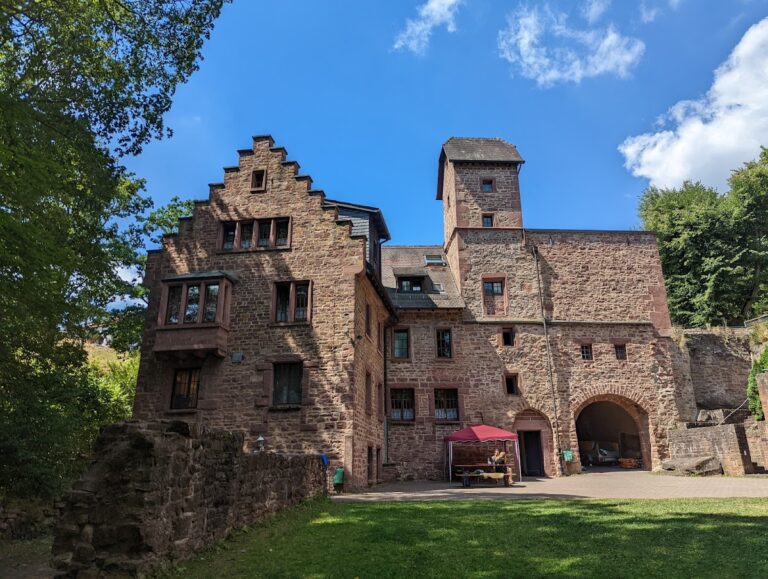
Schloss Dätzingen is a four-wing, two-and-a-half-storey complex arranged around an inner courtyard. Its exterior is predominantly Classical in design. The portico, altered between 1810 and 1812 by Nikolaus Friedrich von Thouret, is a particularly important element of the building’s present appearance.
Interior rooms and decorative features
Maltese Hall
The Maltese Hall dates from 1780 and represents an early Neoclassical interior. Its decoration includes battle scenes and images of the establishments of the Order of Malta. Seven restored strips of Les Chasses de Compiègne were installed on mobile wooden frames in the vestibule of the hall.
Les Chasses de Compiègne
The panoramic wallpaper depicts an aristocratic hunting party in the forests of Compiègne through four episodes. Carle Vernet designed it in 1812. It is regarded as the first panoramic wallpaper produced by Jacquemart & Bénard and the earliest hunting wallpaper of its kind.
A panoramic wallpaper is a large decorative wall covering made from sequential printed scenes that form a continuous visual cycle. The Dätzingen work was assembled from individual paper sheets into 25 strips, each approximately 55 centimeters wide and 250 centimeters long. Woodblocks printed the scenes, with a separate block used for each color.
Four examples of this panoramic wallpaper are preserved. The Dätzingen example is the only one in Germany and the only one preserved in complete form. Seven strips were restored and installed in the vestibule of the Maltese Hall, while the remaining 18 strips, damaged during removal, were kept rolled up until their conservation, restoration, and reassembly in 2019.
Nearby sites