Visconti Castle: A Ducal Residence and Fortress in Abbiategrasso


Site at a Glance
- Rating
- 4.3
- Popularity
- Medium
- Country
- Italy
- Primary era
- Medieval
- External website
- Open
- Eras represented
- Medieval
- Civilizations
- Duchy of Milan, Holy Roman Empire
- Site type
- Domestic
- Remains
- Castle
On this page9 sections
History
Visconti Castle is a medieval castle in Abbiategrasso, Italy, whose origins reach back to an eleventh-century fortification and whose later enlargement created a Visconti residence linked to the political history of Milan. Its development began on the site of an earlier stronghold near a Benedictine monastery and continued through successive phases of military use, ducal occupation, decline, and civic reuse.
Early Fortification and Visconti Enlargement
The earliest evidence for a castle at Abbiategrasso appears in the eleventh century, when Archbishop Ariberto da Intimiano referred to a fortification in the settlement in his will. In 1167, Frederick Barbarossa, the German king and Holy Roman Emperor who intervened militarily in northern Italy, attacked and conquered the castle. It remained under the authority of the Archdiocese of Milan until the death of Archbishop Giovanni Visconti, after which it passed to the Visconti family.
The castle occupied the site of an earlier fortification called Castro Margazario. The Visconti substantially enlarged and restored the stronghold. Azzone Visconti, Lord of Milan, initiated this process, while Gian Galeazzo Visconti, later the first Duke of Milan, ordered major works in 1381 or 1382. These interventions helped establish the quadrangular arrangement associated with Visconti castles and prepared the complex for a role that extended beyond local defense.
A Residence of the Milanese Dynasties
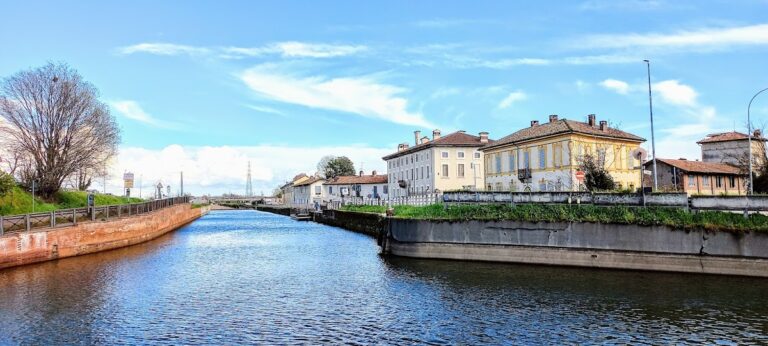
Filippo Maria Visconti, Gian Galeazzo’s son and successor, restored and embellished the castle in 1438. Its position beside the Naviglio Grande, a major historic canal in the Milanese waterway system, made it readily accessible from Milan by water. As its defensive importance declined, this accessibility helped turn the castle into a favored country residence.
During the fourteenth and fifteenth centuries, the castle was used by duchesses of Milan from the Visconti and Sforza houses. Bianca of Savoy and Beatrice of Tenda spent summers there, and the interiors were adapted to a more refined residential function. Agnese del Maino, Filippo Maria Visconti’s mistress, maintained a residence at Abbiategrasso as an alternative to Cusago. Their daughter, Bianca Maria Visconti, grew up at the castle.
The Sforza family, descended from Bianca Maria Visconti and Francesco Sforza, continued to favor the complex because of its connections with the earlier ruling dynasty. Bona of Savoy lived there after her marriage to Galeazzo Sforza in 1468 and made the castle her permanent residence as a widow in 1480. Her son, Gian Galeazzo Sforza, Duke of Milan, was born there in 1469.
Military Decline and Civic Reuse
From the fifteenth century until 1635, the castle remained involved in the political life of the Duchy of Milan. After the Visconti-Sforza period, it again served as a stronghold, particularly during the Italian Wars of 1494–1559, a period of conflict over control of Italy. Its military role later became a liability. During the seventeenth century, the castle was progressively dismantled to prevent it from falling into French hands during wartime. Three towers and the southern wing were demolished, while the fourth tower was reduced in height.
The surviving complex remained a private residence until the 1860s, when it passed into municipal ownership. It was first adapted as a school and later became the headquarters of local associations. Comprehensive restoration in 1995 recovered historic frescoes and graffiti and accompanied the creation of the civic library named for Romeo Brambilla. The surviving portion is owned by the Municipality of Abbiategrasso and now accommodates municipal offices and the city council.
Remains
Plan and Construction
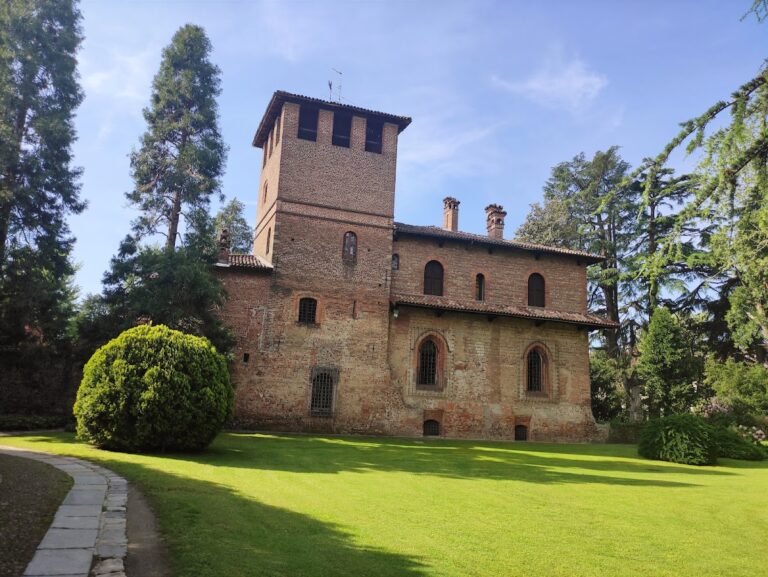
Visconti Castle has a quadrangular plan enclosed by a moat, with a tower originally placed at each corner. Its position was aligned with the Naviglio Grande and with the road between Milan and Vigevano. The castle was also situated between the Naviglio Grande and the Ticino. Inside, the complex was arranged around a courtyard with a portico, an early expression of the quadrangular plan that became characteristic of Visconti castles.
Brick forms the principal building material. Stone was reserved for structural and decorative details, including the slender columns dividing the lights of the mullioned windows, the projecting brackets that support parts of the structure, and the Biscione, the serpent emblem of the Visconti family, displayed on the facade above the former entrance. Successive owners altered and consolidated the complex over the centuries, so the present structure differs substantially from the original castle.
Residential Decoration
Brightly colored frescoes gave the castle an appearance suited to an elegant country residence as well as a fortified building. Original paintings from different periods survive in the courtyard and in some interior rooms. The historic decorative scheme also includes the Visconti motto A bon droit, meaning approximately “with good right.” Renaissance-style mullioned windows and the interior frescoes reflect the changes made when the complex served the Visconti and Sforza households.
Surviving Defensive Features
The southern wing and three of the four corner towers have been lost, while the remaining tower survives in truncated form. The former ramparts were removed to make room for the new railway station. The surviving portion is in good condition, with restored or recovered traces of its historic decoration. Prisoners’ graffiti remains visible on the uppermost floor of the east wing, which was formerly used as a prison.
Civic Functions
The castle’s surviving spaces now contain the civic library, municipal offices, and the city council. These uses occupy the portion that endured after the seventeenth-century dismantling and the later changes made under municipal ownership.