Nideck Castle: A Medieval Hilltop Fortress in France


Site at a Glance
- Rating
- 4.4
- Popularity
- Low
- Country
- France
- Primary era
- Medieval
- Eras represented
- Medieval
- Civilizations
- Holy Roman Empire
- Site type
- Military
- Remains
- Castle
On this page8 sections
History
Nideck Castle, known locally as Château du Nideck, is a medieval hilltop fortress in France, about five kilometres northwest of Oberhaslach. Built by medieval lords in the twelfth or thirteenth century, it formed two fortified complexes above the Hasel Valley, with the upper castle dating architecturally to around 1200.
The upper castle and early records
The fortress first appears in written evidence in 1262, on the seals of Günther, a burgrave, meaning a medieval official responsible for administering and defending a castle or fortified town. Günther was a follower of the Bishop of Strasbourg. A charter from 1264 identifies Burchard, burgrave of Nideck, as the castle’s owner.
A second fortress, known as lower Nideck, was recorded below the original castle in 1336. It belonged to the Bishopric of Strasbourg as a fief, a landholding granted in return for service, and was held by the landgraves of Lower Alsace. A landgrave was a territorial lord whose authority ranked broadly alongside that of a count.
Conflict, shared lordship, and decline
During the fourteenth and fifteenth centuries, Nideck changed hands among regional lords during periods of conflict and brigandage. The Counts of Leiningen held part of the castle in the first half of the fourteenth century. By the late fourteenth century, it had become a shared lordship held by several lesser nobles from Strasbourg. Such a jointly held castle, known as a shared lordship, divided rights of possession and administration among noble families.
Strasbourg forces besieged Nideck in 1448. In 1454, Ludwig of Lichtenberg conquered the fortress, which was then described as a nest of robber knights. The Müllenheim family held the castle until 1509. Its remote position probably caused it to lose its practical function and fall into abandonment during the fifteenth century. Fire finally destroyed the castle in 1636.
Memory and preservation
The castle’s legend became part of the folklore of Alsace. In 1816, the Brothers Grimm recorded a story in which a family of giants lived at Nideck. Their daughter descended to the plain, mistook people for living toys, and learned from her father that they were men who cultivated the land to feed the giants. The tale inspired Adelbert von Chamisso’s poem The Giant’s Daughter. A memorial plaque above the tower entrance commemorates Chamisso.
The ruins have been protected as a French monument historique since December 1898. The listed property consists of the remains, which are owned by the French state.
Remains
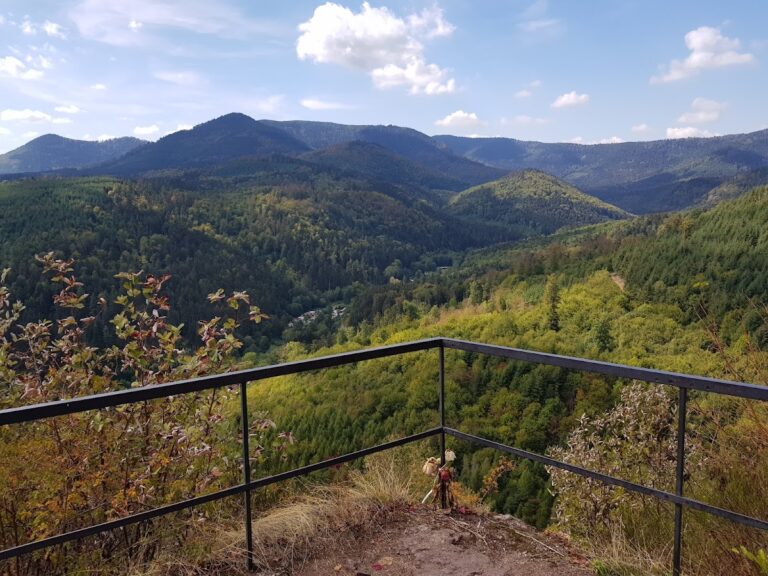
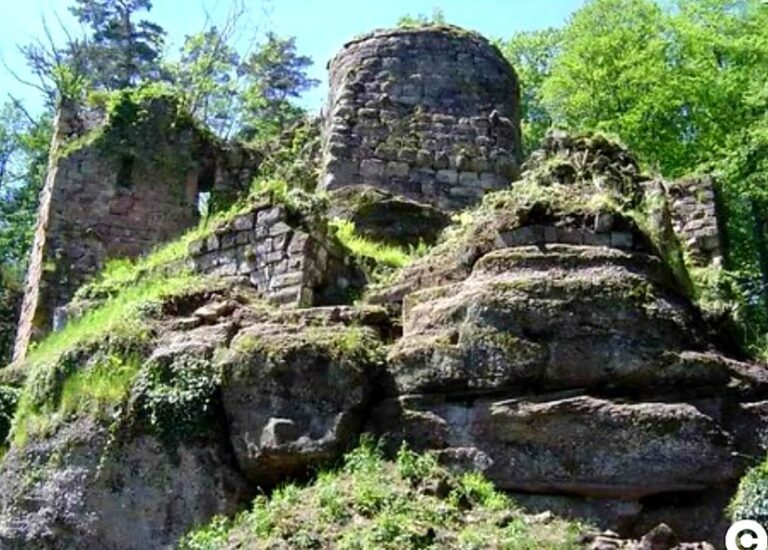
The ruins occupy a steep rhyolite outcrop on the slope of the Bärenberg, at an elevation of about 550 metres above the Hasel Valley. Rhyolite is a hard volcanic rock that can form steep, defensible outcrops. The two parts of the fortress, Ober-Nideck and Unter-Nideck, stand above the 25-metre-high Nideck Waterfall, which lies immediately below the castle.
The two fortified complexes
Ober-Nideck
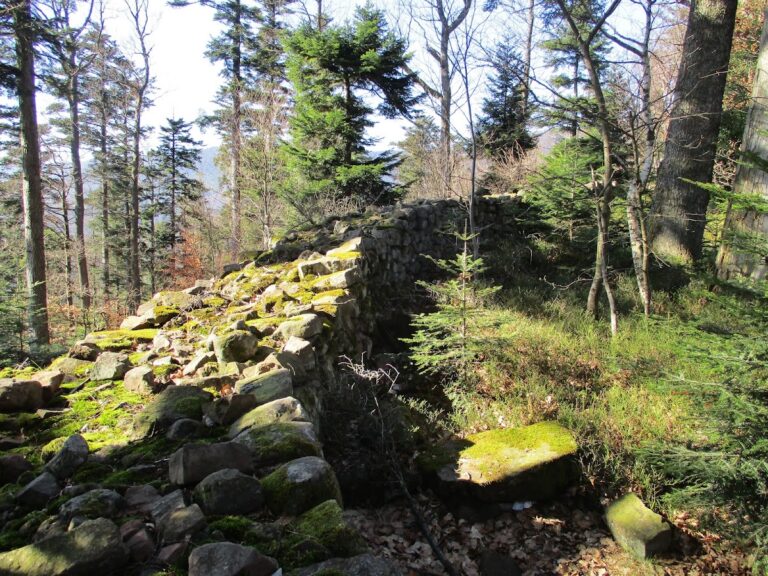
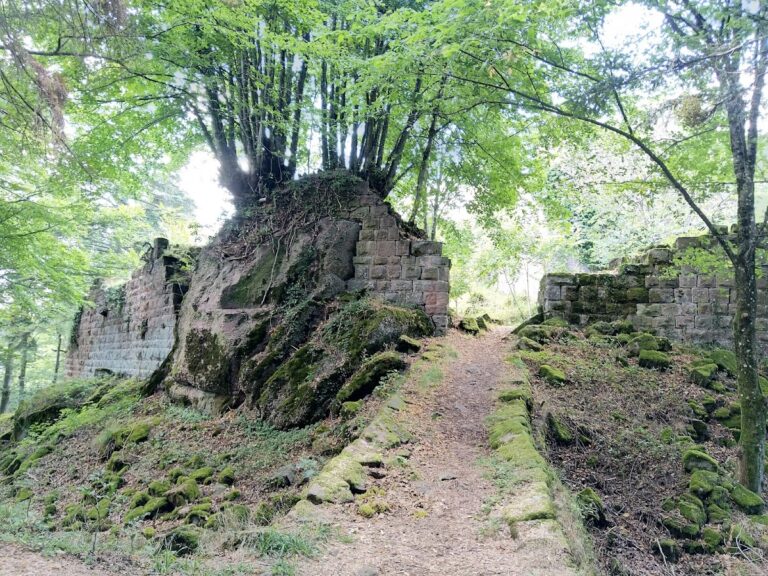
The upper castle, or Ober-Nideck, was probably constructed around 1200. Its surviving fabric includes part of a shield wall, a particularly strong section of an enclosing wall intended to protect a vulnerable side of a fortification. This wall is built from rusticated stone blocks with projecting outer faces that create a roughly textured surface. The upper castle also retains a residential tower and sections of its enclosing walls.
Unter-Nideck
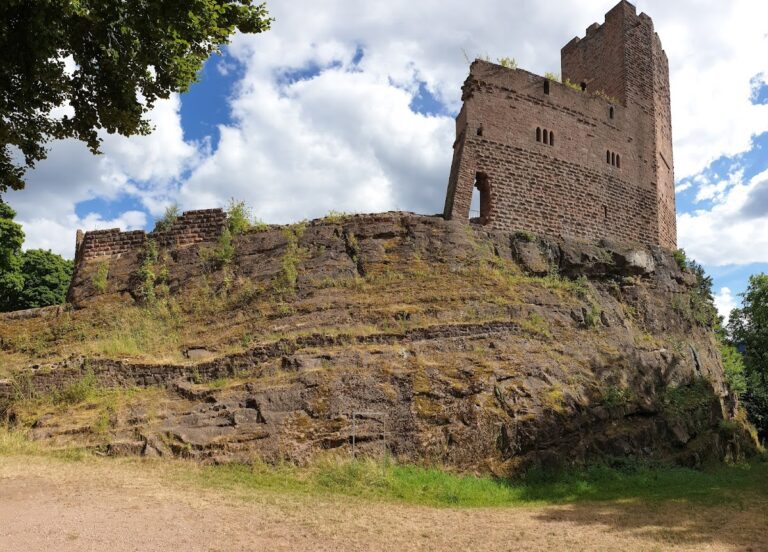
The lower castle, or Unter-Nideck, was built by the burgraves after 1260 in the Early Gothic style. Its surviving square keep rises approximately 20 metres. Together with the remains of the upper castle, it preserves the division of Nideck into two distinct fortified parts. The castle survives today as ruins.
Nearby sites