Château de Chouvigny: A Medieval Fortified Castle in France

Site at a Glance
- Rating
- 4.2
- Popularity
- Low
- Country
- France
- Primary era
- Medieval
- External website
- Open
- Eras represented
- Medieval
- Civilizations
- French
- Site type
- Military
- Remains
- Castle
On this page8 sections
History
Château de Chouvigny is a former medieval fortified castle in Chouvigny, France, built in 1250 by Guillaume I de Chauvigny in the military architecture of the medieval period. It stands above the Sioule valley and may occupy the site of a Gallo-Roman castrum, a fortified settlement associated with Roman rule. The older name Calviniacum is traditionally linked with the origin of “Chouvigny.”
The Chauvigny and La Fayette families
The castle was the original seat of the Chauvigny family. Through a marriage alliance in the thirteenth century, the family became known as Chauvigny de Blot. At the beginning of the fifteenth century, the property passed by marriage to the Montmorin family. In 1543, the marriage of Françoise de Montmorin to Jean Motier de La Fayette, lord of Hautefeuille, transferred the castle to the La Fayette family.
During the seventeenth century, Château de Chouvigny belonged to François de La Fayette, the great-grandson of Jean Motier de La Fayette. His wife, Madame de La Fayette, a French aristocrat and writer known for The Princess of Cleves, stayed at the castle.
From hunting lodge to restored residence
During the Second Empire, the French imperial regime of Napoleon III from 1852 to 1870, the castle belonged to Charles de Morny, Duke of Morny and an influential statesman of the period. He converted it into a hunting lodge.
In the early 1930s, the engineer Jean-Louis Rufenacht and his wife Madeleine acquired the castle with the intention of converting it into guest rooms. The extensive work required and the circumstances of the period led them to abandon the project, and the property was sold again in 1945. After years of abandonment, it was restored around the middle of the twentieth century and underwent further restoration during the 1960s by an enthusiast of medieval history and architecture. Pierre and René Séverac owned it from the 1990s into the 2000s, and Valérie and Jacques Beyssade bought it in 2010. The castle remains privately owned and does not hold the French monument historique designation, a protected heritage status for sites of historical or architectural importance.
Remains
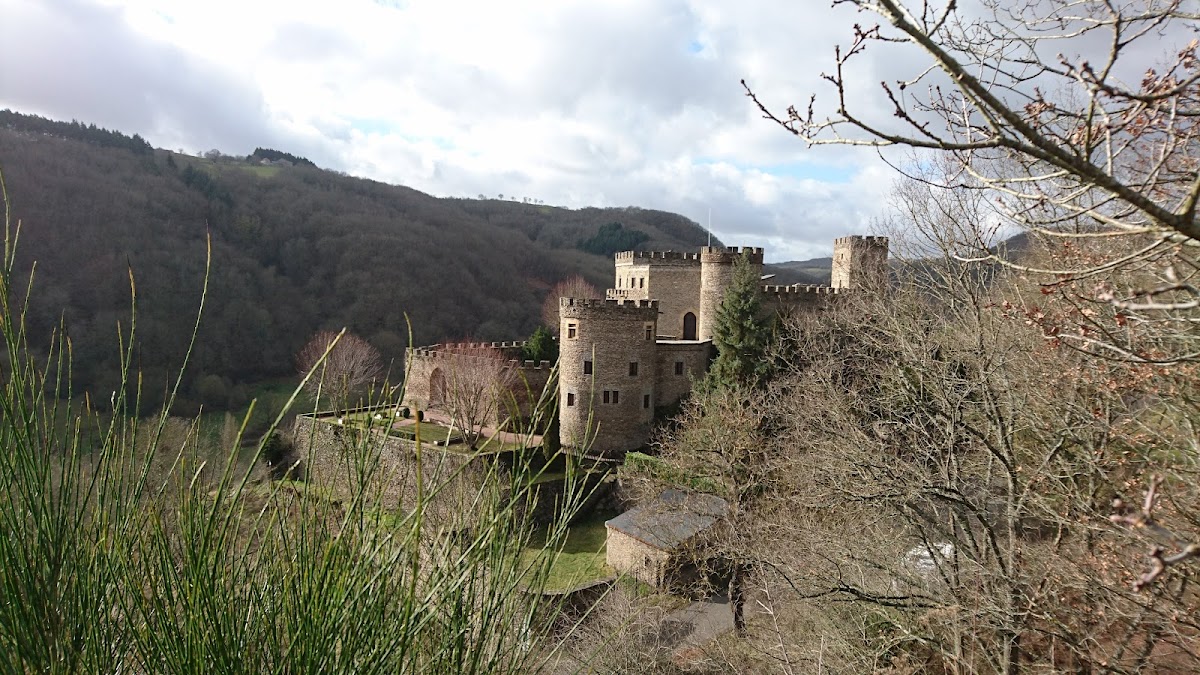
Château de Chouvigny occupies a rocky spur about 80 metres above the Sioule valley, where the Chouvigny gorges widen. The castle lies approximately 300 metres southeast of Chouvigny, in a valley crossed by a route toward Auvergne. The road rising from the Sioule toward the town passes behind the castle and reaches its entrance. Deep cuts in the terrain on both sides place the structure beyond the effective range of medieval artillery that hurled projectiles, even though the surrounding plateaus rise above it.
Fortifications and defensive features
The complex follows the form of a medieval military stronghold. A thirteenth-century cylindrical keep protects the seigneurial buildings arranged in a line behind it. The watchtower retains well-preserved fish-tail-shaped arrow slits, while a cavalry courtyard forms part of the fortified layout.
Residential and religious buildings
Seigneurial lodgings
The seigneurial lodgings, the residential quarters of a feudal lord, are arranged behind the keep. They contain a collection of medieval weapons and armour, linking the domestic part of the complex with its military character.
Oratory and ceremonial rooms
An oratory, a small chapel or private place of prayer, forms part of the complex alongside an honour salon. The castle also includes a treasury tower and several terraces overlooking the Sioule valley.