Castello di Rosciano: A Historic Castle Site in Italy

Site at a Glance
- Rating
- 4.8
- Popularity
- Medium
- Country
- Italy
- Primary era
- Unclassified
- External website
- Open
- Eras represented
- Unclassified
- Civilizations
- Unclassified
- Site type
- Military
- Remains
- Castle
On this page8 sections
History
Castello di Rosciano is a historic castle site in Italy, located in the Signoria hamlet of Torgiano. It occupied a place used during the Etruscan and Roman periods before becoming a fortified medieval settlement. The castle was destroyed by Totila, an Ostrogothic king during the sixth-century Gothic War in Italy, in 548, yet it was later regarded as impregnable during the Middle Ages.
Early Records and Lordship
The locality appears under several names, including Russanum, Rescanum, Recsano, and Rusciano. Its first recorded mention dates to 18 February 1038, when Conrad II, a German king and Holy Roman Emperor, confirmed the possessions of the Tifernate monastery of the Holy Sepulchre. These possessions included the church of Sant’Angelo in Rusciano, which then lay within the territory of Assisi.
Frederick II, the thirteenth-century Holy Roman Emperor, later granted the locality to the Scifi counts of Sassorosso. Control subsequently passed through the Tancredi, Signorelli, Graziani, Baglioni, and Ansidei families before Rosciano became part of the Papal States, the territories governed by the papacy in central Italy.
Religious and Communal Rivalry
In 1266, the body of Saint Crispolto was transferred from the abbey of Passaggio di Bettona to Rosciano. From the thirteenth century until 1521, Sant’Angelo di Rosciano served as the seat of a Camaldolese priory, a small religious house belonging to a branch of the Benedictine tradition, dependent on the abbey of Sansepolcro.
Perugia began constructing the castle of Torgiano in 1274 as an outpost in the territory of Bettona. This development intensified the rivalry between Rosciano and Torgiano, and armed clashes broke out between their inhabitants in September 1277.
Jurisdiction and Destruction
In 1378, Pope Urban VI confirmed Perugia’s direct jurisdiction over Rosciano for twenty years. Tello, the lord of the castle, refused to submit and surrendered in 1383 to Guglielmo di Carlo Fiumi, the gonfaloniere of Assisi, a medieval civic or military official who acted under a communal banner. Urban VI’s successor, Pope Boniface IX, subsequently granted the castle to Tello.
Perugian forces captured Rosciano in 1384 and destroyed the castle down to its foundations. This ended the fortified community’s medieval political and military role.
Remains
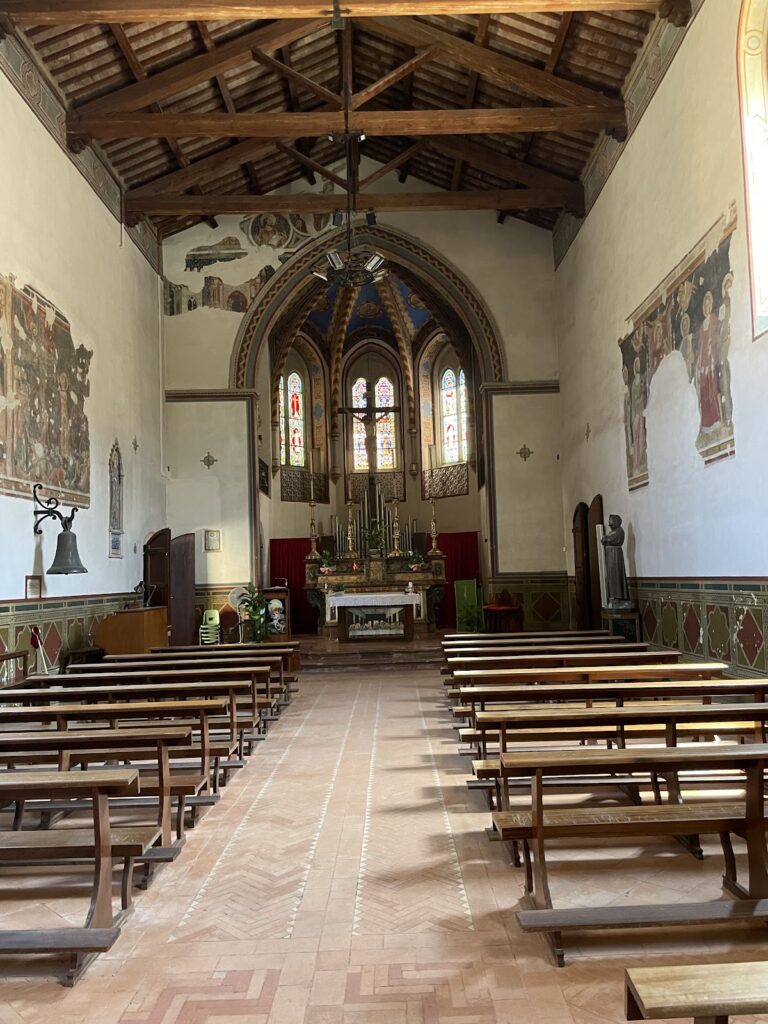
Castello di Rosciano occupies a site whose historical layers extend from Etruscan and Roman occupation to the medieval castle. The physical history of the place is closely connected with Sant’Angelo di Rosciano, the church associated with the locality and with its former religious priory.
Castle Site and Religious Building
Castle Site
The castle stood on ground already used in the Etruscan and Roman periods. Its later fortification formed the physical setting for Rosciano’s medieval authority and for its conflicts with Perugia and Torgiano. The castle was destroyed in 548 and again reduced to its foundations in 1384.
Sant’Angelo di Rosciano
Sant’Angelo di Rosciano is the church explicitly linked with the locality. It was included among the possessions confirmed in 1038 and later housed the Camaldolese priory dependent on Sansepolcro. Its association with the priory continued from the thirteenth century until 1521, giving the site an enduring religious dimension alongside its fortified history.