Basilica of Santa Maria degli Angeli: The Franciscan Sanctuary at the Porziuncola
Site at a Glance
- Rating
- 4.8
- Popularity
- Very High
- Country
- Italy
- Primary era
- Early Modern
- External website
- Open
- Eras represented
- Medieval, Early Modern, Modern
- Civilizations
- Italian, Papal States
- Site type
- Religious
- Remains
- Basilica
On this page21 sections
History
The Basilica of Santa Maria degli Angeli is a Roman Catholic papal minor basilica in Italy, built around the small Porziuncola church at Santa Maria degli Angeli. Commissioned by Pope Pius V and Bishop Filippo Geri, it was constructed between 1569 and 1679 in the late sixteenth-century religious and architectural climate shaped by the Council of Trent. The basilica protects places associated with Saint Francis, including the Porziuncola, the Chapel of the Transito, and the Rose Garden, while providing space for the many pilgrims drawn to the sanctuary.
The Franciscan sanctuary before the basilica
The Porziuncola was central to the early Franciscan movement, the religious tradition founded by Saint Francis and centred on poverty, preaching, and service. Francis repaired and used the small church, recognized his vocation there, gathered his first companions for prayer, and received Saint Clare. Clare, who later founded the Poor Clares, made her religious profession at the Porziuncola during the night of 18 to 19 March 1212. The church also became associated with the Pardon of Assisi, the indulgence traditionally linked with the sanctuary.
After Francis died in 1226, the friars built small huts around the Porziuncola. A refectory and adjoining buildings followed in 1230, with porticoes and accommodation for visiting friars added over time. The growth of pilgrimage eventually made the original complex too small. On the orders of Pope Pius V, the surrounding structures were demolished to make room for a much larger church. The Chapel of the Transito was preserved because it was the place where Francis had died.
Construction and early development
Construction began on 25 March 1569. Galeazzo Alessi established the main design, and Jacopo Barozzi da Vignola later contributed to the building’s development. The original plan was deliberately restrained, reflecting both late-sixteenth-century Tridentine principles and the Franciscan ideal of poverty. Financial and technical difficulties slowed the work. Interior construction continued into the seventeenth century, and parts of the building were still uncovered around the middle of that century. The dome was completed in 1667, and the basilica was completed and consecrated in 1679.
The sanctuary received a bell tower in 1684. Pope Pius X raised the church to the status of a patriarchal basilica and papal chapel on 11 April 1909. The basilica and its associated Franciscan places form part of the UNESCO World Heritage property Assisi, the Basilica of San Francesco and Other Franciscan Sites, inscribed in 2000 under criteria (i), (ii), (iii), (iv), and (vi).
Earthquake, reconstruction, and later restoration
A severe earthquake on 15 March 1832 brought down the central nave, part of a side aisle, and the choir. The dome survived, although it was badly cracked. Luigi Poletti directed the reconstruction between 1836 and 1840, rebuilding the nave and aisles in a Neoclassical Doric style. The basilica reopened for worship on 8 September 1840.
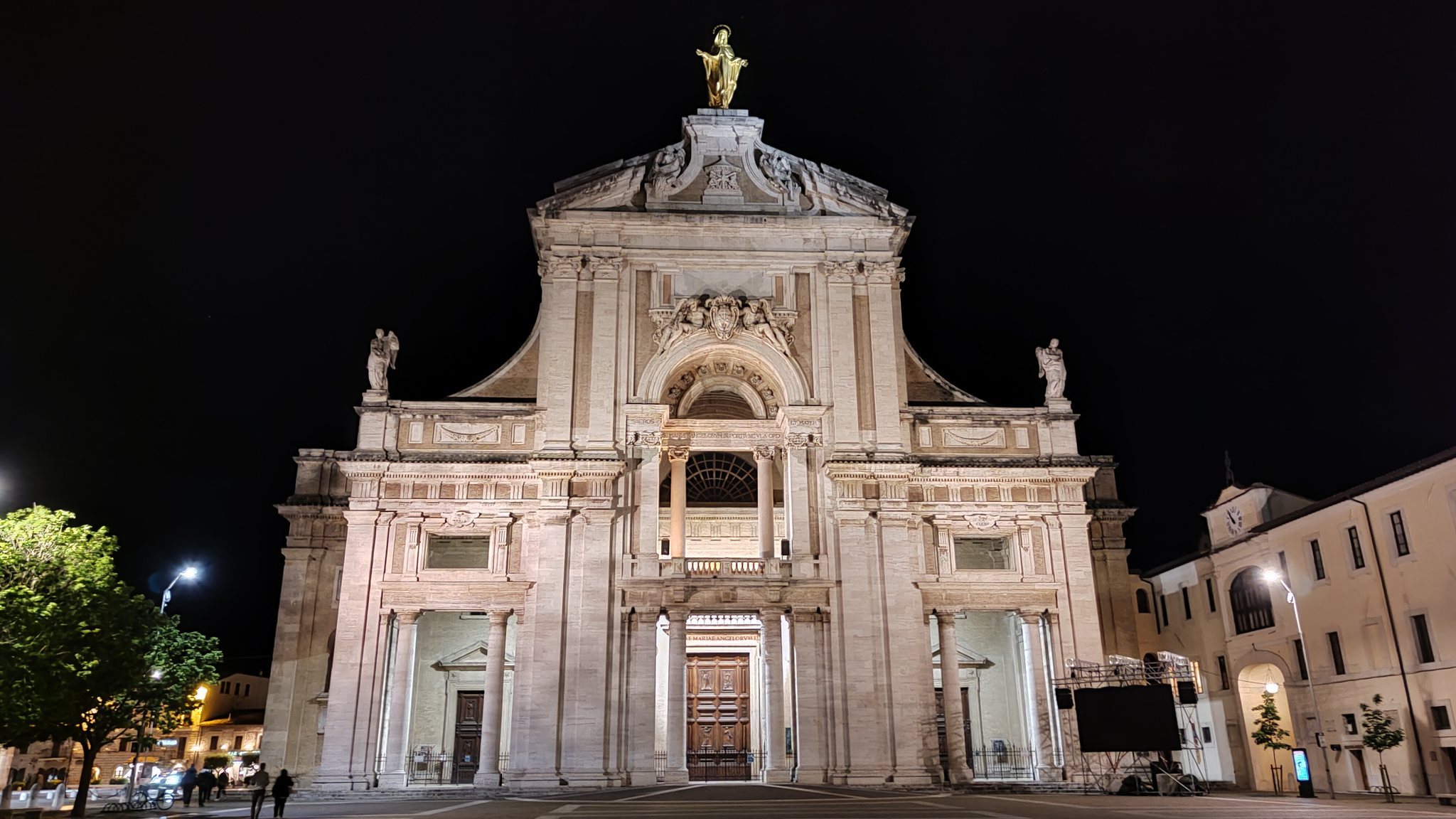
Cesare Bazzani later redesigned the façade between 1924 and 1930. The new front was inaugurated on 8 June 1930. Further restoration followed the earthquake of 1996, which also seriously damaged the Upper Basilica of Saint Francis in Assisi. Excavations and structural work associated with the sanctuary have helped clarify the earlier settlement around the Porziuncola.
Places associated with Saint Francis
The Chapel of the Transito began as the infirmary of the older convent. Saint Francis completed the Canticle of the Creatures, the religious poem associated with him, there shortly before his death on 3 October 1226. Domenico Bruschi painted scenes of the saint’s death and funeral on the chapel’s exterior in 1886.
The Rose Chapel developed from the dwelling or cell occupied by Francis in 1260. Bonaventure of Bagnoregio promoted its conversion into a chapel. Its sixteenth-century paintings present episodes from Franciscan history, including Francis with his first twelve companions, Franciscan saints, the miracle of the roses, and the granting of the Pardon of Assisi.
The convent and museum
The former friary contains the Museum of the Porziuncola. Founded in the 1920s and reorganized in 1999, it brings together religious art, archaeological finds, archival documents, models, graphic reconstructions, and objects connected with the sanctuary and Franciscan history. The surviving early friars’ cells, known as the Conventino, have been restored and are used for temporary exhibitions.
In the former convent refectory, Dono Doni painted a large Crucifixion fresco in 1561. The museum and the surviving convent spaces preserve evidence of the complex that surrounded the Porziuncola before the great basilica was built.
Remains
The basilica and its central sanctuary
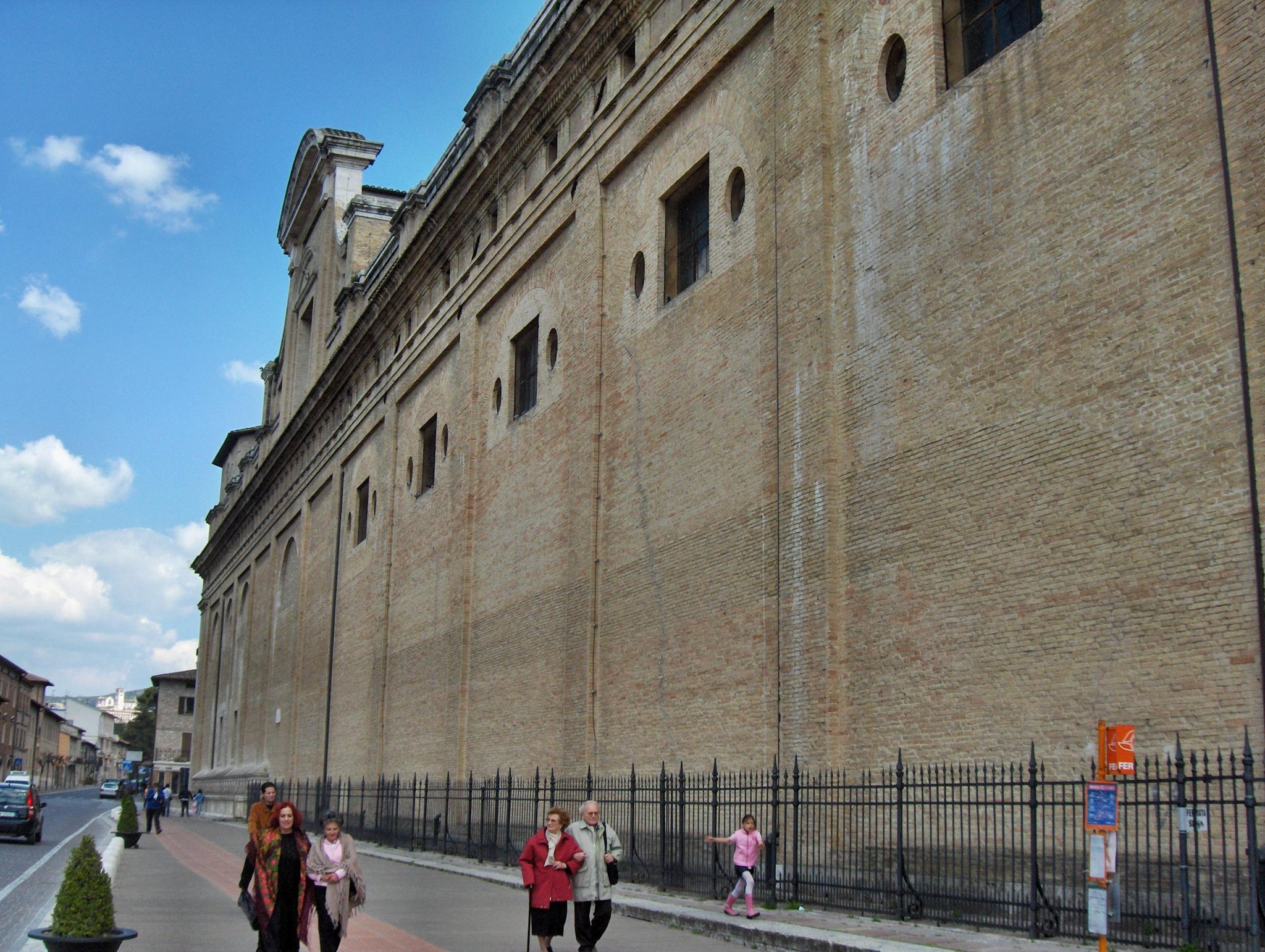
The basilica has a Latin-cross plan, meaning that its long central axis is crossed by a shorter transept. It contains three naves, a transept, a long choir ending in a semicircular apse, and ten side chapels. The building measures approximately 126 metres in length and 65 metres in width. Its spacious, restrained interior keeps the Porziuncola as the principal visual and religious focus, while the side chapels provide a much richer display of late-sixteenth- and early-seventeenth-century painting.
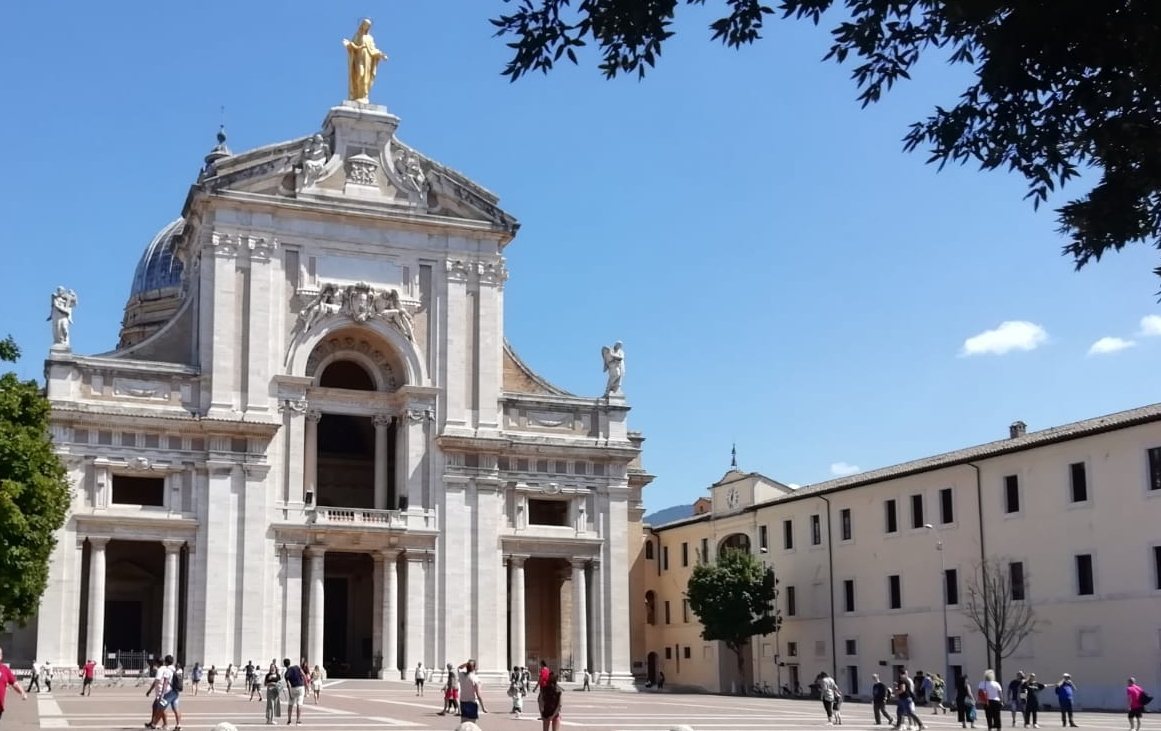
The original dome and apse designed by Alessi survived the earthquake of 1832 and the subsequent rebuilding. The dome rests on an octagonal drum and was completed in 1667. Francesco Appiani frescoed its pendentives in the eighteenth century. The present façade, designed by Cesare Bazzani in a Roman Baroque manner, includes a portico and a Loggia of the Blessings. A gilded-bronze statue of the Madonna degli Angeli crowns the front. Guglielmo Colasanti modelled the statue, which was cast by the Ferdinando Marinelli Artistic Foundry of Florence.
The Porziuncola
The Porziuncola stands beneath the crossing and dome at the centre of the basilica. The small church is generally dated to the ninth century and later passed to the Benedictines before becoming associated with Francis. Its austere interior retains darkened walls and fragments of fourteenth- and fifteenth-century Umbrian frescoes. Ilario da Viterbo painted the six-part apse fresco of the Annunciation in 1393.
The Porziuncola also contains a Crucifixion by Pietro Perugino, fragments by an unidentified Umbrian painter, and rough square stones associated with repairs made by Francis. Above the entrance is Johann Friedrich Overbeck’s 1829 fresco of Francis receiving the Pardon of Assisi from Christ and the Virgin. The lower part of the painting bears the Latin inscription Haec est porta vitae aeternae, meaning “This is the gate of eternal life.”
The Chapel of the Transito
The Chapel of the Transito is a small stone structure beside the choir, beneath the right side of the dome bay. Its form preserves its earlier connection with the convent infirmary. The exterior carries Domenico Bruschi’s 1886 scenes of the death and funeral of Francis.
Inside, Giovanni di Pietro, known as Spagna, painted Franciscan saints and blessed figures, including portraits identified with the early followers Ruffino, Leone, Masseo, and Egidio. Behind the altar is a glazed terracotta statue of Saint Francis by Andrea della Robbia, made around 1490. A reliquary preserves the cord of Saint Francis, presented to the confraternity by Pope Pius IX.
The Rose Garden and Rose Chapel
The Rose Garden lies beside the right side of the basilica’s apse. It contains roses of different colours and varieties and a 1916 bronze statue by Vincenzo Romigno commemorating the story of a lamb given to Francis. Tradition associates the thornless roses in the garden with Francis’s contact with the thorn bushes. They include the cultivar Rosa canina assisiensis.
The Rose Chapel has two rooms on different levels and a grotto-like space below. Its sixteenth-century frescoes by Tiberio d’Assisi and other artists depict Francis and his first twelve companions, Franciscan saints such as Clare, Bonaventure, and Bernardino, the miracle of the roses, and the granting of the Pardon of Assisi. The lower paintings reproduce the five scenes of Ilario da Viterbo’s Porziuncola altarpiece. The grotto contains a statue of Francis in prayer and surviving timbers from the pulpit from which he is traditionally said to have announced the great indulgence of the Porziuncola.
The side chapels and transepts
The chapels on the right
The first chapel contains Giacomo Giorgetti’s altarpiece of Saint Anthony the Abbot, painted between 1670 and 1675, together with a vault fresco by Francesco Appiani from 1756. The second chapel, dedicated to Saint John the Baptist, was frescoed by Cesare Sermei around 1602 after a bequest by Bernardino Locatelli. Its altarpiece shows the Baptism of Christ, while the walls and vault present scenes from the life of John the Baptist.
The Chapel of Saint Anne was decorated around 1602 and 1603 under the patronage of the Roncalli and Fiumi families. Cristoforo Roncalli painted the Nativity of the Virgin for the altar. Antonio Circignani painted scenes from the Virgin’s life, including her Presentation in the Temple, her Marriage, Pentecost, the Wedding at Cana, and Christ among the Doctors. Sibyls and prophets appear on the entrance arch, where David is accompanied by a self-portrait of the painter.
The fourth chapel is now dedicated to Pope Pius V, although it was dedicated to Saint Francis until the eighteenth century. Giovanni Branca produced its stucco decoration, and Baldassarre Croce painted its frescoes around 1602 and 1603. The scenes include episodes from the lives of Francis and the Virgin, Pope Honorius III’s approval of the Pardon, Francis’s intercession for the indulgence, the preaching to the birds, the institution of the Franciscan Third Order at Cannara, and a miracle of Francis. Its present altarpiece is an eighteenth-century painting of Pius V by an unidentified artist.
The Chapel of the Nativity
The Chapel of the Nativity was purchased by Laura Pontani Coli in 1591 and was originally dedicated to the Annunciation. Federico Barocci’s Annunciation was commissioned for it and is now displayed in a transept chapel. Late-sixteenth-century frescoes of Franciscan subjects are attributed mainly to Silla Piccinini, with contributions by Giovanni Battista Lombardelli and Pietro Rancanelli. The vault includes the Granting of the Indulgence of the Porziuncola, the Death of the Knight of Celano, Francis’s gift of Mount La Verna, and the procession of the Sacred Veil of the Virgin. The paintings were restored and partly repainted in 1828.
The transepts
The right transept ends in the large Baroque altar of Saint Peter in Chains, completed by Jean Reinhold in 1675. Its first chapel on the left contains Barocci’s Annunciation, probably painted around 1595 and 1596 for Laura Pontani Coli’s chapel. Another chapel contains Francesco Appiani’s 1760 painting of Christ appearing to Saints Peter of Alcantara and Margaret of Cortona. The left transept, under the patronage of the Municipality of Perugia since 1718, contains an altar dedicated to Saint Anthony of Padua.
The chapels on the left
The fifth chapel on the left, now the Rosary Chapel, was completed in 1584 for the confraternities of Saints Dominic, Augustine, and Francis. Its present altarpiece, painted by Domenico Maria Muratori around 1718 and 1720, shows the Madonna of the Rosary with Saints Rufinus, Clare, Benedict, and Franciscan friars. Carlo Ventura Morelli painted the vault with the Glory of Saint Rufinus and episodes from the lives of Clare and Francis. Baldassarre Orsini’s painting of 1803, completed with Carlo Spiridione Mariotti, shows Alessi presenting his basilica design to Pope Pius V.
The fourth chapel, dedicated to the Coronation of the Virgin, was acquired by the Veglia family in 1600. Simone Ciburri’s signed and dated 1603 altarpiece is a free copy of Raphael’s Coronation of the Virgin, painted for Santa Maria di Monteluce in Perugia. Other works attributed to Ciburri show Saint Diego of Alcalá healing Don Carlos, son of Philip II of Spain, and Saints Francis and Clare appearing to religious people eating at Santa Maria degli Angeli.
The third chapel, the Chapel of the Deposition, was acquired by the Vigilanti family in 1600 and decorated in 1602 and 1603 by Ventura Salimbeni and Baldassarre Croce. Salimbeni painted scenes from the life of Clare, including her Ascension and Death, while Croce painted the altarpiece of the Deposition and completed Clare receiving the habit. Two later side paintings show Christ presenting the redeemed from Limbo to the Virgin and Christ’s farewell to the Virgin; their authorship remains uncertain.
The second chapel, the Chapel of the Stigmata, was decorated for the Franciscan Third Order, a branch of the movement for people who followed Franciscan ideals without joining the friars’ or nuns’ communities. Cesare Sermei and Giacomo Giorgetti worked there around 1625 and 1631. Sermei is associated with frescoes of Clare and her sisters mourning Francis outside San Damiano, the Approval of the Rule, and Francis received into Paradise. Giorgetti painted the altarpiece of the Stigmatization of Francis, the Verification of the Stigmata, and the scene of tertiaries receiving the Franciscan habit.
Organs, crypt, and archaeological remains
The organs
The apse contains the Mascioni organ, opus 802, built in 1961 with part of the pipework from an earlier 1932 organ by Libero Rino Pinchi. Its console has four keyboards of 61 notes and a 32-note pedalboard. The pipework is divided into three bodies, two beside the high altar and one in the dome. The basilica also contains a Pinchi organ, opus 416, built in 2000 from pipework of the Morettini organ of 1840. It has two keyboards and a pedalboard, with mechanical transmission for the manuals and pedal and electrical control for stops and combinations.
The Chapel of the Blessed Sacrament contains a Pinchi organ made in the 1970s and transferred from the seminary church. A mobile positive organ made by Pinchi in the 1980s follows the style of Italian Baroque instruments, while a seventeenth-century Baroque positive organ is preserved in the crypt.
The crypt
The crypt was built behind the Chapel of the Transito between 1965 and 1970. Excavation exposed the rough-stone foundations of the huts that had surrounded the Porziuncola after the death of Francis. The crypt altar rests on a branching tree-trunk form carved by Francesco Prosperi. Behind it is an enameled terracotta relief by Andrea della Robbia showing Francis receiving the stigmata, the Coronation of Mary, Saint Jerome the Penitent, the Annunciation, the Nativity, and the Adoration of the Magi.
The Fountain of the Pilgrims
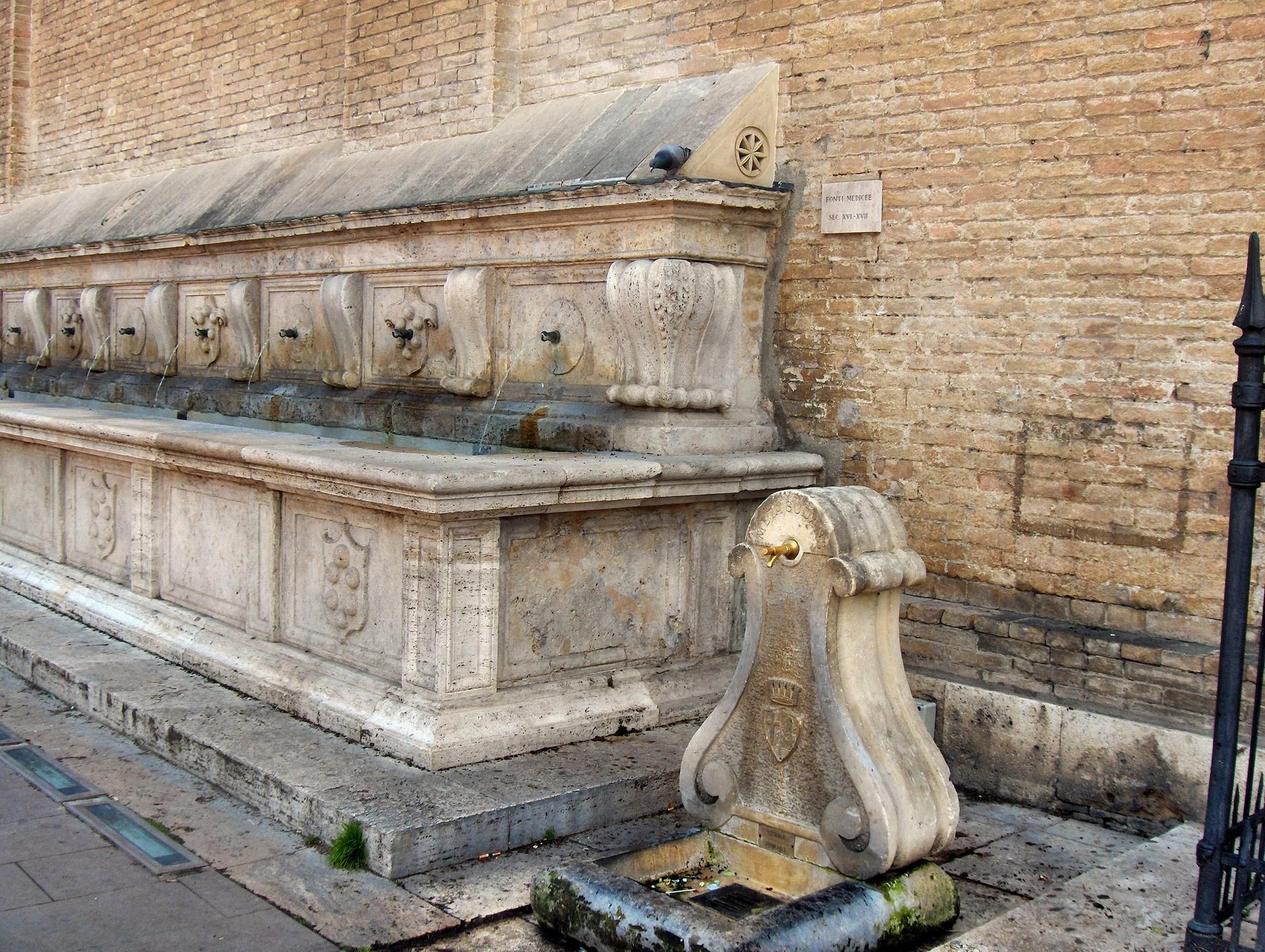
The Fountain of the Pilgrims stands along the exterior left side of the basilica. Donated by the Medici of Florence in 1610, it has 26 water outlets and forms part of the external fabric associated with the sanctuary.
The Museum of the Porziuncola
The Museum of the Porziuncola houses archaeological finds, religious objects, and works of art connected with the sanctuary. Among its holdings are Giunta Pisano’s wooden Crucifix of 1236, a portrait of Francis attributed to Cimabue, a portrait attributed to the Master of Saint Francis, Sano di Pietro’s Madonna and Child, a polychromed terracotta Madonna of the Milk from the late fourteenth or early fifteenth century, works by Andrea della Robbia, and paintings by Cesare Sermei and his workshop. The collection also includes numerous frescoes of uncertain attribution.
A copy of the icon of the Virgin of Philerme is preserved in the basilica. Tsar Nicholas I of Russia commissioned it in the early nineteenth century for processions. The degree to which it follows the original is uncertain, and the image has undergone repainting and an unsatisfactory restoration.